

Who Was Rachel?
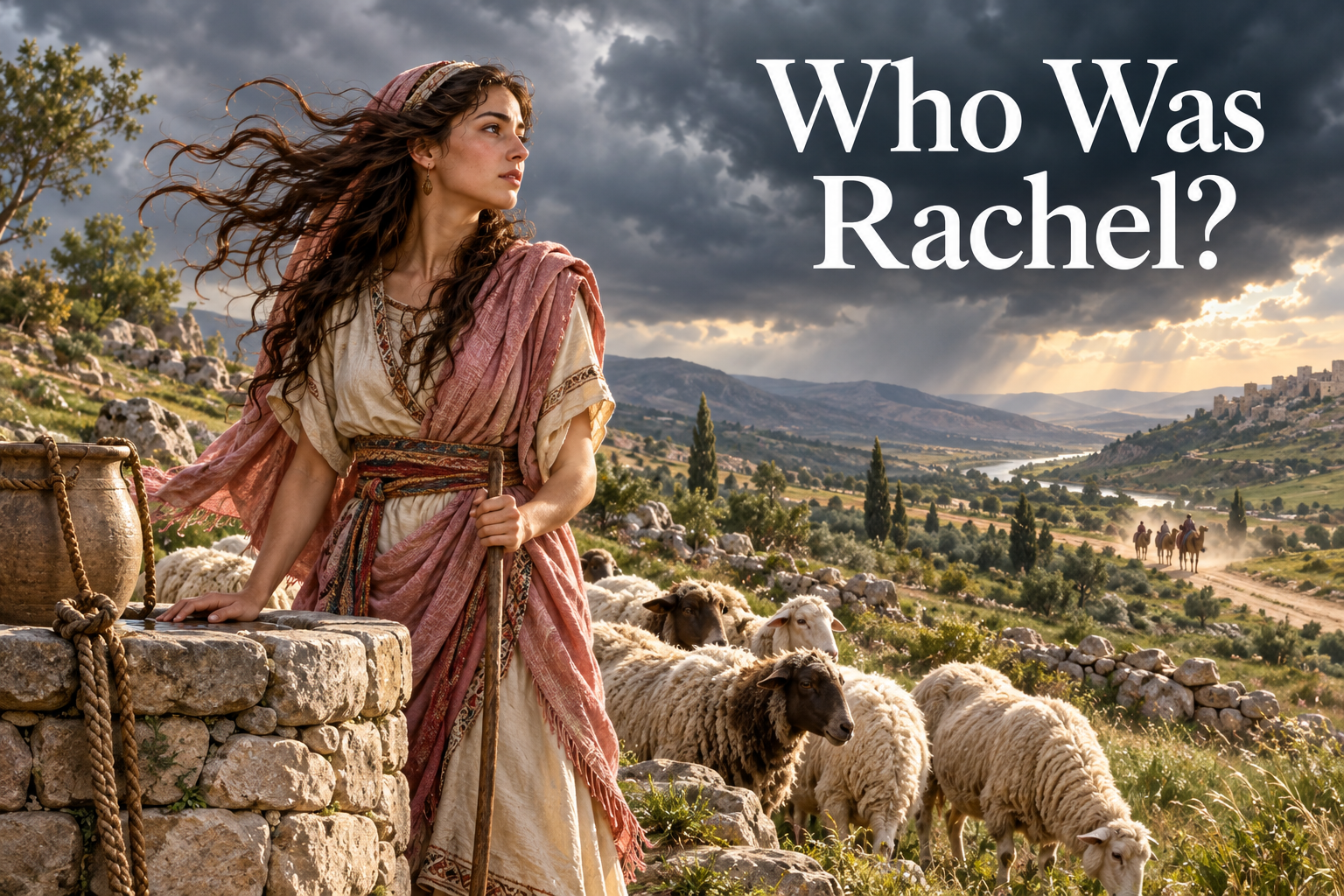
Rachel is remembered as Jacob’s beloved wife, but love doesn’t make her story easy. Her father uses her marriage as leverage, her husband builds a household with four women, and her struggle with infertility turns her sister into a rival and her servant into a surrogate. She eventually becomes the mother of Joseph and Benjamin, then dies giving birth to her younger son. Genesis presents Rachel as beautiful, loved, resourceful, envious, deceptive, and deeply grieved. A fair biography has to let all of those features remain in the picture.
The shepherd at the well
Rachel was the younger daughter of Laban and the sister of Leah. She first appears in Genesis 29 bringing her father’s sheep to a well near Haran, which means she was doing real work rather than waiting offstage to become somebody’s wife. Jacob, newly arrived from Canaan, rolls away the stone from the well, waters Laban’s flock, kisses Rachel, and weeps. The scene deliberately echoes earlier biblical meetings at wells, places where hospitality, providence, and marriage arrangements often converge.
Jacob agrees to serve Laban for seven years in exchange for Rachel’s hand, and Genesis says those years seem like only a few days because of his love for her. Laban then substitutes Leah at the wedding and gives Rachel to Jacob a week later on the condition that he work another seven years. Rachel is loved, but she is still treated by her father as part of a labor bargain. The romantic sentence about Jacob’s service shouldn’t make us overlook the economic power Laban exercises over both daughters.
The resulting marriage places two sisters in a hierarchy neither of them created. Jacob loves Rachel more than Leah, while Leah bears children and Rachel doesn’t. Genesis narrates their rivalry without pretending that polygamy is harmless. The arrangement gives Jacob a large family, but it repeatedly wounds the women and eventually shapes the resentments among their children.
Barrenness and desperate competition
Rachel’s infertility becomes a source of anguish as Leah gives birth to Reuben, Simeon, Levi, and Judah. She envies her sister and tells Jacob, “Give me children, or I’ll die.” Jacob responds in anger that he isn’t in the place of God, who has withheld children from her. His theology is technically direct, but his answer offers little tenderness to a wife in pain. Scripture often records faithful truths spoken without pastoral wisdom, and a sentence doesn’t become compassionate merely because it mentions God.
Rachel gives her enslaved servant Bilhah to Jacob so that Bilhah can bear children on her behalf. Bilhah gives birth to Dan and Naphtali, whom Rachel names in the language of vindication and struggle with her sister. This practice had parallels in the ancient Near East, where an enslaved woman could be made to produce heirs for her mistress. Cultural context explains the arrangement; it doesn’t supply Bilhah’s consent or make the use of her body morally admirable.
The competition continues through the episode of Reuben’s mandrakes, plants associated with fertility. Rachel asks Leah for some, and the sisters negotiate a night with Jacob in return. The irony is hard to miss: Leah conceives after the bargain, while the mandrakes don’t immediately solve Rachel’s barrenness. Genesis finally says God remembers Rachel, listens to her, and opens her womb. She gives birth to Joseph and names him with wordplay that both removes her disgrace and asks God for another son.
Leaving her father’s house
When Jacob decides to leave Laban, he calls Rachel and Leah to the field and explains how their father’s attitude has changed. The sisters answer together that Laban has treated them as foreigners, sold them, and used up what was paid for them. Their shared response is important. Rivalry hasn’t erased their clear judgment that their father has exploited them, and both agree that Jacob should do what God has told him.
As the household departs, Rachel steals Laban’s household gods, often called teraphim. Genesis never states why. Some interpreters think she remains attached to the gods; others suggest the objects represented inheritance rights, family authority, or protection. Evidence from the ancient Near East has been used to support several proposals, but none can be proved from the passage. It is better to preserve the uncertainty than to build a sermon on a motive the narrator withholds.
Laban catches the family and searches for the objects. Rachel has hidden them in a camel saddle and tells her father she cannot rise because she is menstruating. The deception works, and Laban leaves without finding his gods. The scene shows Rachel outmaneuvering the father who has repeatedly outmaneuvered others, but it doesn’t tell readers that theft and lying are therefore virtuous. It also turns ancient assumptions about menstruation and impurity into the means by which the household gods are humiliated beneath her seat, an irony ancient hearers were unlikely to miss.
Favoritism and its consequences
Rachel’s favored status continues after the family leaves Laban. When Jacob prepares to meet Esau, he places the servants and their children first, Leah and her children next, and Rachel and Joseph last. The arrangement appears to put those dearest to him farthest from the expected danger. Later, Jacob’s special love for Joseph contributes to bitter conflict among the brothers. Rachel dies before that crisis, but the preference attached to her branch of the family outlives her.
Genesis also records a disturbing incident involving Rachel’s servant Bilhah after Rachel’s death. Reuben, Leah’s firstborn, sleeps with Bilhah, an act that likely involves both sexual violation and a challenge to Jacob’s authority. The text doesn’t describe Bilhah’s perspective, and Rachel is no longer alive to respond. The episode is one more reminder that the women around this family rivalry aren’t merely pieces on a genealogical chart; their bodies are repeatedly drawn into contests over status and succession.
Rachel’s death
Rachel becomes pregnant again during the journey through Canaan. The labor is severe, and the midwife tells her not to fear because she has another son. As Rachel dies, she names him Ben-oni, usually understood as “son of my sorrow” or “son of my affliction.” Jacob renames him Benjamin, commonly associated with “son of the right hand,” though the exact nuance may involve strength, favor, or geography. The renaming doesn’t cancel Rachel’s grief; Genesis preserves both names and the tragedy in which the child enters the world.
Jacob buries Rachel on the way to Ephrath, identified in Genesis as Bethlehem, and sets up a pillar over her grave. Other biblical passages have led to debate about the precise location of the traditional tomb, and the present site known as Rachel’s Tomb reflects a long history of remembrance rather than archaeological proof of the burial. Genesis itself emphasizes that she dies on the road, before the family reaches its destination. The beloved wife doesn’t share the ancestral tomb at Machpelah with Jacob, Leah, Isaac, Rebekah, Abraham, and Sarah.
The mother who weeps for her children
Rachel’s memory later becomes larger than her own household. Jeremiah 31 imagines her weeping from Ramah for children who are gone, a poetic personification of the northern tribes and of exiles being led away. Rachel is especially suited to that image because Joseph’s sons Ephraim and Manasseh became leading northern tribes, Benjamin was also associated with the region around Ramah, and her own life ended in maternal sorrow. The prophet then answers the weeping with hope that the children will return.
Matthew 2 applies Jeremiah’s language to the slaughter of children around Bethlehem under Herod. Matthew isn’t claiming Jeremiah originally wrote a direct prediction naming that event. He recognizes a pattern of Israel’s mothers grieving violent loss and sees it filled with new significance in the story surrounding Jesus. Later Jewish tradition also remembers Rachel as an interceding mother of Israel, a development that grows from Jeremiah but goes beyond what Genesis explicitly says.
History and the woman in the text
No independent ancient inscription confirms Rachel as an individual, and archaeology can’t verify the intimate family scenes in Genesis. The patriarchal narratives also function as stories about Israel’s tribes, since Rachel’s sons stand behind Joseph, Ephraim, Manasseh, and Benjamin. Scholars therefore discuss Rachel at both a biographical and a symbolic level. Recognizing the national dimension doesn’t require declaring that no historical woman stood behind the tradition, but neither should faith be confused with archaeological certainty we don’t possess.
Rachel shouldn’t be idealized because Jacob loved her or condemned because she envied Leah. She lived within constraints imposed by her father, her marriage, infertility, and a culture that tied a woman’s security closely to children. She sometimes answered those pressures by using what power she had at someone else’s expense, especially Bilhah’s. Genesis neither airbrushes her failures nor treats her suffering as punishment explained.
Rachel’s story ends before she sees what becomes of Joseph and Benjamin. One son will preserve the family during famine; the other will become the father of a tribe with a difficult but important history. Her legacy is therefore marked by both absence and endurance. Scripture remembers the loved woman who couldn’t control love’s consequences, the grieving mother whose voice becomes a language for Israel’s grief, and the matriarch whose tears aren’t the final word.