
Who Was Rahab?
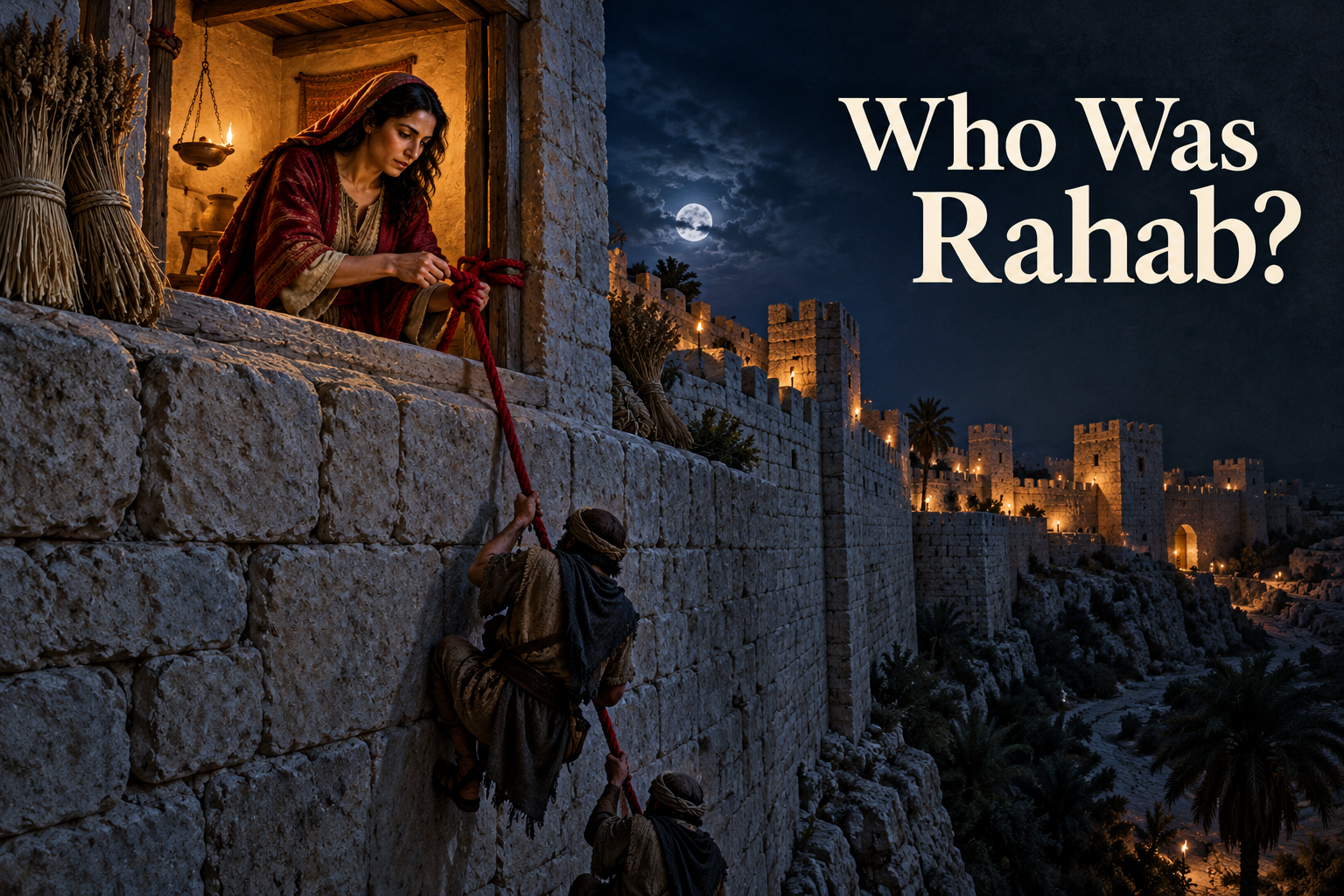
Rahab’s first scene begins with a city under threat and two enemy agents at her door. She is a Canaanite woman living in Jericho, identified plainly as a prostitute, and she has no obvious claim on Israel’s covenant. Yet she recognizes what Jericho’s rulers refuse to admit: Israel’s God is not one local deity among others. Rahab risks her life, secures protection for her household, and becomes one of the Bible’s clearest examples of faith expressed through decisive action. Her story is hopeful, but it also belongs to the morally difficult account of Israel’s conquest of Canaan.
A dangerous house in Jericho’s wall
Joshua 2 begins as Israel prepares to cross the Jordan. Joshua secretly sends two men to scout Jericho, and they enter Rahab’s house. The Hebrew text calls her a zonah, the ordinary word for a prostitute. Some later interpreters described her as an innkeeper, perhaps because a lodging house would explain the spies’ visit or because they wanted to soften her occupation. An inn and a brothel aren’t mutually exclusive in an ancient setting, but the simplest reading is the one most English Bibles give: Rahab was a sex worker.
Her house was built into the city wall, with a window facing outward. That location gave Rahab access to travelers and eventually gave the spies an escape route. When the king of Jericho heard that Israelite men had entered her house, he ordered Rahab to surrender them. She had hidden them under stalks of flax on her roof, and she sent the king’s officers on a false trail toward the Jordan crossings. The danger was immediate; if her deception had been discovered, Rahab and probably her household would have been treated as traitors.
Before helping the spies escape, Rahab explained her decision. Jericho had heard what the Lord did at the sea and what Israel had done to the Amorite kings east of the Jordan. The city’s courage had melted, but Rahab moved from fear to confession: “The Lord your God is God in heaven above and on the earth below” (Joshua 2:11). She knew only what news had reached Jericho, yet she acted on it. In the narrative, the Canaanite prostitute understands Israel’s God more clearly than many Israelites will in the chapters that follow.
The oath and the scarlet cord
Rahab asked the spies to show faithfulness to her family because she had shown faithfulness to them. The Hebrew word involved is often translated “kindness,” but it carries the sense of loyal commitment. She requested the lives of her father, mother, brothers, sisters, and everyone belonging to them. Her courage wasn’t only self-preservation. She used the leverage she had to create a place of safety for an extended household.
The spies agreed, provided that Rahab kept their mission secret and gathered her family inside her house. She was to tie a scarlet cord in the window through which she lowered them from the wall. When Israel later took Jericho, the two spies brought Rahab and her relatives out before the city was destroyed (Joshua 6:22-25). Joshua says that she lived among Israel “to this day,” indicating that Rahab and her household became part of the community rather than merely being released outside it.
Christian interpreters have often seen the scarlet cord as a symbol of Christ’s blood, and some have compared Rahab’s protected house with the Israelite homes marked at Passover. The parallels can make useful Christian typology, but Joshua doesn’t explain the cord that way. In the story, it is a practical identifying sign tied to the same window used for the spies’ escape. We can appreciate a later symbolic reading without pretending it is the passage’s stated meaning.
Faith, deception, and the conquest
Rahab’s lie to the king’s officers has generated a long ethical debate. Some readers argue that deception is justified when it protects innocent life from murderous authorities. Others maintain that Scripture commends her faith and protection of the spies without approving every part of her method. Joshua itself doesn’t pause to give a theory of truth-telling under tyranny. It presents Rahab’s actions as a unified act of allegiance carried out under severe pressure, while later biblical writers praise what she did for the messengers.
Her rescue also occurs within the conquest of Jericho, one of the hardest narratives in the Old Testament. The text presents the city’s fall as divine judgment and Rahab’s deliverance as an exception created by her response to Israel’s God. Christians disagree about how the conquest accounts relate to ancient war rhetoric, archaeology, and the exact historical process by which Israel occupied the land. Excavations at Jericho have generated continuing debate over dates and how the remains relate to Joshua’s account. Archaeology doesn’t independently identify Rahab, so claims that her house or belongings have been found should be treated skeptically.
Those historical debates don’t remove the moral seriousness of the story. Rahab isn’t a decorative success story attached to an otherwise uncomplicated battle. She is a Canaanite whose faith exposes the danger of drawing a simple line between righteous insiders and wicked outsiders. The Israelites under judgment in the wilderness had seen far more than she had. Rahab heard, believed, and acted.
Rahab in the New Testament
The New Testament remembers Rahab three times, and each reference adds something important. Hebrews 11:31 places her among examples of faith because she welcomed the spies and wasn’t destroyed with those who were disobedient. James 2:25 points to the same event while arguing that genuine faith acts. Rahab’s deeds didn’t purchase God’s grace, but her claim to believe was made visible by the risk she accepted.
Matthew 1:5 names Rahab in Jesus’ genealogy as the mother of Boaz by Salmon. The Old Testament doesn’t narrate such a marriage, and Joshua never names Rahab’s husband or children. Matthew’s genealogy is selective and can compress generations, as ancient genealogies commonly did. Christian readers have normally understood Matthew’s Rahab to be the woman from Jericho, but we should still distinguish Matthew’s genealogical statement from later stories that fill in the courtship.
Rahab is one of several women Matthew names in a genealogy otherwise structured around fathers and sons. Whatever additional patterns readers find in that list, her inclusion makes at least one point impossible to miss: the messianic line isn’t a record of respectable people protecting themselves from outsiders. It includes a Canaanite woman with a stigmatized past who entrusted herself to Israel’s God. By the time the genealogy reaches Jesus, grace has already been overturning human expectations for generations.
What later tradition added
Jewish tradition greatly expanded Rahab’s biography. Some rabbinic texts portray her as a famous beauty who later repented, married Joshua, and became an ancestor of priests and prophets. Josephus, the first-century Jewish historian, calls her an innkeeper when retelling the story. These accounts testify to Rahab’s powerful place in Jewish memory, but neither her marriage to Joshua nor a line of prophetic descendants appears in the biblical narrative.
Christian retellings have sometimes gone in the opposite direction, reducing Rahab to her former occupation so that her rescue can serve as a dramatic conversion story. Joshua doesn’t say she had left prostitution before the spies arrived, and it doesn’t linger over a catalog of her sins afterward. Her profession is part of the surprise, not her permanent identity. The Bible remembers her for faith, hospitality, courage, and membership among God’s people.
Why Rahab matters
Rahab knew less than many people around her, but she responded more faithfully. She couldn’t control Jericho’s future or erase her place in its social order. She could decide whom she believed, whom she protected, and where she would stand when the crisis came. Biblical faith is more than agreeing that God exists; Rahab staked her safety on the conviction that Israel’s God truly rules heaven and earth.
Her story doesn’t make every question easy. The deception remains ethically debated, the conquest remains difficult, and later traditions don’t supply historical certainty where Scripture is silent. But the central biblical claim is plain. Rahab the Canaanite wasn’t kept at a polite distance after her rescue. She was received among Israel, remembered among the faithful, and named in the family line through which the Messiah came.