
Who Was Rebekah?
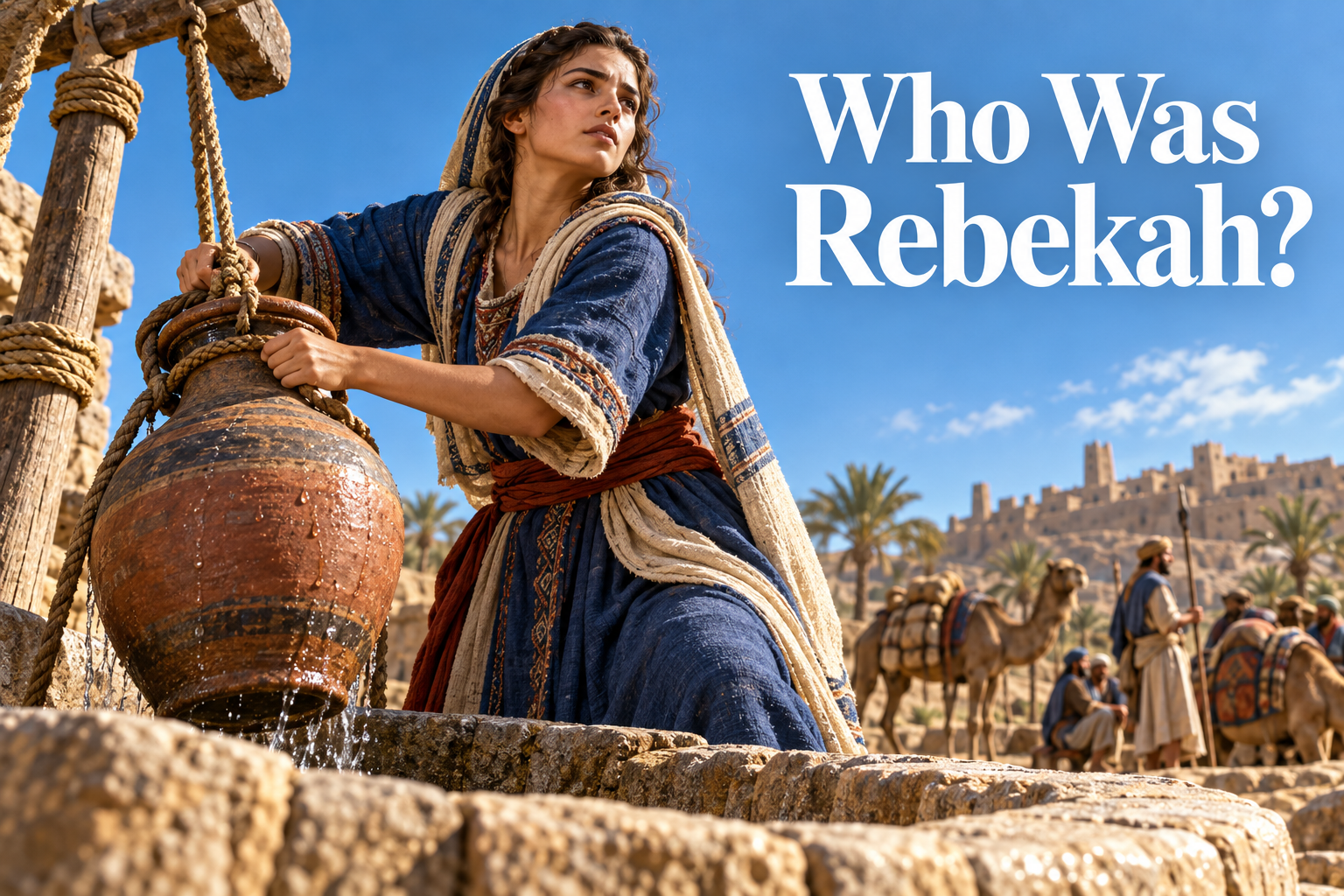
Rebekah enters Genesis in motion. Before Abraham’s servant has finished praying, she arrives at the spring, lowers her jar, gives him water, and volunteers to water his camels as well. By the end of Genesis 24 she has agreed to leave home for a husband she has never met. Years later, the same decisiveness will take a darker form when she organizes the deception of her blind husband so that Jacob receives Esau’s blessing. Rebekah is intelligent, energetic, hospitable, prayerful, partial, and controlling. A faithful biography has to allow all of those features to remain visible.
The woman at the spring
Abraham sent his senior servant to the region of his relatives to find a wife for Isaac. The servant prayed for a sign: the right woman would offer water not only to him but also to his camels. Rebekah, the daughter of Bethuel and granddaughter of Abraham’s brother Nahor, did exactly that. Watering a caravan’s camels required repeated trips to the spring, so the action showed more than politeness. It displayed the practical generosity and stamina needed in a large pastoral household.
The servant gave Rebekah jewelry and asked about her family. After hearing his account, her brother Laban and father Bethuel recognized the Lord’s direction and agreed to the marriage. Yet when the family wanted her to remain for a while, they called Rebekah and asked her directly whether she would go with the man. “I will go,” she answered. The story occurs within ancient marriage negotiations involving families, gifts, and household interests, but Rebekah is not shipped away as a silent parcel. Her decision propels the story forward.
When the traveling party approached its destination, Rebekah saw Isaac in the field and covered herself with a veil after learning his identity. Isaac brought her into Sarah’s tent, married her, loved her, and was comforted after his mother’s death. Later tradition has sometimes tried to calculate Rebekah’s age from other chronological details and concluded that she was extraordinarily young. Genesis itself never gives her age at marriage, and confident claims that she was three years old depend on a later reconstruction rather than an explicit biblical statement.
Infertility, prayer, and two struggling sons
Rebekah was unable to conceive for about twenty years. Isaac prayed on her behalf, and the Lord answered, but her pregnancy was severe. The children struggled within her so violently that she asked why this was happening and went to inquire of the Lord. God answered her directly: two nations and two peoples were within her, one would be stronger, and the older would serve the younger (Genesis 25:23). Before Jacob and Esau could compete in the open, their mother knew that their conflict would have consequences beyond the household.
Esau was born first, red and hairy, with Jacob grasping his heel. The boys developed in different directions. Esau became a skillful hunter and man of the open country, while Jacob was a quiet man living among the tents. Isaac favored Esau because he enjoyed the game Esau brought home; Rebekah favored Jacob. The parents’ preferences turned differences between the brothers into factions within the marriage. Genesis reports the reasons with almost uncomfortable bluntness, as though a family could be organized around appetite and affinity and then act surprised when resentment followed.
Rebekah also experienced the insecurity created by Isaac’s fear. While they lived in Gerar, he called her his sister because he thought local men might kill him to obtain her. King Abimelech eventually saw enough interaction between them to realize that they were married. Unlike Sarah, Rebekah was apparently not taken into another man’s household, but Isaac still protected himself by concealing their marriage. Abimelech’s order shielding them prevented the lie from producing worse harm.
The stolen blessing
Rebekah’s defining moral failure comes in Genesis 27. Isaac, old and nearly blind, told Esau to hunt game and prepare a meal before receiving his father’s blessing. Rebekah overheard the plan and immediately constructed an alternative. She ordered Jacob to bring two young goats, prepared the food Isaac liked, dressed Jacob in Esau’s clothing, and covered his hands and neck with goatskins. Jacob worried that he would be discovered and cursed; Rebekah accepted the risk of the curse upon herself.
Her goal fit the oracle she had received before the twins were born, but the method depended on lies and exploited Isaac’s disability. The text never says God needed her fraud in order to keep his word. It is possible to believe that Rebekah remembered the oracle and also to recognize that favoritism and urgency had distorted her response to it. Biblical narratives often show God accomplishing his purposes through morally mixed people, which isn’t the same as declaring every useful act righteous.
Jacob deceived Isaac and received the principal blessing. When Esau returned and the truth emerged, he cried out and planned to kill his brother after Isaac’s death. Rebekah learned of the threat and told Jacob to flee to her brother Laban in Harran “for a few days” until Esau’s fury passed. She then persuaded Isaac that Jacob should marry within her extended family rather than among the local Hittite women. Isaac formally sent Jacob away with the blessing of Abraham.
The few days became about twenty years. Genesis never records Rebekah seeing Jacob again, nor does it narrate her death. When Jacob later speaks of the family burial place at Machpelah, he says that Isaac and Rebekah were buried there (Genesis 49:31). Her nurse Deborah dies and receives a named burial notice in Genesis 35, which may preserve an indirect echo of Rebekah’s household. Claims about the exact time or circumstances of Rebekah’s death go beyond what Scripture tells us.
How should Rebekah be remembered?
Some interpretations cast Rebekah as the faithful parent who understood God’s choice while Isaac stubbornly resisted it. Others make her the villain who corrupted Jacob and destroyed domestic peace. Each reading notices something, but neither is enough. Isaac’s favoritism and secret plan to bless Esau contributed to the crisis, while Esau had already despised his birthright. Rebekah nevertheless chose deception and taught Jacob to secure a promised future by manipulating his father. Shared dysfunction does not make individual responsibility disappear.
The oracle about the older serving the younger also needs careful handling. In its wording, the twins represent peoples as well as individuals, later associated with Israel and Edom. Paul cites the prenatal choice in Romans 9 while discussing God’s freedom in the history of his covenant purpose. That passage has generated major debates about election. At minimum, Genesis concerns God’s choice of the line through which the promise will advance; readers should not assume without argument that every vocational choice in the narrative settles the eternal destiny of both individuals.
No independent inscription or artifact identifies Rebekah. The customs in Genesis 24 can be compared with ancient Near Eastern marriage practices and household negotiations, but such parallels don’t prove a specific date or verify an individual life. The biblical narrative remains our source for her biography. Later Jewish interpretation fills some of the narrative’s silences, sometimes imaginatively, and should be identified as tradition rather than confused with the wording of Genesis.
Rebekah’s story begins with courageous generosity and ends, so far as the narrative follows her, in the consequences of calculated deceit. That isn’t an argument that her early faith was fake. It is a warning that real knowledge of God’s promise doesn’t make a person’s methods automatically godly. Rebekah saw possibilities others missed and acted when others hesitated. Her tragedy was that the same strength used to serve a stranger at the spring was eventually bent toward controlling the people she loved.