
Who Was Ruth?
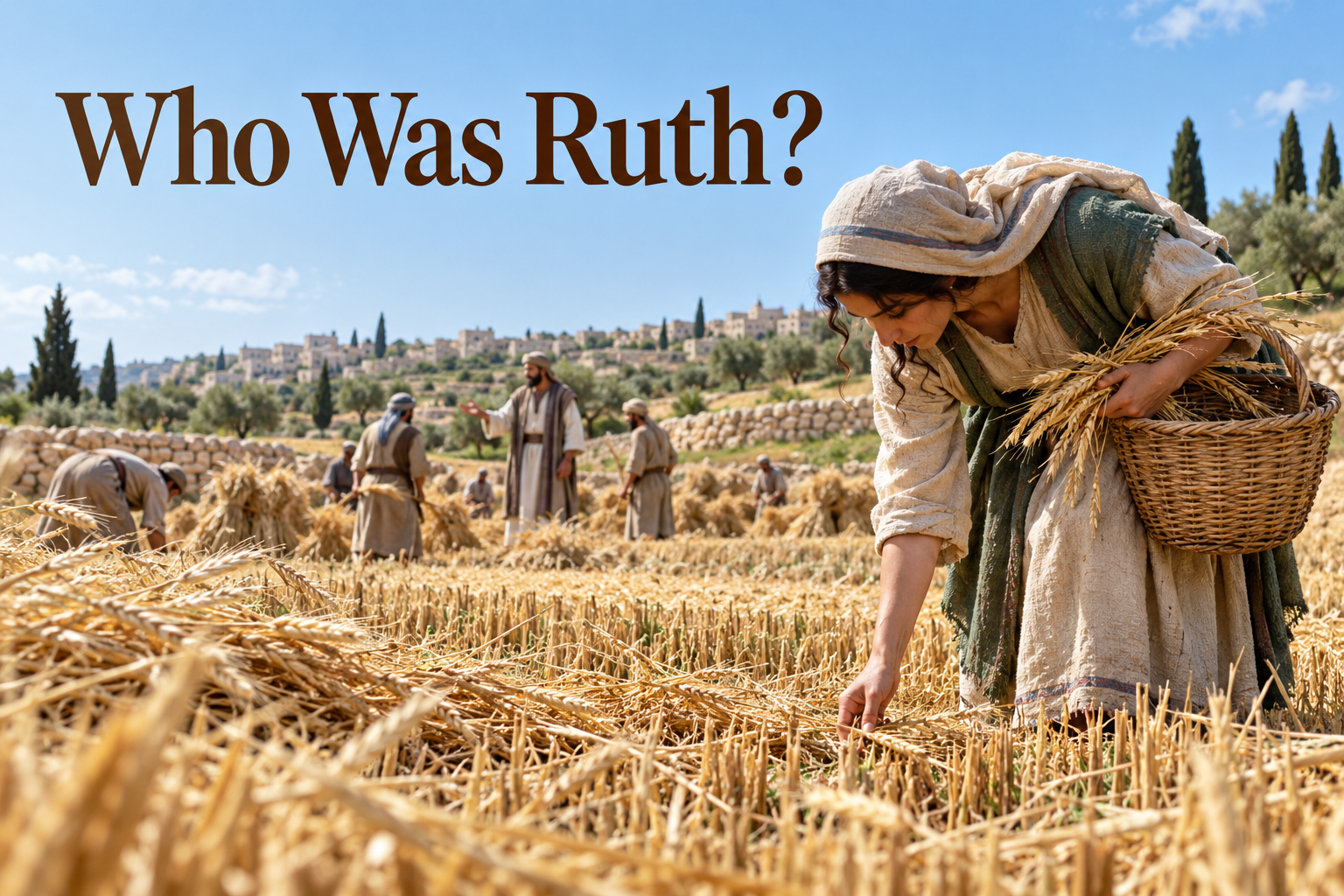
Ruth’s story is small enough to read in one sitting, but it reaches from an empty house in Bethlehem to the family line of King David. There are no parted seas, royal battles, or recorded visions. Most of the action involves famine, bereavement, gleaning, family obligations, and a complicated marriage proposal. That ordinary scale is part of the book’s power. Ruth shows how God can work through loyal choices and responsible human action when nobody in the story can see the larger outcome.
Loss in Moab and a costly return
The story is set “in the days when the judges ruled,” a period remembered for instability and recurring unfaithfulness. A famine drives Elimelech, his wife Naomi, and their two sons from Bethlehem in Judah to Moab. Elimelech dies, the sons marry Moabite women named Orpah and Ruth, and after about ten years the sons also die. Naomi is left without her husband and children in a foreign land. The text doesn’t say that these deaths were punishment, and attempts to identify a secret sin behind each loss go beyond what the narrator tells us.
When Naomi hears that the Lord has provided food for Judah, she decides to return home. She urges both daughters-in-law to remain in Moab, remarry, and rebuild their lives. Orpah tearfully accepts that advice, and the story never condemns her for it. Ruth refuses. Her famous words, “Where you go I will go,” are first of all a pledge to a widowed mother-in-law, not a wedding reading detached from their situation.
Ruth binds her future to Naomi’s people, land, and God, even sealing the promise with an oath. Readers often describe this as Ruth’s conversion, and it certainly expresses a profound change or confirmation of allegiance. Yet the book doesn’t describe a formal conversion ceremony, and later Jewish procedures shouldn’t simply be projected backward into the period of the story. Ruth’s commitment is relational as well as theological: Naomi’s people will be her people, and Naomi’s God will be her God. She chooses a future in which poverty and social vulnerability are more immediately likely than security.
The two women reach Bethlehem at the beginning of the barley harvest. The town recognizes Naomi, but she asks to be called Mara, meaning “bitter,” because she believes the Almighty has brought her back empty. The reader knows she hasn’t returned alone, but the narrative doesn’t scold her grief with that observation. Naomi has suffered devastating losses, and her theology at this point is spoken from inside them. The rest of the book answers her emptiness gradually rather than with a lecture.
Ruth in the field of Boaz
Ruth goes out to glean, gathering grain left behind by harvesters. Israel’s law required landowners to leave portions of the harvest for the poor and the resident foreigner (Leviticus 19:9-10; Deuteronomy 24:19-22). The provision preserved dignity because the vulnerable could work for food, but written protection didn’t eliminate danger. Ruth was a foreign woman laboring among male workers, and the story makes her exposure plain. When Boaz orders his men not to touch her and gives her access to water, his protection addresses a real threat.
Boaz has already heard about Ruth’s loyalty to Naomi. He blesses her for seeking refuge under the wings of Israel’s God, feeds her at his table, and quietly instructs his workers to pull extra grain from the bundles for her. Ruth responds with humility, but she isn’t passive. She takes initiative, works from morning until evening, and carries a large amount of barley home. The relationship develops through observed character rather than instant romance.
When Naomi learns whose field Ruth entered, she identifies Boaz as one of their goelim, or family redeemers. A redeemer was a relative responsible for protecting family interests, which could include buying back land that poverty had forced out of the clan (Leviticus 25:25). Readers sometimes call Boaz a “kinsman-redeemer” as though the phrase described one simple office with a fixed list of duties. Ruth’s situation is more complicated. The book brings together land redemption, preservation of a dead man’s name, and marriage, although the Torah’s explicit law of levirate marriage applies to a deceased man’s brother, which Boaz was not.
The night at the threshing floor
After the harvest, Naomi develops a plan to secure a home for Ruth. She tells her to wash, dress, go to the threshing floor, and uncover Boaz’s feet after he lies down. Ruth does so, and at midnight Boaz awakens to find a woman there. Ruth asks him to spread his garment, or “wing,” over her because he is a redeemer. The request deliberately echoes Boaz’s earlier prayer that she find refuge beneath God’s wings: Ruth now asks Boaz to become part of the answer to his own blessing.
The scene is charged with risk and possible sexual overtones, and responsible interpretation shouldn’t pretend otherwise. Threshing floors could be associated with feasting and sexual encounters, while “feet” can function as a euphemism elsewhere in Scripture. At the same time, the narrator portrays Ruth and Boaz as acting with restraint. Boaz praises her loyalty, promises to address the matter lawfully, protects her reputation, and sends her home before she can be recognized. The text gives us a daring proposal, not an account of a secret consummation.
Boaz also reveals that another relative has a prior claim. This detail keeps him from behaving as though good intentions allow him to ignore communal obligations. At the city gate, before elders and witnesses, he offers the nearer relative the opportunity to redeem the property associated with Elimelech’s family. When the man learns that the arrangement also involves Ruth and preserving the dead man’s name, he declines out of concern for his own estate. Boaz then publicly assumes the obligation and takes Ruth as his wife.
The legal procedure doesn’t map neatly onto any single command in the Torah. It resembles the land-redemption provisions of Leviticus 25 and the concern for a deceased man’s line in Deuteronomy 25, but it adapts those concerns to a case involving more distant relatives. Scholars disagree about whether Ruth reflects a local custom, a creative application of several laws, or a literary reshaping of legal traditions. The safest conclusion is also the most important one: Boaz uses his position to protect Ruth and Naomi rather than exploiting ambiguity for his own advantage.
Ruth the Moabite
The narrator repeatedly calls Ruth “the Moabite.” Her ethnicity isn’t a detail that disappears once she behaves well. Moab had a troubled relationship with Israel, and Deuteronomy 23:3-6 excludes an Ammonite or Moabite from the assembly of the Lord, using language that later readers struggled to reconcile with Ruth’s acceptance. Rabbinic interpretation concluded that the restriction applied to Moabite men rather than women. Other interpreters see Ruth as evidence that covenant loyalty can overcome an exclusion associated with hostile national conduct.
Scholars also debate when and why the book was written. Its story is set during the judges, but its closing genealogy looks toward David and therefore comes from a perspective later than the events it narrates. Some date its composition to the monarchy and see it chiefly as an account of David’s ancestry. Others place it after the exile and read its favorable portrait of a Moabite woman as participating in debates about foreigners and intermarriage reflected in Ezra and Nehemiah. The text doesn’t announce its date or identify its author, so neither proposal should be presented as established fact.
Whatever the book’s original setting, Ruth isn’t accepted because ethnicity has ceased to matter or because she has useful connections. She arrives as a poor foreign widow and demonstrates hesed, the loyal kindness that binds people to one another. Boaz and the Bethlehem community increasingly answer her loyalty with their own. By the end, the women who once merely recognized Naomi bless the Lord for providing a redeemer and celebrate Ruth as worth more to Naomi than seven sons.
Providence without spectacle
God rarely acts through direct speech in Ruth. The Lord ends the famine, grants conception, and receives the characters’ prayers and blessings, but there is no audible command telling Ruth which field to enter. She “happens” to come to the part belonging to Boaz, and a chain of ordinary decisions follows. The narrative invites readers to see providence without treating every coincidence as a private revelation. God’s care works through gleaning laws, family responsibility, Ruth’s labor, Naomi’s strategy, and Boaz’s integrity.
That doesn’t make the story sentimental. Ruth and Naomi survive because they work within a system where women without husbands or sons faced severe economic insecurity. Boaz’s goodness matters precisely because another landowner or group of workers could have treated Ruth differently. The book praises personal character while also showing why communities need practices that protect people with little power. Kindness becomes concrete in grain, safety, legal advocacy, and a durable home.
From Obed to David and beyond
Ruth and Boaz have a son named Obed. The women of Bethlehem describe the child as a restorer of Naomi’s life, and Naomi takes him into her care. Obed becomes the father of Jesse and the grandfather of David. A story that began with famine, death, and a threatened family line ends by locating a Moabite widow within the ancestry of Israel’s greatest king.
Matthew’s Gospel carries that line forward by naming Ruth in the genealogy of Jesus (Matthew 1:5). Ruth couldn’t have known that her loyalty to Naomi would become part of Israel’s royal history, much less the Messiah’s human ancestry. The point isn’t that every faithful decision produces visible historical greatness. Most don’t. Ruth’s story teaches that faithfulness has value before we know its outcome, because God’s purposes are larger than the part any one person can see.
Later tradition has rightly treasured Ruth as a model of loyalty and welcomed her story in Jewish celebration of Shavuot. Still, the biblical Ruth is more than an emblem of conversion, romance, or family devotion. She is a widow who chooses costly solidarity, a foreigner who entrusts herself to Israel’s God, and a worker whose courage is met by responsible kindness. Her life joins personal faithfulness to God’s quiet providence, and that is why this short story carries such lasting weight.