
Who Was Sarah?
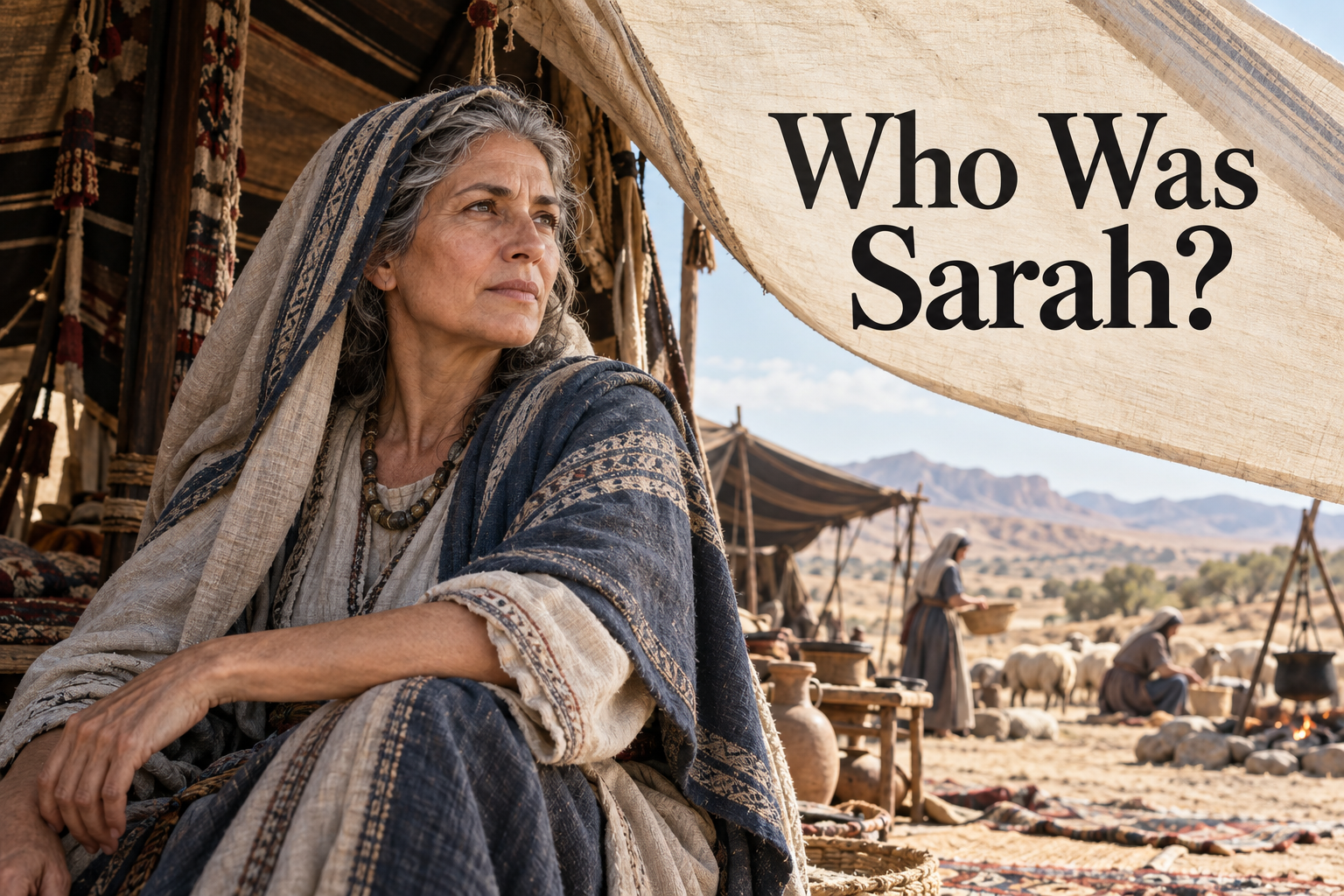
Sarah is easy to reduce to a supporting role in Abraham’s life, especially when the story is summarized as a list of patriarchs. Genesis doesn’t let us do that. God names her as the mother of the covenant son, changes her name, protects her when Abraham’s fear places her at risk, and preserves both her laughter and her anger. She is a woman of faith, but she is not a stained-glass figure. Her story includes long infertility, displacement, beauty used by powerful men, mistreatment of an enslaved woman, joy at an impossible birth, and fierce concern for her son’s future.
Sarai leaves home
Sarai first appears in the family line of Terah as Abram’s wife and as a woman unable to have children (Genesis 11:29–30). That brief notice establishes the tension that will govern much of her life. God promises Abram a great nation, but the couple has no heir. Sarai leaves Harran for Canaan with the household and then travels to Egypt when famine strikes. The biblical text says little about her response to these moves, which is a useful reminder not to invent emotions and call them facts.
In Egypt, Abram fears that men will kill him to take Sarai because she is beautiful. He asks her to say she is his sister, and Pharaoh brings her into his house. Abram receives livestock, servants, and other wealth while Sarai’s own wishes disappear from the account. God afflicts Pharaoh’s household, and Pharaoh returns her with a justified rebuke for Abram. Genesis later reports that Sarah was Abraham’s half sister as well as his wife, but a technically defensible phrase can still be used as a lie when it is designed to conceal the decisive truth.
The episode isn’t a romantic story about a husband cleverly surviving danger. Sarai is made vulnerable by the man who should protect her, and God rescues her. Genesis 20 repeats the danger in Gerar, where Abimelech takes Sarah after Abraham again calls her his sister. God warns Abimelech before sexual relations occur and explicitly protects Sarah from violation. These accounts reflect a world in which rulers could absorb women into their households and male heads of households could make decisions over them. Narrating that social reality is not the same as endorsing it.
Hagar and the attempt to secure an heir
After years in Canaan, Sarai proposes a solution to her childlessness. She gives Hagar, her Egyptian enslaved woman, to Abram so that Sarai might “be built up” through her. Ancient societies sometimes used enslaved women or secondary wives to produce heirs, and interpreters have compared the story with surviving legal customs from the ancient Near East. Those comparisons may explain the strategy, but they cannot supply Hagar’s consent or turn ownership of another person into a moral good. The text never says God instructed Sarai to do this.
When Hagar becomes pregnant, the relationship collapses. Hagar looks on Sarai with contempt, or at least Sarai perceives that she does; the Hebrew expression leaves some room for nuance. Sarai blames Abram, and Abram tells her that Hagar is in her power. Sarai then treats Hagar so harshly that she runs away. God meets Hagar in the wilderness, hears her affliction, and promises a future for Ishmael. Sarah’s pain was real, but suffering does not excuse her use and abuse of someone who had even less control over the situation.
This is one place where later interpretation must be handled carefully. Paul uses Sarah and Hagar allegorically in Galatians 4 to argue that Gentile believers must not submit to the Mosaic law as the basis of covenant membership. His theological argument doesn’t erase the women’s actual suffering or authorize contempt toward Hagar and her descendants. Genesis itself insists that God sees Hagar and cares for Ishmael. A reading that notices only Sarah’s covenant status and not Hagar’s affliction has missed something the narrator took pains to show.
A new name and unbelievable news
In Genesis 17 God changes Sarai’s name to Sarah. Both forms are related to the idea of a princess, so the point is probably not a simple dictionary change but a new stage in her covenant identity. More important, God speaks directly about her future: God will bless her, give Abraham a son by her, and make her the mother of nations and kings. Abraham laughs when he hears it. The promise is biologically absurd by ordinary standards, and the text doesn’t pretend otherwise.
Sarah laughs too when visitors repeat the promise at Abraham’s tent. Listening from inside, she considers both her age and Abraham’s and laughs to herself. When confronted, she denies it because she is afraid. Readers sometimes portray Sarah’s laughter as unbelief and Abraham’s as joy, but Genesis does not draw so tidy a contrast. Both laugh; both must learn that the Lord’s question, “Is anything too difficult for the Lord?” is larger than their exhausted expectations.
Sarah gave birth to Isaac at the announced time and said that God had made laughter for her, so that everyone who heard would laugh with her. Isaac’s name is itself connected with laughter. The laughter of disbelief and the laughter of delight aren’t opposites as much as two moments in the same transformation. Sarah had spent years carrying the social shame and private grief of infertility. Genesis neither scolds her for that grief nor treats the eventual birth as something she achieved by maintaining a flawless attitude.
Sarah, Hagar, and the two sons
Conflict returned when Isaac was weaned. Sarah saw Ishmael doing something described by a Hebrew participle related to laughter or play. Some translations say he was mocking, while others simply say he was playing; Galatians 4:29 interprets the situation as persecution. Sarah demanded that Abraham drive out Hagar and her son because Ishmael would not share Isaac’s inheritance. The demand distressed Abraham, but God told him to listen to Sarah regarding the covenant line and promised also to make a nation from Ishmael.
That divine instruction raises difficult questions, and easy answers usually flatten the story. God’s purpose through Isaac does not make every motive in Sarah’s demand pure, nor does it mean Hagar and Ishmael are disposable. They nearly die after Abraham sends them into the wilderness, and God again hears the boy and provides water. Genesis distinguishes covenant vocation from divine indifference: Isaac carries a particular promise, while God remains attentive to the family forced away. Readers should preserve both truths instead of using one to cancel the other.
Sarah’s death and legacy
Sarah died at Kiriath-arba, or Hebron, at the age of 127 according to Genesis 23. Abraham mourned for her and negotiated to purchase the cave of Machpelah from Ephron the Hittite. The chapter’s detailed account of the purchase gives Sarah an important place in the family’s relationship to the promised land. The first property Abraham’s household securely possesses in Canaan is her burial place. Her death therefore joins personal grief with the still-unfinished promise.
The New Testament remembers Sarah in several ways. Romans 4 refers to Abraham’s body and Sarah’s womb when describing the apparent impossibility of the promised birth. Hebrews 11:11 is translated in more than one way because the Greek wording is difficult, but it places the conception of Isaac within the story of faith. First Peter 3:5–6 presents Sarah as an example to wives and mentions her calling Abraham lord. That passage should not be turned into permission for husbands to imitate Abraham’s failures or put wives in danger; the same letter commands husbands to honor their wives.
Later Jewish, Christian, and Islamic traditions developed Sarah’s story beyond the relatively spare details in Genesis. Those traditions can show how communities have remembered her, but they should be labeled as later interpretation rather than reported as though Genesis said it. Historically, no external inscription identifies Sarah, and archaeology cannot verify the private events of her household. The text places her in the ancestral memory of Israel, while the New Testament includes her in the history of God’s promise.
Sarah’s life resists simple moral packaging. She endured decisions made over her, then used power harshly over Hagar. She laughed at a promise and later laughed because it came true. She acted within a patriarchal world without being merely incidental to it, because God explicitly included her in the covenant promise. Remembering Sarah honestly means neither excusing her wrongs nor allowing those wrongs to erase the faithfulness of God she lived long enough to see.