

Who Was the Prophet Ezekiel?
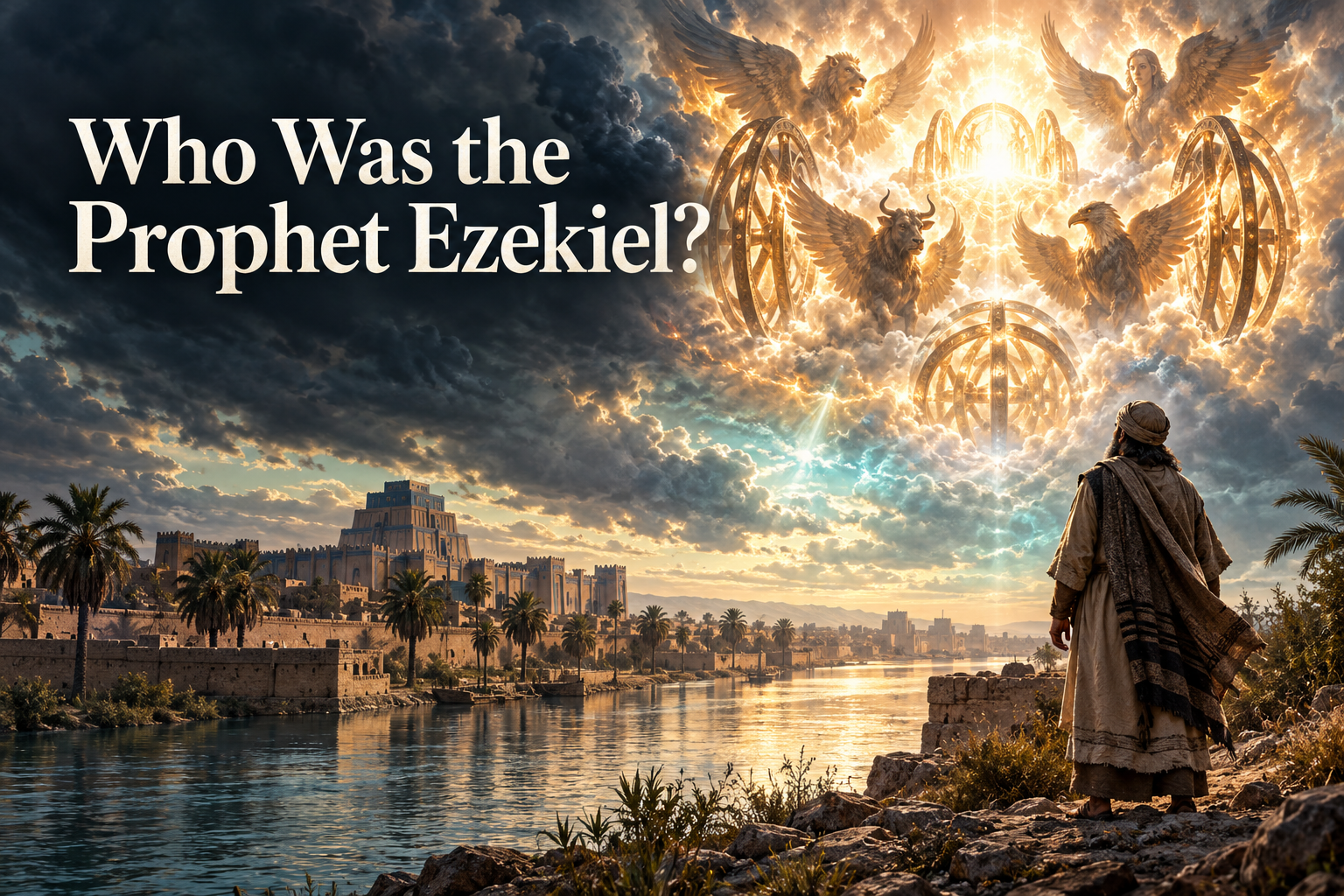
Ezekiel was a priest who lost the temple before he ever stopped thinking like a priest. His book is filled with altars, purity, sacrifice, sacred space, and the glory of God, but he delivered most or all of his recorded ministry far from Jerusalem. He spoke among displaced Judeans in Babylonia while their nation was collapsing in stages. Before Jerusalem fell, he warned people who still expected the city to survive. After it fell, he had to explain how judgment could be real without making restoration impossible.
A priest among the exiles
The book identifies Ezekiel as the son of Buzi and a priest living among the exiles by the Kebar canal (Ezekiel 1:1–3). It dates his call to the fifth year of King Jehoiachin’s exile, usually calculated as 593 or 592 BC. Jehoiachin had surrendered Jerusalem to Nebuchadnezzar in 597 BC and was taken to Babylon along with members of Judah’s royal court, military leadership, craftsmen, and other prominent residents. Ezekiel was apparently part of that displaced community, though Scripture doesn’t tell us the circumstances of his deportation or much about his earlier life.
The historical setting is reasonably firm, but some dates need to be stated with care. Jerusalem was destroyed in 587 or 586 BC, depending on how ancient regnal years and calendars are correlated. Ezekiel’s dated messages extend from the early 590s into the 570s, with the latest dated oracle usually placed in 571 BC. Those dates belong to the world described by the book and fit what is known about the Babylonian exile, but they don’t answer every question about when the material was collected or edited.
Traditional Jewish and Christian interpretation has treated Ezekiel as the author of the book that bears his name. The book speaks largely in the first person, repeatedly supplies dates, and displays an unusually consistent set of images and theological concerns. Many modern scholars also recognize a substantial sixth-century prophetic core associated with the historical Ezekiel, while debating whether disciples or later editors arranged and expanded some of the material. The evidence doesn’t permit us to reconstruct every stage of composition with confidence. It does permit us to say that the book is deeply rooted in the language, politics, and religious crisis of the Babylonian exile.
The vision beside the canal
Ezekiel’s ministry begins with one of the strangest call visions in Scripture. A storm cloud approaches, flashing with fire, and four living creatures appear beside intersecting wheels covered with eyes. Above them is an expanse, a throne, and a humanlike figure surrounded by radiant glory (Ezekiel 1). Artists have been trying to draw the scene ever since, usually proving that Ezekiel’s description was never intended as a convenient set of assembly instructions. The imagery communicates movement, overwhelming awareness, royal authority, and a holiness that the prophet can describe only by piling comparison upon comparison.
The central point is easier to grasp than every visual detail. Ezekiel sees the glory of the Lord in Babylonia, not in the Jerusalem temple. Exile had not carried the Judeans beyond God’s reach, and Babylon’s conquest had not confined Israel’s God to a ruined sanctuary. The wheeled throne suggests that the divine presence is not immobilized by geography. That conclusion is a theological reading of the vision rather than a decoding of each wheel, wing, face, and eye, and interpreters should be cautious about claiming more precision than the text supplies.
Ezekiel is addressed repeatedly as “son of man,” an expression that emphasizes his humanity in contrast to the divine glory before him. In Ezekiel, the phrase ordinarily means something like “human being” or “mortal”; it isn’t automatically the fully developed messianic title familiar to Christian readers from the Gospels and Daniel 7. God gives him a scroll filled with lamentation and tells him to eat it, making the message part of him before he delivers it (Ezekiel 2–3). He is also appointed as a watchman. His responsibility is to warn faithfully, even when his hearers refuse to listen.
Signs that could not be ignored
Ezekiel didn’t rely only on sermons. He built a model of besieged Jerusalem, lay on his side for extended periods, ate measured rations, shaved his head and divided the hair, packed an exile’s baggage, and dug through a wall (Ezekiel 4–5; 12). These acts dramatized siege, scarcity, death, and deportation for an audience inclined to believe that Jerusalem remained secure. Scholars disagree about whether every detail was performed exactly as narrated, enacted in a modified form, or experienced partly within prophetic visions. Whatever the mechanics, the book presents them as embodied messages, not eccentric behavior included for entertainment.
The most painful sign comes when Ezekiel’s wife, “the delight of your eyes,” dies and the prophet is told not to observe the expected public mourning rites (Ezekiel 24:15–24). Her death becomes a sign of the coming loss of the temple, which the people also regarded as the delight of their eyes. The passage is emotionally severe, and there is no need to soften it into something harmless. It shows what Ezekiel’s calling cost him, while also forcing readers to confront how prophetic symbolism can involve real human grief. The text reports the command and its meaning; it doesn’t answer every moral and emotional question the episode raises.
Why Jerusalem was judged
Ezekiel’s message before Jerusalem’s destruction is dominated by judgment. In chapters 8–11, he is taken in a vision to the temple and shown idolatrous practices within its precincts. The glory of the Lord then moves from the inner sanctuary to the threshold, to the east gate, and finally away from the city. The departure unfolds in stages, as though the gravity of the moment requires the reader to watch it happen. The temple’s destruction will not mean that Babylon’s gods defeated the Lord; Ezekiel presents it as judgment on persistent covenant unfaithfulness.
Some of the book’s accusations are expressed through extended allegories that modern readers find disturbing, especially in chapters 16 and 23. Their sexualized and violent imagery reflects ancient prophetic rhetoric, but describing the genre doesn’t remove its harshness. The point of those chapters is that Jerusalem betrayed the God who had established and cared for her, yet the metaphors can wound readers when they are repeated carelessly or detached from their ancient setting. Faithful interpretation should acknowledge both the theological accusation and the troubling form in which it is delivered.
Ezekiel also confronts the exiles’ tendency to explain their condition entirely through the sins of previous generations. They quoted a proverb about parents eating sour grapes and their children’s teeth being set on edge. Chapter 18 doesn’t deny that one generation’s wrongdoing can damage the next; the exile itself makes that consequence impossible to miss. It insists, however, that inherited circumstances don’t erase present moral responsibility. The wicked person who turns may live, and the righteous person who turns toward evil cannot use past obedience as permanent protection. God takes no pleasure in the death of the wicked but calls people to turn and live (Ezekiel 18:23, 32).
Shepherds, a new heart, and the Spirit
Once news arrives that Jerusalem has fallen, the book’s balance shifts toward restoration, though judgment never disappears. Ezekiel 34 condemns Israel’s shepherds, meaning its rulers and leaders, because they fed themselves rather than the flock. God promises to seek the scattered sheep personally and to set over them “my servant David.” In its exilic setting, that language expresses hope for renewed Davidic rule rather than the literal return of the long-dead king. Christians have understood the promise messianically and connected it with Jesus’ description of himself as the good shepherd, but that is a canonical Christian reading built upon the chapter’s original royal and pastoral imagery.
Ezekiel 36 promises cleansing, a new heart, a new spirit, and God’s own Spirit enabling obedience. Restoration will not come because Israel finally develops enough willpower to repair the covenant. God acts for the honor of his holy name, which Israel’s exile had profaned among the nations, and then transforms his people from within. Christians rightly hear this passage in discussions of regeneration and the work of the Holy Spirit. Even so, the chapter first addresses Israel’s restoration to the land, so its Christian application shouldn’t erase the people and historical crisis to whom it was originally spoken.
The valley of dry bones
The vision of the dry bones in Ezekiel 37 is one of the Bible’s most memorable pictures of hope. Ezekiel sees a valley filled with bones that are not merely dead but very dry. At God’s command, the bones come together, receive flesh, and finally receive breath. The Hebrew word translated “breath” can also mean “wind” or “spirit,” allowing the vision to move between physical imagery and divine re-creation. What no human observer could reverse, God restores by his word and Spirit.
The chapter explains its immediate meaning: the bones are “the whole house of Israel,” whose members say their hope is gone. The vision is therefore about a people experiencing national death in exile and God’s promise to restore them. Jewish and Christian readers have also seen it as compatible with, or suggestive of, bodily resurrection, especially when read alongside later biblical teaching. That broader application is understandable, but it shouldn’t replace the interpretation the chapter itself provides. Ezekiel’s first concern is not an abstract lesson about optimism; it is God’s ability to bring a covenant people out of a condition that looked final.
The sign of two sticks follows, symbolizing the reunion of Judah and Joseph under one Davidic shepherd. Chapters 38–39 then describe the defeat of Gog of the land of Magog, an enemy assembled against a restored people. Attempts to identify Gog confidently with a particular modern nation have produced far more certainty than the text warrants. The imagery portrays a final, massive threat that God defeats for the sake of his name and people. Revelation later reuses Gog and Magog in its own vision of the last rebellion, which shows the image’s continuing power without giving us permission to turn every international crisis into a prophetic matching game.
The glory returns
Ezekiel 40–48 contains an extensive vision of a new temple, ordered worship, redistributed land, and a life-giving river. The vision is commonly dated around 573 BC, although the book’s latest dated oracle appears elsewhere. The glory that departed from Jerusalem in chapters 8–11 returns from the east and fills the sanctuary (Ezekiel 43). A river flows from the temple, deepens as it goes, and brings life even to the Dead Sea. The book ends with the restored city named “The Lord Is There.”
Christians disagree sharply over how literally these chapters should be read. Some understand them as plans for a restored sanctuary that Israel did not build. Some premillennial interpreters expect a physical temple during Christ’s future reign. Others read the vision symbolically or typologically as a portrayal of God dwelling with a purified people, ultimately reaching its fulfillment in the new creation. The detailed measurements favor taking the vision’s concrete features seriously, while the miraculous river and transformed geography caution against treating it as ordinary architectural documentation. The return of sacrifice creates further questions for Christians who confess the sufficiency of Christ’s sacrifice, and no interpretation should pretend those questions disappear through a single confident assertion.
The New Testament repeatedly draws on Ezekiel without simply reproducing his visions. Revelation uses imagery associated with the living creatures, the scroll, Gog and Magog, the measuring of sacred space, and the river of life. Christian readers have also connected Ezekiel’s shepherd, cleansing water, new heart, and Spirit with the work of Christ and the new covenant. Those connections are strongest when Ezekiel is first allowed to address exile, failed leadership, defiled worship, and Israel’s promised restoration on his own terms. Christian fulfillment should enlarge the text’s horizon, not make its original setting vanish.
Why Ezekiel still matters
Ezekiel’s visions are strange because the catastrophe he addressed was enormous. Judah had lost its king, land, capital, and temple, and the exiles needed more than the reassurance that circumstances would soon improve. Ezekiel told them that their disaster involved real judgment, that each generation remained responsible for its response to God, and that the Lord’s presence had never depended on Jerusalem’s walls. He also insisted that restoration would require more than rebuilding what had been destroyed. God would have to gather the scattered, replace hearts of stone, breathe life into the dead, and dwell among his people again.
We know little about Ezekiel’s life beyond the ministry recorded in his book, and Scripture gives no account of his death. What remains is the witness of a priest without a functioning temple and a prophet among people who believed their future had been buried with their past. His answer was not that loss was imaginary or judgment unimportant. It was that neither Babylon nor death had the authority to write the final line of Israel’s story.