
Who Was the Prophet Malachi?
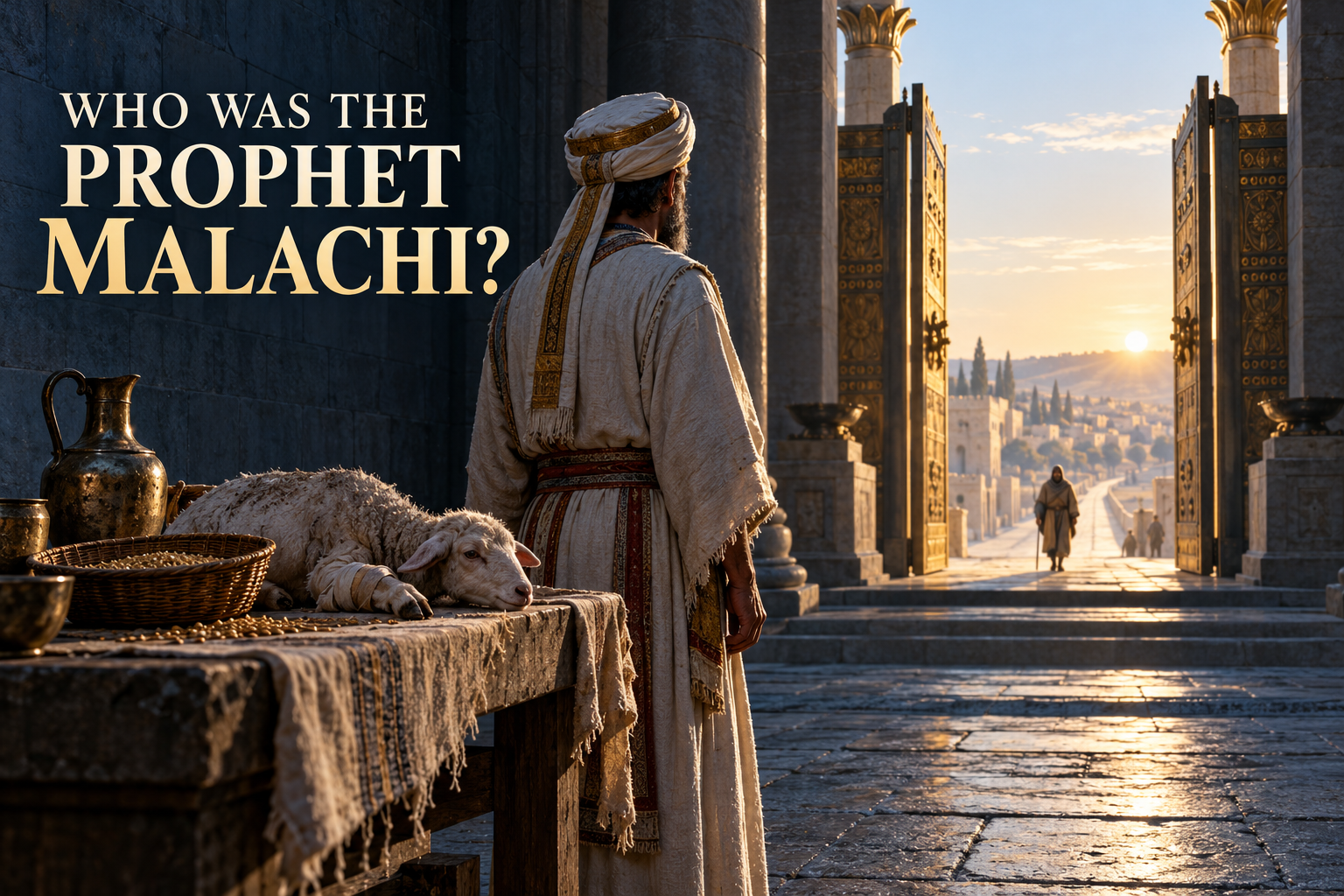
By the time the prophetic voice we call Malachi spoke, the great crisis of exile had given way to a quieter spiritual danger: cynicism. Worship continued, sacrifices were offered, and the language of covenant remained familiar. Yet priests accepted defective offerings, people broke faith with one another, and some had begun to say that serving God made no practical difference. Open rebellion is easier to recognize. Malachi confronted a community that had learned to practice disappointment religiously.
Was Malachi His Name?
The book opens with “the word of the Lord to Israel by Malachi” (Malachi 1:1), but the Hebrew word mal’akhi means “my messenger.” It may be the prophet’s personal name, as Jewish and Christian tradition has generally treated it, or it may be a title connected with the messenger promised in Malachi 3:1. The name does not appear elsewhere in the Old Testament as an unquestionably personal name. We can continue to call the prophet Malachi while admitting that Scripture may not have preserved his actual name.
The book gives no king, genealogy, or exact date. Its reference to a Persian-style governor and its picture of an operating sacrificial system point broadly to the Persian period after the exile. Many interpreters place it in the fifth century BC and compare its concerns with those found in Ezra and Nehemiah, but attempts to position it precisely before, during, or after their reforms remain uncertain. The setting is clearer than the calendar: the community had a functioning center of worship but was treating covenant faithfulness as negotiable.
A Prophet Who Argues With His Audience
Malachi’s style is distinctive. God makes a statement or accusation, the people answer with an objection, and the prophet exposes what their question reveals. “I have loved you,” says the Lord, and the people ask, “How have you loved us?” God charges the priests with despising his name, and they ask how they have done so. The people’s replies may represent actual sayings or the prophet’s sharp summary of their attitudes. Either way, Malachi doesn’t allow vague religious language to hide the dispute.
The first exchange begins with God’s covenant love for Israel, demonstrated by his choice of Jacob in contrast with Esau and by the judgment of Edom (Malachi 1:2-5). The language of love and hate describes covenant choice and historical treatment, not a passing change of emotion. Paul later draws on this text in Romans 9 while discussing God’s freedom in election and Israel’s vocation. Malachi’s immediate point is that Israel’s present frustration has not erased God’s covenant commitment.
Careless Worship and Failed Priests
Malachi’s strongest early criticism falls on the priests. The law required acceptable animals for sacrifice, but they were presenting blind, lame, and sick animals while expecting God to receive what even a provincial governor might reject. The offense was not merely a technical mistake in ritual procedure. Their offerings communicated that God deserved whatever was left over, and the priests who should have guarded instruction were cooperating with the dishonor.
Malachi describes the priest as a messenger of the Lord whose lips should preserve knowledge (Malachi 2:7). Instead, these priests had caused many to stumble and had shown partiality in their instruction. That failure explains why the book gives so much attention to worship. Ritual and ethics are not competing concerns in Malachi. Corrupt worship both expresses and teaches a distorted view of God, while faithful priestly service is supposed to guide the community in truth.
Faithlessness at Home
Malachi 2:10-16 turns from the sanctuary to broken covenant relationships. The passage accuses Judah of marrying “the daughter of a foreign god” and condemns men who dealt treacherously with the wives of their youth. The concern is religious unfaithfulness and the betrayal of covenant partners, not ethnicity considered by itself. Throughout the Old Testament, the decisive issue in such marriages is allegiance to the Lord rather than the ancestry of the spouse.
The Hebrew of Malachi 2:15-16 is notoriously difficult, and translations differ. Some render verse 16 as God’s declaration, “I hate divorce,” while others understand it as a condemnation of the man who hates and divorces his wife, covering his garment with violence. The exact grammar is debated, but the central accusation is not: men were betraying wives to whom they had been joined in covenant. This passage should not be used as a blunt instrument against an abandoned or endangered spouse. Malachi directs his anger toward the person committing treachery, not toward the person suffering from it.
The Messenger and the God of Justice
The people also complained that evildoers prospered and asked where the God of justice was. Malachi answered that a messenger would prepare the way, after which the Lord they sought and the messenger of the covenant would come (Malachi 3:1). The identities and relationship of these figures are not completely explained within the passage. What is clear is that the coming they claimed to desire would involve purification and judgment. God would refine the priesthood and testify against sorcery, adultery, false oaths, the oppression of workers, widows, and orphans, and the mistreatment of foreigners.
The Gospels apply the preparing messenger language to John the Baptist (Matthew 11:10; Mark 1:2-3; Luke 7:27), who prepares the way for Jesus. Christians therefore read Malachi 3:1 in the light of Christ’s coming. That fulfillment preserves the warning in the original passage. The Lord’s arrival is good news, but it is not harmless religious scenery. The God who comes near also exposes what his people have preferred not to examine.
Tithes, Blessing, and the Fear of the Lord
Malachi next accuses the people of robbing God by withholding tithes and contributions. Their failure deprived the storehouse of what supported the community’s worship and care, and the prophet called them to bring the full tithe (Malachi 3:8-10). God promised agricultural abundance in response. This was a concrete covenant word to postexilic Judah, whose life depended on rain, crops, and protection from pests. It should not be converted into a mechanical promise that every Christian who gives money will become wealthy. The passage condemns withholding from God while promising his faithful provision; it does not turn generosity into an investment scheme.
Some still complained that serving God was useless because the arrogant appeared to prosper. In answer, Malachi describes those who feared the Lord speaking with one another while God listened and recorded a book of remembrance. A day would come when the distinction between the righteous and the wicked became visible. The image of the “sun of righteousness” rising with healing announces that judgment and restoration belong together: the same day that consumes persistent evil brings freedom to those who honor God.
Elijah and the Book’s Final Word
Malachi closes by calling the people to remember the law of Moses and promising that Elijah will come before the great and fearful day of the Lord. He will turn the hearts of parents and children toward one another (Malachi 4:4-6 in most Christian Bibles; 3:22-24 in the Hebrew chapter numbering). The ending brings law and prophets together and points forward to reconciliation before judgment. Its placement at the end of the Christian Old Testament has made it sound like a deliberate bridge to the Gospels, although the Hebrew Bible arranges its books differently.
Jesus identifies John the Baptist with the promised Elijah in a qualified but real sense (Matthew 11:14; 17:10-13), while Luke says John goes before the Lord in the spirit and power of Elijah (Luke 1:17). John himself denies that he is literally Elijah returned (John 1:21). Taken together, the passages present John as fulfilling Elijah’s preparatory role rather than requiring us to imagine that the two men were the same person.
Why Malachi Matters
Malachi addressed people who had not abandoned religion. Their danger was that they continued it without honor, fidelity, justice, or hope. Priests performed sacrifices they wouldn’t have offered to a governor, spouses treated covenants as disposable, and worshipers judged God’s goodness by the apparent success of arrogant people. The prophet answered their cynicism with both memory and promise: remember the covenant, and remember that the Lord will come.
That combination keeps Malachi from becoming either a lecture about religious standards or a collection of predictions. God’s love comes first, but it is a covenant love that confronts contempt and treachery. The promised messenger prepares people for the Lord, and preparation means more than waiting. It means giving God more than leftovers, dealing faithfully with others, practicing justice, and recovering the ability to hope.