

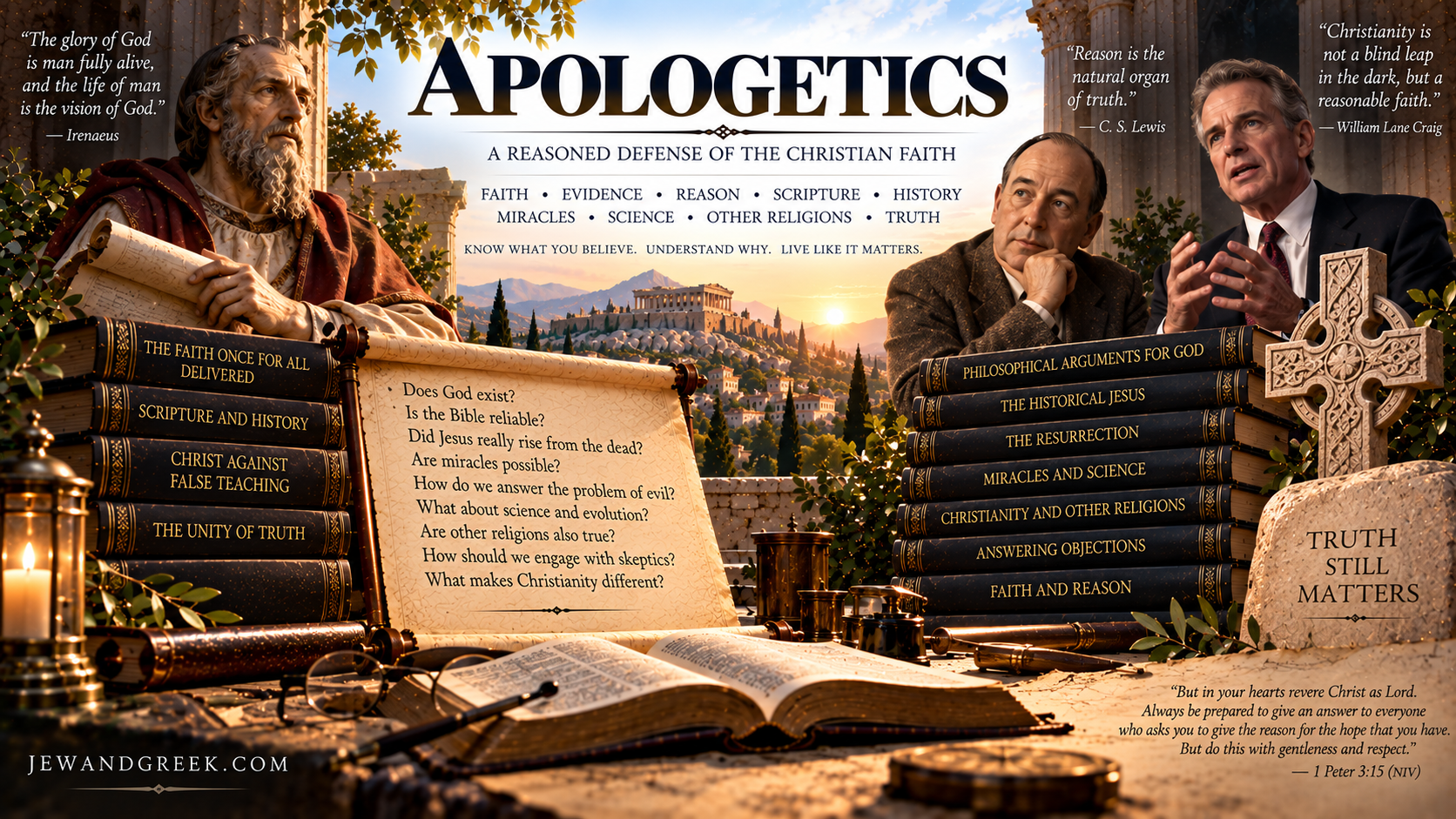
Christian apologetics is the reasoned defense of the Christian faith. It asks whether Christianity can withstand serious intellectual examination and whether there are good reasons for believing its central claims. Does God exist? Can we know anything about God? Is the Bible historically reliable? Did Jesus really rise from the dead? Are miracles possible? How can a good and powerful God allow suffering? Does modern science make belief in God unnecessary? Are Christianity’s moral claims defensible? And in a world containing many religions and worldviews, why should anyone believe Christianity is true?
These are not questions Christians should fear. Christianity makes claims about reality, history, morality, and human existence, and claims of that kind can be investigated. Faith and reason need not be enemies. They can coexist. Faith may extend beyond what can be demonstrated philosophically or scientifically, but that does not mean faith must contradict reason. Christian apologetics begins with the conviction that truth can withstand examination, and that believers should be willing both to give reasons for their beliefs and to listen seriously to objections.
What Is Apologetics?
The word apologetics comes from the Greek apologia, meaning “a defense or reasoned answer”. The New Testament uses the term in contexts where Christians explain or defend their beliefs. The passage most commonly associated with Christian apologetics is 1 Peter 3:15, where believers are instructed to be prepared to give an answer for the hope within them.
The final words of that instruction are just as important as the command to give an answer: the defense is to be offered with gentleness and respect. Apologetics is therefore not simply the art of defeating opponents in arguments. Its purpose is to explain Christian belief truthfully, answer legitimate objections, expose faulty reasoning when necessary, and help people consider whether Christianity provides a coherent account of reality. An apologist who wins an argument through ridicule, distortion, or intimidation may have demonstrated rhetorical skill while failing at Christian apologetics.
Faith and Reason
One of the oldest misconceptions about Christianity is that faith means believing something without reason or evidence. Christian thinkers throughout history have generally understood the relationship more carefully. Augustine, Anselm, Thomas Aquinas, Blaise Pascal, C. S. Lewis, Alvin Plantinga, and many others have approached Christianity with the conviction that faith and rational inquiry can coexist.
Reason has limits. Human beings do not possess exhaustive knowledge, and many important beliefs cannot be demonstrated with mathematical certainty. Yet this is true outside religion as well. We rely upon testimony, historical evidence, inference, memory, probability, and accumulated experience in ordinary life. The appropriate question is therefore not whether Christian beliefs can be proven with absolute certainty, but whether they are supported by sufficient reasons to make belief rational.
Knowing What We Believe
Before Christians can defend Christianity, they need to understand what Christianity actually teaches. Many arguments about religion become confused because people are defending or attacking ideas that historic Christianity does not affirm. A Christian who cannot explain basic doctrines such as the Trinity, incarnation, atonement, resurrection, salvation, revelation, or the nature of Scripture will have difficulty responding when those beliefs are challenged.
This makes theology an essential partner of apologetics. Apologetics cannot merely accumulate clever responses to skeptical questions. It requires careful biblical interpretation, historical understanding, and familiarity with the development of Christian doctrine. Sometimes the appropriate answer to an objection is not a sophisticated philosophical argument but simply, “That isn’t what Christianity teaches.”
Understanding Why We Believe It
Knowing Christian doctrine is only the beginning. Christians should also ask why they believe those doctrines are true. A belief inherited from parents, a church, or a culture may be correct, but inheritance alone does not establish its truth.
This is where apologetics overlaps with philosophy, history, biblical studies, archaeology, textual criticism, science, and other disciplines. Arguments for God’s existence involve metaphysics and cosmology. Questions about miracles involve philosophy and historical reasoning. Questions concerning the biblical text involve manuscript evidence and textual criticism. The resurrection requires historical investigation. Moral arguments involve ethics. Claims concerning consciousness and the soul lead into philosophy of mind. Good apologetics therefore requires more than memorizing a handful of arguments.
Scripture and Apologetics
For Christians, Scripture possesses an authority that it does not automatically possess for someone who rejects Christianity. This creates an important distinction in apologetic methods. When discussing theology with another Christian who accepts biblical authority, arguments from Scripture may appropriately carry considerable weight. When speaking with someone who does not believe the Bible is divinely authoritative, simply quoting another Bible verse would probably accomplish very little.
Paul appears capable of adapting his reasoning to his audience. Acts describes him reasoning from the Scriptures in synagogues, where those Scriptures represented shared authority. In Athens, however, he addressed an audience immersed in Greek religion and philosophy and even quoted their own poets. The message remained Christian, but the starting point changed. Effective apologetics similarly asks what beliefs, evidence, or principles are shared with the person with whom we are speaking.
Interpretation Matters
Quoting Scripture is not the same as interpreting Scripture correctly. A verse removed from its literary, historical, or theological context can be made to support conclusions the biblical author never intended. Christian apologetics therefore requires hermeneutics – careful interpretation of biblical texts.
This is especially important when Christians disagree with one another. Protestants, Catholics, Orthodox Christians, Pentecostals, Calvinists, Arminians, cessationists, continuationists, and other groups frequently appeal to the same Bible while reaching different conclusions. Simply producing a proof text does not resolve those disagreements. The real questions concern context, language, genre, historical background, theological assumptions, and whether an interpretation accounts adequately for all of the relevant passages.
Logic and Argument
An argument is not necessarily a quarrel. In philosophy, an argument is a set of reasons offered in support of a conclusion. Christian apologetics therefore depends upon the same principles of logic that govern reasoning in other disciplines.
Apologists should understand the difference between deductive, inductive, and abductive arguments; between validity and soundness; and between evidence and assertion. They should recognize common fallacies such as straw-man arguments, false dilemmas, circular reasoning, ad hominem attacks, appeals to irrelevant authority, and hasty generalizations. Just as importantly, Christians should be willing to recognize these errors when Christians themselves commit them. Logic is not a weapon that applies only to the other side.
Representing Opponents Fairly
One of the easiest ways to win an argument is to attack a weak version of the opposing position (known as strawmanning). It is also one of the least useful forms of apologetics. Serious engagement requires understanding an argument well enough that someone who holds the position could recognize it as an accurate description of what they believe (aka steelmanning).
This principle applies whether Christians are interacting with atheists, Muslims, Jews, Buddhists, skeptics, scientists, philosophers, or other Christians. An atheist should not automatically be portrayed as someone who secretly knows God exists but simply wants to sin. A Christian should not automatically be portrayed as someone who believes because he is afraid of death. Psychological speculation is not a substitute for addressing an argument. The strongest apologetics engages the strongest reasonable version of the objection.
Evidence
Christianity makes historical claims, which means evidence matters. The existence of Jesus, his crucifixion, the beliefs of his earliest followers, the formation of the New Testament, and the rise of Christianity can be investigated using historical methods. Archaeology, manuscripts, inscriptions, ancient literature, and comparative historical analysis can clarify the world in which Christianity emerged.
Evidence must also be handled responsibly. Archaeological discoveries rarely “prove the Bible” in the sweeping way popular headlines sometimes suggest, and the discovery of an ancient manuscript does not automatically establish every theological conclusion someone wants to draw from it. Responsible apologetics distinguishes what evidence establishes, what it supports, and what remains uncertain.
Does God Exist?
The existence of God is one of the foundational questions of apologetics. Christian philosophers have developed several families of arguments, including cosmological arguments from causation or contingency, teleological arguments involving order or fine-tuning, moral arguments, ontological arguments, and arguments involving consciousness, reason, or religious experience.
These arguments should not be treated as magic formulas capable of forcing belief. Each contains premises that can be challenged, and philosophers continue debating them. Their value lies in asking whether features of reality make better sense if God exists than if God does not. Rather than relying upon a single argument, many Christian philosophers make a cumulative case, asking which worldview best explains the broad range of evidence.
Why Is There Something Rather Than Nothing?
Perhaps the most fundamental metaphysical question is why anything exists at all. The universe contains stars, planets, matter, energy, physical laws, conscious beings, and enormous complexity. Yet why should there be a universe rather than nothing?
Christian theism answers that contingent reality ultimately depends upon a necessary Creator. God is not proposed merely as another object within the universe requiring the same kind of explanation as everything else. Classical Christianity understands God as the ultimate ground of created existence. Critics challenge whether such a being is necessary or whether the universe itself might simply exist without further explanation. That disagreement takes us directly into metaphysics.
Science and Christianity
Science and Christianity are frequently portrayed as competitors offering rival explanations of the same phenomena. The actual relationship is more complicated. Science investigates the structures, processes, and history of the natural world, while Christian theology addresses broader questions concerning creation, purpose, meaning, and God’s relationship to nature.
Conflicts can certainly occur, particularly when Christians make scientific claims or scientists make philosophical claims extending beyond empirical evidence. It is therefore important to distinguish methodological naturalism, the practice of seeking natural explanations within science, from metaphysical naturalism, the philosophical belief that nothing beyond nature exists. The success of scientific explanations does not by itself establish the second proposition.
Creation and Evolution
Few subjects have generated more unnecessary hostility between Christians and the scientific community than creation and evolution. The discussion is often presented as though every Christian must reject evolutionary biology and every person accepting evolution must reject God. Neither description accurately reflects the range of actual positions.
Christians disagree about the age of the earth, the interpretation of Genesis, common ancestry, Adam and Eve, and the extent to which evolutionary processes can be incorporated into Christian theology. Scientists who accept evolution likewise hold different philosophical and religious beliefs. Good apologetics should therefore identify precisely what is being disputed rather than turning a complicated collection of scientific, biblical, and philosophical questions into a contest between “science” and “faith.”
The Problem of Evil
If God is all-powerful and perfectly good, why is there so much suffering? For many people this is not merely an abstract philosophical objection. It emerges from experiences of disease, abuse, disaster, violence, grief, and apparently pointless suffering.
Christian philosophers have offered responses involving human freedom, the regularity of natural laws, moral development, the fallen condition of creation, and the limitations of human knowledge. Christianity also places suffering within the larger story of the cross, resurrection, judgment, and restoration. None of these ideas should be used casually in the presence of someone experiencing tragedy. An intellectually possible explanation of suffering is not necessarily a pastorally appropriate response to a grieving person.
Miracles
Can miracles occur? The answer depends partly upon larger assumptions about reality. If nature is a completely closed system and no God exists, then of course genuine divine miracles can’t occur. If God created and sustains nature, however, divine action within creation is possible.
This means that reports of miracles should be evaluated rather than accepted uncritically or rejected automatically. Extraordinary claims deserve careful examination, and Christians have good reason to be skeptical of exaggeration and fraud. But skepticism should operate in both directions. Declaring a miracle impossible before examining the evidence is not a conclusion produced by historical investigation; it is a philosophical assumption brought into the investigation.
The Resurrection of Jesus
Christianity ultimately stands upon a historical claim: Jesus Christ was raised from the dead. The apostle Paul made the consequences explicit – if Christ has not been raised, Christian faith is futile. The resurrection therefore deserves particularly careful examination.
The historical investigation involves questions concerning Jesus’ death, the earliest resurrection proclamation, traditions concerning the empty tomb, reported appearances, the experiences of the disciples, Paul’s conversion, and the emergence of the Christian movement. Scholars disagree about how individual pieces of evidence should be evaluated and what explanations best account for them. Apologetics should acknowledge those debates rather than claiming any consensus. The central question is whether the resurrection provides the best explanation of the relevant historical evidence within a worldview in which divine action is possible.
Is the Bible Reliable?
The question “Is the Bible reliable?” actually contains several questions. Has the text been transmitted accurately? Are its historical claims credible? How should apparent contradictions be understood? What does inspiration mean? How was the canon formed? Are the Gospels historically trustworthy? These questions should not be collapsed into a single slogan.
Apparent discrepancies deserve careful investigation rather than panic or superficial harmonization. Independent witnesses frequently describe the same event differently, and variation does not automatically establish contradiction. At the same time, Christians should not pretend that every difficult passage has an obvious solution. A responsible doctrine of Scripture should be strong enough to permit serious examination of the actual biblical text rather than depending upon the claim that no difficulty exists.
Apparent Contradictions
Independent accounts of an event do not normally reproduce every detail identically. Differences among biblical accounts therefore need to be analyzed rather than automatically classified either as contradictions or as meaningless variations.
Some apparent contradictions disappear when context, chronology, language, or different perspectives are considered. Others remain genuinely difficult and have generated multiple proposed solutions. Intellectual integrity requires distinguishing a plausible reconciliation from a merely possible one. Christian confidence does not require pretending we possess an answer to every textual difficulty.
Textual Criticism
Because the original manuscripts of the biblical books no longer survive, scholars compare ancient manuscript copies to determine the earliest recoverable wording of the text. This discipline is called textual criticism. The existence of textual variants sometimes alarms Christians who first encounter the subject, but variants are exactly what one expects when documents were copied by hand for centuries.
The relevant question is not whether variations exist but whether scholars possess enough manuscript evidence to identify where they occur and reconstruct the text responsibly. Modern Bible translations already incorporate this scholarship and frequently identify important variants in footnotes. Textual criticism therefore need not be regarded as an attack upon Scripture; it is one of the principal tools used to study how the biblical text was transmitted.
The New Testament and History
The New Testament belongs to the world of first-century Judaism and the Roman Empire. Its writings can therefore be examined alongside archaeological discoveries, Jewish literature, Roman sources, inscriptions, geography, and other ancient evidence.
Historical confirmation of a city, ruler, custom, or political office does not prove every theological claim made by a biblical author. It can, however, help establish whether the writer demonstrates knowledge of the historical environment being described. At the same time, genuine historical difficulties should be acknowledged rather than hidden. Apologetics is strongest when the standard of evidence remains the same whether a discovery appears helpful or challenging.
Jesus
Christian apologetics eventually centers upon Jesus of Nazareth. Arguments about generic theism can establish at most a generic conclusion about God. Christianity makes much more specific claims: Jesus was the Messiah, uniquely revealed God, died by crucifixion, and was raised from the dead.
The historical Jesus therefore deserves investigation independent of assumptions derived from later Christian theology. What can be established about Jesus using historical methods? How early are the traditions preserved in the Gospels and Paul’s letters? What did Jesus claim about himself? Why was he crucified? What caused his followers to proclaim his resurrection? These questions form a bridge between general arguments for God and the distinctive claims of Christianity.
Other Religions
Christian apologetics also encounters the reality of religious diversity. Judaism, Islam, Hindu traditions, Buddhism, and other religions contain thoughtful adherents, sophisticated intellectual traditions, and claims about ultimate reality that deserve accurate representation.
The existence of many religions does not logically establish that none can be true, just as disagreement among philosophers does not establish that philosophy is meaningless. But religious diversity does create a legitimate challenge: Why Christianity rather than another religion? Answering that question requires more than attacking competitors. It requires understanding their strongest claims and comparing them carefully with Christianity.
Atheism and Naturalism
Atheism is simply the absence or denial of belief in God, while naturalism is the broader philosophical position that reality consists fundamentally of the natural world. The two should not be treated as identical. An atheist need not hold every position commonly associated with naturalism, and someone questioning Christianity should not automatically be assigned an entire worldview.
Christian engagement with naturalism can nevertheless raise important questions. Why does anything exist? Why is nature intelligible? What explains consciousness, rationality, moral obligation, and the apparent reliability of human cognition? Naturalists have developed substantial answers to these questions, and Christian apologetics should engage those answers rather than merely asking rhetorical questions. The relevant issue is comparative explanatory power: which account of reality explains what we observe with the greatest coherence?
Doubt
Apologetics is not only for arguments with unbelievers. It can also help Christians dealing with doubt. Doubt may arise from intellectual objections, painful experiences, unanswered prayer, moral disappointment, exposure to new information, or the behavior of Christians themselves.
Treating every doubt as rebellion can drive honest questions underground. On the other hand, treating every doubt as proof that Christianity is collapsing gives uncertainty more significance than it deserves. Questions should be examined individually. Sometimes an objection exposes a weak argument Christians should abandon. Sometimes it reveals that a person was taught something Christianity never required. Sometimes serious investigation strengthens the original belief.
Apologetics Within the Church
Some of the most vigorous apologetic disputes occur among Christians themselves. Questions involving baptism, spiritual gifts, divine sovereignty, free will, eternal security, church government, creation, healing, communion, eschatology, and biblical interpretation have produced centuries of disagreement.
These disputes require a somewhat different method because the participants may share Scripture as an authority while disagreeing about its interpretation. The task becomes exegetical and theological as well as philosophical. Christians should also distinguish doctrines central to historic Christianity from secondary questions over which sincere believers have disagreed. Not every disagreement deserves the label of heresy.
Charismatic Claims
For Pentecostal and charismatic Christians, apologetics includes another category of questions: Do the supernatural gifts described in the New Testament continue today? Claims involving healing, prophecy, tongues, miracles, and spiritual experiences deserve both theological and evidential examination.
Two errors should be avoided. One is assuming that supernatural claims must be false because they do not fit a naturalistic worldview. The other is assuming that every supernatural claim made by a Christian must be accepted because miracles are biblically possible. The New Testament itself commands discernment. A theology that allows miracles should also allow investigation, accountability, and the possibility that particular claims are mistaken or fraudulent.
Civil Discourse
Christian apologetics should be marked by intellectual courage without unnecessary hostility. Disagreement does not require contempt. Ridicule might generate applause from people who already agree while accomplishing little with those who do not.
This does not mean arguments should never be challenged forcefully. Contradictions can be exposed, evidence can be questioned, double standards can be identified, and false claims can be corrected. But the objective is truth rather than humiliation. The person on the other side of an argument is not merely an obstacle to be defeated but someone whose ideas deserve the same fair examination Christians want for their own.
Intellectual Humility
Apologetics becomes dangerous when defending Christianity is confused with defending every argument Christians have ever made. Some apologetic arguments are weak. Some popular quotations are inaccurate. Some supposed scientific proofs are exaggerated. Some historical claims circulate for decades despite poor evidence.
Christians lose nothing by correcting these mistakes. If Christianity is true, it does not need false evidence to support it. Intellectual humility means being willing to say, “I don’t know,” “That argument doesn’t work,” or “I used to think that, but the evidence changed my mind.” Such admissions strengthen rather than weaken a serious commitment to truth.
The Goal of Apologetics
The goal of apologetics is not to construct an intellectual fortress in which Christians never encounter uncomfortable questions. Nor is it to develop an arsenal of clever responses capable of ending every argument. It is to pursue truth seriously and help others do the same.
Peter’s instruction remains an excellent summary: be prepared to give a reason for the hope that you have, and do it with gentleness and respect. Paul reasoned from Scripture with those who accepted Scripture and engaged the intellectual world of his Greek audiences when addressing them.
That approach fits the larger purpose of Jew & Greek particularly well. Apologetics brings together virtually everything we’re building – Bible, theology, church history, philosophy, science, religion, and careful reasoning. It asks Christians not merely to repeat conclusions but to understand them well enough to examine their foundations.
Know what you believe. Understand why you believe it. Live like it matters.
Does God Exist?
Cosmological • Fine-Tuning • Moral • Contingency
Creationism
Genesis • Creation • Evolution • Age of the Earth
The Resurrection of Jesus
Empty Tomb • Appearances • Early Testimony • Explanations
Is the Bible Reliable?
Manuscripts • Canon • History • Apparent Contradictions
The Historical Jesus
Sources • Teachings • Claims • Crucifixion
The Problem of Evil
Suffering • Free Will • Hiddenness • Providence
Miracles
Possibility • Evidence • Hume • Supernatural Claims
Christianity and Science
Science • Faith • Cosmology • Naturalism
Christianity and Other Religions
Judaism • Islam • Hinduism • Buddhism
Countercult Apologetics
Cults • Heresy • Authority • Christian Doctrine
Atheism and Naturalism
God • Materialism • Reason • Morality
Evidence for Christianity
Historical • Philosophical • Cumulative Case • Worldview
Defending the Faith
Scripture • Logic • Evidence • Civil Dialogue
Charismatic Apologetics
Gifts • Healing • Tongues • Prophecy