

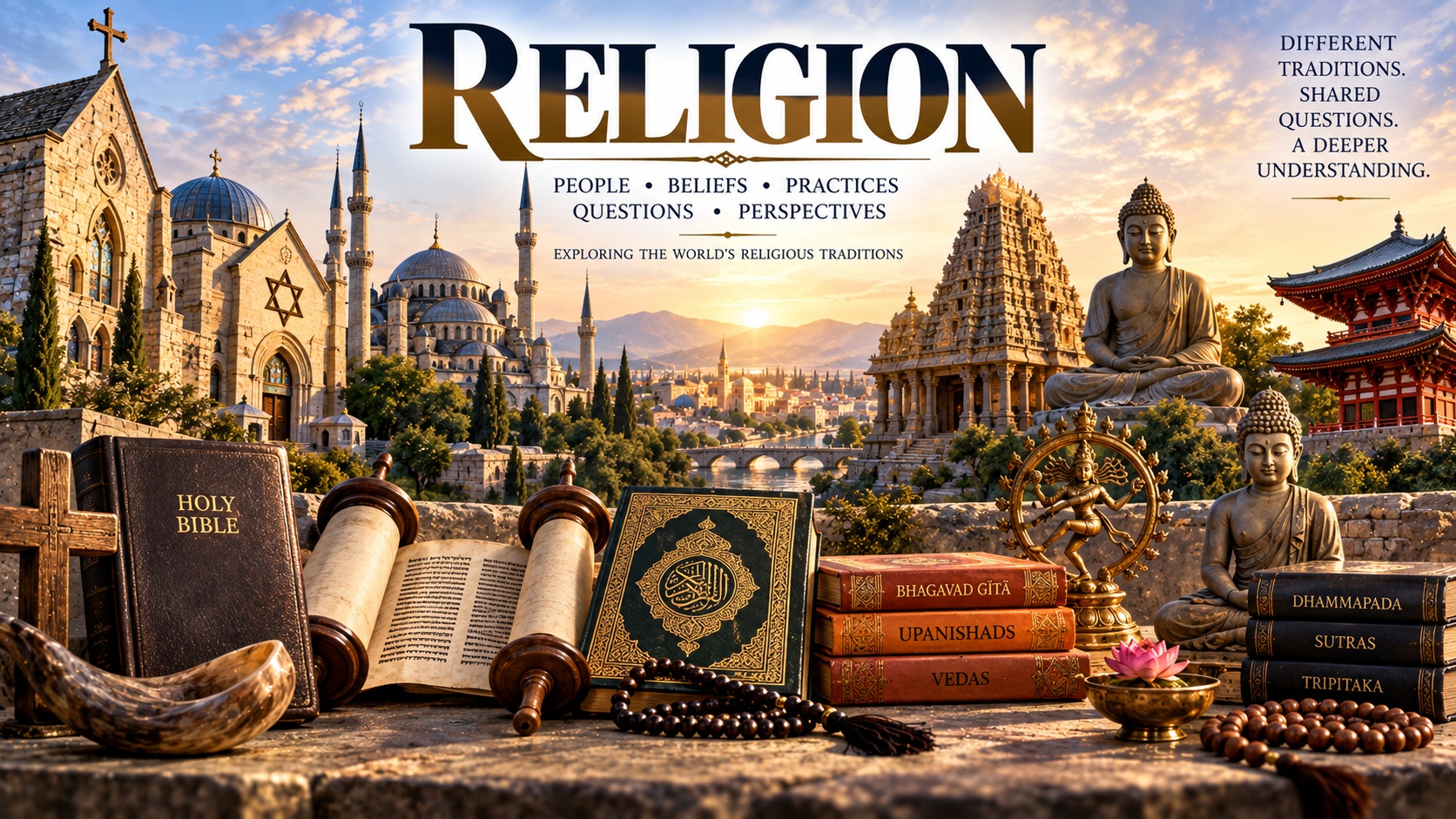
Religion has shaped human civilization for thousands of years. Across cultures and throughout recorded history, human beings have asked questions about the origin of the world, the nature of the divine, the meaning of life, the basis of morality, the problem of suffering, the reality of death, and the possibility that something lies beyond it. Those questions have produced an extraordinary variety of beliefs and practices, from the monotheistic traditions of Judaism, Christianity, and Islam to the diverse religious traditions of India and East Asia and the traditional religions of indigenous peoples around the world. Religion has inspired art, architecture, music, literature, philosophy, law, charitable institutions, political movements, and entire civilizations. It has also been associated with conflict, persecution, political power, and profound disagreements about truth and authority. To understand human history and culture, therefore, it is virtually impossible to ignore religion.
Yet religion is not merely a historical or sociological phenomenon. For billions of people, religious beliefs concern reality itself: whether God exists, whether human beings possess a spiritual dimension, whether moral obligations are objectively real, whether divine revelation has occurred, and whether death is the end of personal existence. These claims cannot be evaluated merely by observing the social functions religions perform. Explaining why people believe something is different from determining whether what they believe is true. The serious study of religion consequently requires both understanding religious traditions on their own terms and examining the truth claims those traditions make.
What Is Religion?
Defining religion is more difficult than it initially appears. A definition such as “belief in God” works reasonably well for Christianity, Judaism, and Islam but fits Buddhism poorly and fails to account for traditions in which ultimate reality is understood in ways that are not straightforwardly theistic. Defining religion primarily through worship encounters similar problems because traditions disagree about what worship is and toward whom or what it should be directed. Some religions possess detailed creeds and authoritative scriptures, while others emphasize ritual, ancestral traditions, meditation, philosophical insight, or communal practice more strongly than formal doctrinal statements.
Religion can therefore be understood broadly as a pattern of beliefs and practices through which human beings relate themselves to what they regard as sacred, transcendent, divine, or ultimately real. Religious traditions commonly address questions about why the universe exists, what human beings are, how people ought to live, why suffering occurs, whether divine or spiritual beings exist, and what happens at death. They often contain sacred stories, moral teachings, rituals, communities, authorities, and practices intended to shape the lives of their adherents. No single feature appears identically in every religion, which is why scholars continue to debate how the category itself should be defined. Nevertheless, the persistent human attempt to understand ultimate reality and humanity’s place within it provides an important thread connecting the world’s religious traditions.
Why Is Religion So Widespread?
Religious behavior appears throughout recorded history and across societies that developed with little or no contact with one another. Archaeological evidence reveals ancient temples, burials, sacrifices, ritual objects, and sacred spaces, while written civilizations left prayers, hymns, myths, theological texts, and accounts of encounters with the divine. This remarkable persistence has led historians, philosophers, psychologists, sociologists, anthropologists, and theologians to ask why human beings appear so consistently drawn toward religion. Proposed explanations include the desire for meaning, fear of death, experiences interpreted as encounters with the divine, the need for social cohesion, attempts to explain natural events, psychological tendencies toward detecting agency, and the ability of shared beliefs and rituals to strengthen communities.
Religious believers may accept some of these explanations while maintaining that they do not tell the whole story. Christianity, for example, understands humanity’s religious impulse within a larger theological account in which human beings are creatures of God living in a world that bears witness to its Creator. A psychological explanation for prayer does not by itself demonstrate that nobody is listening, just as a psychological explanation for why people seek friendship does not demonstrate that friends do not exist. Conversely, the universality of religious belief does not prove that any particular religion is true. Questions about the origins of religious belief and questions about the truth of religious claims must therefore be distinguished rather than confused.
God and Ultimate Reality
The world’s religions differ substantially in their understanding of ultimate reality. Judaism, Christianity, and Islam affirm one God who is the Creator and who stands in a meaningful relationship with humanity, although these traditions disagree significantly about God’s nature, revelation, and saving activity. Christianity uniquely confesses the one God as Father, Son, and Holy Spirit and identifies Jesus Christ as the eternal Son who became human. Judaism rejects this Christian understanding of Jesus and the Trinity, while Islam recognizes Jesus as an important prophet but explicitly rejects his divine sonship in the Christian sense. These are not merely different names for the same theological system but incompatible claims about who God is.
Religions outside the Abrahamic traditions introduce even greater differences. Hinduism contains multiple philosophical and devotional traditions and therefore cannot be reduced to either simple polytheism or monotheism; different Hindu schools understand Brahman, individual selfhood, and the gods in significantly different ways. Buddhism generally does not make belief in a creator God central to its explanation of reality and instead focuses upon suffering, impermanence, craving, ignorance, and liberation. Traditional and indigenous religions may understand the world as populated by spiritual beings, ancestors, sacred powers, or divine forces closely associated with particular peoples and places. The category of “religion” consequently contains radically different answers to the most basic metaphysical question: What is ultimately real?
Revelation and Sacred Texts
Many religions claim that human beings possess access to truths that could not have been discovered through ordinary observation alone. Judaism understands its Scriptures within the history of God’s covenant with Israel, while Christianity receives the Old and New Testaments as Scripture and sees the biblical story reaching its decisive fulfillment in Jesus Christ. Islam regards the Qur’an as divine revelation given to Muhammad and also draws upon traditions concerning Muhammad’s words and actions. Hindu traditions possess a large and diverse body of sacred literature, including the Vedas, Upanishads, Bhagavad Gita, and other writings, while Buddhist traditions preserve extensive collections of teachings that differ among their major branches.
The existence of sacred texts immediately raises questions about authority and interpretation. What makes a document Scripture? How can claims of divine revelation be evaluated? How reliably has a text been transmitted, and what role should historical context play in interpreting it? Who possesses authority when believers disagree about what a sacred text means? These questions occur not only between religions but within them, helping to explain the development of denominations, schools of interpretation, theological traditions, and religious authorities. The study of religion therefore involves both understanding what sacred texts say and examining how communities have interpreted them.
Worship, Ritual, and Religious Practice
Religion is more than a collection of propositions about invisible realities; it is something people practice. Prayer, worship, meditation, fasting, pilgrimage, sacrifice, festivals, sacred meals, initiation ceremonies, rites surrounding birth and death, and other religious practices connect belief with everyday life. Christians gather for worship, prayer, preaching, baptism, and Communion. Muslims practice daily prayer, charitable giving, fasting during Ramadan, and pilgrimage to Mecca when possible, while Jewish religious life includes prayer, Sabbath observance, festivals, Torah study, and numerous practices rooted in Jewish law and tradition. Hindu and Buddhist practices vary greatly among their different schools but may include meditation, pilgrimage, offerings, chanting, devotional practices, and participation in festivals.
These practices do more than outwardly demonstrate what people already believe. Repeated practices can shape identity, memory, character, and community, teaching participants to understand themselves and the world in particular ways. A religious calendar, for example, can cause a community to experience history through recurring remembrance of sacred events. Prayer can express theological convictions while simultaneously reinforcing them. Religious traditions must therefore be studied not only by asking what their official texts teach but also by observing how their adherents actually live.
Religion and Morality
Religions have historically provided powerful frameworks for thinking about morality. They address honesty, sexuality, marriage, family, violence, justice, compassion, wealth, treatment of strangers, obligations toward the poor, and responsibilities within communities. Judaism and Christianity connect morality with the character and commands of God, while Islam likewise understands moral obligation within submission to God and divine revelation. Hindu, Buddhist, Confucian, and other traditions have developed moral systems rooted in different understandings of human nature, virtue, duty, karma, social harmony, compassion, or liberation. Similar ethical principles sometimes appear across very different religious traditions, but the philosophical foundations supporting those principles can differ substantially.
The relationship between religion and morality also generates important philosophical questions. Are actions good simply because God commands them, or does God’s character provide the foundation for moral goodness? Can objective moral obligations exist if God does not exist? Can human beings discover genuine moral truths through reason and conscience without possessing special revelation? Religious and secular philosophers have offered competing answers to these questions for centuries. The fact that believers and nonbelievers can often agree that murder, cruelty, or dishonesty is wrong does not by itself settle the deeper question of what ultimately makes such judgments true.
The Human Problem
Most major religions identify something seriously wrong with the human condition, but they do not agree about what the problem is. Christianity identifies sin as a fundamental rupture in humanity’s relationship with God and teaches that human beings cannot ultimately repair that relationship merely through moral improvement. Judaism emphasizes covenant, faithfulness, repentance, justice, and reconciliation with God, while Islam stresses submission to God, human accountability, repentance, righteous living, and divine mercy. Many Hindu traditions understand the human predicament in connection with karma, ignorance, attachment, rebirth, and bondage to the cycle of samsara. Buddhism begins with the reality of suffering and analyzes craving, attachment, and ignorance as central elements of the problem.
These different diagnoses lead naturally to different understandings of salvation or liberation. If humanity’s deepest problem is sin and separation from God, forgiveness and reconciliation become central. If the problem is ignorance, enlightenment becomes central; if the problem is bondage to repeated rebirth, liberation from that cycle becomes the goal. Buddhism’s understanding of nirvana should not simply be equated with the Christian concept of heaven, nor should Hindu moksha be treated as another term for Christian salvation. Religions do not merely propose different roads toward an agreed destination; they frequently disagree about the destination, the traveler, the problem, and the means by which the problem is overcome.
Death and What Comes After
Few questions reveal religious differences more clearly than the question of death. Christianity teaches bodily resurrection, final judgment, and eternal life, grounding its hope particularly in the resurrection of Jesus Christ. Historic Christian hope is therefore not merely that an immaterial soul survives the body but that death itself will ultimately be defeated through resurrection. Judaism contains a long history of reflection concerning resurrection, judgment, and the world to come, while Islam strongly affirms resurrection, judgment, paradise, and punishment. Despite important similarities among these traditions, their understandings of salvation and the conditions associated with humanity’s final destiny differ considerably.
Many Indian religious traditions approach death through a substantially different framework. Hindu traditions commonly understand human existence within cycles of birth, death, and rebirth shaped by karma, with liberation from samsara as the ultimate goal. Buddhist traditions likewise speak of rebirth while rejecting the existence of an eternal, unchanging self in the sense assumed by many Western philosophical and religious traditions. These beliefs influence far more than expectations about what happens after death; they shape understandings of human identity, moral responsibility, suffering, and the purpose of life itself. What a religion believes about death often reveals what it believes about nearly everything else.
Christianity
Christianity emerged in the first century from the Jewish world surrounding the life, teachings, crucifixion, and proclaimed resurrection of Jesus of Nazareth. Christians believe that Jesus is Israel’s Messiah and the Son of God and that through his death and resurrection God has acted decisively for human salvation. Christianity teaches that Jesus was crucified, truly died, and bodily rose from the dead, making the resurrection not merely an inspiring symbol but a foundational historical and theological claim. The Christian Scriptures consist of the Old and New Testaments, and the New Testament presents the story of Jesus as the fulfillment of the larger biblical story of creation, covenant, Israel, redemption, and God’s kingdom.
Christianity spread throughout the Roman world and eventually far beyond it, developing into a global religion encompassing a remarkable range of cultures. Over its history, several major Christian traditions emerged, especially Roman Catholicism, Eastern Orthodoxy, and Protestantism, together with numerous churches and movements that do not always fit neatly within those categories. Christians disagree over church government, sacraments, spiritual gifts, predestination, the role of tradition, and numerous other theological questions while historically sharing central convictions concerning God, Christ, and the resurrection. Because Christianity is the central religious tradition explored throughout Jew & Greek, its Scriptures, history, theology, denominations, controversies, and relationship to other traditions are examined in considerably greater detail elsewhere on the site.
Explore → Christianity
Judaism
Judaism is one of the world’s oldest continuing monotheistic traditions and the religious world from which Christianity emerged. Its history is inseparable from the biblical story of Abraham, Israel, Moses, covenant, Torah, the land of Israel, the monarchy, the prophets, exile, restoration, and the Temple. Jewish religious life changed substantially after the destruction of the Second Temple by the Romans in AD 70, with Torah study, synagogue life, prayer, rabbinic interpretation, and community assuming increasingly important roles. Rabbinic Judaism developed an extensive tradition of interpretation and legal reasoning preserved in works including the Mishnah and Talmud.
Modern Judaism contains substantial diversity, including Orthodox, Conservative, Reform, and other expressions, while Jewish identity itself can encompass religious, ethnic, historical, cultural, and national dimensions. This complexity means Judaism should not simply be treated as Christianity without Jesus or as the religion of the Old Testament frozen in time. Christianity and rabbinic Judaism both developed historically from the Jewish world of antiquity, though in very different directions. Understanding Judaism is indispensable for understanding Christianity because Jesus, the apostles, and the earliest Christian communities emerged entirely within a Jewish historical and theological setting.
Explore → Judaism
Islam
Islam emerged in seventh-century Arabia through the preaching of Muhammad, whom Muslims regard as the final prophet in a line that includes figures such as Abraham, Moses, and Jesus. Muslims affirm one God—Allah being simply the Arabic word for God—and regard the Qur’an as God’s revelation delivered to Muhammad. Islam honors Jesus as Messiah and prophet and affirms his miraculous birth, yet rejects the Christian doctrines of the Trinity and Jesus’ divine sonship. These similarities and differences make Christianity and Islam closely connected historically while separated by fundamental theological disagreements concerning God, Christ, revelation, and salvation.
Islamic religious life is commonly introduced through the Five Pillars: profession of faith, daily prayer, charitable giving, fasting during Ramadan, and pilgrimage to Mecca for those able to undertake it. Over time Islam developed extensive traditions of theology, jurisprudence, philosophy, spirituality, and Qur’anic interpretation, while major divisions emerged, particularly between Sunni and Shia Muslims. Islamic civilization also played a major role in the history of philosophy, science, mathematics, medicine, and the preservation and development of ancient learning. Islam should therefore be studied as a complex global religious civilization rather than reduced either to its similarities with Christianity or to modern political controversies associated with parts of the Muslim world.
Explore → Islam
Hinduism
Hinduism is a broad designation for an extraordinarily diverse family of religious and philosophical traditions originating primarily on the Indian subcontinent. Unlike Christianity, Islam, or Buddhism, Hinduism cannot be traced to a single historical founder, nor does it possess one creed or single institution defining orthodoxy for every Hindu. Its traditions include different understandings of Brahman, the individual self, gods and goddesses, karma, rebirth, devotion, knowledge, ritual, and liberation. Major devotional traditions have centered upon Vishnu, Shiva, and the Goddess, while philosophical schools have offered competing accounts of the relationship between ultimate reality, the world, and the human self.
Important concepts across many Hindu traditions include dharma, karma, samsara, and moksha, although these concepts themselves can be understood differently among various schools. Hindu sacred literature is likewise extensive and includes the Vedas, Upanishads, Bhagavad Gita, epics, devotional writings, and many other texts. Some Hindu philosophical systems emphasize a profound unity underlying reality, while others preserve stronger distinctions between God, souls, and the world. Because of this internal diversity, sweeping statements beginning “Hindus believe” often require considerable qualification, and serious study must allow Hindu traditions to speak in their own distinct voices.
Explore → Hinduism
Buddhism
Buddhism developed from the teachings associated with Siddhartha Gautama, the Buddha, in ancient India. Its starting point is not primarily a doctrine about a creator God but an analysis of the human condition, especially the pervasive reality of suffering and dissatisfaction. The Four Noble Truths traditionally identify suffering, its origin, its cessation, and the path leading toward its cessation, while the Noble Eightfold Path describes dimensions of wisdom, ethical conduct, and mental discipline associated with liberation. Buddhist teachings concerning impermanence, craving, dependent origination, karma, rebirth, and the absence of an eternal unchanging self distinguish its account of human existence sharply from many Western religious traditions.
As Buddhism spread throughout Asia, it developed numerous schools and cultural expressions. The major families commonly identified are Theravada, Mahayana, and Vajrayana, but each contains significant internal diversity. Meditation occupies an important role in many forms of Buddhism, though popular Western portrayals sometimes detach Buddhist meditation from the religious and philosophical framework within which it historically developed. Buddhism provides an especially important reminder that the category of religion is broader than belief in a creator God and that different religious traditions may begin with fundamentally different questions about the nature of the human predicament.
Explore → Buddhism
Sikhism
Sikhism originated in the Punjab region of South Asia beginning with Guru Nanak in the fifteenth century and continuing through a succession of Sikh Gurus. Sikh teaching emphasizes devotion to one God, prayer, honest work, moral living, generosity, service to others, and the rejection of social distinctions that assign greater human worth on the basis of caste. The Sikh community developed a strong communal identity, and the Guru Granth Sahib came to occupy the central scriptural role as the continuing Guru of the community. Sikh worship and community life reflect the conviction that devotion to God should be expressed through both spiritual discipline and practical service.
Because Sikhism developed in a region shaped by Hindu and Islamic cultures, outsiders have sometimes attempted to describe it simply as a mixture of the two. That characterization fails to respect Sikhism as a distinct religious tradition with its own history, Scriptures, practices, and theological identity. Sikh teachings emerged in conversation with their cultural environment, just as Christianity emerged within Judaism and later interacted with Greek and Roman culture, but historical interaction does not eliminate religious distinctiveness. Understanding Sikhism therefore requires approaching it on its own terms rather than forcing it into categories borrowed from neighboring traditions.
Explore → Sikhism
Chinese and East Asian Religious Traditions
The religious traditions of China and East Asia often resist Western attempts to separate religion sharply from philosophy, ethics, culture, and social practice. Confucianism emphasizes moral cultivation, education, family relationships, social responsibility, ritual propriety, and harmonious human relationships, while Daoist traditions focus upon living in accordance with the Dao, the underlying Way or order of reality. Chinese religious life has also incorporated ancestor veneration, popular religious practices, local deities, Buddhist traditions, and forms of ritual that may coexist rather than demand exclusive religious allegiance. A person may participate in practices influenced by several traditions without understanding that participation in the same exclusive terms common within Western monotheistic religions.
Japan presents another complex religious environment in which Shinto and Buddhism have interacted for centuries. Shinto traditions emphasize kami, sacred places, ritual purity, festivals, community, and relationships with the natural world, while Japanese Buddhist schools developed distinctive forms of practice and theology. Confucian ideas also influenced East Asian understandings of ethics, family, government, and education. These traditions demonstrate why religious categories developed in Western contexts cannot always be transferred unchanged to other civilizations and why understanding religion requires attention to culture as well as doctrine.
Indigenous and Traditional Religions
Thousands of indigenous and traditional religious systems have existed throughout Africa, the Americas, Oceania, Asia, and other parts of the world. These traditions are enormously diverse and should not be treated as though they constitute a single religion. Many include beliefs involving ancestors, spiritual beings, sacred places, ritual specialists, healing practices, oral traditions, initiation ceremonies, and relationships between human communities and the natural environment. In some traditions, distinctions between religious, political, familial, and cultural life are far less pronounced than they are in modern Western societies.
The study of indigenous religions presents particular challenges because many transmitted their beliefs primarily through oral traditions rather than through extensive written scriptures. Colonial observers sometimes described those traditions using categories that reflected their own assumptions rather than the self-understanding of the communities they encountered. Modern scholarship has attempted to correct many of those distortions, although interpretation remains complicated. Respectful study requires acknowledging both the enormous diversity among traditional religions and the historical circumstances through which outsiders came to describe them.
Are All Religions Basically the Same?
A popular modern claim holds that all religions are essentially different paths leading to the same destination. There is an understandable intuition behind this idea because religions frequently address similar human concerns and often commend virtues such as compassion, generosity, self-control, justice, and concern for others. Religious people from very different traditions may also report experiences of transcendence, prayer, awe, moral conviction, or spiritual transformation. These similarities can provide important points of dialogue, but they do not demonstrate that the underlying religious systems teach the same thing.
Their central claims often directly conflict. Christianity teaches that Jesus is the divine Son of God who was crucified and bodily raised from the dead, while Islam honors Jesus as a prophet but rejects central elements of that Christian confession. Judaism does not recognize Jesus as the Messiah in the Christian sense. Buddhism does not identify humanity’s fundamental problem as alienation from a personal Creator, while many Hindu traditions operate within metaphysical frameworks involving karma and rebirth that differ substantially from Christian teaching about creation, resurrection, and judgment. If contradictory claims are treated as though they all mean the same thing, the traditions are not being respected; they are being rewritten.
Recognizing these disagreements does not require hostility. Two people can disagree profoundly about reality while accurately representing one another and treating one another with dignity. Indeed, meaningful interreligious dialogue depends upon precisely that honesty. The important question is not whether every religion can be made to sound alike, but whether its claims are true. Taking religion seriously ultimately means taking that question seriously.
Religion and Philosophy
Religion and philosophy have interacted throughout the history of civilization because both address questions about reality, knowledge, morality, human nature, and ultimate meaning. Philosophers have asked whether God’s existence can be established through reason, whether miracles are possible, whether human beings possess souls, whether moral obligation requires a transcendent foundation, whether religious experiences provide knowledge, and whether suffering is compatible with belief in an all-good and all-powerful God. Religious thinkers, in turn, have used philosophical concepts and arguments to clarify theological claims and respond to intellectual challenges. The boundaries between philosophy and theology have therefore frequently overlapped without disappearing altogether.
The history of Western thought provides numerous examples. Augustine interacted extensively with Platonism, while Thomas Aquinas engaged Aristotle and drew upon Jewish and Islamic philosophers including Maimonides and Avicenna. Modern thinkers such as Descartes, Hume, Kant, Kierkegaard, and Nietzsche placed religious questions near the center of major philosophical debates. Contemporary philosophy of religion continues to examine arguments concerning God’s existence, divine hiddenness, miracles, evil, religious epistemology, consciousness, morality, and life after death. Religion and philosophy therefore remain natural conversation partners even when philosophers reach sharply different conclusions about religious claims.
Religion and Science
Religion and science are often portrayed as though they have existed in a perpetual state of warfare, but the historical relationship is much more complicated. Modern science developed within cultures deeply influenced by religious institutions and assumptions, and numerous major scientific figures held religious beliefs while pursuing investigations of the natural world. At the same time, genuine conflicts have occurred when religious interpretations made claims about nature that appeared inconsistent with accumulating scientific evidence. The relationship cannot adequately be described either by pretending that religion and science have never conflicted or by claiming that they are inherently incompatible.
Part of the confusion arises because science and religion frequently address different kinds of questions, although their territories can overlap. Science investigates the natural world through observation, experimentation, mathematical analysis, and theories capable of being tested against evidence. Religion addresses questions about God, revelation, morality, worship, meaning, and humanity’s ultimate destiny, but religious traditions can also make claims concerning events in the natural and historical world. Similarly, methodological naturalism, which limits scientific explanations to natural causes for purposes of scientific investigation, should be distinguished from philosophical naturalism, which claims that nothing beyond the natural world exists. The first is a method used in science; the second is a philosophical position that cannot simply be assumed to have been demonstrated by the scientific method itself.
Questions at the boundaries of religion, philosophy, and science remain active. The origin and apparent order of the universe, biological evolution, human consciousness, free will, the foundations of morality, the historical investigation of miracle claims, and the possibility of divine action all generate continuing discussion. Christians disagree among themselves about some of these questions, just as scientists and philosophers do. Productive discussion therefore requires distinguishing scientific evidence from philosophical conclusions drawn from that evidence and distinguishing theological doctrines from particular interpretations that believers may attach to them.
Religion in the Modern World
Predictions that modernization would simply cause religion to disappear have not adequately described the contemporary world. Religious belief remains enormously influential across much of Africa, Asia, Latin America, the Middle East, and the United States, even while many Western societies have experienced declining participation in traditional religious institutions. At the same time, the number of people describing themselves as religiously unaffiliated has grown substantially in some countries. The modern religious landscape therefore includes both vigorous religious movements and significant secularization rather than a simple worldwide progression from religion to unbelief.
Globalization has also brought religious traditions into much closer contact. People living in the same city may now routinely encounter Christians, Muslims, Jews, Hindus, Buddhists, atheists, agnostics, and people whose beliefs combine ideas from multiple traditions. Immigration, international travel, universities, popular culture, and especially the internet have placed competing religious claims in a shared intellectual marketplace. A Christian can watch a Buddhist teacher, a Muslim apologist, an atheist philosopher, and a Hindu lecturer within the same hour without leaving home. This unprecedented accessibility makes accurate knowledge of religion increasingly important because people are encountering competing worldviews directly rather than merely inheriting the beliefs of their immediate communities.
Christianity and the Study of Religion
Jew & Greek approaches religion from a Christian perspective while seeking to describe other religious traditions accurately and fairly. Those goals are not contradictory. Christians do not need to pretend that Christianity and other religions make identical claims in order to treat their adherents with respect, and genuine respect does not require withholding disagreement. In fact, criticism of another worldview becomes meaningful only after that worldview has been understood well enough to avoid attacking a caricature of it. Christians should want Muslims to recognize authentic Christian teaching rather than a distortion of it, and the same standard should govern Christian descriptions of Islam, Hinduism, Buddhism, Judaism, and other traditions.
Christianity itself emerged in a religiously pluralistic world. The biblical story interacted with Egyptian, Canaanite, Babylonian, Persian, Greek, and Roman cultures, while the New Testament was written in an environment containing Jewish sects, Greek philosophical traditions, Roman civic religion, emperor worship, mystery religions, and numerous local cults. The earliest Christians did not respond by claiming that every religion represented an equally valid path to the same destination. They made a particular historical and theological claim: the God of Israel had acted decisively in Jesus of Nazareth, whom God raised from the dead and proclaimed as Lord.
Studying other religions therefore provides Christians with more than information about other people. It forces us to clarify our own beliefs and distinguish inherited assumptions from convictions we can actually explain and defend. Why believe in one God rather than many gods or no God? Why believe that Jesus is more than a prophet or religious teacher? Why trust the biblical writings? What distinguishes Christian salvation from enlightenment, moral improvement, or liberation from rebirth? Those questions deserve careful answers rather than slogans.
The study of religion ultimately returns us to questions that human beings have asked for thousands of years: What is real? Who are we? Why are we here? How should we live? What happens when we die? And how can we know what is true? Religions offer dramatically different answers. Jew & Greek exists in part to understand those answers, examine them carefully, and explore the Christian claim that the search for ultimate truth leads not merely to an idea or philosophical system, but to the God revealed in Jesus Christ.
It’s too bad that the old time word of faith preachers did not teach eternal security (one point calvinism) but present day wof preachers do.
Also very said to keep copeland embrace the heretical ecumenical movement leading people to become in agreement with the heresy of rome – something early copeland would never do or teach. He’s definitely been deceived.
It’s not like God’s Word does not foretell of the falling away from the faith and that many will be deceived.