
Who Was Esther?
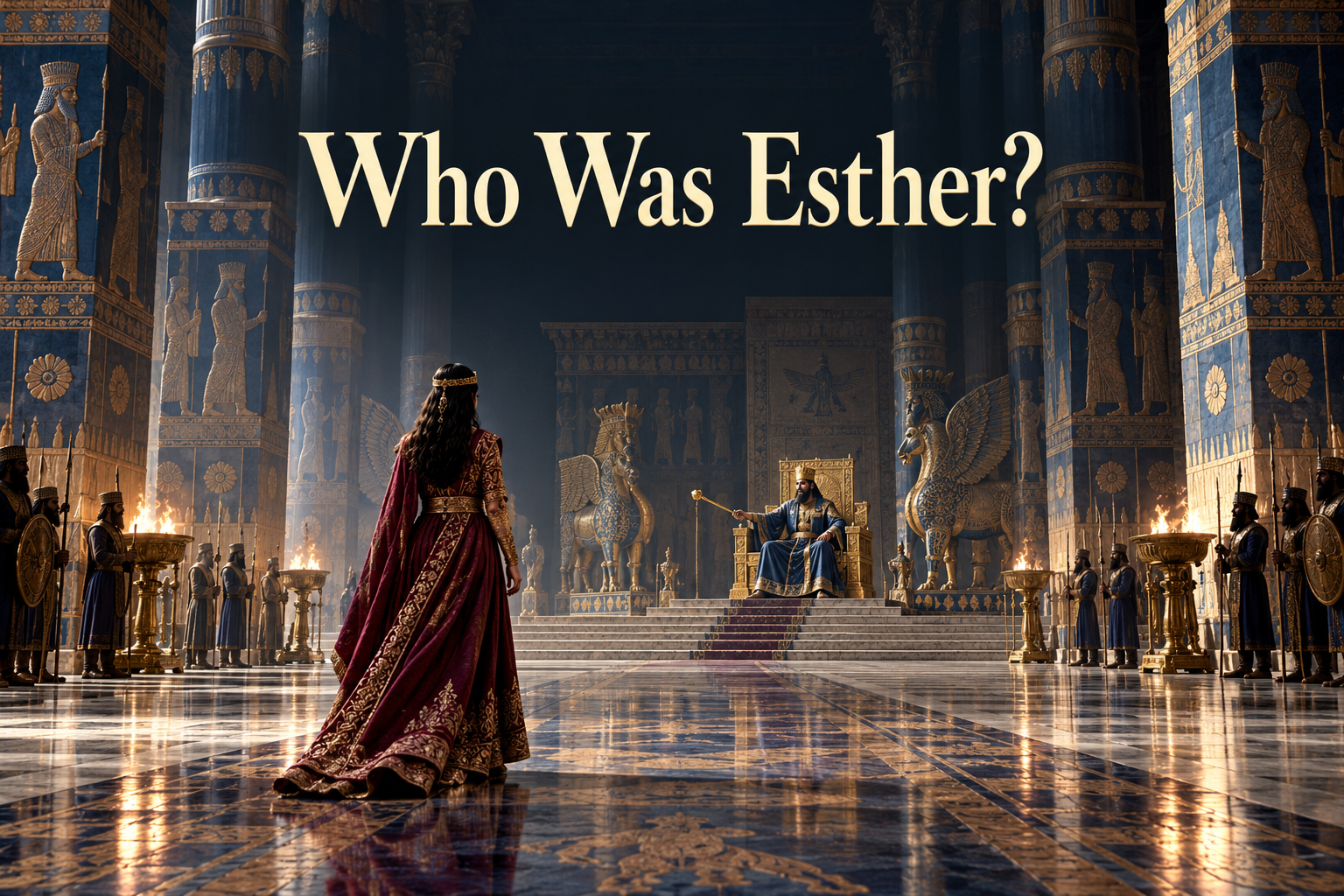
Esther enters the biblical story in a palace where one queen has already been removed for saying no. That detail should keep us from turning her rise into a pleasant royal romance. She was a young Jewish woman living under foreign rule, brought into the king’s household through a process she didn’t design, and chosen to occupy a position that was prestigious but hardly secure. When a plan to destroy her people reached the palace, she had influence, but no guarantee that using it would leave her alive. Esther’s courage grew inside that dangerous combination of privilege and vulnerability.
A Jewish woman in the Persian court
The book introduces her by two names. Hadassah was her Hebrew name, while Esther was the name by which she was known in the Persian setting. She had lost both parents and was raised by her older cousin Mordecai, who took her as his own daughter (Esther 2:5-7). The family belonged to the Jewish population scattered outside Judah after the Babylonian exile. Even after some exiles returned to Jerusalem, many Jewish families continued to live throughout the Persian Empire, learning how to preserve their identity in places where they had little political control.
The king is called Ahasuerus in the Hebrew text. Most historians identify that name with Xerxes I, who ruled the Persian Empire from 486 to 465 BC, although the identification isn’t beyond dispute. The story is set in Susa, one of the empire’s royal centers, and its descriptions reflect familiarity with Persian court life. At the same time, scholars disagree about how closely the book corresponds to recoverable political history. No known Persian record confirms Esther as queen, and several features of the narrative have led many scholars to read it as a historical novella rather than a modern court chronicle. Others maintain that it preserves an essentially historical account whose participants wouldn’t necessarily appear in the limited records that survive. The responsible answer is that the Persian setting is real and recognizable, while independent confirmation of Esther and the specific crisis described in the book hasn’t been found.
Esther became queen after Vashti was deposed and young women were gathered for the king. The text says Esther pleased Hegai, the official in charge of the women, and eventually won the king’s favor. It doesn’t tell us that she volunteered for the arrangement, and it would be a mistake to pour modern ideas about courtship into an ancient royal selection process. On Mordecai’s instructions, she concealed her Jewish identity. Readers have debated whether that concealment showed compromise, prudence, or simply the limited options of a displaced young woman. The narrative doesn’t pause to issue a verdict, but it does make her hidden identity central to the crisis that follows.
Haman’s plot and Esther’s decision
Mordecai later exposed a plot against the king, an act recorded in the royal annals but initially left unrewarded. The larger danger began when Haman was promoted and Mordecai refused to bow before him. The book doesn’t explicitly say why Mordecai refused. It identifies Haman as an Agagite and Mordecai as a Benjaminite descended from Kish, language that may recall the old conflict involving King Saul and Agag in 1 Samuel 15. Whatever Mordecai’s immediate reason, Haman answered one man’s refusal with a plan to annihilate an entire people. He cast lots, or purim, to choose the date and persuaded the king to authorize the destruction of the Jews throughout the empire.
Mordecai urged Esther to approach the king, but appearing uninvited could carry a death sentence. His famous appeal is sometimes paraphrased as though he assured her that God had made her queen for this exact assignment. His actual words are more searching. He warned that silence wouldn’t finally secure her safety, expressed confidence that relief would arise for the Jews from another place, and then asked, “Who knows whether you have come to the kingdom for such a time as this?” (Esther 4:14). He trusted that the Jewish people wouldn’t simply disappear, but he didn’t claim private access to God’s explanation of Esther’s circumstances.
Esther chose to act, though she didn’t rush into the throne room with a speech ready. She asked the Jews in Susa to fast for three days while she and her attendants did the same. Then she approached the king with the sober words, “If I perish, I perish.” Once admitted, she invited the king and Haman to a banquet, then to a second banquet, allowing tension to build while Haman’s confidence outran his judgment. Her strategy required courage, patience, and a careful reading of the people around her. Biblical faithfulness isn’t always loud, and Esther’s restraint was part of her bravery rather than an alternative to it.
The God who isn’t named
The Hebrew form of Esther never names God, and it contains no explicit prayer. That absence is so unusual that readers have wondered whether the book is secular, spiritually subtle, or intentionally written to show providence without announcing it. The Greek versions of Esther include prayers, dreams, and direct references to God that aren’t present in the Hebrew text used in Jewish and Protestant Bibles. Catholic and Orthodox Old Testaments preserve these additions, while Protestant editions generally place them in the Apocrypha when they include them at all. The differences are part of the book’s textual history and shouldn’t be quietly blended together.
In the Hebrew story, providence appears through timing and reversal. The king can’t sleep, so the neglected record of Mordecai’s service is read aloud. Haman arrives intending to have Mordecai executed and is instead ordered to honor him publicly. Esther reveals her Jewish identity at the right moment, and the apparatus designed for Mordecai’s death becomes the means of Haman’s downfall. None of these events is labeled a miracle. Taken together, however, they present a world in which evil is real and human choices matter, yet the future isn’t finally controlled by Haman’s influence or the king’s impulsiveness.
Deliverance, violence, and Purim
Persian decrees couldn’t simply be revoked within the logic of the story, so a second decree authorized the Jews to assemble and defend themselves. Esther 9 reports the deaths of Haman’s sons and many enemies of the Jews, followed by an additional day of fighting in Susa at Esther’s request. These scenes trouble many modern readers, and they shouldn’t be softened into harmless celebration. The text presents the violence as defense against an authorized campaign of extermination and repeatedly notes that the Jews didn’t take the plunder. Even so, interpreters debate the reported numbers, Esther’s request for another day, and the moral questions raised by the scale of the retaliation. Describing the narrative fairly means acknowledging both the genocidal threat and the severity of its reversal.
The deliverance became the basis for Purim, a yearly Jewish festival marked by feasting, gifts, and care for the poor. Its name recalls the lots Haman cast, turning the instrument of his supposed control into the name of a celebration he never intended. Esther and Mordecai helped establish the observance in writing, so Esther’s role extended beyond one decisive audience with the king. She became a public guardian of communal memory, ensuring that later generations would remember how quickly security could vanish and how unexpectedly deliverance could come.
Esther’s enduring witness
Later Jewish and Christian tradition has filled in details the biblical book leaves open. Some retellings make Esther a nearly flawless saint, while others condemn her participation in the royal court or speculate about matters the text never explains. She has also been identified with various figures from Persian history, but none of those proposals commands broad agreement. The biblical portrait is more compelling when its unanswered questions remain unanswered. Esther lived within compromised circumstances, made decisions under pressure, and risked the position that had once seemed to protect her.
Her story doesn’t promise that faithful people will always gain access to the powerful or succeed when they speak. It does show that apparent safety can become a form of captivity when it depends on silence. Esther moved from concealment to identification with her threatened people, and she used the limited power available to her with intelligence and courage. The book never places God’s name on the page, but it refuses to imagine history as though arrogant rulers and carefully stamped decrees have the last word.