
Who Was Titus?
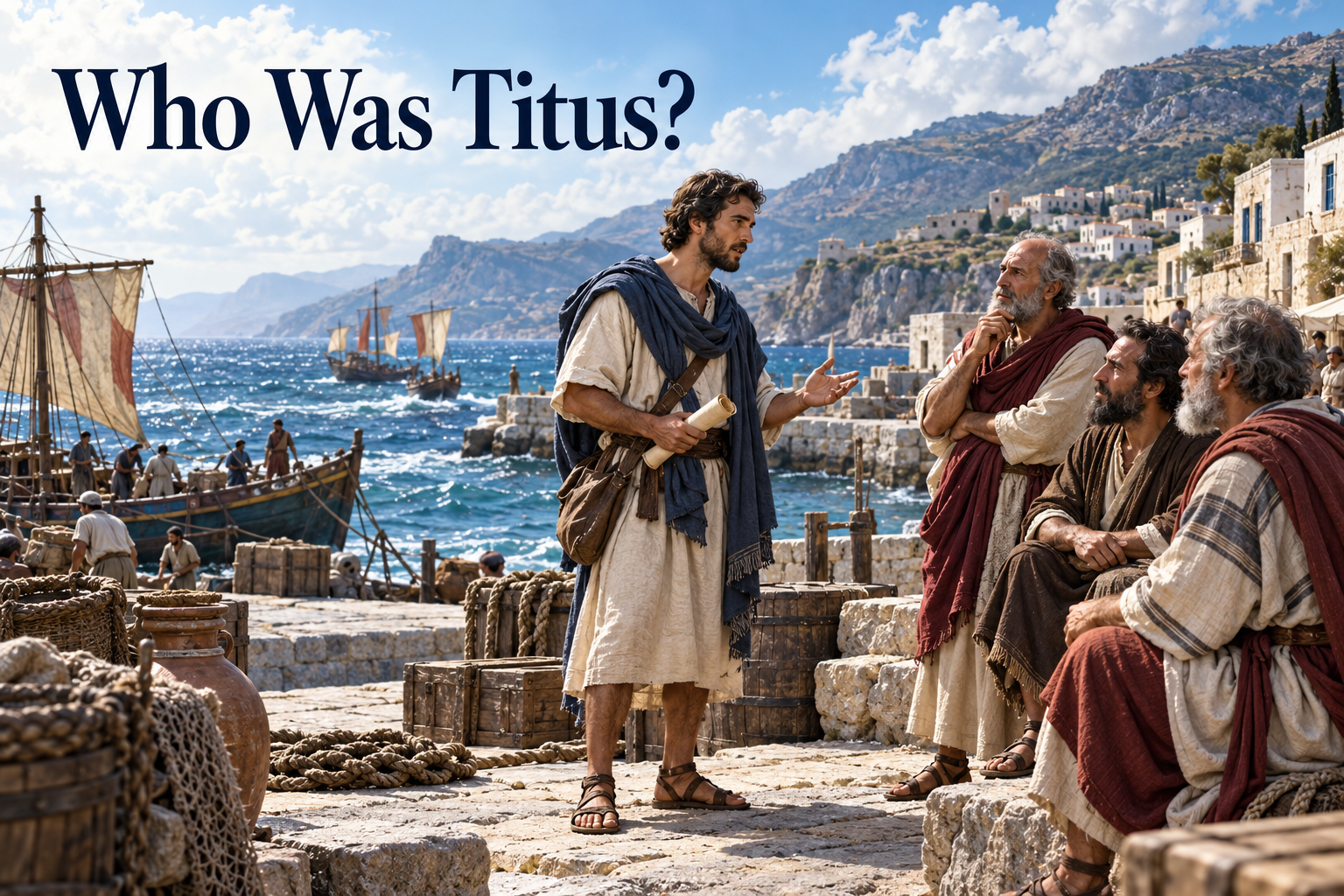
Titus never appears in the Book of Acts, yet he was one of Paul’s most trusted coworkers. We meet him in Paul’s letters at moments when the unity and credibility of the early Christian mission were under pressure. He accompanied Paul into a dispute over whether Gentile believers had to adopt Jewish boundary markers, carried difficult messages to a troubled church, and helped organize relief for Christians in Jerusalem. That isn’t the career of a ceremonial assistant. Titus was the person Paul sent when a church needed both courage and tact.
A Gentile at the Center of an Early Christian Dispute
Paul introduces Titus in Galatians 2, where he calls him a Greek. Titus went with Paul and Barnabas to Jerusalem for a meeting about the gospel Paul preached among the Gentiles. Some believers insisted that Gentile converts should be circumcised and required to live as Jews. Titus, an uncircumcised Gentile who already belonged to Christ, made the argument personal. If he had to be circumcised in order to be fully accepted, then faith in Christ wasn’t enough to bring a Gentile into God’s people.
Paul says Titus wasn’t compelled to be circumcised. The point wasn’t that circumcision was bad; Paul himself could accommodate Jewish practice when it served the mission. The issue was whether circumcision could be imposed as a condition of belonging to Christ. Titus stood as living evidence that God’s grace had reached the nations without first turning Gentiles into Jews. His presence at Jerusalem therefore mattered far beyond his own biography.
Galatians doesn’t tell us when or how Titus became a believer. In Titus 1:4, the writer calls him a “true child” in a shared faith, language that has often been taken to mean Paul led him to Christ. That’s possible, but the phrase can also describe a close relationship of spiritual mentorship. What we can say with confidence is that Titus was a Gentile Christian whom Paul trusted, and that his uncircumcised status became important in the church’s struggle to understand the scope of the gospel.
Paul’s Troubleshooter in Corinth
Second Corinthians gives us the fullest picture of Titus at work. Paul’s relationship with the Corinthian church had become strained. There had been opposition, a painful visit, and a severe letter that Paul sent with considerable anxiety. When Titus finally met Paul in Macedonia with encouraging news from Corinth, Paul described his arrival as God’s comfort to the discouraged. Titus reported that the believers longed to see Paul and had responded seriously to his correction.
This assignment required more than delivering an envelope. Titus had to represent Paul without inflaming an already tense situation, listen to the congregation, and bring back an honest account. Paul says Titus shared his concern for the Corinthians and dealt with them without exploiting them. He wasn’t merely following orders; he had invested himself in their welfare. Paul could be direct, even severe, but Titus seems to have combined firmness with the kind of presence that helped reconciliation become possible.
Paul also involved Titus in the collection for impoverished believers in Jerusalem. The Corinthian church had begun participating, and Titus was to help them complete what they had started. Handling money across a network of churches could easily produce suspicion, so Paul took precautions. Titus traveled with other representatives approved by the churches, and Paul emphasized transparent administration. In that setting, calling Titus his “partner and fellow worker” was both a personal tribute and a public endorsement of his character.
It’s striking that Acts never names Titus, especially since Acts reports many of Paul’s journeys. Several explanations have been proposed, including the possibility that Luke knew him by another name or omitted him for literary reasons. None can be demonstrated from the text. Silence in Acts doesn’t cancel the direct evidence of Paul’s letters, but it does remind us not to invent an itinerary where the sources don’t provide one.
Titus in Crete and the Pastoral Epistles
The Letter to Titus places him in Crete, where he was to address unfinished work and appoint qualified elders in the island’s towns. The task included correcting disruptive teaching, encouraging conduct consistent with sound doctrine, and showing how grace produces a life of self-control, justice, and devotion to God. Paul’s proposed replacement, either Artemas or Tychicus, would allow Titus to meet him at Nicopolis. The letter presents Titus as an authorized missionary delegate rather than the settled head of a single local congregation.
The authorship and date of Titus are disputed. The letter identifies Paul as its author, and the traditional reading places its setting after the close of Acts, perhaps following Paul’s release from his Roman imprisonment. Many modern scholars argue that the Pastoral Epistles—1 Timothy, 2 Timothy, and Titus—were written in Paul’s name by a later follower who applied his teaching to a new stage of church life. They point to differences in vocabulary, style, church organization, and the opponents being addressed. Defenders of direct Pauline authorship answer that a different audience, a secretary, and a later period in Paul’s ministry could account for those features.
The debate shouldn’t be hidden, but neither should Titus the man be dissolved into it. His work in Galatians and 2 Corinthians rests in letters widely accepted as genuinely Pauline. Those sources independently establish him as a Gentile coworker who carried major responsibility. The Letter to Titus either preserves a further assignment from Paul or portrays Titus through a later Pauline tradition. In both readings, the choice of Titus makes sense because his established reputation was that of a reliable leader sent into demanding situations.
Second Timothy 4:10 says Titus had gone to Dalmatia, the region along the eastern Adriatic coast. That notice belongs to another Pastoral Epistle, so its historical use is connected to the same authorship discussion. It may preserve a final glimpse of Titus’s missionary travel, but Scripture tells us nothing more about that assignment. Later church tradition remembered him as the first bishop of Crete and placed his death there at an advanced age. Those traditions may reflect an enduring association with the island, but they aren’t information supplied by the New Testament.
A Ministry of Trust
Titus is sometimes overshadowed by Timothy, partly because Acts narrates Timothy’s travels and the New Testament contains two letters addressed to him. But Paul’s language for Titus is remarkably warm. He calls him a brother, partner, fellow worker, and a source of comfort. Titus repeatedly enters the story when relationships, money, doctrine, and the reputation of the gospel are all at stake. Paul didn’t send him to places where nothing could go wrong.
His story also shows that early Christian leadership wasn’t confined to public preaching. Reconciliation, financial integrity, patient correction, and the formation of local leaders were essential parts of the mission. Titus served the church by making Paul’s teaching credible in practice. He helped Gentile believers understand that grace welcomed them fully, while also insisting that grace trained them to live differently.
We don’t know where Titus was born, how he met Paul, or how his life ended. What we do know is substantial enough. He crossed ethnic boundaries, endured difficult assignments, and earned the confidence of an apostle who didn’t give such confidence cheaply. Titus became important not by drawing attention to himself, but by proving that he could be trusted when the health of a church depended on what happened next.