
Who Was Apollos?
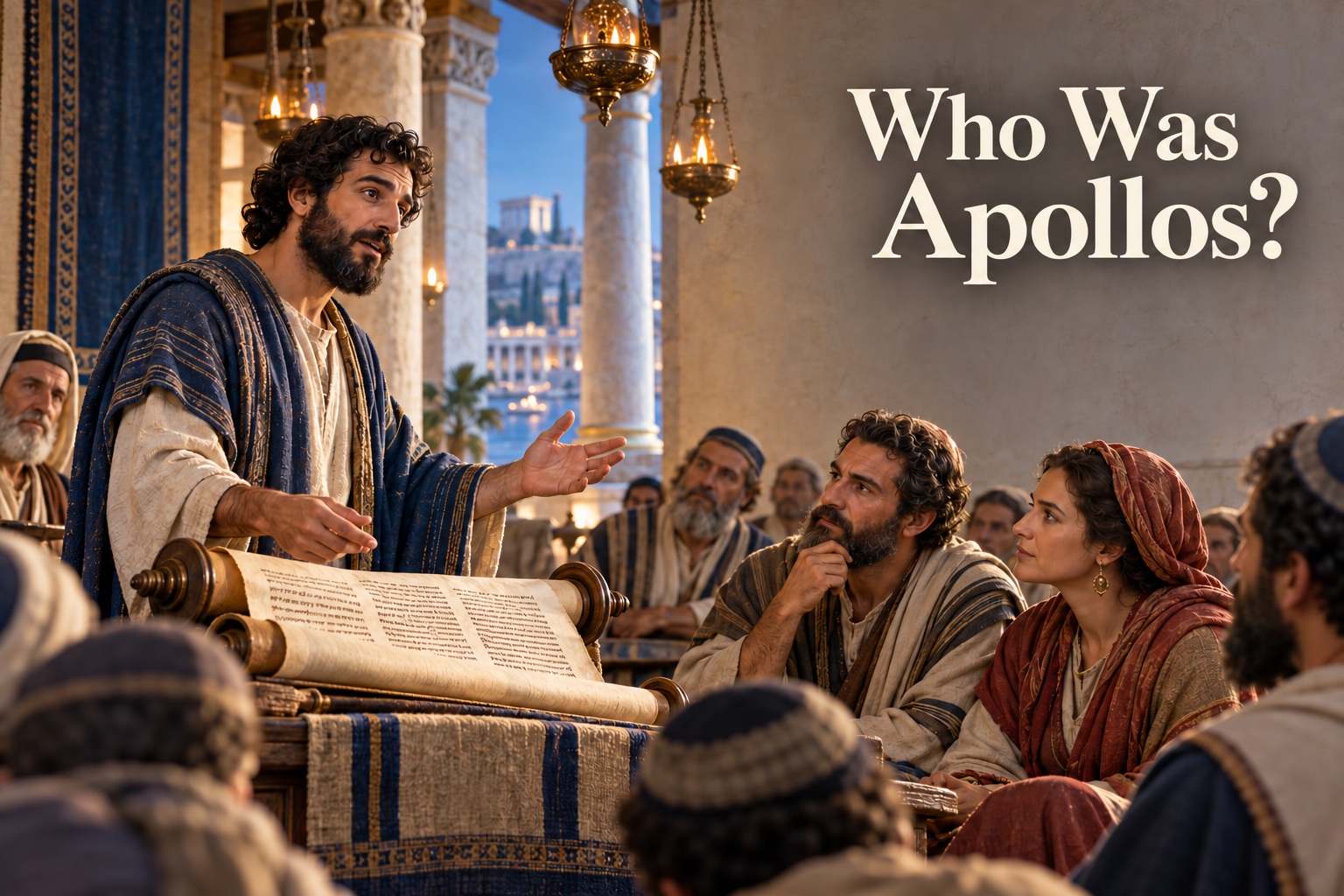
Apollos enters the New Testament story as a gifted preacher with a gap in his understanding. That combination could have ended badly. Instead, he accepted instruction from two fellow believers and became an effective defender of the Christian message. His ministry later attracted such loyalty in Corinth that Paul had to remind the church that Christian workers aren’t rival brands. Apollos was impressive, but the New Testament remembers him best as a servant whose ability belonged to a larger work God was doing.
An Alexandrian Teacher in Ephesus
Acts 18 describes Apollos as a Jewish man from Alexandria. The city was a major center of learning and had a large Jewish population, but Acts doesn’t tell us where Apollos studied or whether he had any connection with famous Alexandrian thinkers such as Philo. It calls him eloquent or learned—the Greek word can carry either sense—and says he was powerful in the Scriptures. He spoke with fervor and taught accurately about Jesus, yet he knew only the baptism of John.
That description raises questions Acts doesn’t completely answer. Apollos apparently knew enough about Jesus to speak accurately, but his knowledge hadn’t caught up with the fuller Christian proclamation represented by Paul’s circle. “The baptism of John” refers to John the Baptist’s call to repentance in preparation for the coming Messiah. Whether Apollos lacked information about Christian baptism, the gift of the Spirit, some part of Jesus’s death and resurrection, or a combination of these isn’t specified. We shouldn’t pretend the text gives us a syllabus of what he knew and what he didn’t.
When Priscilla and Aquila heard Apollos speaking boldly in the synagogue at Ephesus, they took him aside and explained the way of God more accurately. Acts presents this as correction without humiliation. They recognized both the value of his ministry and the need to strengthen it. Priscilla is named first in this scene in the usual Greek text, and both spouses participate in the instruction. Apollos’s willingness to learn is as important as his eloquence: a teacher who can’t be taught is dangerous, no matter how gifted he sounds.
Some readers have tried to determine whether Apollos was already a Christian before this conversation. Acts says he had been instructed in the way of the Lord and taught accurately about Jesus, which strongly associates him with the Christian message. At the same time, his knowledge was incomplete. The narrative’s concern isn’t to make us assign him a precise conversion date. It shows the gospel moving through people whose understanding could be real without yet being complete.
From Ephesus to Corinth
Apollos wanted to travel west to Achaia, the Roman province that included Corinth. The believers in Ephesus wrote to encourage the disciples there to welcome him. Once he arrived, he greatly helped those who had believed through grace and publicly refuted Jewish opponents by showing from the Scriptures that Jesus was the Messiah. The description fits a man trained to reason from Israel’s sacred writings and able to do so in public debate.
His work in Corinth was fruitful, but the Corinthians turned their appreciation for different leaders into factions. Some said, “I follow Paul,” others “I follow Apollos,” and others appealed to Cephas or Christ. Paul didn’t solve the problem by attacking Apollos. He insisted that both men were servants: Paul planted, Apollos watered, and God gave the growth. Their roles differed, but neither minister could create spiritual life or claim the church as his personal following.
Nothing in 1 Corinthians suggests Apollos encouraged a party built around his name. Paul speaks of him as a brother and says he strongly urged Apollos to return to Corinth. Apollos wasn’t willing to go at that time but intended to go when he had an opportunity. That detail is easy to overlook. Paul could urge, but Apollos exercised his own judgment about the timing, and Paul reported the disagreement without portraying him as disloyal.
Scholars have offered different reconstructions of the Corinthian factions. Some imagine that Apollos brought a distinctive Alexandrian theology or a more polished speaking style that appealed to status-conscious Corinthians. His background and rhetorical ability make those ideas possible, but Paul never says Apollos taught a defective gospel. The problem in 1 Corinthians is the congregation’s boastful use of its teachers, not a documented rivalry between the teachers themselves.
Did Apollos Write Hebrews?
Apollos is often proposed as the author of Hebrews. The suggestion has understandable attractions: Hebrews is written in accomplished Greek, draws deeply on Scripture, and appears connected to an educated Jewish Christian teacher. Apollos was Alexandrian, articulate, and scripturally adept, so he fits part of the profile. Martin Luther is usually credited with popularizing the proposal during the Reformation, although discussion of the letter’s unknown author is much older.
Still, Hebrews never names its author, and no biblical passage or early manuscript attributes it to Apollos. Other candidates have included Paul, Barnabas, Luke, Priscilla, and several less familiar figures. Each proposal explains some evidence and encounters difficulties elsewhere. Saying that Apollos could have written Hebrews is reasonable; saying that he did goes beyond what we know. The letter’s authority doesn’t depend on our solving an authorship question the early church itself couldn’t settle with certainty.
The only possible later New Testament reference to Apollos comes in Titus 3:13, which asks that Zenas the lawyer and Apollos be supplied for their journey. The wording suggests continued traveling ministry, but it supplies no location or destination. Since the authorship and date of Titus are disputed, scholars also differ over how directly that notice can be connected to Paul’s lifetime. Later traditions assign Apollos episcopal roles in various cities, but those claims aren’t established by first-century evidence.
Giftedness Without Ownership
Apollos mattered because he combined unusual ability with teachability. Acts doesn’t downplay his strengths: he was learned, fervent, bold, and effective. It also doesn’t hide that his understanding needed correction. Priscilla and Aquila didn’t treat his incomplete knowledge as proof that his whole ministry was worthless, and Apollos didn’t treat their correction as an insult to his calling.
Paul’s response to the factions in Corinth adds another lesson. Christian teachers may plant or water, but they don’t own the field. Their gifts are real, their work can be valuable, and God may use one person to continue what another began. None of that makes them the source of the church’s life. The congregation belongs to God, not to the most compelling speaker in the room.
We don’t know Apollos’s age, family, conversion story, or final ministry. We can’t identify him as the author of Hebrews with confidence, and we shouldn’t build a biography out of later titles. What Scripture does show is a man whose learning served the gospel because he remained willing to learn. That is a quieter achievement than eloquence, but it may be the reason his eloquence remained useful.