
Who Was Stephen?
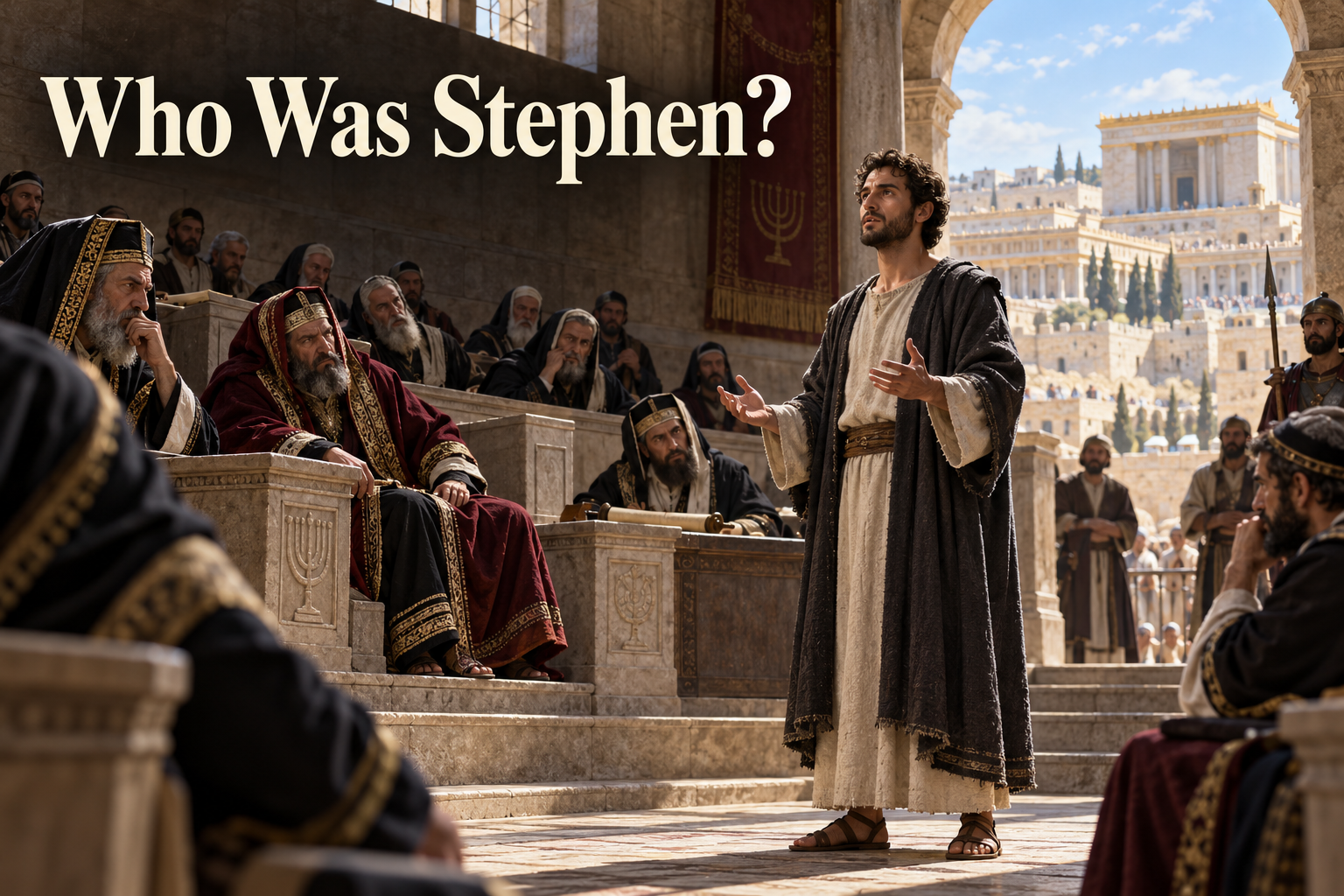
Stephen appears in the New Testament for only a few chapters, yet his death changes the direction of the story. Acts introduces him during a dispute over neglected widows, follows him into public ministry and a hostile hearing, and then records his execution as Saul watches. That brief account has made Stephen famous as the first Christian martyr. It can also make him seem like little more than the victim in a dramatic final scene. Luke presents something richer: a trusted servant, a forceful witness, and a man whose vision of Jesus exposed just how serious the conflict over the early Christian message had become.
Stephen Among the Greek-Speaking Believers
The main account of Stephen appears in Acts 6-8, with a later recollection by Paul in Acts 22:20. His Greek name doesn’t by itself prove where he was born, but the setting strongly suggests that he belonged to the Hellenists, the Greek-speaking Jewish believers in Jerusalem. These weren’t Gentile converts. They were Jews shaped to some degree by the Greek language and the wider Greco-Roman world, often because their families had lived outside Judea. Acts distinguishes them from the Hebrew-speaking believers, and that cultural difference became important when the Hellenists complained that their widows were being overlooked in the church’s daily distribution.
The apostles asked the congregation to choose seven reputable men who were full of the Spirit and wisdom. Stephen heads the list and is specifically described as full of faith and the Holy Spirit. All seven have Greek names, which may indicate that the church wisely entrusted the neglected group to leaders who understood its situation. Acts doesn’t say that the seven held an office called “deacon,” though their work contributed to the later Christian understanding of diaconal service. Calling Stephen one of the first deacons is reasonable shorthand, but it shouldn’t obscure the fact that Acts portrays him preaching and performing signs as well as overseeing practical care.
That combination matters. The early church didn’t treat feeding widows as spiritually second-rate work, and it didn’t treat spiritual power as the private territory of the apostles. Stephen was entrusted with a material problem because character, wisdom, and the Spirit were needed to solve it. He then became one of the first believers outside the Twelve whom Acts explicitly associates with great wonders and signs. Service at a table and public witness belonged to the same life of faithfulness.
Dispute, Arrest, and Accusation
Stephen’s ministry brought him into debate with members of a synagogue associated with freedmen and Jews from several regions of the Roman world. The wording in Acts leaves room for debate over whether Luke means one synagogue or several connected groups. Either way, these were likely Greek-speaking Jews like Stephen, not outsiders who couldn’t understand his background. His opponents couldn’t overcome the wisdom and the Spirit with which he spoke, so the dispute moved from argument to accusation. Witnesses charged him with speaking against Moses, God, the temple, and the law.
Acts calls those witnesses false, but that doesn’t mean they invented every word without context. Stephen was proclaiming Jesus, and the Christian claim that Jesus fulfills Israel’s story necessarily changed how the temple and law were understood. Jesus himself had been accused of threatening the temple. The charge against Stephen seems to take a genuine Christian claim and twist it into contempt for everything Israel held sacred. That pattern is familiar: a distorted accusation usually works best when it borrows enough truth to sound plausible.
The council saw Stephen’s face “like the face of an angel.” Luke doesn’t explain whether this describes a visible radiance, a striking composure, or both. The language recalls Moses, whose face shone after meeting with God, and that irony shouldn’t be missed. Stephen stood accused of opposing Moses while his appearance marked him as a witness to God’s presence.
What Stephen’s Speech Was Arguing
Stephen’s speech in Acts 7 is the longest in the book. At first it can sound like a long review of Old Testament history, but he isn’t stalling or offering the council a lesson it doesn’t need. He is answering the charges by retelling Israel’s story around two recurring realities: God has never been confined to one location, and God’s appointed deliverers have repeatedly been rejected before being recognized. The God of glory appeared to Abraham in Mesopotamia. God was with Joseph in Egypt. God met Moses in Midian and in the wilderness. The temple had a real place in Israel’s life, but even Solomon acknowledged that the Most High doesn’t live in houses made by human hands.
Stephen wasn’t arguing that the Old Testament temple had always been a mistake. He moved from the tabernacle to Solomon’s temple without condemning either one, and then quoted Isaiah’s warning against treating a building as though it could contain its Creator. His target was confidence in sacred institutions without obedience to the God who gave them. The council honored the temple while resisting the Righteous One to whom Israel’s story pointed. Stephen’s argument was severe because he believed their response to Jesus repeated the very pattern they condemned in earlier generations.
Readers sometimes get sidetracked by details in the speech that differ from familiar Old Testament wording, such as the number of Jacob’s family who went to Egypt or Stephen’s compressed account of a burial place. At least some differences reflect the Greek Old Testament, which was the Bible commonly used by Greek-speaking Jews and gives the number as seventy-five rather than seventy. Other details may reflect a compressed retelling or interpretive traditions known to Stephen’s audience. Those questions deserve honest study, but Luke’s purpose isn’t to present Stephen as reciting a modern chronology from memory. The speech is a theological case: Israel’s God acts beyond expected boundaries, and rejecting God’s messenger while defending religious tradition is a tragic possibility.
Stephen’s Vision and Death
When Stephen accused the council of resisting the Holy Spirit, the hearing erupted. He looked into heaven and said that he saw God’s glory and Jesus standing at God’s right hand. His description of Jesus as the Son of Man echoed Daniel 7 and Jesus’ own words before the council. For Stephen, the crucified Jesus wasn’t a defeated blasphemer. He was the vindicated ruler beside God, and Stephen’s heavenly vision functioned as God’s verdict over against the court’s verdict.
Why Jesus was standing rather than sitting has prompted several interpretations. He may be pictured welcoming Stephen, rising as his advocate, or standing as a witness in the heavenly court. The text doesn’t choose among those suggestions, so we shouldn’t pretend that it does. What is clear is that Stephen saw Jesus in the place of divine authority and confessed what he saw even when the confession put him beyond the crowd’s tolerance.
The crowd drove him out of the city and stoned him. Scholars debate whether this was an official execution or a violent lynching that followed a broken hearing. Acts describes a council, witnesses, and the customary location outside the city, but it also depicts a furious rush rather than a measured sentence. Roman restrictions on local capital punishment make a mob action plausible, though our knowledge of how consistently those restrictions were enforced is incomplete. Luke’s theological point doesn’t depend on settling the legal classification: Stephen was killed because he bore witness to Jesus.
Stephen died praying in ways that recall Jesus. He entrusted his spirit to the Lord Jesus and asked that his killers not be charged with their sin. Luke isn’t presenting Stephen as a second savior. He is showing what discipleship can look like when the life of Jesus has taken hold of someone. Stephen’s courage wasn’t mere stubbornness, and his forgiveness wasn’t sentimental denial of evil. He named the truth, endured the cost, and left judgment with the Lord.
Saul, Persecution, and the Expanding Mission
A young man named Saul guarded the witnesses’ garments and approved Stephen’s death. Acts will soon turn Saul from persecutor to apostle, but it doesn’t soften his involvement. Stephen’s story and Paul’s story are joined at an ugly point before grace changes the direction of Saul’s life. Later, Paul would remember that he stood by when Stephen’s blood was shed. The church’s great missionary to the Gentiles entered the story as an accomplice to the death of a Spirit-filled witness.
Stephen’s death also triggered a wider persecution that scattered believers from Jerusalem. That scattering helped carry the message into Judea, Samaria, and eventually farther into the Gentile world. We shouldn’t say that God needed Stephen to be murdered or that the killers unknowingly did God’s will. Acts places moral responsibility squarely on those who resisted and killed him. Yet their violence couldn’t stop the mission. God brought witness out of displacement and growth out of an attempt to silence the church.
Christian tradition calls Stephen the “protomartyr,” meaning the first Christian martyr. Within the story of the church after Pentecost, the title fits. It doesn’t mean that he was the first faithful person ever killed for serving God, nor does it minimize John the Baptist’s death before Jesus’ crucifixion. It recognizes Stephen as the first follower of the risen Christ whose death Acts records as an explicit act of Christian witness.
What We Know and What Tradition Added
Acts tells us nothing about Stephen’s family, age, occupation before his selection, or previous history with Jesus. Later Christian stories filled some of those gaps. A fifth-century account claimed that Stephen’s remains were discovered after a vision, and traditions about the movement of his relics became widespread. Churches have also assigned him feast days and made him a patron of deacons and various ministries. Those traditions show how deeply Christians honored him, but they aren’t independent evidence for his biography.
The Stephen we can know from Scripture doesn’t need embellishment. He noticed the needs of an overlooked community, accepted responsibility, spoke with wisdom, and refused to make an idol of religious familiarity. He also shows why martyrdom isn’t a Christian search for suffering. Stephen didn’t die because he despised life or provoked trouble for its own sake. He died because he remained faithful when the truth about Jesus became costly, and his final words showed that the mercy he preached had reached all the way into his character.