
Who Was Gideon?
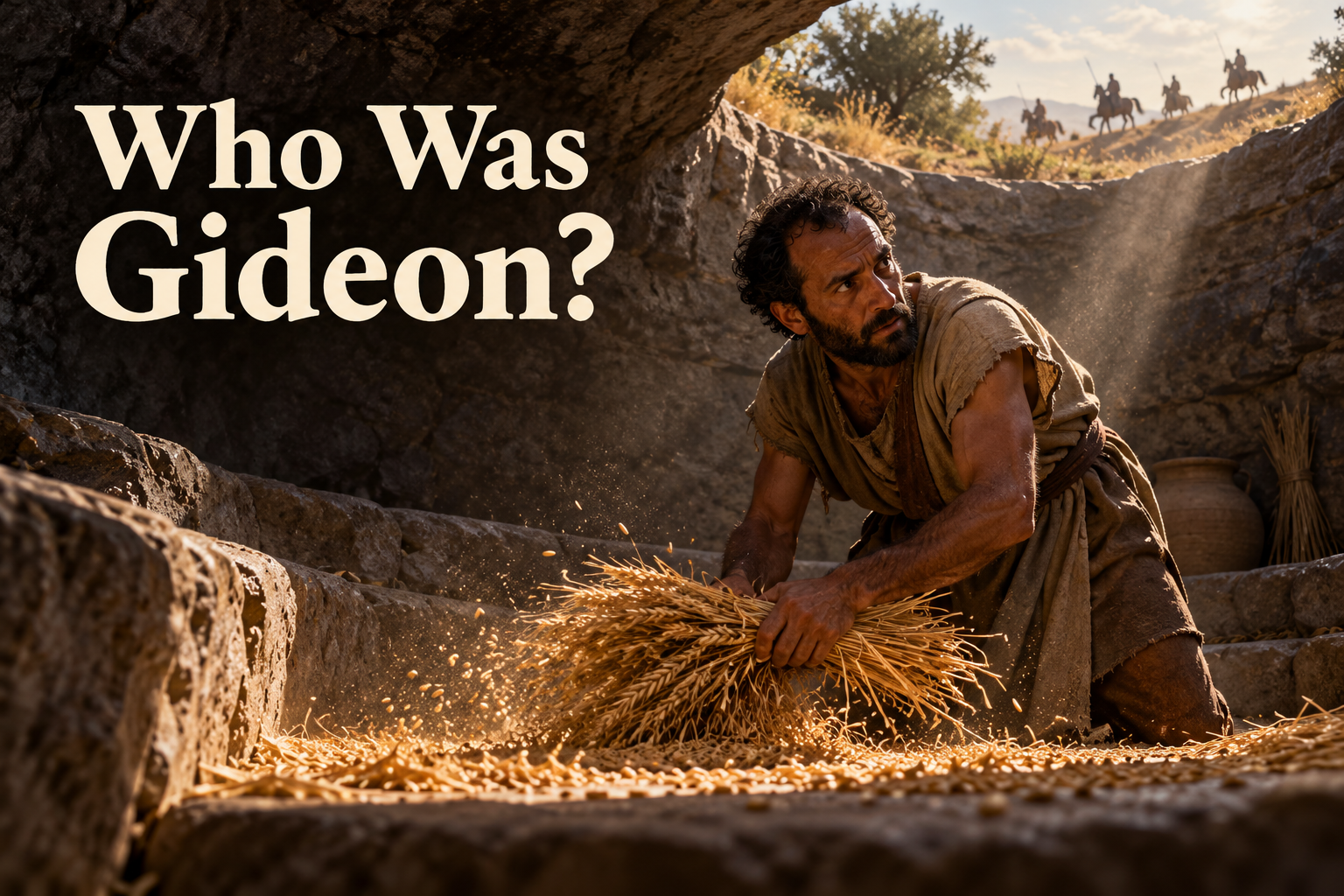
Gideon begins his story hiding grain from Midianites and ends it surrounded by gold, wives, sons, and the trappings of a ruler. Between those scenes, God uses him to break a crushing occupation with an army small enough to make boasting ridiculous. That victory made Gideon one of Israel’s celebrated judges, and Hebrews 11 later names him among people who acted by faith. Judges itself gives a more complicated verdict. The fearful man becomes courageous, but success is followed by ambitions and appetites that complicate his earlier courage.
Israel under Midian
Judges 6 describes Midianite and allied raiders sweeping into Israel at harvest, camping in the land, and destroying crops and livestock. Their use of camels gave these mobile groups speed and reach, while Israelites fled to caves and strongholds. The oppression was economic as well as military: families could do the work of planting and then watch an armed coalition carry away the food. Israel cried to the Lord, but before a deliverer appeared, a prophet reminded the people that their trouble was tied to covenant unfaithfulness and idolatry.
Gideon was threshing wheat in a winepress when the angel of the Lord addressed him as a mighty warrior. A winepress was a poor place for threshing, which normally needed open air for wind to separate grain from chaff, but it offered concealment. Gideon’s answer was blunt: if the Lord was with Israel, where were the wonders their ancestors described? The question wasn’t polished faith, yet God didn’t dismiss it. He commissioned the man asking where divine deliverance had gone to become part of the answer.
A reluctant calling
Gideon protested that his clan was the weakest in Manasseh and he was the least in his father’s household. The Lord’s answer was not that Gideon had underestimated his natural leadership but that God would be with him. Gideon then asked for a sign and brought an offering, which was consumed by fire from a rock. Only afterward did he grasp whom he had encountered and fear that he would die, but the Lord spoke peace to him.
His first assignment was local rather than military. Gideon had to tear down his father’s altar to Baal, cut down the Asherah beside it, and build an altar to the Lord. He obeyed at night because he was afraid of his family and the townsmen. When the town demanded his death, Gideon’s father Joash challenged Baal to defend himself and gave his son the name Jerubbaal, meaning in context that Baal should contend with him. Gideon’s nighttime obedience was still obedience; courage sometimes begins before fear has had the courtesy to leave.
The fleece and the Spirit
When the Midianite coalition gathered in the Jezreel Valley, the Spirit of the Lord clothed Gideon, and he summoned fighters from several tribes. Gideon nevertheless asked for further reassurance through a wool fleece, first requesting dew on the fleece while the ground remained dry and then the reverse. God granted both signs. The episode shows divine patience with a hesitant servant, but it isn’t presented as a general method for discovering God’s will. Gideon already had a command; the fleece confirmed what had been plainly spoken rather than replacing wisdom and obedience with a private test.
God then reduced Gideon’s army from thirty-two thousand to three hundred. Those who were afraid went home, and a second selection occurred at the water. Interpreters have tried to find military superiority in the way the chosen men drank, but Judges states the theological reason: Israel must not claim that its own strength produced the rescue. The odd selection makes the force visibly inadequate, which is the point.
Three hundred against Midian
Before the attack, God again accommodated Gideon’s fear by sending him into the enemy camp. There he overheard a Midianite recount a dream about a barley loaf overturning a tent, and another man interpreted it as Gideon’s victory. Gideon worshiped, returned to his force, and divided the men into three companies. Each carried a trumpet and a jar concealing a torch, equipment better suited to confusion than conventional combat.
At Gideon’s signal, the men broke the jars, raised the torches, blew the trumpets, and shouted. Panic swept the camp, and the Lord caused the Midianites to turn their swords against one another before fleeing. Other Israelites joined the pursuit, and the Ephraimites captured the Midianite commanders Oreb and Zeeb. When Ephraim later complained about not being summoned earlier, Gideon answered diplomatically and defused the quarrel. At this point he looked like a leader who knew both dependence on God and restraint with offended allies.
Victory becomes vengeance
The tone darkens as Gideon pursues the kings Zebah and Zalmunna across the Jordan. The towns of Succoth and Penuel refuse provisions because the kings have not yet been captured and retaliation from Midian remains possible. Gideon promises punishment, then returns after victory to beat the elders of Succoth with desert thorns and tear down Penuel’s tower, killing men of the town. Judges reports these actions without saying God commanded them.
Gideon also reveals that Zebah and Zalmunna killed his brothers at Tabor. He orders his young son Jether to execute them, apparently as a public act of vengeance and initiation, but the boy is afraid. Gideon kills the kings himself after they appeal to his adult strength. The campaign that began as liberation under God’s command has become entangled with personal revenge and brutal punishment of fellow Israelites. Biblical narrative often trusts readers to notice that change without placing a moral caption under every sword.
The man who refused a crown and lived like a king
The Israelites asked Gideon to rule over them and establish a dynasty because he had delivered them from Midian. Gideon refused, saying that neither he nor his son would rule because the Lord would rule Israel. The answer sounds exemplary, and at one level it is. Yet what follows makes the refusal less tidy than a campaign speech about theocracy might suggest.
Gideon requested gold earrings from the plunder and made an ephod, probably some kind of ceremonial priestly object, though its exact form is uncertain. He placed it in Ophrah, and Israel prostituted itself after it; the object became a snare to Gideon and his household. He also had many wives, seventy sons, and a concubine in Shechem whose son he named Abimelech, a name that can mean “my father is king.” Gideon rejected the title while accumulating royal wealth, a large household, and an heir with a royal name. Judges has a dry eye for political irony.
Gideon’s household after Gideon
Gideon lived to old age, and the land had rest for forty years during his lifetime. After his death, Israel returned to the Baals and forgot both the Lord and Gideon’s family. Yet Judges 9 also shows that Gideon’s household carried seeds of its own destruction. Abimelech used money from the temple of Baal-berith to hire reckless men and murdered his seventy brothers on one stone, with only Jotham escaping.
Abimelech’s bloody attempt at kingship isn’t simply an unrelated sequel. It grows from the household Gideon created and the unresolved contradiction between refusing monarchy and behaving like a monarch. Jotham’s parable of the trees warns that a destructive bramble may accept power when worthier trees refuse it. Gideon delivered Israel from an external oppressor, but he didn’t build a faithful succession, and his legacy became a warning about what victory can do to a leader.
History and interpretation
Midianites are known elsewhere in biblical and ancient Near Eastern contexts as groups associated with regions south and east of Canaan, but no inscription independently identifies Gideon or his battle. The Jezreel Valley is a real strategic corridor, and mobile raiding fits the social world portrayed in Judges. Those points provide historical setting, not proof of three hundred named fighters or a particular night attack. Scholars differ over how much early memory Judges preserves and how its stories were shaped to explain Israel’s repeated cycle of idolatry, oppression, crying out, and deliverance.
Later readers have often remembered Gideon mainly for the fleece or the tiny army. Hebrews 11 includes him in its rapid list of faithful figures who, through faith, became strong in weakness and routed armies. That recognition doesn’t erase the ephod, the reprisals, or Abimelech. The Bible can commend genuine faith in a person whose later conduct should still trouble us.
Gideon’s finest moment came when he knew three hundred men could not save Israel unless God acted. His worst decisions came after he had enough success to imagine that power, plunder, and personal vengeance belonged to him. He was a real deliverer and a compromised leader, not one or the other. Judges preserves both truths because the danger in Gideon’s story isn’t merely fear; it is forgetting, after the battle is won, who the deliverer really was.