
Who Was Zerubbabel?
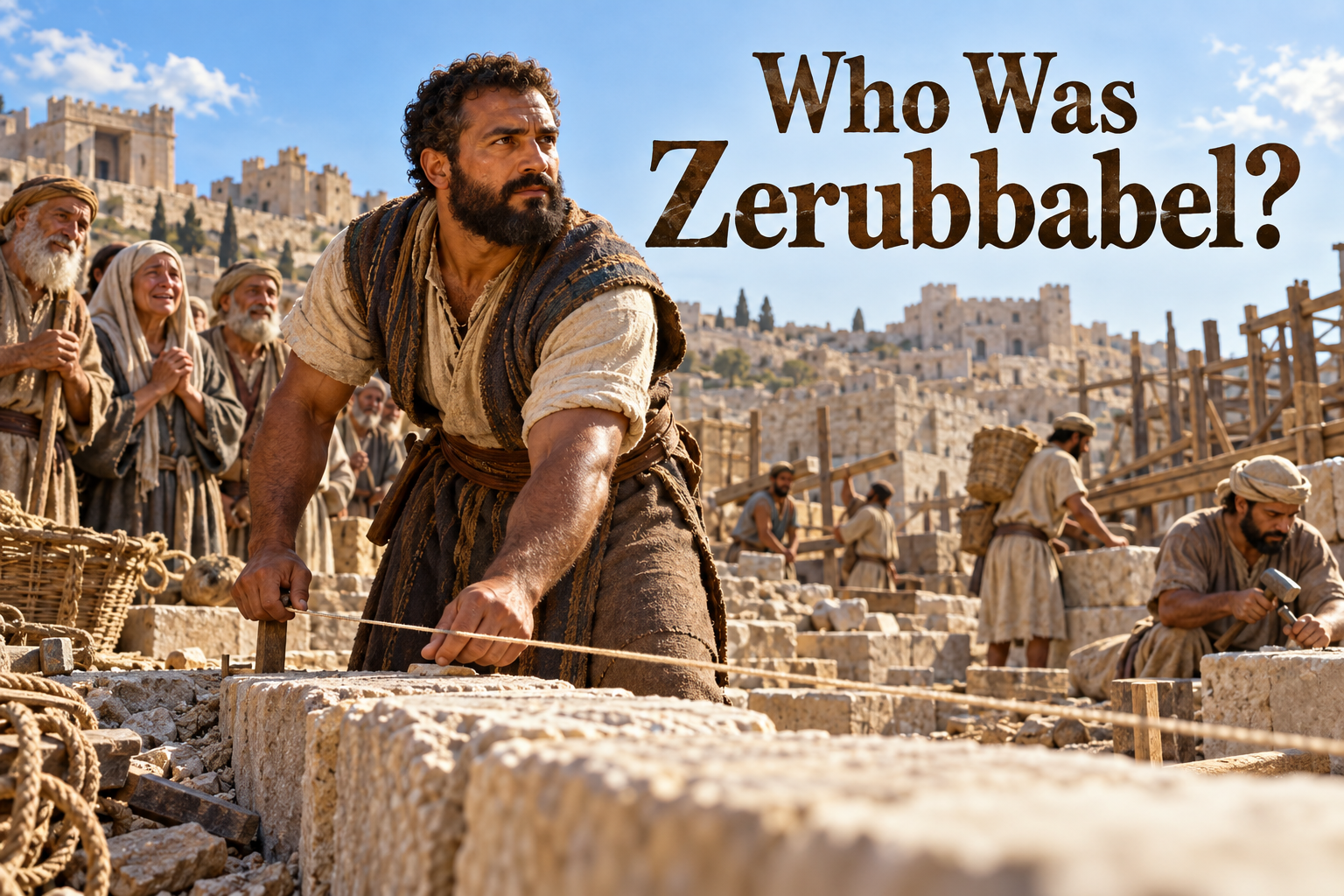
Zerubbabel carried a royal ancestry but held a governor’s title. He descended from the exiled house of David, led the Judean community during the rebuilding of the temple, and received promises through prophecy that carried political and messianic possibility. Yet he never became king, and Scripture does not tell us how his public career ended. Zerubbabel matters because he stood where Israel’s old monarchy, Persian rule, priestly leadership, and hope for restoration met without resolving neatly.
A Davidic heir born in exile
Zerubbabel’s name probably means “offspring of Babylon” or “born in Babylon,” fitting a man whose family belonged to the exiled Judean royal line. Haggai 1:1 and Ezra 3:2 call him the son of Shealtiel. Shealtiel was a son or descendant of King Jehoiachin, who had been taken to Babylon, so Zerubbabel represented continuity with David’s dynasty even though the throne in Jerusalem no longer existed.
First Chronicles 3:19 appears to call Zerubbabel the son of Pedaiah rather than Shealtiel. Proposed explanations include adoption, a levirate arrangement in which one brother fathered an heir for another, scribal or genealogical variation, and the possibility that “son” expresses a legal rather than biological relationship. None can be proved from the surviving text. The honest conclusion is that the sources agree on Zerubbabel’s Davidic family but preserve a difficult difference about his immediate father.
Matthew 1:12-13 and Luke 3:27 later include a Zerubbabel and Shealtiel in genealogies of Jesus, although the two Gospel lines differ around them and from parts of the Old Testament genealogy. Christian readers have therefore seen Zerubbabel as part of the messianic line. Genealogies can trace legal, dynastic, and family descent in ways that do not operate like a modern birth certificate, but that observation should not be used as a magic phrase that solves every difference.
Sheshbazzar and Zerubbabel
Ezra 1 says Cyrus entrusted the returned temple vessels to Sheshbazzar, the “prince of Judah.” Ezra 5:14-16 calls Sheshbazzar governor and credits him with laying the temple foundation. Yet Ezra 3 places Zerubbabel and Joshua at the head of the community when the altar and foundation were established. The relationship between these two leaders is one of the restoration period’s unresolved questions.
Some interpreters identify Sheshbazzar and Zerubbabel as the same man using a Babylonian or official name and a Jewish name. Others regard Sheshbazzar as an earlier governor whom Zerubbabel succeeded, perhaps with Ezra telescoping different stages of the work. Attempts to identify Sheshbazzar with another member of Jehoiachin’s family are also disputed. Scripture never explicitly says they are the same person, so that harmonization remains a possibility rather than an established fact.
Governor alongside Joshua
Haggai identifies Zerubbabel as governor of Judah under Darius I, not as king. Persian governors administered provinces under imperial authority, and Judah, often called Yehud in Persian-period sources, was a small community within the vast Achaemenid system. Zerubbabel’s Davidic blood gave him symbolic importance, but his office depended on Persia. That combination made him both useful to the empire and potentially charged with hope for Judeans.
Zerubbabel led with Joshua son of Jehozadak, the high priest. Ezra 3:1-6 says they rebuilt the altar and resumed sacrifices before the temple itself was restored. This partnership between governor and priest appears repeatedly in Ezra, Haggai, and Zechariah. The community did not simply revive the old monarchy; civil and priestly leadership shared the work under foreign rule.
When the foundation was laid, priests sounded trumpets, Levites played cymbals, and the people praised God. Older people who remembered the first temple wept while others shouted for joy, and Ezra 3:13 says the sounds could not be distinguished at a distance. Restoration produced gratitude and grief at the same time. A new beginning did not require pretending the destruction and exile had cost nothing.
Opposition and delay
Ezra describes local people offering to participate in the building because they too worshiped Israel’s God. Zerubbabel, Joshua, and the family heads refused, insisting that the returned community alone had Cyrus’s authorization. The rejected groups then discouraged the builders and worked through Persian channels against the project. Later Jewish-Samaritan conflict has often been read back into this scene, but the identities and motives of the parties are more complicated than a mature denominational split.
The temple work stalled. Ezra arranges opposition notices across several reigns, and sorting the chronology of chapter 4 requires care because some correspondence concerns later conflict over Jerusalem’s walls rather than the temple under Zerubbabel. Haggai gives the community’s own neglect a prominent role. People lived in paneled houses while the Lord’s house remained in ruins, so external hostility was not the only reason for delay.
Haggai’s challenge
In the second year of Darius I, 520 BC, Haggai addressed Zerubbabel, Joshua, and the people. He interpreted failed harvests and economic frustration as a summons to rebuild. Zerubbabel and Joshua obeyed, the people feared the Lord, and work resumed. Haggai 1:14 says the Lord stirred their spirits, echoing the way Ezra describes God stirring Cyrus for the original decree.
Some who remembered Solomon’s temple considered the new structure unimpressive. Haggai answered that God’s presence mattered more than visible comparison and promised that the latter glory of the house would be great. The promise should not be reduced to architectural optimism. The restored temple became the center of Judean worship for centuries and the structure later expanded by Herod was the temple known in the New Testament.
Zechariah’s word to Zerubbabel
Zechariah 4 presents a lampstand and two olive trees, imagery connected with God’s provision for the restored community. The word to Zerubbabel declares, “Not by might nor by power, but by my Spirit,” and promises that the mountain before him will become level. The hands that laid the foundation will complete the work. Leadership is affirmed, but the power accomplishing the task belongs to God.
The “two anointed ones” beside the Lord are often understood as Zerubbabel and Joshua, representing civil and priestly leadership. Other interpretations identify prophetic or heavenly figures. Zechariah does not name them within the vision, so the common identification is plausible rather than certain. The imagery does show that restored worship requires divine supply rather than the grandeur of an independent kingdom.
The signet ring promise
Haggai’s final oracle addresses Zerubbabel amid language about shaking heavens, earth, kingdoms, chariots, and armies. God promises to make him like a signet ring because he has been chosen. The image reverses Jeremiah 22:24, where King Jehoiachin was compared to a signet that God would pull off. To a Davidic descendant living as a Persian governor, the restored signet language carried unmistakable dynastic weight.
Interpreters disagree about how directly the promise anticipated Zerubbabel’s kingship. Some see immediate hope for restoration of the Davidic monarchy; others understand God’s authentication of Zerubbabel without a change of office. Haggai does not call him king, and no evidence shows that he revolted against Persia or took a throne. Christian interpretation sees the Davidic promise continuing toward Christ, but that later fulfillment should not be confused with a claim that Zerubbabel secretly reigned.
Completing the temple
Persian officials led by Tattenai investigated the renewed construction and wrote to Darius. A search found Cyrus’s earlier authorization, and Darius ordered the officials not only to leave the builders alone but to support the work from royal revenues. Ezra 6:14-15 says the elders prospered through the preaching of Haggai and Zechariah and completed the temple in the sixth year of Darius, usually dated to 515 BC.
Ezra does not single out Zerubbabel in the final dedication scene, and the prophets stop mentioning him before the completion notice. We do not know whether he died, retired, was recalled, or simply disappeared because the sources moved on. Later theories that Persia removed or executed him because of royalist hopes are possible reconstructions without direct evidence.
History and legacy
No contemporary Persian inscription securely names Zerubbabel. The historical framework of Darius’s reign, Persian provincial administration, Aramaic correspondence, and the completed Second Temple is well established, but the biblical books remain the evidence for his personal career. Haggai’s dated oracles bring us unusually close to the concerns of the community in 520 BC, while Ezra’s final form connects those events with a larger story of return.
Later Jewish and Christian tradition remembered Zerubbabel as a royal heir and restoration leader. Some later writings expanded his role or associated him with eschatological hopes, while Christian genealogy placed him on the road to Jesus. The canonical portrait is more restrained. Zerubbabel rebuilds an altar and temple, receives a signet promise, and then leaves the stage without a crown.
That unfinished quality is part of his importance. Zerubbabel did not restore the empire of David, end foreign rule, or complete every prophetic hope attached to restoration. He did help a battered community worship again. His life stands between promise and fulfillment, showing that faithful rebuilding can matter even when the leader does not live to see every hope take its final form.