
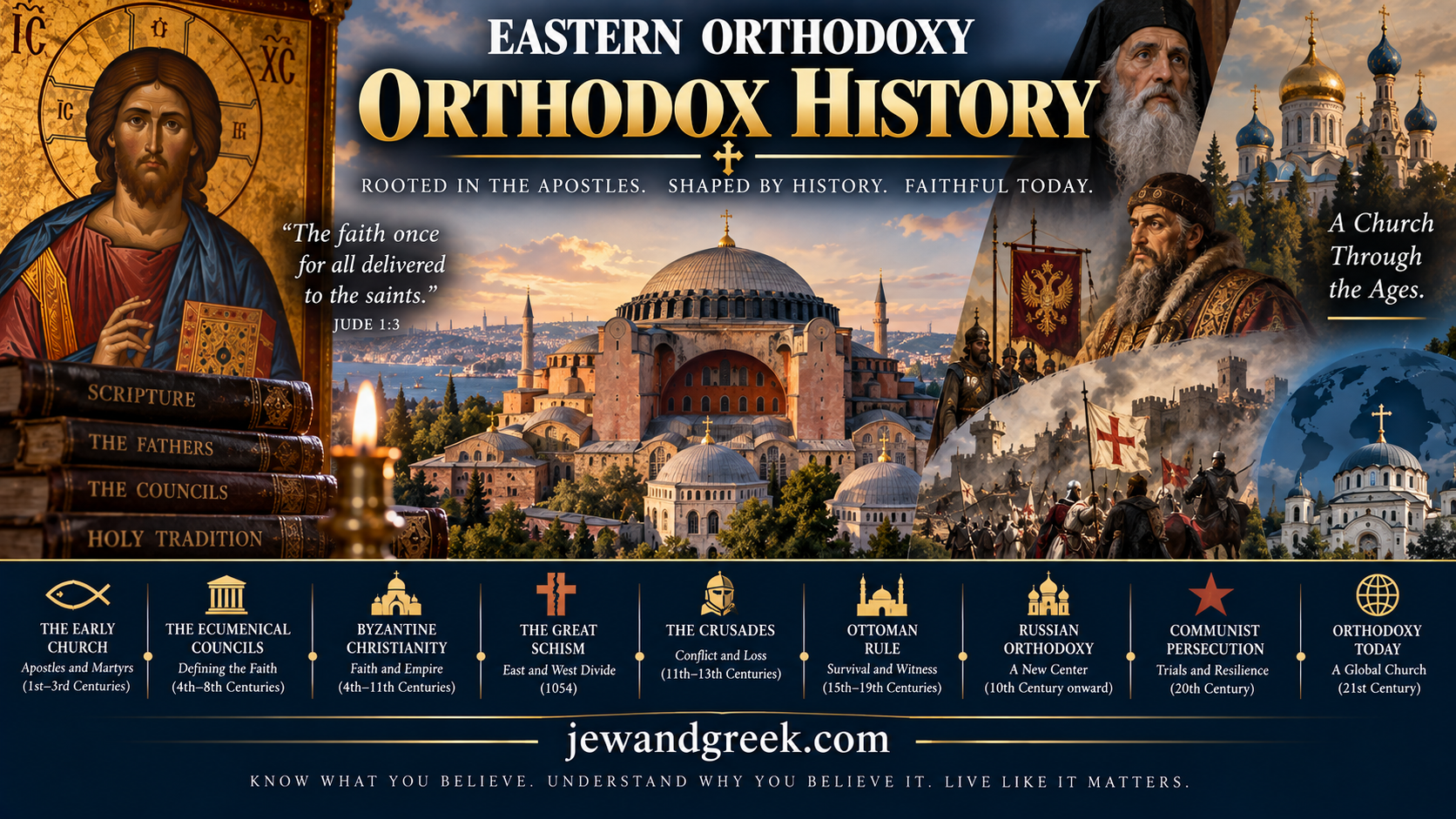
Eastern Orthodoxy understands itself not as a later branch that separated from an originally Roman Catholic church, but as a continuation of the ancient Christian church of the apostles and the early centuries. Roman Catholics make a similar claim about their own continuity, of course, which tells us immediately that the history is more complicated than simply deciding which church came first.
For roughly the first thousand years of Christianity, the histories of what we now call Roman Catholicism and Eastern Orthodoxy were largely a shared history. The eventual separation between East and West developed gradually through differences in language, culture, politics, theology, and church authority.
The Early Church
Christianity began in the eastern Mediterranean world. Jerusalem, Antioch, Alexandria, Ephesus, and other eastern cities became important centers of the early church long before Christianity acquired the institutional forms familiar today.
Greek was the principal language of much early Christian theology and the language in which the New Testament itself was written. Many of the theologians who shaped Christian doctrine—including Athanasius, Basil the Great, Gregory of Nazianzus, Gregory of Nyssa, and John Chrysostom—came from the Greek-speaking East.
Orthodox Christians therefore see their tradition as deeply connected with the theology, worship, and spiritual practices of the early church.
The Ecumenical Councils
The great theological controversies of the early centuries produced a series of councils that became foundational for Eastern Orthodox Christianity.
Nicaea in 325 addressed the relationship between the Father and the Son and rejected Arianism. Constantinople in 381 further clarified Trinitarian teaching. Ephesus in 431 and Chalcedon in 451 addressed controversies concerning the person and natures of Christ.
Later councils dealt with additional Christological disputes, and the Second Council of Nicaea in 787 defended the veneration of icons.
Eastern Orthodoxy recognizes these first seven councils as ecumenical councils and regards their doctrinal decisions as authoritative expressions of the apostolic faith.
Constantinople and the Byzantine Empire
The history of Eastern Orthodoxy became closely connected with the Byzantine Empire. When Constantine established Constantinople as an imperial capital in the fourth century, the city’s bishop gradually became one of Christianity’s most influential church leaders.
Constantinople eventually joined Rome, Alexandria, Antioch, and Jerusalem among the great patriarchal centers of Christianity. This arrangement became known as the Pentarchy, referring to the five major episcopal sees.
Church and empire developed a close and sometimes complicated relationship. Emperors called councils, intervened in theological disputes, built churches, and influenced ecclesiastical affairs. Bishops sometimes cooperated with imperial authority and sometimes resisted it.
The relationship between church and state was never quite as simple as either complete separation or complete control. Byzantine history provides plenty of examples of both cooperation and conflict.
Growing Differences Between East and West
Eastern and Western Christianity gradually developed in somewhat different cultural worlds. Greek predominated in the East, while Latin became dominant in the West. Political structures also diverged after the collapse of imperial authority in Western Europe.
Theological vocabulary developed differently as well. Eastern theology was particularly shaped by the Greek Fathers, while Western Christianity increasingly drew upon figures such as Augustine and later Latin theologians.
Differences also appeared in liturgy, clerical practices, fasting, and church discipline. Many of these differences did not initially prevent communion between East and West, but over centuries they contributed to increasing distance.
The Filioque
One of the most famous disputes involved a small addition to the Nicene-Constantinopolitan Creed.
The original creed said that the Holy Spirit proceeds from the Father. Western Christians eventually added the Latin word Filioque, meaning “and the Son,” so that the Spirit was said to proceed from the Father and the Son.
Eastern Christians objected on two grounds. They disagreed with the theological implications of the addition, and they argued that no portion of the church had authority to alter an ecumenical creed unilaterally.
Two words had managed to carry questions about the Trinity, church authority, and the relationship between East and West all at once. They have been keeping theologians occupied ever since.
The Great Schism
The traditional date for the separation between Eastern Orthodoxy and Roman Catholicism is 1054.
In that year, representatives of Pope Leo IX and Patriarch Michael Cerularius of Constantinople exchanged excommunications during a period of considerable tension. The event later became symbolic of the division between the churches.
But there was no morning in 1054 when Christians throughout Europe and the Middle East suddenly discovered that Christianity had split in two. The separation developed over centuries, and relationships varied considerably from place to place.
Disagreements over papal authority, the Filioque, theology, worship, and jurisdiction all contributed to the growing division.
The Fourth Crusade
Whatever ambiguity remained between Eastern and Western Christianity suffered a devastating blow during the Fourth Crusade.
In 1204, Western crusaders captured and sacked Constantinople, a Christian city. Churches were looted, sacred objects were taken, and considerable violence accompanied the conquest. A Latin administration was then established in the city.
The event left a deep wound in Orthodox memory. The crusaders had originally set out under the banner of recovering the Holy Land. Somehow they ended up sacking one of Christendom’s greatest cities.
Attempts at reunion between the churches continued afterward, but 1204 made reconciliation considerably more difficult.
The Fall of Constantinople
In 1453, Constantinople fell to the Ottoman Turks, bringing the Byzantine Empire to an end.
Orthodox Christians now lived under Muslim political rule throughout much of the former Byzantine world. The Ecumenical Patriarch of Constantinople continued to exercise religious leadership, but under dramatically different political circumstances.
Monasteries, local churches, and liturgical traditions helped preserve Orthodox identity through centuries of Ottoman rule.
Meanwhile, other centers of Orthodoxy grew in importance—especially Russia.
The Rise of Russian Orthodoxy
Christianity had reached the eastern Slavic world centuries earlier, with the traditional conversion of Kievan Rus’ associated with Prince Vladimir in 988.
As Byzantine political power declined, the Russian church became increasingly important. Moscow eventually developed into a major center of Orthodox Christianity, and the Russian church received patriarchal status in the late sixteenth century.
Some Russians came to describe Moscow as the “Third Rome”—the heir to Christian Rome and Constantinople after the fall of the Byzantine capital.
The Russian Orthodox Church eventually became the largest national church within Eastern Orthodoxy.
Orthodoxy Under Communism
The twentieth century brought severe persecution to Orthodox Christians in several communist countries.
Following the Russian Revolution of 1917, the Soviet government confiscated church property, closed or destroyed churches and monasteries, imprisoned or executed clergy, and attempted to suppress religious belief. Orthodox Christians elsewhere in Eastern Europe later experienced varying degrees of restriction under communist governments.
Church-state relationships during this period were complicated. Some church leaders resisted government pressure, some accommodated authorities in order to preserve church life, and others were accused of excessive cooperation.
The collapse of communist governments near the end of the twentieth century allowed Orthodox churches to reemerge publicly in many of these countries.
Eastern Orthodoxy Today
Eastern Orthodoxy today consists of a family of self-governing churches spread throughout Eastern Europe, the Middle East, Africa, Asia, the Americas, and elsewhere.
Historic centers such as Constantinople, Alexandria, Antioch, and Jerusalem remain important, while churches such as those of Russia, Greece, Romania, Serbia, Bulgaria, Georgia, and others maintain their own hierarchies and traditions.
Modern Orthodoxy also faces internal disagreements over jurisdiction, national identity, and relations among its various churches. Ancient church structures have not made modern politics disappear.
Yet despite political upheaval, the fall of empires, Islamic rule, communist persecution, migration, and division with Western Christianity, Eastern Orthodoxy has preserved a remarkably continuous liturgical and theological tradition.
An Ancient Church in the Modern World
The history of Eastern Orthodoxy cannot be reduced to the Great Schism. Its roots extend into the earliest centuries of Christianity, through the Church Fathers, ecumenical councils, Byzantine Christianity, monastic movements, missionary expansion, and centuries of worship.
That history also helps explain why Orthodox Christians place such importance on continuity. Ancient liturgies, icons, bishops, councils, fasting practices, and the writings of the Fathers are not regarded simply as interesting artifacts from Christianity’s past. They remain part of the church’s present life.
Eastern Orthodoxy has changed as it has moved through different cultures and political circumstances, but it generally understands its task not as reinventing Christianity for each generation, but as receiving, living, and handing on the faith it believes was entrusted to the church from the beginning.