
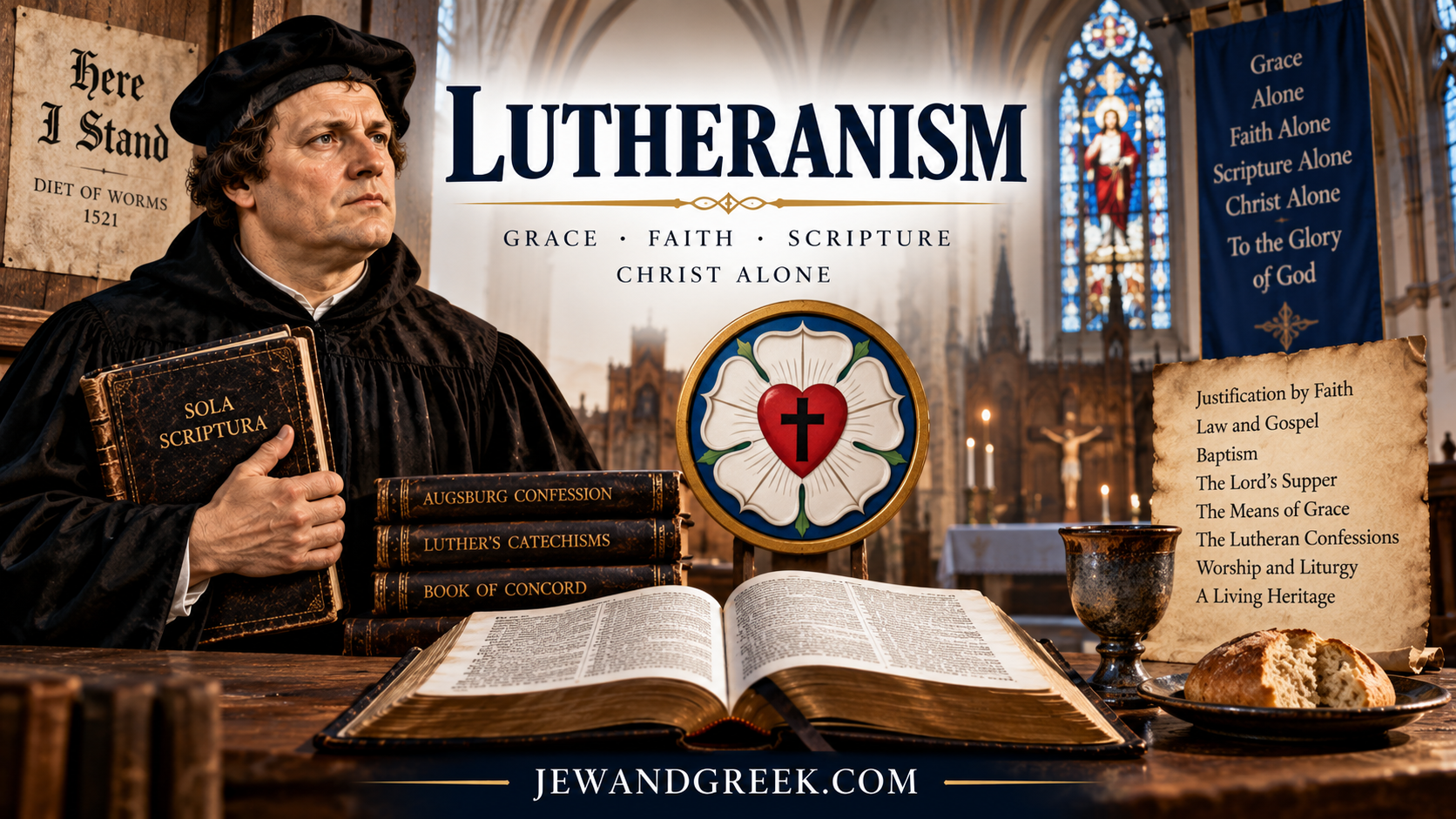
Lutheranism is one of the oldest major traditions of Protestant Christianity, emerging directly from the sixteenth-century Reformation associated with Martin Luther. It developed first in the German-speaking territories of the Holy Roman Empire and subsequently became especially influential in Scandinavia, northern Europe, and eventually throughout the world.
Lutherans share many convictions with other Protestants, particularly the authority of Scripture and salvation by grace through faith. At the same time, Lutheran theology has distinctive teachings concerning justification, baptism, the Lord’s Supper, law and gospel, and the means through which God communicates grace.
Martin Luther and the Reformation
Martin Luther was born in Eisleben, Germany, in 1483. After studying at the University of Erfurt, he entered an Augustinian monastery and was eventually ordained as a priest.
Luther struggled intensely with questions of sin, righteousness, and his standing before God. His study of Scripture, particularly Paul’s writings, gradually led him toward an understanding of justification centered on God’s grace received through faith.
The immediate controversy that brought Luther widespread attention concerned indulgences.
In 1517, Luther circulated his Ninety-Five Theses, challenging abuses associated with indulgence preaching and raising broader questions about repentance, forgiveness, and ecclesiastical authority.
What began as an academic dispute soon became a confrontation with church authorities.
Luther increasingly argued that Scripture possessed supreme authority over popes and councils and that justification before God was received through faith rather than earned through human works.
In 1521, at the Diet of Worms, Luther was ordered to recant teachings that had been condemned. He refused to withdraw them unless persuaded that they were contrary to Scripture or sound reason.
The controversy ultimately resulted in Luther’s separation from the Roman Catholic Church and the development of churches shaped by his theology.
Scripture and Authority
Lutheranism affirms the Bible as the authoritative written Word of God and the final standard for Christian doctrine.
This conviction became associated with the Reformation principle sola Scriptura—Scripture alone.
Luther did not believe Christians should disregard the historic church, creeds, or earlier theologians. He frequently appealed to the early church and accepted the major ecumenical creeds.
Nevertheless, all traditions and ecclesiastical authorities remained subordinate to Scripture.
Historic Lutheran churches therefore maintain a strongly confessional identity while insisting that their confessions derive their authority from their agreement with Scripture.
Justification by Faith
Few doctrines are more closely associated with Lutheranism than justification by faith.
Luther taught that fallen human beings cannot establish righteousness before God through their own moral or religious accomplishments.
Instead, God justifies sinners by grace through faith in Jesus Christ.
Christ’s righteousness, rather than human merit, provides the basis for acceptance before God.
This teaching is commonly summarized by the Reformation expressions sola gratia—grace alone—and sola fide—faith alone.
Good works remain important in Lutheran theology, but they are understood as the fruit of faith rather than the cause of justification.
The believer performs good works because he or she has been reconciled to God, not in order to earn that reconciliation.
Law and Gospel
A particularly important feature of Lutheran theology is the distinction between Law and Gospel.
The Law reveals God’s commands and exposes human sin. It demonstrates humanity’s inability to achieve righteousness through obedience.
The Gospel announces what God has accomplished for sinners through Jesus Christ.
The distinction does not mean that the Old Testament is simply Law and the New Testament simply Gospel. Both themes can be found throughout Scripture.
Rather, Law and Gospel describe two different ways God’s Word addresses humanity: the Law commands and exposes sin, while the Gospel promises forgiveness and salvation through Christ.
Properly distinguishing the two became a foundational principle of Lutheran preaching and biblical interpretation.
The Theology of the Cross
Luther also developed what became known as the theology of the cross.
Human beings naturally look for God in power, success, wisdom, and visible glory. Luther argued that God has revealed himself most decisively in the apparent weakness and suffering of the crucified Christ.
The cross therefore challenges human expectations about divine power and human achievement.
For Luther, Christian theology must begin not with speculation about God’s hidden purposes but with God’s self-revelation in Jesus Christ, particularly Christ crucified.
Baptism
Lutherans recognize Baptism and the Lord’s Supper as sacraments instituted by Christ.
Unlike many later Protestant traditions, Lutheranism does not understand baptism merely as a public symbol of an individual’s faith.
Lutherans traditionally teach that God genuinely acts through baptism, offering grace and forgiveness and joining the baptized person to Christ.
For this reason, Lutheran churches traditionally baptize infants as well as adult converts.
Infant baptism reflects the Lutheran conviction that salvation depends upon God’s gracious action rather than the intellectual or moral achievement of the recipient.
Lutherans nevertheless emphasize the continuing life of faith that should follow baptism.
The Lord’s Supper
Luther’s understanding of the Lord’s Supper became one of the major points of disagreement within the early Reformation.
Luther rejected the Roman Catholic explanation of transubstantiation, but he strongly rejected the idea that Communion was merely symbolic.
Lutherans affirm the real presence of Christ in the Lord’s Supper.
Christ’s body and blood are truly received with the bread and wine according to Christ’s words, “This is my body” and “This is my blood.”
The Lutheran position is sometimes described by outsiders as consubstantiation, but many Lutherans reject that term because it attempts to explain philosophically how Christ is present rather than simply affirming the sacramental promise.
This doctrine separated Luther particularly from the Swiss reformer Huldrych Zwingli, whose interpretation of Communion was more strongly memorial.
The Means of Grace
Lutheran theology frequently speaks of the means of grace.
God does not ordinarily leave believers to search inwardly for assurance that grace has been given. Instead, God communicates his promises through outward means.
These include especially the Word of God, Baptism, and the Lord’s Supper.
This emphasis gives Lutheran Christianity a sacramental character that distinguishes it from some other Protestant traditions.
Faith receives God’s promise, but the promise comes from outside the believer through God’s Word and sacraments.
Confession and Absolution
Luther rejected the medieval sacramental system as it had developed within Roman Catholicism, but he did not reject confession of sins or pastoral absolution.
Many Lutheran traditions retain forms of confession and absolution in their worship.
The pastor announces forgiveness on the basis of Christ’s promise rather than exercising an independent power to forgive sins.
For Luther, hearing the promise of forgiveness could provide powerful assurance to Christians struggling with guilt and uncertainty.
The Lutheran Confessions
As Lutheran churches developed, they produced formal statements explaining their beliefs.
The most important early Lutheran confession is the Augsburg Confession, presented in 1530 and principally written by Luther’s colleague Philip Melanchthon.
Other important documents include Luther’s Small Catechism and Large Catechism, the Apology of the Augsburg Confession, the Smalcald Articles, and the Formula of Concord.
These and other documents were collected in the Book of Concord, published in 1580.
Confessional Lutheran churches continue to regard these writings as authoritative explanations of biblical doctrine, although different Lutheran bodies vary in how strictly they require adherence to them.
Worship and Liturgy
Lutheran worship retained more elements of historic Western Christian liturgy than some other branches of the Reformation.
Luther did not believe every practice inherited from medieval Christianity should automatically be discarded.
Instead, practices could be retained when they did not contradict the gospel.
Consequently, traditional Lutheran worship commonly includes Scripture readings, hymns, preaching, confession and absolution, the Apostles’ or Nicene Creed, and the Lord’s Supper.
Luther himself was deeply interested in congregational music and wrote numerous hymns, including “A Mighty Fortress Is Our God.”
Music became an especially important part of Lutheran worship and culture.
Church Government
Lutheran churches have never adopted one universal system of church government.
Some are governed by bishops, particularly in Scandinavian and European traditions.
Others use presidents, superintendents, synods, councils, or combinations of pastoral and representative leadership.
Lutheranism therefore tends to define itself more by theological confession than by a particular form of church government.
Lutheranism After Luther
After Luther’s death in 1546, disagreements emerged among his followers concerning aspects of his theological legacy.
The Formula of Concord of 1577 attempted to resolve many of these disputes and establish greater doctrinal unity.
During the seventeenth century, Lutheran theology became highly developed and systematic.
A reaction against what some perceived as overly intellectual or formal Christianity contributed to the rise of Pietism, which emphasized personal devotion, Bible study, Christian experience, and practical holiness.
Pietism subsequently influenced numerous Protestant movements beyond Lutheranism.
Lutheranism Around the World
Lutheranism became deeply established in Germany and Scandinavia and later spread through immigration and missionary activity.
Today Lutheran churches exist throughout Europe, North America, Africa, Asia, Latin America, and Oceania.
Some Lutheran denominations maintain strongly traditional or confessional theological positions, while others have adopted more liberal approaches to biblical interpretation, theology, and contemporary social questions.
These differences can be substantial enough that Lutheran church bodies sometimes disagree sharply despite sharing the same historical heritage.
Nevertheless, the writings of Luther, the Augsburg Confession, and the broader Lutheran theological tradition continue to provide a recognizable identity across much of global Lutheranism.
Lutheranism in Perspective
Lutheranism occupies a distinctive place within Protestant Christianity.
It stands at the beginning of the Protestant Reformation yet retains a more sacramental and liturgical character than many Protestant movements that developed later.
Its enduring theological emphases include justification by faith, the distinction between Law and Gospel, the authority of Scripture, the real presence of Christ in Communion, baptism as a means of grace, and the centrality of the cross.
Nearly five centuries after the Reformation, Lutheran Christianity continues to reflect Martin Luther’s central concern: that sinners find their confidence before God not in their own accomplishments but in the grace of God revealed in Jesus Christ.