
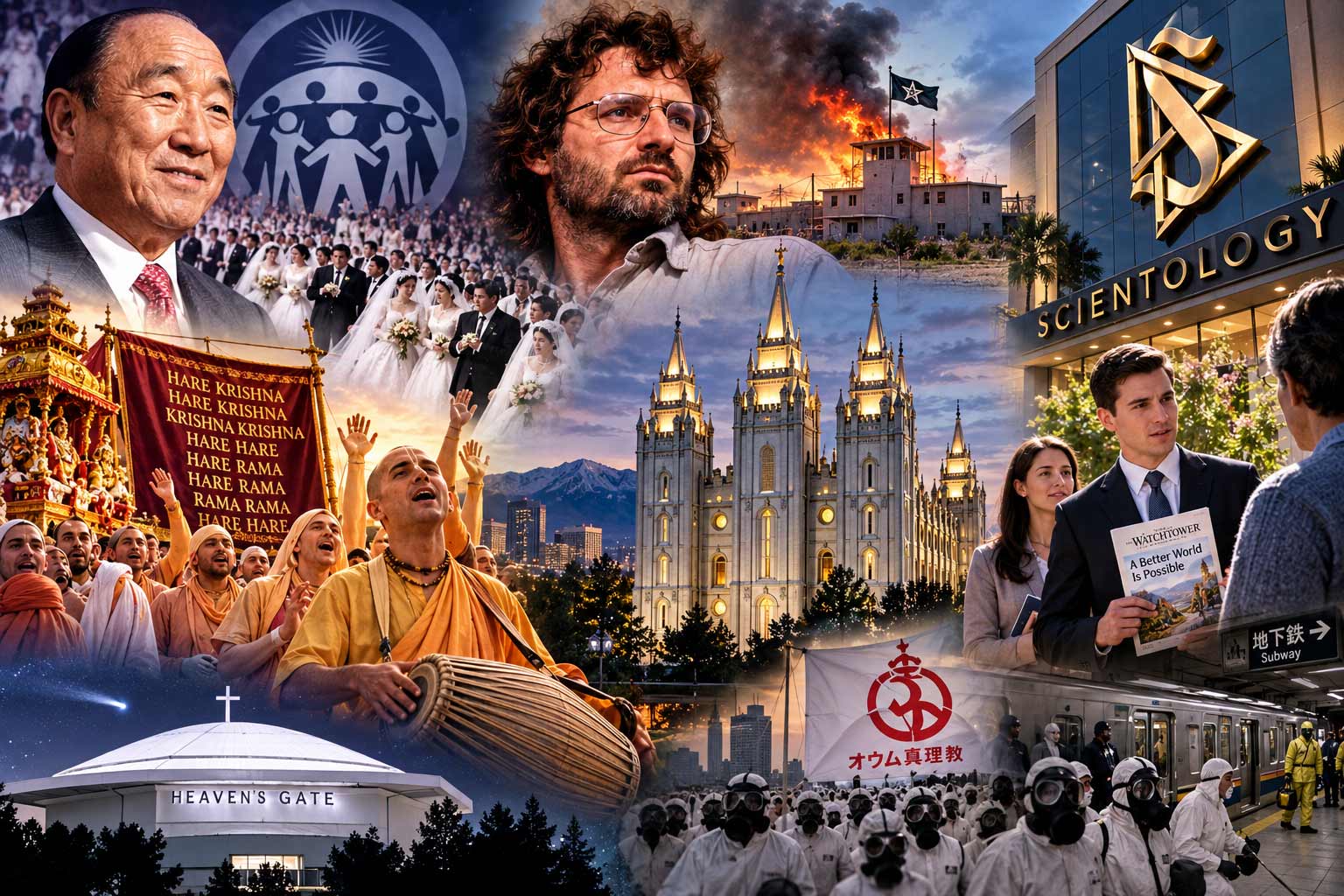
Few words in religion produce a reaction as quickly as the word “cult.” Call a group a denomination and nobody pays much attention. Call it a cult and you’ve probably started an argument.
Part of the problem is that “cult” doesn’t have a single universally accepted definition. In popular conversation, it may describe almost any strange, secretive, or unpopular religious group. Sociologists generally prefer terms such as “new religious movement” because “cult” can carry so much negative baggage. Christian apologetics has traditionally used the word somewhat differently, particularly for groups that identify themselves with Christianity while rejecting doctrines historically considered essential to the Christian faith.
Those aren’t necessarily the same thing. A religious group can depart dramatically from historic Christianity without controlling its members or following a dangerous charismatic leader. Conversely, a group can use manipulative and abusive methods without claiming to be Christian at all. If we’re going to use the word cult, then, we need to know what we mean by it.
What Is a Cult?
There are at least two useful ways of approaching the subject. The first is theological. From a traditional Christian perspective, a cult may be a movement that claims some relationship to Christianity while substantially redefining central Christian doctrines such as the nature of God, the identity of Jesus Christ, the Trinity, salvation, or the authority of Scripture.
The second approach looks primarily at behavior and organization. Does the group exercise excessive control over its members? Is leadership effectively beyond accountability? Are members discouraged from questioning doctrine or leadership? Is information from outsiders treated as inherently dangerous? Are relationships with former members discouraged or severed? Does leaving the group carry severe social, spiritual, or financial consequences?
Those two definitions can overlap, but they don’t have to. That’s important because otherwise we end up using the same word for every religious group we disagree with. A Baptist shouldn’t call a Methodist a cult because they disagree about baptism, and a Pentecostal shouldn’t call a Presbyterian a cult because they disagree about spiritual gifts. Christianity has always contained significant disagreements within its boundaries.
The more useful question is whether the disagreement changes something fundamental about what Christianity is.
Christian Cults
Some of the movements most frequently described as Christian cults use Christian vocabulary extensively. They talk about God, Jesus, Scripture, salvation, prayer, and eternal life. Their members may consider themselves Christians and may sincerely believe that they represent Christianity more faithfully than traditional churches do.
That makes theological comparison more complicated than simply asking whether a group talks about Jesus.
Two of the best-known examples are the Church of Jesus Christ of Latter-day Saints, commonly known as Mormonism, and Jehovah’s Witnesses. Both emerged in the nineteenth-century religious environment of the United States, both make extensive use of the Bible, and both consider Jesus enormously important. Nevertheless, both depart from historic Christian theology at fundamental points.
Mormonism
The Church of Jesus Christ of Latter-day Saints traces its beginning to Joseph Smith in the early nineteenth century. Smith said that God had called him as a prophet and that he translated an ancient record that became the Book of Mormon. The movement subsequently developed additional scriptures, prophetic authority, temples, priesthood offices, and doctrines that distinguish it sharply from Catholic, Orthodox, and Protestant Christianity.
Latter-day Saints believe in the Father, Son, and Holy Ghost, but they don’t understand the Trinity according to the historic Christian creeds. The Father, Son, and Holy Ghost are understood as distinct beings united in purpose rather than one God existing eternally as three persons. Mormon teaching also developed a distinctive understanding of humanity’s premortal existence, eternal progression, temple ordinances, continuing revelation, and the possibility of exaltation.
That creates an interesting situation. Ask a Latter-day Saint whether he believes in Jesus Christ and the answer will emphatically be yes. Ask what he believes about the nature of God, Christ, humanity, revelation, and salvation, however, and substantial differences from historic Christianity quickly appear.
That is why serious discussion of Mormonism requires more than saying, “They believe in Jesus too,” or, on the other side, “They’re a cult.” The important question is what those familiar Christian words mean within the Latter-day Saint theological system.
We’ll examine Mormonism much more thoroughly in a separate article.
Jehovah’s Witnesses
Jehovah’s Witnesses also arose from nineteenth-century America, developing from the Bible Student movement associated with Charles Taze Russell. Most people have encountered Witnesses through their door-to-door evangelism or literature, although their methods have changed considerably with technology and culture.
Jehovah’s Witnesses emphasize the name Jehovah, reject the Trinity, and teach that the Father alone is Almighty God. Jesus is understood as God’s unique Son but not as Almighty God in the Trinitarian sense. They also reject the traditional doctrine of an immortal soul and the idea of eternal conscious torment in hell. Their eschatology includes the well-known teaching concerning 144,000 anointed Christians who receive a heavenly calling, while other faithful servants of God anticipate everlasting life in an earthly paradise.
Once again, the disagreement isn’t over whether Jesus matters. Jehovah’s Witnesses talk about Jesus constantly. The disagreement concerns who Jesus is.
That distinction is going to appear repeatedly as we study groups that developed from Christian roots.
What About Seventh-day Adventists?
This is where careful definitions become important. Seventh-day Adventists were once routinely grouped with Mormonism and Jehovah’s Witnesses in some evangelical treatments of cults. Most contemporary evangelical scholars, however, distinguish Adventism from those movements because mainstream Seventh-day Adventism officially affirms doctrines such as the Trinity, Christ’s full deity and humanity, His bodily resurrection, and salvation by grace through faith.
Evangelicals may still disagree strongly with distinctive Adventist teachings concerning the Sabbath, Ellen G. White, the investigative judgment, and other subjects. But theological disagreement by itself doesn’t automatically make another Christian movement a cult.
That’s precisely why we need definitions rather than labels.
Non-Christian Cults
The terminology becomes even more complicated when we move outside groups claiming Christian identity. Calling a religion a “cult” merely because it isn’t Christian would be useless. Islam isn’t a Christian religion, but that doesn’t make Islam a cult. The same applies to Hinduism, Buddhism, Sikhism, Shinto, and other established religious traditions.
When the word cult is applied to non-Christian movements, the discussion usually involves something other than deviation from Christian orthodoxy. It may concern a relatively recent origin, unusual authority claims, a charismatic founder, organizational control, methods of recruitment, treatment of dissenters, or the degree of authority exercised over members’ lives.
Scientology provides an obvious example.
Scientology
Scientology was founded by science-fiction writer L. Ron Hubbard and developed during the 1950s. Hubbard initially introduced Dianetics as a system intended to address psychological and emotional problems and subsequently developed Scientology into a religious movement with its own terminology, practices, institutions, and understanding of human existence.
Scientology teaches that the human being is fundamentally an immortal spiritual entity called a thetan. Through a process known as auditing, adherents seek to address harmful experiences and spiritual impediments and progress through increasingly advanced levels of Scientology.
The result is a worldview that bears little resemblance to historic Christianity despite occasional references to religious ideas. Its concepts of God, humanity, spiritual existence, salvation, and ultimate reality arise from a completely different framework.
Scientology is also one of the movements for which the behavioral meaning of “cult” frequently enters public discussion. Former members, journalists, governments, scholars, and the Church of Scientology itself have disputed allegations concerning organizational control, finances, treatment of critics, and the experiences of members. Those subjects deserve careful treatment rather than being reduced to an insulting label, so we’ll examine Scientology separately as well.
And yes, the fact that the religion was founded by a science-fiction writer is going to make that article difficult to write without occasionally raising an eyebrow.
Hare Krishna
The Hare Krishna movement presents a different situation. Officially known as the International Society for Krishna Consciousness, or ISKCON, it was founded in New York in 1966 by A. C. Bhaktivedanta Swami Prabhupada. Westerners encountered its members particularly during the 1960s and 1970s, when saffron-robed devotees chanting the Hare Krishna mantra became a familiar sight in airports, city streets, and other public places.
But Hare Krishna didn’t simply appear from nowhere in the 1960s. Its theology grows from the much older Gaudiya Vaishnava tradition of Hinduism, which emphasizes devotion to Krishna. ISKCON therefore has historical roots extending centuries before its modern organization.
Devotees practice bhakti, or loving devotion, toward Krishna and place great importance upon chanting the Hare Krishna mantra. Their familiar public chant isn’t merely a recruiting slogan or catchy religious song. It is itself a devotional practice intended to focus consciousness upon Krishna.
Whether ISKCON should be called a cult depends heavily upon the definition being used. It isn’t a Christian cult in the theological sense because it doesn’t claim to represent historic Christianity. It is more accurately understood as a modern religious movement within the broader Vaishnava Hindu tradition. Like many religious organizations, it has also experienced controversies and internal reforms that deserve discussion in their proper historical context.
That distinction is precisely why we’re not going to throw every unfamiliar religion into the same bucket.
When Cults Become Dangerous
Some groups deserve concern for reasons that have little to do with theological disagreements. History contains movements in which charismatic leaders acquired extraordinary control over followers and produced disastrous consequences.
Jim Jones and the Peoples Temple ended with the deaths of more than 900 people at Jonestown in Guyana in 1978. David Koresh’s Branch Davidian community became the center of the disastrous 1993 federal siege near Waco, Texas. Heaven’s Gate ended in the mass suicide of 39 members in 1997. Japan’s Aum Shinrikyo carried out the 1995 sarin attack on the Tokyo subway.
These groups differed enormously in their beliefs, histories, and circumstances. We shouldn’t pretend that they were all manifestations of one simple psychological formula. Nevertheless, they demonstrate why people sometimes use the word cult to describe something much more serious than unusual theology.
A religious organization becomes particularly concerning when leaders demand unquestioning obedience, isolate members from outside relationships or information, punish legitimate questions, manipulate people through fear, exercise inappropriate control over marriage or finances, claim exclusive access to truth through an unaccountable leader, or make leaving psychologically or socially devastating.
Strange beliefs alone aren’t enough. People are allowed to believe strange things.
The question is what happens when someone says no.
Charismatic Leaders
One pattern worth watching is the movement from spiritual authority to personal authority. Religious leaders naturally exercise influence. Pastors teach congregations, rabbis interpret Torah, imams teach Islam, gurus instruct disciples, and professors somehow convince students to purchase a $200 textbook they’ll use for four months.
Authority itself isn’t evidence of a cult.
The danger appears when a leader effectively becomes immune to correction. Criticism of the leader becomes criticism of God. Questions become rebellion. Failed predictions are explained away. Contradictions are blamed on followers for misunderstanding. Moral failures are concealed because exposing them would supposedly damage the movement. Eventually loyalty to the leader becomes almost indistinguishable from loyalty to the faith.
Christianity actually contains a built-in warning against that tendency. Its leaders remain accountable to a message and Scripture that exist independently of them. Paul could confront Peter publicly. Churches could evaluate prophetic claims. Even an apostle’s teaching was to be rejected if he proclaimed a different gospel.
“No one is allowed to question me” isn’t an impressive demonstration of spiritual authority.
It’s a warning sign.
Does Leaving Cost You Everything?
Another useful question is what happens when someone leaves.
Leaving any close religious community can be painful. Friendships change, families disagree, and people may feel betrayed. None of that automatically makes a church or religious organization a cult. Human relationships are complicated.
But some organizations institutionalize those consequences. Former members may be shunned, portrayed as spiritually dangerous, cut off from family relationships, threatened with catastrophic spiritual consequences, or treated as though disagreement proves moral corruption.
A group that can attract members only by making departure unbearably costly deserves scrutiny.
Truth shouldn’t need hostages.
Secret Knowledge
Cults and new religious movements have also frequently appealed to the idea that ordinary people possess only part of the truth. The real truth is available only to insiders, advanced members, initiates, or those who have demonstrated sufficient loyalty.
That pattern isn’t new. Ancient religious movements sometimes promised secret knowledge, mystery religions restricted rituals to initiates, and forms of Gnosticism offered special spiritual knowledge. Modern movements can reproduce the same attraction in different forms.
There is something psychologically powerful about being told, “Millions of people don’t know this, but you do.”
Christians aren’t immune to that temptation. Any teacher who builds an audience by continually discovering biblical secrets nobody noticed for two thousand years should probably make us reach for our theological seat belt.
A Christian Approach to Cults
Christians should be able to evaluate religious claims without treating the people who believe them as enemies. A Mormon missionary at your door is a human being. So is a Jehovah’s Witness. So is a Scientologist, a Hare Krishna devotee, or somebody involved with a tiny religious group you’ve never heard of.
Mockery isn’t apologetics.
Neither is pretending that substantial theological differences don’t matter. Respecting another person doesn’t require telling him that his beliefs are basically the same as ours when they aren’t. In fact, genuine respect means taking someone’s beliefs seriously enough to understand what he actually believes before criticizing it.
That will be the approach throughout this section. We’ll examine movements individually, look at their founders and histories, allow them to explain their beliefs from their own authoritative sources whenever possible, and then compare those beliefs with historic Christianity.
Sometimes we’ll find popular Christian criticisms that are accurate. Sometimes we’ll find criticisms that are exaggerated, outdated, or simply wrong.
If we’re defending truth, we don’t need bad information to help us.
Understanding Cults
The word “cult” isn’t going away, and there’s still a legitimate place for it. But it’s most useful when it begins a discussion rather than ends one. Saying “Mormonism is a cult” tells us very little unless we can explain what Latter-day Saints actually believe and where those beliefs differ from historic Christianity. Calling Scientology a cult doesn’t teach us what a thetan is or why auditing matters. Describing Hare Krishna as a cult doesn’t explain its relationship to Hinduism or why devotees chant Krishna’s name.
That’s what the articles that follow are intended to do.
We’ll look more closely at Mormonism, Jehovah’s Witnesses, Scientology, Hare Krishna, and other movements individually. Some arose from Christianity and substantially reinterpreted it. Others came from entirely different religious traditions. Still others developed around charismatic personalities or new revelations. They shouldn’t all be treated as though they were the same phenomenon.
The objective isn’t to see how many groups we can slap with the word “cult.”
It’s to understand what people believe, why they believe it, how those beliefs developed, and how they compare with Christianity.
That’s a much more interesting conversation.