
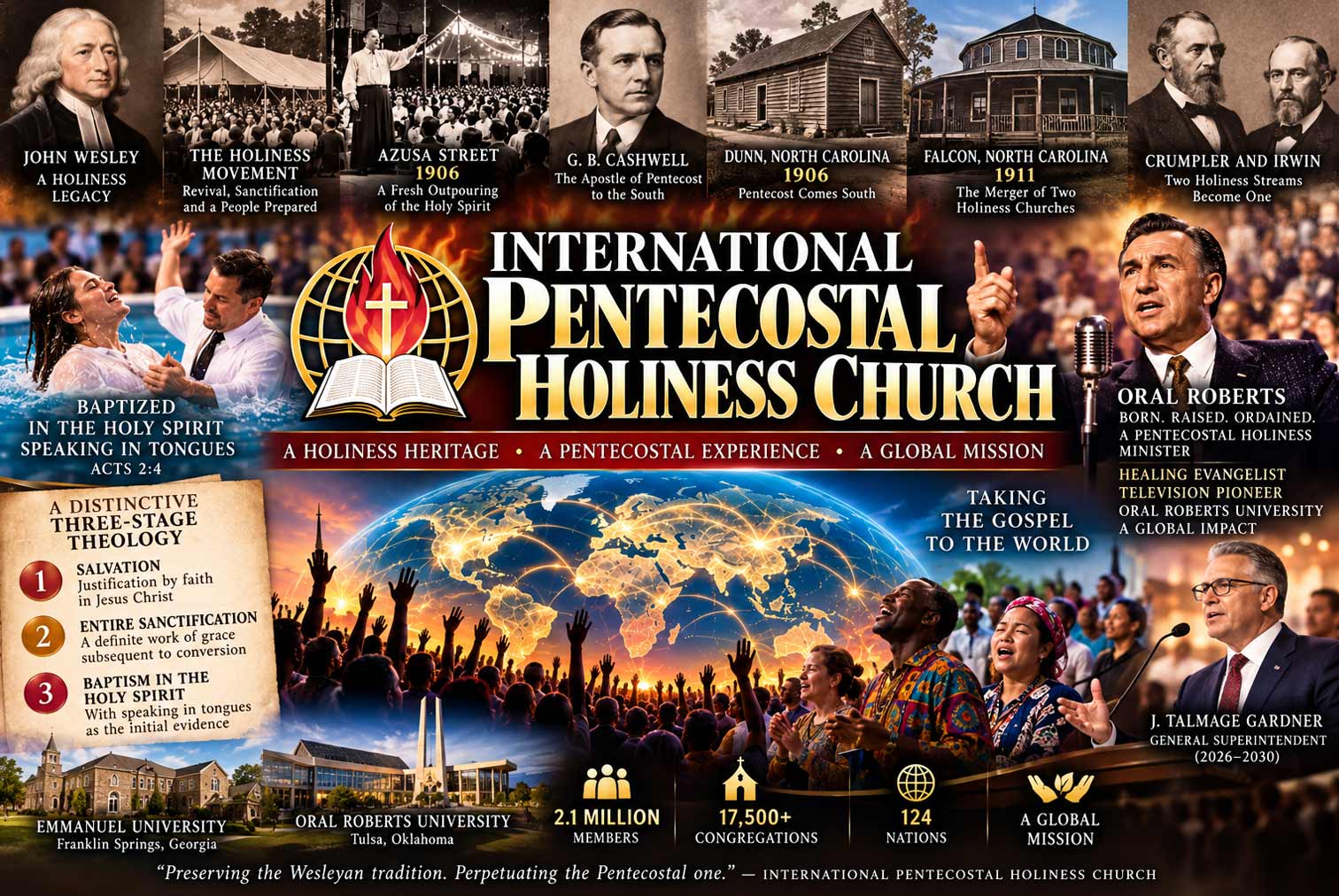
If you’ve spent much time around Pentecostalism, you almost certainly know the name Oral Roberts. What you may not know is the denominational tradition that helped form him. Roberts was born into the Pentecostal Holiness Church, was ordained by it, and emerged from a theological tradition that already believed strongly in divine healing, sanctification, Spirit baptism, and supernatural ministry long before his healing crusades made him one of the most recognizable Pentecostal preachers in America. Pentecostal historian Vinson Synan, himself deeply connected with the denomination, described Roberts as having been born, raised, and ordained within the Pentecostal Holiness Church and traced Roberts’ healing theology directly to that background.
That discovery immediately made the International Pentecostal Holiness Church, or IPHC, more interesting to me. Oral Roberts didn’t make the denomination important, and its history certainly didn’t begin with him. But knowing where Roberts came from gives us some idea of the spiritual world that produced him. The IPHC represents one of the oldest streams of Wesleyan-Holiness Pentecostalism, and its history provides another missing piece in the story we’ve been assembling. If the Assemblies of God represents one major form of classical Pentecostalism, the IPHC represents something older underneath Pentecostalism: the nineteenth-century Holiness movement meeting the twentieth-century Pentecostal revival.
Before Pentecostalism Was Pentecostal
To understand the IPHC, we have to begin before Azusa Street. The denomination’s theological ancestry reaches into the Wesleyan Holiness movement of the nineteenth century and ultimately to the teachings of John Wesley. Wesley emphasized not only conversion but sanctification—the continuing work of God by which believers are made holy. Later Holiness Christians increasingly emphasized an experience of entire sanctification, understood as a definite work of grace subsequent to conversion. The IPHC still explicitly identifies Wesleyan Holiness teaching as one of its theological foundations.
This is important because Pentecostalism didn’t suddenly materialize in Los Angeles in 1906 without a history. Before Pentecostals were talking about speaking in tongues, Holiness Christians were already holding camp meetings, praying for divine healing, expecting dramatic encounters with God, preaching sanctification, sending missionaries, and talking about the baptism of the Holy Spirit. What changed with Pentecostalism was the understanding of that Spirit baptism and, especially, the identification of speaking in tongues as its initial evidence.
The IPHC sits almost perfectly at the intersection of those two movements. In fact, its name tells the story: Pentecostal Holiness. One word comes from the twentieth-century Pentecostal revival. The other comes from the nineteenth-century Holiness revival. The denomination itself describes its distinctive historical task as preserving the Wesleyan tradition while perpetuating the Pentecostal one.
Two Holiness Movements
Two organizations are especially important in the IPHC family tree: the Holiness Church of North Carolina and the Fire-Baptized Holiness Church. Both developed during the intense Holiness revivalism of the late nineteenth century, although their histories and leadership were distinct. The North Carolina movement was closely associated with A. B. Crumpler, while the Fire-Baptized movement grew under the leadership of Benjamin Hardin Irwin and later Joseph H. King.
The phrase Fire-Baptized Holiness may sound Pentecostal to modern ears, but originally it didn’t mean exactly what later Pentecostals would mean by baptism in the Holy Spirit with speaking in tongues. Holiness movements were already using biblical language about the Holy Spirit and fire to describe deeper experiences with God before the Pentecostal revival appeared.
Then Azusa Street happened. And one North Carolina preacher decided he needed to see it for himself.
G. B. Cashwell Goes to Los Angeles
We’ve already met Gaston Barnabas Cashwell in our study of the Church of God (Cleveland), but now we encounter him in his natural denominational habitat. Cashwell was a minister in the Holiness Church of North Carolina when reports began circulating about the extraordinary revival taking place under William Seymour at the Azusa Street Mission in Los Angeles.
In late 1906, Cashwell traveled across the country to investigate. His arrival also forced him to confront something beyond theology. He was a white Southerner entering a revival led by an African-American preacher in which racial barriers were being crossed with unusual freedom for the period. IPHC’s own historical account describes Cashwell receiving Spirit baptism, speaking in tongues, experiencing healing, and remaining in Los Angeles for several weeks before returning east.
When Cashwell returned to North Carolina, he didn’t quietly add the experience to his personal theology. He started preaching it.
Pentecost Comes South
On New Year’s Eve, 1906, Cashwell began revival meetings in a rented tobacco warehouse in Dunn, North Carolina. People came from across the region, and the meetings continued into January. Ministers from several Holiness traditions received what they understood as the Pentecostal baptism in the Holy Spirit accompanied by speaking in tongues. Cashwell then traveled through the South carrying the message with him.
His influence was remarkable. IPHC historians call him the “Apostle of Pentecost to the South,” and the description isn’t much of an exaggeration. Through Cashwell’s ministry, Pentecostal teaching spread directly or indirectly into the Pentecostal Holiness Church, Fire-Baptized Holiness Church, Pentecostal Free Will Baptists, Church of God (Cleveland), and other Southern Pentecostal networks. IPHC’s history even identifies connections extending into COGIC and the later Assemblies of God story.
This is one of the things I’m enjoying about tracing these denominations individually. We keep discovering that their histories aren’t really individual histories at all. The same people keep walking through different chapters.
When the Founder Walked Out
The Pentecostal transition wasn’t painless. A. B. Crumpler had been instrumental in establishing the North Carolina Holiness movement, but he didn’t accept the developing Pentecostal teaching that tongues should be regarded as the initial evidence of baptism in the Holy Spirit. By 1908 the movement he had helped create formally adopted the Azusa understanding of Spirit baptism. Crumpler left.
Think about that for a moment. The founder of the movement watched his own denomination embrace a doctrine he couldn’t accept and then walked out of the organization he had helped establish. Church history has a way of reminding us that denominational founders don’t always get the final word about what their denominations become.
Falcon, North Carolina
Another place now enters our Pentecostal geography: Falcon, North Carolina. Falcon had become an important Holiness camp-meeting center where ministers from the developing movements worshiped and built relationships. By 1910 representatives of the Pentecostal Holiness Church of North Carolina and the Fire-Baptized Holiness Church were discussing formal union. The two groups already shared Wesleyan-Holiness theology, and both had now embraced the Pentecostal experience associated with Azusa Street.
On January 31, 1911, representatives met at the Octagon Tabernacle in Falcon. After debate over the proposed organizational structure, delegates approved the merger by a vote of 36–2. The resulting denomination took the name Pentecostal Holiness Church and brought together roughly 2,000 members, with congregations concentrated primarily across the Southeast and Oklahoma. Missionaries connected with the two movements were already serving in China, India, and Africa.
This was happening three years before the Assemblies of God organized in Hot Springs. The Pentecostal Holiness Church was already there.
Three Works of Grace
Here’s where the IPHC becomes especially helpful for understanding the different branches of Pentecostal theology. The denomination traditionally teaches a sequence that can be summarized as: Salvation → Entire Sanctification → Baptism in the Holy Spirit
This is sometimes called three-stage Pentecostalism or the three-blessing understanding of Christian experience. The terminology can oversimplify things, but it helps distinguish Wesleyan-Holiness Pentecostalism from the theology that later became dominant in the Assemblies of God and Foursquare.
The IPHC officially teaches justification by faith, followed by a definite work of sanctification subsequent to regeneration, followed by Pentecostal baptism in the Holy Spirit. It teaches that the initial evidence of Spirit baptism is speaking in other tongues as the Spirit gives utterance. At the same time, it says sanctification continues through lifelong growth in grace, so the doctrine shouldn’t be caricatured as “I got sanctified once and therefore I’m finished.”
That theological sequence puts IPHC in the same broad Wesleyan-Holiness Pentecostal family as the Church of God (Cleveland) and COGIC.
Why the Assemblies of God Is Different
The Assemblies of God came to reject the idea that entire sanctification must occur as a distinct second crisis experience between conversion and Spirit baptism. That position became associated with the Finished Work understanding of sanctification, especially through the influence of William Durham.
IPHC retained its Wesleyan inheritance. That means two Pentecostal preachers can agree that people should be saved, live holy lives, receive the baptism in the Holy Spirit, speak in tongues, pray for healing, practice spiritual gifts, evangelize the lost, and expect Jesus to return—and still disagree about the theological order in which some of those things occur.
That’s basically Pentecostal denominational history in one paragraph. Everybody agrees something happened. Then we start arguing about which number to put beside it.
The Five Cardinal Doctrines
IPHC traditionally summarizes its identity through five cardinal doctrines: justification by faith in Jesus Christ; sanctification as a second definite work of grace; baptism in the Holy Spirit with speaking in tongues as the initial evidence; divine healing as provided in Christ’s atonement; and the premillennial second coming of Jesus Christ.
Those five doctrines tell us almost everything we need to know about the denomination’s theological location. It is evangelical in its proclamation of salvation through Christ, Wesleyan in its doctrine of sanctification, Pentecostal in its doctrine of Spirit baptism and tongues, continuationist in its expectation of healing and supernatural gifts, and premillennial in its expectation of Christ’s return.
It is also thoroughly Trinitarian. Unlike UPCI and PAW, IPHC explicitly confesses the Holy Spirit as a divine person sharing the one divine being with the Father and Son.
So after our excursion through Oneness Pentecostalism, we’ve returned to the Trinitarian side of the Pentecostal family.
Divine Healing
Healing deserves more than a sentence because it provides the bridge to Oral Roberts.
Early Pentecostal Holiness Christians believed strongly that Christ still healed the sick. Some early Holiness and Pentecostal advocates went considerably further and regarded reliance on physicians and medicine as evidence of insufficient faith. The denomination eventually worked through those controversies and moved toward a position that retained strong belief in divine healing without treating medical care as the enemy of faith.
Vinson Synan’s research into the Pentecostal roots of Oral Roberts’ healing ministry traces this development directly through the Pentecostal Holiness tradition. By the 1940s the denomination had moved toward affirming both prayer for healing and appropriate medical treatment. That theological environment became the background from which Roberts developed his healing ministry.
That caught my attention because it helps explain something about Roberts that can otherwise appear suddenly. He didn’t invent Pentecostal healing. He inherited it.
Oral Roberts
Granville Oral Roberts was born in Oklahoma in 1918 into a Pentecostal Holiness family. His father was a Pentecostal Holiness minister, and Roberts himself was ordained within the denomination. Long before television audiences knew his name, he had been formed inside a church culture that believed Jesus saves, sanctifies, baptizes with the Holy Spirit, heals, and is coming again.
Roberts eventually became one of the most influential figures in twentieth-century Pentecostal and charismatic Christianity. Beginning in the late 1940s, his healing campaigns drew enormous crowds. His ministry expanded through radio, television, publications, tent crusades, and eventually higher education. He founded Oral Roberts University in Tulsa in the 1960s, creating an institution that brought Pentecostal and charismatic spirituality into an academic environment on a scale that would have been difficult to imagine during the movement’s early years.
That’s why Roberts’ IPHC connection matters.
It doesn’t make the IPHC historically important; the denomination had already been part of Pentecostalism for decades before Roberts became famous. But Roberts provides unmistakable evidence of how influential this theological tradition became. One of the people most responsible for carrying divine healing and Pentecostal experience into American mass media came directly out of the Pentecostal Holiness Church.
From the Healing Revival to the Charismatic World
Roberts also became something larger than a denominational Pentecostal evangelist.
During the postwar healing revival, evangelists such as Roberts brought Pentecostal expectations of miracles and healing before enormous audiences. Roberts proved particularly adept at using modern communications technology. Radio expanded his audience, television expanded it further, and direct-mail fundraising helped create a national ministry independent of the normal boundaries of a local church or denomination.
Over time Roberts increasingly interacted with Christians outside classical Pentecostal denominations. His ministry became an important bridge into what eventually became the Charismatic Movement, where Episcopalians, Catholics, Baptists, Methodists, Presbyterians, and Christians from other traditions began reporting Pentecostal-type experiences without necessarily leaving their denominations.
That’s another reason the IPHC story deserves to be told. One of its sons helped Pentecostal experience escape Pentecostal denominational boundaries.
Oral Roberts University and Pentecostal Scholarship
There’s another connection I particularly like because it comes back around to IPHC history. Vinson Synan, one of the foremost historians of Pentecostalism, came from the Pentecostal Holiness tradition and later served at Oral Roberts University. ORU’s archival collections now preserve substantial material relating to Pentecostal Holiness history, including Synan’s lectures on the denomination and historical Pentecostal publications.
So the relationship between IPHC and Oral Roberts wasn’t merely a footnote from his early ministry. The denomination, Roberts, ORU, and Pentecostal historical scholarship became interconnected in ways that helped Pentecostals preserve and study their own history. That’s a considerable journey from a tobacco warehouse in Dunn, North Carolina.
Women in Ministry
IPHC also has a long history of recognizing women in ministry. The denomination’s official position states that women have been licensed and ordained throughout its history, including service as pastors and in conference and denominational leadership. In 1996, IPHC leaders went further and formally addressed what they described as the church’s historical patterns of male domination, and its later Centennial Covenant explicitly affirmed the Spirit’s gifts and ministries working through both men and women.
That fits the broader pattern we’ve repeatedly encountered in early Pentecostalism. When Pentecostals believed Joel’s prophecy that God’s Spirit would be poured out on “sons and daughters,” women didn’t remain merely spectators. They preached, evangelized, planted churches, went overseas as missionaries, prayed for the sick, taught Scripture, and sometimes led congregations.
Whatever else Pentecostals disagreed about, apparently they could always find another person willing to preach.
Church Government
IPHC government reflects its Methodist and Wesleyan ancestry more than the congregational tendencies of some other Pentecostal bodies. Local congregations belong to regional conferences, and conferences are led by bishops. The international denomination is overseen through a General Conference and a Council of Bishops, combining local church life with broader denominational accountability.
The denomination has just entered a new leadership era. At its 30th General Conference in July 2026, delegates approved a restructuring of the denomination’s general leadership and elected J. Talmadge Gardner as General Superintendent and Terry Tramel as Assistant General Superintendent. Gardner succeeded longtime Presiding Bishop Doug Beacham, and subsequent elections completed the leadership team for the 2026–2030 period.
That’s a very recent development, and it means we’re writing this article almost exactly as a new chapter in IPHC history begins.
Oklahoma
There’s another connection that makes the IPHC story particularly interesting: Oklahoma.
The movement established an early presence there, and surviving Pentecostal Holiness publications document its development in the state. IPHC history records twenty-five Oklahoma churches already represented in denominational records around the time of the 1911 merger, and Agnes Ozman, remembered as the first student at Charles Parham’s Topeka school to speak in tongues in 1901, later served as a Pentecostal Holiness evangelist in Oklahoma.
Today the denomination’s Global Ministry Center is in the Oklahoma City metropolitan area, in Bethany.
And of course Oral Roberts’ story would eventually make Tulsa one of the most recognizable cities in modern Pentecostal and charismatic Christianity. North Carolina gave this movement one of its cradles. Oklahoma became one of its homes.
Education
Like most early Pentecostal groups, IPHC began among people considerably more interested in revival and evangelism than in building an academic establishment. But that changed as the denomination matured.
The IPHC educational tradition includes Emmanuel University in Franklin Springs, Georgia, whose institutional ancestry reaches back to early Pentecostal Holiness educational work. The denomination has also historically been associated with Southwestern Christian University in Oklahoma. Education increasingly became part of preparing ministers, missionaries, teachers, and lay leaders rather than something Pentecostals regarded with suspicion.
That development parallels the larger Pentecostal movement. The first generation asked whether the Spirit could empower ordinary people without formal education. Later generations discovered that being empowered by the Spirit wasn’t a particularly good reason to stop learning.
A Global Church
The name eventually became International Pentecostal Holiness Church, and International isn’t merely decorative.
Current IPHC figures report approximately 2.1 million members in more than 17,500 congregations across 124 nations, with nearly 1,700 churches in the United States. The denomination’s 2025 statistics show that the overwhelming majority of its constituency now lives outside the United States.
Once again we’re seeing the same transformation we’ve encountered throughout Pentecostalism. These movements may have organizational headquarters in Springfield, Cleveland, Memphis, Indianapolis, Los Angeles, or Oklahoma City, but their demographic future is increasingly African, Asian, Latin American, and global.
The IPHC began among relatively small Holiness churches in the American South. Today the sun really doesn’t set on the movement.
IPHC and the Other Pentecostals
By this point, our denominational map is becoming much clearer.
The Assemblies of God and Foursquare represent the Trinitarian Pentecostal stream that doesn’t require entire sanctification as a distinct second work of grace before Spirit baptism. The Church of God (Cleveland), COGIC, and IPHC retain stronger Wesleyan-Holiness understandings of sanctification. UPCI and PAW belong to the Oneness Apostolic tradition and differ from all of these over the doctrine of the Trinity and Jesus-name baptism.
IPHC therefore helps us understand that Pentecostalism didn’t originate from a single theological pipeline. There were overlapping streams. The Holiness movement supplied one. Azusa Street supplied another. Healing movements supplied another.
And people like G. B. Cashwell carried the water from one stream into another until Pentecostal history became something closer to a river delta.
The Denomination Behind Oral Roberts
I knew Oral Roberts was Pentecostal. What I hadn’t appreciated was how much denominational history stood behind that statement.
Roberts came from a tradition that had been preaching sanctification, Spirit baptism, divine healing, and Christ’s return before his name appeared on a revival tent. He inherited a theology of healing rather than inventing one. He inherited an expectation of supernatural ministry. He inherited the conviction that the Holy Spirit could empower ordinary believers to do extraordinary things.
Then he took that inheritance somewhere his Pentecostal Holiness predecessors probably never imagined. He put it on television. He carried it into massive healing crusades. He built a university around it. And he helped introduce Pentecostal expectations to Christians who would never have considered joining a Pentecostal denomination.
That doesn’t make Oral Roberts the whole IPHC story. It makes him evidence that the story mattered.
IPHC’s Place in Pentecostal History
The International Pentecostal Holiness Church isn’t simply another Pentecostal denomination we needed to include so our list would be complete. It helps explain where Pentecostalism came from.
Its Wesleyan ancestry takes us back before Azusa Street. Its doctrine of entire sanctification preserves the Holiness theology that shaped many early Pentecostals. G. B. Cashwell connects Azusa with the Pentecostalization of the American South. Falcon shows Pentecostal organizations merging before the Assemblies of God even existed. Its healing tradition helps explain Oral Roberts. Roberts helps explain the healing revival. And the healing revival helps explain how Pentecostal experience eventually traveled beyond Pentecostal denominations into the broader Charismatic Movement.
That’s quite a lot of history hiding behind four letters: IPHC. And I think that’s why this denomination turned out to be much more interesting than I expected. I started with Oral Roberts because I knew his name. I ended up discovering the church world that helped produce him. Sometimes that’s the best reason to study a denomination in the first place.