
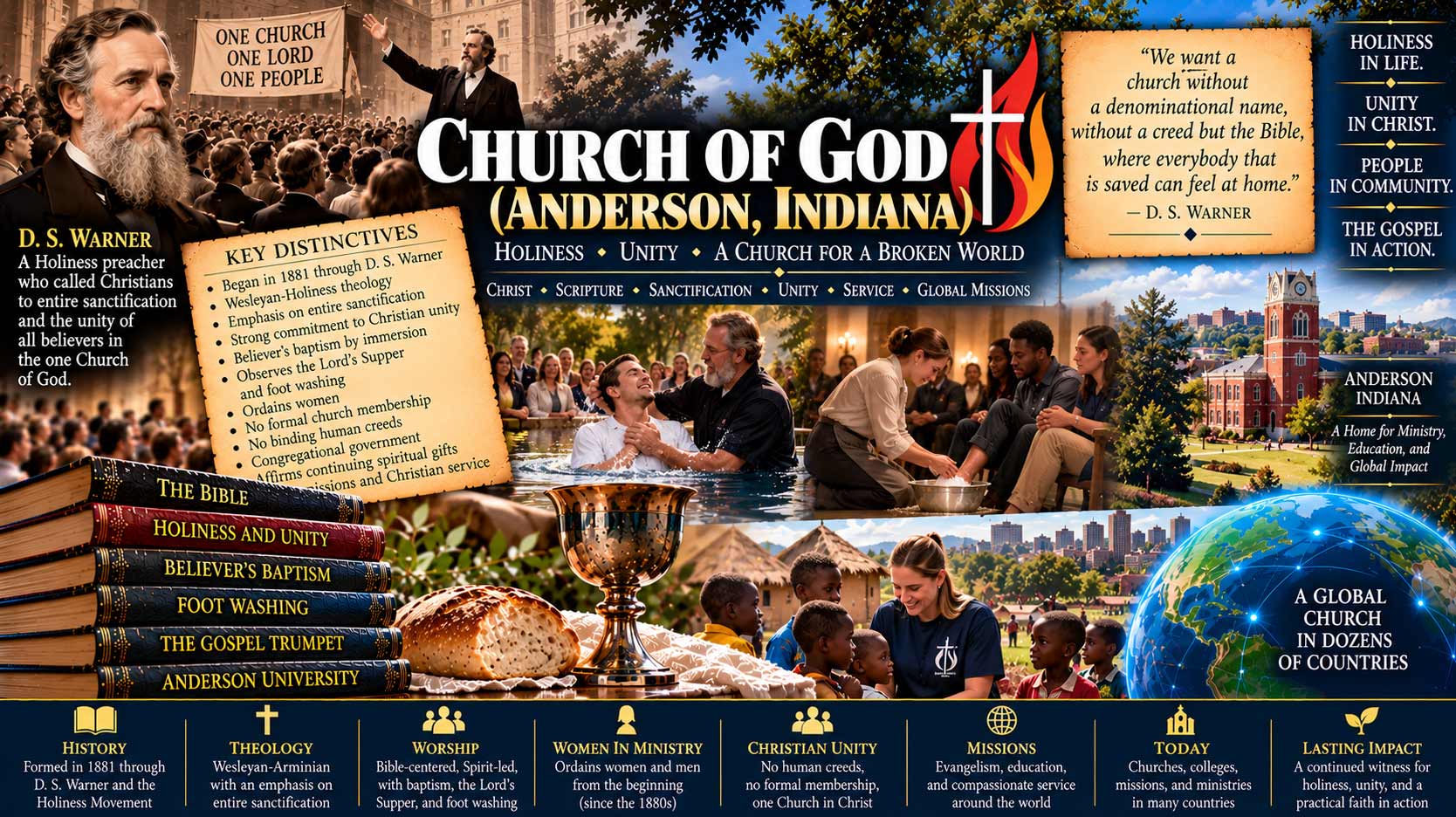
The Church of God (Anderson, Indiana) presents us with an immediate problem: which Church of God?
We’ve already encountered the Church of God (Cleveland, Tennessee), a major Pentecostal denomination. There’s also the Church of God of Prophecy, Church of God in Christ, Church of God (Seventh Day), Church of God (Guthrie, Oklahoma), and enough other Churches of God to make you wonder whether somebody should have started assigning numbers.
The Church of God headquartered in Anderson, Indiana, is different from all of them. It isn’t Pentecostal in the denominational sense, although it believes the gifts of the Holy Spirit continue today. It comes from the Holiness Movement, practices believer’s baptism by immersion, observes foot washing, ordains women, rejects formal creeds, has no formal church membership, and historically resisted even calling itself a denomination.
That’s because its founders weren’t trying to establish another denomination. They thought denominations were part of the problem.
Daniel Sidney Warner
The central figure in the movement’s beginning was Daniel Sidney Warner, usually known as D. S. Warner. Born in Ohio in 1842, Warner became a minister associated with the General Eldership of the Church of God, a movement connected with the earlier ministry of John Winebrenner. Warner eventually embraced the Holiness teaching that entire sanctification could occur as a definite work of God’s grace following conversion. His increasingly strong Holiness convictions brought him into conflict with the church body in which he ministered, and in 1881 Warner and several companions separated from it.
But Warner’s disagreement involved more than sanctification. He became convinced that denominational divisions themselves contradicted God’s intention for the Church. Christ had established one Church. Christians had divided themselves into Methodists, Baptists, Presbyterians, Lutherans, and countless other organizations. Warner believed something had gone badly wrong.
His solution was wonderfully simple. Get rid of the denominations. As church history repeatedly demonstrates, however, one of the easiest ways to oppose denominations is to accidentally start another one.
The Church Without a Denominational Name
Warner and the early movement deliberately adopted the biblical expression Church of God because they didn’t want a sectarian name identifying Christians with a human founder or theological party. They didn’t want to be Warnerites. They didn’t want to establish a new creed. They didn’t want denominational membership separating one group of genuine Christians from another. They believed everyone genuinely saved through Christ already belonged to God’s Church. The Church wasn’t created by signing a membership card or joining an organization. God added people to his Church through salvation.
That’s still one of the movement’s most distinctive ideas. The Church of God doesn’t ordinarily maintain formal membership rolls in the conventional denominational sense. A Christian belongs to Christ’s Church because he or she belongs to Christ. The irony is obvious. The movement that didn’t want to become a denomination eventually needed offices, institutions, ministers, publishing houses, conferences, missionaries, colleges, and some way of distinguishing itself from the twenty other groups also calling themselves the Church of God.
Hence the parenthetical clarification: Church of God (Anderson, Indiana). Sometimes bureaucracy wins by exhaustion.
Holiness and Unity
Two words summarize the early Church of God movement particularly well: holiness and unity. Warner believed the Holiness revival had recovered an important biblical truth. Salvation wasn’t merely forgiveness from the penalty of sin. God’s grace could transform Christians and free them from the domination of sin.
But Warner connected holiness with another conviction: genuinely saved people belonged to one spiritual Church. Denominational barriers artificially divided people whom Christ had already united. Early Church of God preaching therefore called Christians both toward sanctification and toward Christian unity.
That combination distinguished the movement from some other Holiness churches. Nazarenes emphasized entire sanctification. Wesleyans carried their abolitionist and Holiness heritage. Salvationists combined sanctification with evangelism and social ministry. The Church of God made the unity of all believers one of its defining themes.
Holiness without unity was incomplete, but unity without holiness wasn’t much better.
Coming Out of Babylon
Early Church of God preaching could be considerably less diplomatic than its contemporary language. Warner and his associates sometimes described denominational Christianity using the biblical image of Babylon from Revelation. Christians were called to “come out” from sectarian religious systems and return to the unity of God’s true Church.
The reasoning was straightforward, even if the rhetoric was severe. Christ established one Church. Denominations divided that Church into competing organizations. Therefore Christians should abandon denominational identities and recognize fellowship with every genuinely redeemed believer.
Early adherents were consequently sometimes called “come-outers.” The movement’s understanding of Babylon and denominationalism became less rigid over time. Today’s Church of God cooperates freely with Christians from other denominations and doesn’t generally go around telling Baptists and Presbyterians that their church signs are evidence of Babylon.
That probably makes ecumenical luncheons considerably more comfortable. But the original concern remains: Christian identity should ultimately be found in Christ rather than a denominational label.
No Creed but the Bible
The Church of God historically rejected formal creeds as tests of Christian fellowship. Warner feared that creeds could become another mechanism for dividing Christians. The movement instead emphasized the Bible as the authoritative standard of faith and the Holy Spirit as the Church’s guide.
That doesn’t mean the Church of God has no theology. It has very definite theological convictions concerning the Trinity, Christ, salvation, sanctification, the Church, ordinances, Christian living, and the return of Christ. Church of God scholars and institutions have produced extensive theological literature explaining those beliefs. The distinction is between having beliefs and making a humanly composed creed the boundary defining who belongs to God’s Church.
That creates an interesting tension. Eventually someone asks, “What does the Church of God believe?” At which point you have to write something down. The movement has spent more than a century navigating that problem.
Wesleyan-Holiness Theology
The Church of God belongs broadly within the Wesleyan-Holiness tradition, although its Restorationist emphasis on the unity of the Church gives it a distinctive flavor. Human beings are fallen and require God’s saving grace. Salvation comes through Christ and is received through repentance and faith. God’s grace doesn’t merely pardon sin but begins transforming the believer.
Like other Wesleyan traditions, the Church of God rejects the idea that salvation is restricted to an eternally predetermined group of people. Christ’s saving work is offered to everyone, and people may genuinely respond to or resist God’s grace. The movement historically emphasized entire sanctification as a subsequent work of grace in which believers surrender themselves fully to God and experience the sanctifying work of the Holy Spirit.
The goal isn’t simply to become a person who believes the correct doctrines. It’s to become holy.
Entire Sanctification
Warner’s belief in entire sanctification was one of the issues that contributed directly to his separation from his previous church body. Early Church of God preaching presented sanctification as a definite spiritual experience following conversion. The believer who had been justified and regenerated could consecrate himself completely to God and receive the sanctifying work of the Holy Spirit.
As with the Nazarenes and other Holiness traditions, this didn’t mean believers became incapable of mistakes, temptation, ignorance, or further spiritual growth. Sanctification concerned the cleansing and orientation of the heart toward God. Later Church of God theology has sometimes expressed sanctification in less rigidly formulaic ways than some nineteenth-century Holiness teachers did. Greater emphasis has been placed upon both decisive surrender and continuing spiritual formation.
The essential conviction remains that Christianity should actually transform people. If salvation never changes the way somebody lives, the Holiness tradition is going to start asking uncomfortable questions.
The Holy Spirit
The Church of God has a strong theology of the Holy Spirit and explicitly affirms that spiritual gifts continue to operate in the Church. That immediately raises an interesting question because the Church of God isn’t Pentecostal.
The movement recognizes that the Holy Spirit continues distributing gifts for the edification and mission of the Church. Its historical teaching has even allowed for tongues, generally understood either as the Spirit-given ability to speak or understand another language for the advancement of the gospel or as a private prayer language used for personal edification.
What the denomination doesn’t teach is the classical Pentecostal doctrine that speaking in tongues is the necessary initial physical evidence of baptism in the Holy Spirit. That puts the Church of God in an interesting position. It comes from the Holiness Movement, predates modern Pentecostalism, believes spiritual gifts remain active, and can accept tongues without making tongues the defining evidence of a particular post-conversion experience.
So although the Church of God (Anderson) and Church of God (Cleveland) share a name and both believe the Holy Spirit still gives supernatural gifts, they come from different denominational histories and shouldn’t be confused. Apparently “Church of God” wasn’t specific enough.
Believer’s Baptism
Here’s another place where the Church of God differs from the Methodists and Nazarenes we’ve recently studied. The Church of God practices believer’s baptism, not infant baptism. Baptism is administered by immersion to people who have personally placed their faith in Christ. It is understood as the outward testimony of the inward work God has already accomplished through salvation.
Baptism therefore doesn’t produce salvation. A person is saved by God’s grace through faith in Christ rather than by entering the water. That makes Church of God baptism look considerably more Baptist than Methodist, even though the denomination’s theology of salvation and sanctification comes much closer to Wesleyan-Holiness Christianity.
This is one of the things that makes the Anderson tradition difficult to classify neatly. It borrowed no denominational package wholesale. It wanted to recover what it believed Scripture taught.
Communion
The Church of God also practices the Lord’s Supper, generally understanding the bread and cup symbolically as reminders of Christ’s body and blood. Communion looks backward toward Christ’s sacrificial death and forward toward his return. It also expresses the fellowship believers share through Christ.
The movement doesn’t teach that the elements become Christ’s physical body and blood, nor does it treat Communion as necessary for salvation. It is an ordinance commanded by Christ and practiced by the Church. But baptism and Communion aren’t the entire list.
The Church of God has a third ordinance that many evangelical Christians rarely encounter.
Foot Washing
The Church of God practices foot washing as an ordinance. The practice comes from John 13, where Jesus washed the disciples’ feet and instructed them to follow his example. Church of God Christians historically concluded that this shouldn’t merely be admired as a lesson about humility. Jesus gave the Church something to practice. Foot washing therefore joins baptism and Communion as one of the movement’s three ordinances.
The meaning is straightforward: humility, equality, servanthood, and Christian love. The person kneeling to wash another believer’s feet is reenacting Christ’s willingness to take the position of a servant. Foot washing also fits beautifully with Warner’s emphasis upon Christian unity. Social rank becomes rather difficult to maintain when everyone is kneeling in front of someone else’s bare feet. I suspect it also makes everyone suddenly remember whether they changed their socks that morning.
No Formal Membership
Another distinctive feature is the Church of God’s traditional rejection of formal church membership. The logic follows directly from its understanding of the Church. If salvation makes someone part of Christ’s Church, a congregation shouldn’t pretend it possesses the authority to make that person more officially Christian by placing a name on a membership roll.
Local congregations obviously still need practical ways to identify participants, leaders, voters, volunteers, ministers, and people receiving pastoral care. Modern organizational life requires some administrative structure. But the theological principle remains important. The Church is composed of redeemed people, not people whose paperwork has been processed. That’s one of the clearest places where Warner’s anti-denominational vision survives today.
Women in Ministry
The Church of God has supported women in ministry and leadership from its earliest history. Women served as preachers, evangelists, pastors, missionaries, writers, and leaders during the formative years of the movement. The Church of God continues to affirm that the Holy Spirit calls and gifts both women and men for ministry and that women may serve at every level of church leadership.
This places the denomination alongside the Nazarenes, Wesleyans, Free Methodists, and Salvation Army within the broader Holiness tradition. Once again, women’s ministry in this tradition didn’t originate with twentieth-century mainline Protestantism. Holiness Christians were arguing about the issue in the nineteenth century while simultaneously preaching conversion, biblical authority, sanctification, and revival. That doesn’t settle the biblical debate. Christians who understand passages such as 1 Timothy 2 differently will still disagree. But it tells us what kind of disagreement we’re actually dealing with.
Mary Cole and the Early Women Preachers
One of the important early figures was Mary Cole, whom the Church of God itself remembers among the movement’s formative leaders. Cole and other women preached during an era when female ministers faced considerable resistance throughout American Christianity. Their presence wasn’t an incidental exception to the movement’s normal practice. Early Church of God theology emphasized the conviction that the Holy Spirit determines spiritual gifts and ministry callings.
That produced a practical conclusion: if God had clearly gifted a woman to preach, the Church shouldn’t tell the Holy Spirit he had filled out the wrong application. Again, Christians can dispute the interpretation. But the historical logic is easy to follow.
Race and the Church
The early Church of God also developed a striking emphasis upon racial unity. If all genuinely redeemed Christians belonged to one Church, racial separation presented an obvious theological problem. Black and white Christians worshiped and ministered together in early Church of God settings at a time when segregation was deeply embedded in American society and increasingly embedded in American churches.
The movement understood interracial worship as a visible expression of the unity it proclaimed. Christian unity couldn’t merely mean white Christians from several denominations learning to tolerate one another. If Christ had created one Church, racial barriers couldn’t determine its boundaries either. Like many American denominations, the Church of God hasn’t always lived perfectly according to its highest ideals. But interracial fellowship wasn’t added recently to make the denomination appear socially enlightened. It was present near the beginning.
Pacifism
Early Church of God Christians were also strongly associated with pacifism. Warner and other leaders believed Christians should follow Jesus’ teaching concerning love of enemies and refuse participation in warfare. That position fit within the movement’s larger emphasis upon holiness and separation from worldly systems.
Over time, particularly through the pressures created by the two World Wars, attitudes became more diverse. Pacifism ceased functioning as the universal expectation it had been among earlier adherents. That development provides another example of how denominations change even when they insist they’re simply following the Bible. Every generation inherits interpretations from the generation before it and then has to decide whether those interpretations really are demanded by Scripture.
Marriage and Sexuality
The Church of God maintains the historic Christian understanding of marriage as the union of one man and one woman and teaches sexual intimacy within that covenant. The denomination has faced internal disagreements over sexuality, particularly as some ministers and congregations have advocated affirming same-sex relationships. Church of God leadership has maintained its traditional doctrinal position, and the dispute has resulted in disciplinary actions involving ministers who publicly rejected that standard.
That controversy demonstrates that the debates affecting United Methodists, Presbyterians, Anglicans, and other Protestant traditions haven’t entirely bypassed the Holiness Movement. But the Church of God’s official position remains traditional. Its reasoning connects sexual ethics with the larger Holiness conviction that the body belongs to God and Christian discipleship includes sexuality rather than placing it outside the reach of spiritual formation.
Congregational Government
The Church of God differs significantly from several other Wesleyan-Holiness denominations in church government. Nazarenes have general superintendents. Methodists have bishops. The Salvation Army has officers, commissioners, and a General. Church of God congregations are substantially autonomous and congregational.
Local churches cooperate through state, regional, national, and international structures, but these structures don’t function as a traditional episcopal hierarchy governing every congregation from above. That reflects Warner’s original suspicion of denominational machinery. The movement needed organization to accomplish missions, publishing, education, credentialing, and cooperative ministry, but it wanted organization to serve the Church rather than define it.
This produces another interesting combination: Wesleyan-Holiness theology with a church structure that can sometimes look more Baptist or nondenominational. The Church of God has never been especially worried about fitting neatly into somebody else’s category.
Anderson, Indiana
So why do we keep adding “Anderson, Indiana”? Because the movement’s major institutional center developed there. The publishing ministry relocated to Anderson in the early twentieth century, and the city became home to important Church of God institutions, including its national offices and educational ministries.
Today Church of God Ministries maintains its U.S. offices in Anderson. The geographical label isn’t normally part of the church’s official name. Congregations simply call themselves Church of God, and many local congregations don’t even include that phrase prominently in their public branding.
But historians and religion writers need some way to distinguish this movement from all the other Churches of God. So Anderson gets drafted into service. The city probably never expected to become a theological parenthesis.
Anderson University
One of the movement’s most important institutions is Anderson University, founded in Anderson in 1917. The university grew from the Church of God’s commitment to preparing ministers and missionaries while also providing broader Christian education. Over time it developed into a comprehensive university while retaining its relationship with the Church of God.
Its theological school has been especially important in articulating Church of God theology. That’s significant for a movement that historically resisted creeds. Someone still has to teach pastors what the movement believes, explain its history, and wrestle with theological questions. “No creed but the Bible” doesn’t eliminate theology. It just gives the theology professors more explaining to do.
Warner Press and the Gospel Trumpet
Publishing played an enormous role in spreading the early movement. Warner began publishing the Gospel Trumpet, which became the movement’s principal newspaper and a vehicle for preaching holiness, Christian unity, evangelism, and the Church of God’s distinctive understanding of the Church.
The publishing ministry eventually became Warner Press, another major institution associated with Anderson. This mattered enormously before radio, television, YouTube, podcasts, and social media. A religious newspaper could connect scattered believers who might otherwise have no idea that people hundreds of miles away shared their convictions.
In a real sense, the printing press helped turn Warner’s network of revivalists into a movement. Every generation finds its platform. Warner had newsprint.
Missions
The Church of God developed an international missionary vision very early. Its first missionary was sent to Mexico in 1891, only about a decade after the movement began. Missionary work subsequently spread the Church of God into numerous regions around the world.
Today the movement is an international Christian fellowship extending across dozens of countries. That international growth presents the same challenge we’ve seen with several other denominations. A movement that began in the American Midwest can no longer assume that American concerns define Christianity everywhere. African, Asian, Latin American, Caribbean, European, and other Church of God communities bring their own cultures, challenges, leaders, and theological questions into the movement.
Christian unity becomes considerably more interesting when the Christians you’re trying to unite don’t all look or think like people from Indiana.
Jesus Is the Subject
The contemporary Church of God has adopted the memorable phrase “Jesus is the Subject.” It’s more than a slogan. It deliberately reaches back toward Warner’s original vision. The Church of God wasn’t supposed to exist to promote D. S. Warner, defend an institution, protect a denominational brand, or convince everyone that Anderson, Indiana, had discovered Christianity’s final organizational form. Jesus was supposed to remain the center.
That phrase also gives the modern movement a way to express its historic anti-sectarian impulse without repeating some of the harsher nineteenth-century rhetoric about denominations and Babylon. Instead of saying, “Come out of everybody else’s church,” the contemporary emphasis is closer to, “Let’s remember who the Church belongs to.” That’s probably an improvement.
The Church of God and Pentecostalism
Because of the name, this distinction deserves repeating. The Church of God (Anderson, Indiana) isn’t the Church of God (Cleveland, Tennessee). The Cleveland body is a classical Pentecostal denomination whose modern identity developed through the Pentecostal revival and includes speaking in tongues within its doctrine of Spirit baptism. The Anderson movement began in 1881, before the emergence of modern Pentecostalism, and belongs historically to the Holiness and Restorationist traditions. It affirms continuing spiritual gifts but doesn’t require tongues as the initial evidence of Spirit baptism.
The two denominations share the words Church of God, an emphasis upon holiness, belief in the work of the Holy Spirit, and evangelical Christianity. After that, check the address. It will save considerable confusion.
The Church of God and the Holiness Movement
Within our Jew & Greek structure, Holiness Movement is exactly where the Church of God (Anderson) belongs. Its family tree looks something like this: Wesley → Methodism and the Holiness revival → D. S. Warner → Church of God movement.
But Warner added something particularly distinctive to the Holiness inheritance: a radical vision of Christian unity. That gives us a useful contrast among the denominations we’ve just studied. The Nazarenes make entire sanctification especially prominent. The Wesleyans combine holiness with a powerful abolitionist and social-reform heritage. The Salvation Army turned holiness into an evangelistic and humanitarian army. The Church of God emphasized holiness alongside the conviction that Christ has only one Church with different branches in the same nineteenth-century Holiness forest.
The Church of God Today
Today’s Church of God retains a fascinating combination of beliefs and practices: evangelical biblical authority, Wesleyan-Holiness theology, Christian unity, entire sanctification, believer’s baptism by immersion, Communion, foot washing, congregational government, women in ministry, continuing spiritual gifts, traditional Christian marriage, missions, and resistance to formal creedalism.
It’s simultaneously Holiness and Restorationist, Wesleyan in much of its theology but Baptist-like in baptism and congregational government, charismatic enough to affirm continuing spiritual gifts but not Pentecostal, and organized enough to operate an international movement while remaining suspicious of denominationalism.
That’s quite a collection. But there’s an internal logic holding it together. Warner believed Christians should remove unnecessary barriers between themselves and return to Christ, Scripture, holiness, and the unity of God’s people. Everything else developed around that vision.
Why the Church of God (Anderson) Matters
The Church of God (Anderson, Indiana) matters because it asks a question Christians have never completely solved: If everyone who belongs to Christ already belongs to his Church, what exactly are all these denominations for?
Warner’s solution was more radical than most Christians will accept. History also demonstrated that rejecting denominational structures doesn’t eliminate the practical need for organization, doctrinal boundaries, ministerial standards, institutions, and collective decision-making. Eventually even an anti-denominational movement begins looking suspiciously like a denomination.
But Warner’s underlying challenge remains worth hearing. Christians can become so attached to Baptist, Methodist, Presbyterian, Pentecostal, Catholic, Orthodox, Nazarene, or Church of God identities that the label begins to compete with the One whose name supposedly unites them.
The Church of God began by insisting that holiness matters, unity matters, and Jesus matters more than the name on the church sign. More than 140 years later, that’s still a pretty good conversation to have.