
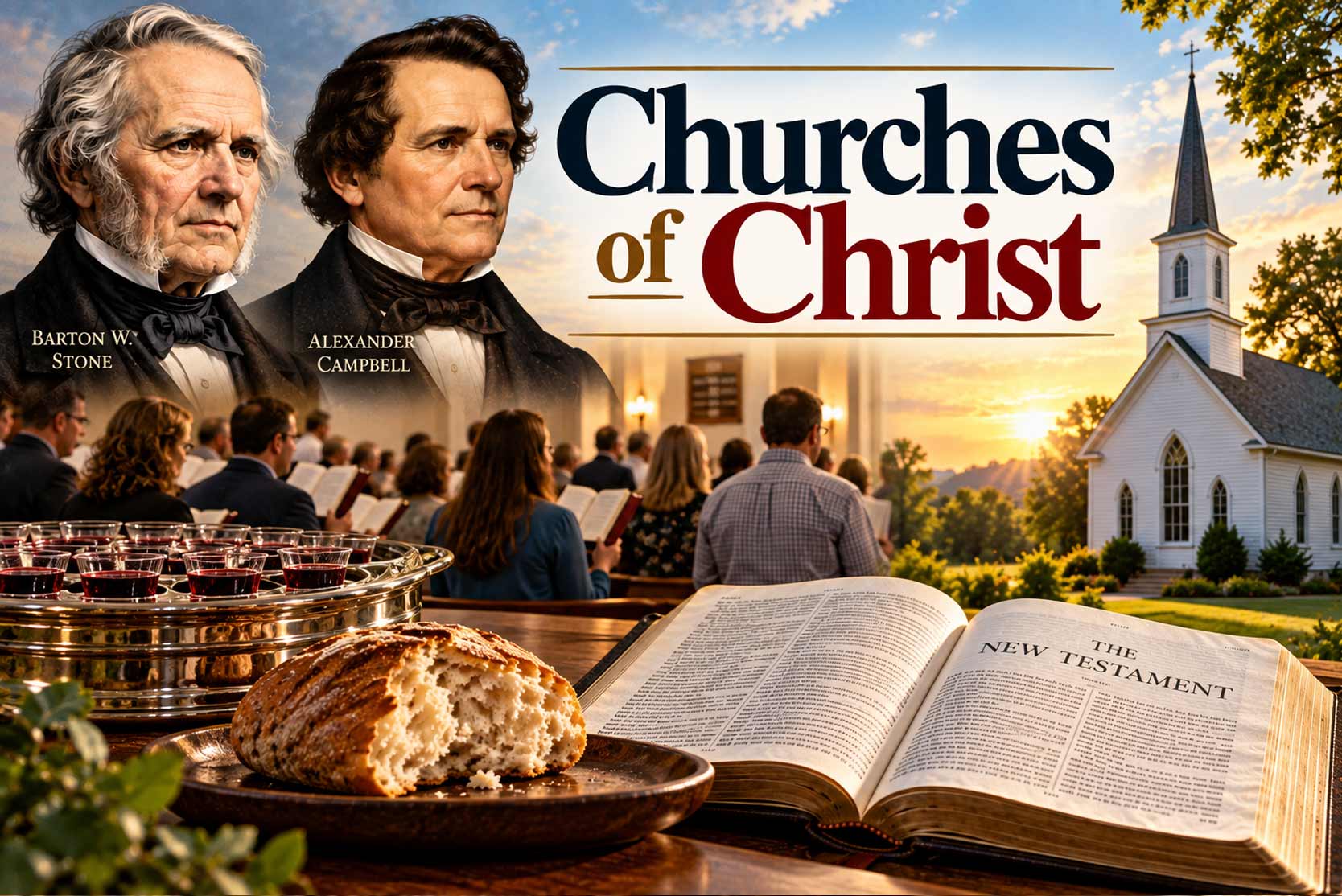
Churches of Christ are one of the three major branches of the Restoration Movement, along with the Christian Church (Disciples of Christ) and the Independent Christian Churches and Churches of Christ. All three trace much of their history to Barton W. Stone, Alexander Campbell and the nineteenth-century effort to restore the faith and practice of the New Testament church. But if the Disciples eventually moved toward the mainline Protestant world, Churches of Christ generally moved in the opposite direction.
Even calling the Churches of Christ a denomination can get you into trouble. Most members don’t think of themselves that way. There is no national Church of Christ headquarters, no denominational president, no bishop overseeing congregations and no central organization with the authority to tell local churches what to do. Each congregation is autonomous, normally governed by its own elders.
That’s not an accidental feature. It’s part of the theology.
Restoring the New Testament Church
Churches of Christ emerged from the same Restoration Movement we discussed earlier. Barton W. Stone and Alexander Campbell believed that denominational divisions had obscured the essential simplicity of New Testament Christianity. Instead of organizing Christians around creeds and denominational traditions, they wanted believers to return to Scripture and simply be Christians.
That sounds simple enough until you try to do it.
Everyone agrees that Christians should follow the Bible. The harder question is what to do when the Bible doesn’t specifically address something. Can a church adopt a practice simply because Scripture doesn’t prohibit it? Or should the church limit its practices to those for which it can find New Testament authorization?
Churches of Christ generally moved toward the second approach.
This became one of the major differences between them and other Restoration churches. It wasn’t enough to argue that something wasn’t forbidden. The question became whether the New Testament provided authority for doing it in the first place.
That principle helps explain several Church of Christ practices that can seem unusual to outsiders.
Why There Are No Instruments
The best-known example is probably instrumental music.
Most Churches of Christ worship without pianos, organs, guitars or other musical instruments. Congregational singing is a cappella, a term that literally means “in the manner of the chapel.”
The reason isn’t that members of Churches of Christ think musical instruments are inherently sinful. The issue is New Testament authority. The New Testament repeatedly refers to Christians singing in worship, but it never instructs churches to accompany that singing with instruments. Therefore, traditional Church of Christ reasoning concludes that the church should practice what the New Testament specifies: singing.
Other Christians respond that the New Testament doesn’t prohibit instruments either. Churches of Christ have historically answered that this misses the point. The church doesn’t need a biblical prohibition against every possible innovation. It needs biblical authority for what it introduces into worship.
Once you understand that argument, a lot of Church of Christ history makes more sense. The disagreement isn’t really about a piano. It’s about how Christians determine what the church is authorized to do.
Not every congregation approaches the issue with exactly the same rigidity today, and a small number of Churches of Christ have introduced instrumental services. Nevertheless, a cappella worship remains one of the movement’s most recognizable characteristics.
Baptism
Baptism is another major emphasis.
Churches of Christ practice baptism by immersion of people who have personally believed the gospel. Infant baptism isn’t practiced because they don’t find it in the New Testament pattern.
But baptism is more than a public symbol of a salvation that has already occurred. Churches of Christ have traditionally taught that baptism is part of the conversion process and is connected with receiving forgiveness of sins. Acts 2:38, where Peter tells his hearers to repent and be baptized “for the remission of sins,” has naturally played an important role in that understanding.
This is one reason evangelical Christians sometimes accuse Churches of Christ of teaching baptismal regeneration. Members of Churches of Christ don’t necessarily accept that description. They generally don’t believe there is saving power in the water itself, and they don’t believe baptism earns salvation. Salvation is made possible by Christ and received through faith, repentance and obedient response to the gospel.
The disagreement is over where baptism fits into that response.
A typical Baptist might say that a person believes, is saved and is then baptized because he has been saved. A traditional Church of Christ understanding places baptism within the process by which the believer responds to the gospel. That difference may sound small when summarized in a sentence, but it has produced a lot of theological argument.
The Lord’s Supper
Churches of Christ normally observe the Lord’s Supper every Sunday.
Here again, the practice comes from an attempt to follow the New Testament pattern. Acts 20:7 describes believers gathering on the first day of the week to break bread, and Churches of Christ have traditionally understood weekly Communion as part of the ordinary worship of the church.
In many congregations, Communion is simple and relatively quiet. Bread and the fruit of the vine are distributed to the congregation following prayer and often a short devotional thought about the death of Christ.
There is no priest standing at an altar transforming the elements into the body and blood of Christ. Churches of Christ reject the Roman Catholic doctrine of transubstantiation. At the same time, Communion isn’t treated as something Christians need to do only a few times a year. It belongs at the center of the weekly gathering.
That’s another Restoration characteristic that survived remarkably well.
How the Churches Are Organized
Local autonomy is extremely important in Churches of Christ.
A congregation with qualified men normally appoints elders, also called shepherds or overseers, who provide spiritual leadership. Deacons serve in various areas of ministry, and preachers teach and preach. A preacher may be highly influential, but he isn’t the ecclesiastical ruler of the congregation.
There is no bishop somewhere who can transfer him to another church.
Congregations cooperate with one another in missions, education, disaster relief and other ministries, but one congregation doesn’t normally exercise authority over another. There are Church of Christ colleges, universities, publications and ministry organizations, but none of them governs the churches.
That independence makes the movement difficult to describe with absolute precision. There is no headquarters that can issue an official doctrinal statement binding every Church of Christ congregation.
It also means there can be significant differences from one congregation to another.
The Divisions
A movement devoted to Christian unity has had its share of divisions.
Some Churches of Christ have disagreed over whether congregations should financially support institutions such as orphanages. Others have disputed whether multiple congregations can cooperate through a sponsoring church arrangement to conduct missionary or benevolent work. Those controversies contributed to the development of what are commonly called non-institutional Churches of Christ.
There have also been disagreements about Sunday schools, multiple Communion cups, kitchens and fellowship halls, women’s roles, worship practices and other issues.
To outsiders, some of these arguments can look remarkably minor. To the people involved, however, they concern a much larger question: Does the church have biblical authority to do this?
That’s the same question that appeared in the instrumental music controversy. Once a movement makes restoration of the New Testament pattern a central principle, determining exactly what belongs to that pattern becomes extremely important.
And Christians don’t always agree about the answer.
Churches of Christ and Other Christians
Historically, some Churches of Christ developed a reputation for believing that they alone constituted the true church. There certainly have been congregations and preachers who spoke that way, sometimes quite emphatically.
The reasoning usually wasn’t that salvation came from belonging to an organization called the Church of Christ. It was that Christ established one church, the New Testament describes that church, and Christians should simply belong to it rather than joining denominations created later in history.
That distinction makes sense within Restoration theology, although outsiders may not find the practical difference particularly large.
Attitudes today vary considerably. Some congregations remain strongly separatist and are reluctant to recognize Christians outside Churches of Christ. Others have developed much warmer relationships with evangelical churches and emphasize the broader body of Christ.
Again, congregational autonomy makes sweeping statements difficult.
What Churches of Christ Believe
Churches of Christ are generally conservative in their view of Scripture and emphasize the authority of the Bible over later creeds and traditions. They believe in the Trinity, the deity of Christ, His death and bodily resurrection, salvation through Christ and the future resurrection and judgment.
Historically, many Churches of Christ have avoided formal creeds. That’s not because they believe doctrine is unimportant. The objection is to making a human statement of faith authoritative alongside Scripture.
The old Restoration instinct remains: Why write another creed when Christians already have the Bible?
That sounds persuasive, but it doesn’t eliminate interpretation. Two people can agree that the Bible is their only authority and still disagree about what the Bible teaches. The history of Churches of Christ demonstrates that as clearly as the history of virtually every other Christian tradition.
A Distinctive American Tradition
Churches of Christ are especially associated with the American South and parts of the Midwest, although congregations can be found throughout the United States and around the world. The movement has also established colleges and universities that have played an important role in its history and culture.
Visitors are likely to notice several things immediately: congregational singing without instruments, weekly Communion, a strong emphasis on Scripture and a relatively simple style of worship. In a traditional congregation, the sermon may contain considerably more Bible quotations than stories about the preacher’s vacation.
Underneath those practices is an idea that reaches all the way back to the Restoration Movement.
What would Christianity look like if Christians could get behind centuries of denominational development and simply practice the faith described in the New Testament?
Churches of Christ have pursued that question more rigorously than most Christian traditions. Whether every conclusion they’ve reached actually reproduces the first-century church is another question. But the attempt to answer it explains almost everything distinctive about them.