
If you’ve visited enough large nondenominational churches in America, you’ve probably noticed that some of them look remarkably similar. The building may be different and the pastor may have a different haircut, but the basic experience is familiar: contemporary worship, a casually dressed pastor, children’s ministries with their own branding, an emphasis on reaching people who don’t normally attend church and a sermon intended to be biblical without requiring a seminary degree to understand it. Somewhere along the way you’re also likely to hear the church described as “life-giving.”
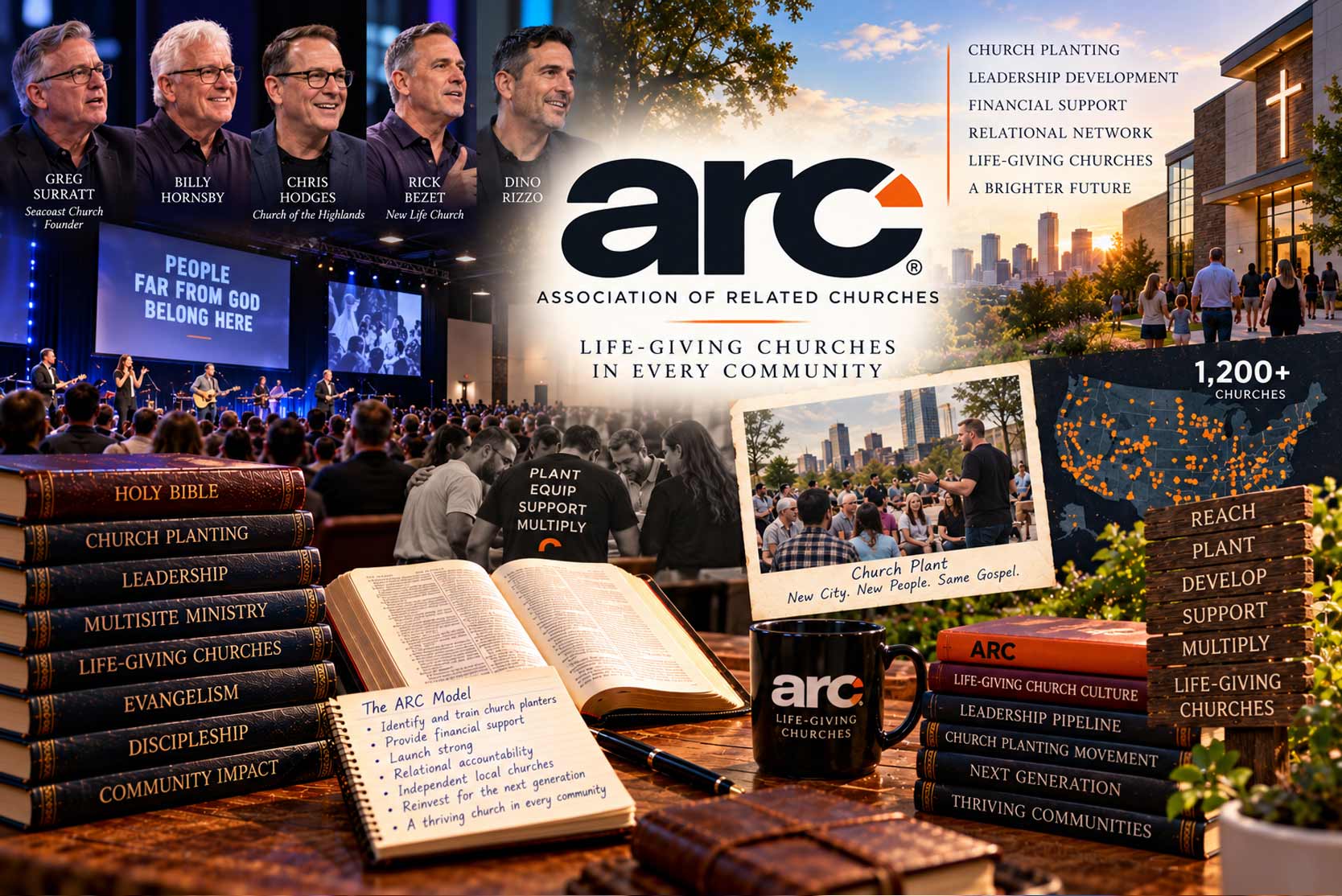
There are several reasons for that family resemblance, but one of the most important is the Association of Related Churches, better known as ARC. ARC isn’t a denomination, and it doesn’t govern the churches associated with it. It’s a church-planting network that provides training, relationships, coaching and financial support to people starting new churches. Since its founding in 2000, ARC has helped launch more than 1,200 congregations, making it one of the most significant church-planting organizations in contemporary American evangelicalism. |
ARC also provides a good example of what has happened as American Christianity has become increasingly nondenominational. Christians may have become less interested in denominations, but they haven’t stopped needing relationships, money, training, accountability and institutional support.
So they created networks.
Where ARC Came From
The story begins with Greg Surratt, founding pastor of Seacoast Church in South Carolina. Surratt had developed a vision of helping plant thousands of what he called “life-giving churches.” The phrase would eventually become closely associated with ARC, describing churches designed to present Christianity in an accessible, positive and contemporary environment.
In 2000 Surratt met Billy Hornsby, who had developed the Cell Church Network at Bethany World Prayer Center in Baton Rouge, Louisiana. Hornsby was impressed with the way Seacoast was attracting people who weren’t regular churchgoers, while Surratt wanted a practical way to reproduce successful churches in other communities. They realized their interests fit together remarkably well.
Several other pastors became part of the original group: Chris Hodges, Rick Bezet, Dino Rizzo and Scott Hornsby. On November 1, 2000, the Association of Related Churches was officially formed. Two of those names would become particularly important. Chris Hodges went on to pastor Church of the Highlands in Alabama, while Rick Bezet planted New Life Church in Arkansas. Both churches became early demonstrations of what the ARC model could produce.
The $25,000 Idea
The original financial model was wonderfully simple. Surratt offered Hodges and Bezet $25,000 each to help launch their churches, along with additional monthly support during their first year. Once those churches became financially stable, they were asked to put the money back into the system so it could help finance the next generation of church plants.
The money therefore didn’t simply disappear into one congregation. It could be recycled into another church and then another. That principle remains part of ARC’s model, although the amounts have grown considerably. ARC currently says it will match the first $50,000 raised by an approved church planter dollar for dollar, with those funds subsequently reinvested into future church plants.
It’s essentially a revolving church-planting fund.Instead of asking a young pastor to move into a city with a Bible, a folding chair and the conviction that somehow everything will work out, ARC tries to give him enough resources and training to have a reasonable chance of surviving the first few years.
Launching Strong
ARC places considerable emphasis on the launch of a new church. Prospective planters receive training in subjects such as budgeting, recruiting volunteers, building teams, church government, marketing and preparing for launch day. ARC recommends that potential planters begin the process roughly twelve to eighteen months before their intended launch.
This represents a significant change from older approaches to starting churches. Traditionally, a pastor might gather a small group in someone’s living room and gradually build a congregation over several years. The ARC model tends to prepare a substantial team before the first public service so that the new church can begin with functioning children’s ministries, worship teams, volunteers and organizational systems already in place.
The idea is to launch large enough to survive. That doesn’t guarantee success, of course. Churches are composed of human beings, and human beings have demonstrated a remarkable ability to complicate even the best organizational plan. But ARC approaches church planting as something that can be studied, planned and improved rather than simply attempted.
The Life-Giving Church
ARC repeatedly uses the expression “life-giving church.” Its stated vision is to see a thriving church in every community reaching people with the message of Jesus.
The phrase isn’t a theological category in the way Reformed, Pentecostal or Baptist would be. It describes more of a ministry philosophy and atmosphere. ARC churches generally want Christianity to appear hopeful, accessible and relevant rather than angry, institutional or unnecessarily complicated.
That often produces churches with contemporary worship, polished children’s programs, practical preaching, casual dress and an intentional friendliness toward people who aren’t already comfortable in church.
There is considerable overlap here with the seeker-sensitive and church-growth movements, although ARC shouldn’t simply be identified with either one. ARC emerged after churches such as Willow Creek and Saddleback had already demonstrated that large numbers of unchurched Americans could be reached through intentionally accessible church environments.
ARC helped take some of those instincts and build a church-planting system around them.
Is ARC a Denomination?
No. ARC is unusually emphatic about this point. ARC describes itself as a cooperative or relational network of independent churches. Churches may belong to other denominations or networks while participating in ARC, and churches planted through ARC remain legally and governmentally autonomous. ARC doesn’t own their property, employ their pastors or exercise denominational authority over them.
The founders made that decision deliberately. ARC’s organizational explanation says they determined from the beginning that the organization wouldn’t become a denomination and wouldn’t exercise operational, financial or governmental authority over churches it helped plant. ARC has conferences, leaders, doctrinal expectations, church planters, affiliated churches, training programs and a recognizable ministry culture. From a distance, that can look suspiciously like many of the things denominations have traditionally provided.
The difference is where the authority stops. A denomination may possess formal authority over churches or ministers. ARC deliberately doesn’t.
Doctrine
ARC churches aren’t required to become theological clones of one another. ARC describes its network as including churches from different denominations, backgrounds, regions and ministry styles. Churches listed in its network are nevertheless expected to align with ARC’s Statement of Faith and values.
In practice, the movement sits comfortably within contemporary evangelical Christianity. The emphasis is on Jesus, biblical authority, conversion, evangelism and the local church rather than detailed theological systems. That helps explain ARC’s broad appeal. A pastor doesn’t necessarily have to settle every debate between Calvinists and Arminians before participating in church planting. Neither does ARC require every church to adopt precisely the same worship style or denominational heritage.
The theological boundaries are real, but the organization is primarily built around mission and church planting rather than theological distinctives. That makes ARC considerably different from something like Acts 29, where a more explicitly Reformed theological identity is part of the network’s character.
Pentecostal and Charismatic Influence
Although ARC isn’t a Pentecostal denomination, some of its important early leaders came from Pentecostal or charismatic backgrounds, particularly through connections with Bethany World Prayer Center. That influence helps explain why ARC culture often feels more comfortable with charismatic Christianity than many traditional conservative evangelical networks.
At the same time, ARC isn’t the Assemblies of God. There is no requirement that every ARC church teach classical Pentecostal doctrines such as speaking in tongues as the initial physical evidence of baptism in the Holy Spirit. Churches within the ARC world can differ considerably in how prominently they emphasize spiritual gifts.
This is another example of the flexibility that comes from organizing around relationships and church planting rather than a detailed denominational confession. The network has theological boundaries, but it also leaves a lot of room inside them.
Church of the Highlands
One of ARC’s most prominent success stories is Church of the Highlands, planted by Chris Hodges in Alabama in 2001. It grew into a large multisite congregation and became influential far beyond Alabama through leadership training, church planting and ministry resources.
Its importance to the ARC story isn’t simply its size. Church of the Highlands demonstrates the kind of congregation the ARC model can produce: contemporary, organizationally sophisticated, evangelistically oriented and designed to reproduce ministry through multiple locations and leaders.
The relationship also works in the opposite direction. Successful churches within the ARC family don’t merely receive help. They become part of the system that helps other churches. That principle was there from the beginning: Somebody helped you, now go help somebody else.
Relationships Instead of Hierarchy
ARC frequently describes itself as a family, and that language reveals something important about the organization. The network is intended to function through relationships among pastors rather than through an ecclesiastical hierarchy.
That can be extremely valuable for independent pastors. One of the hidden problems of nondenominational ministry is isolation. A denominational pastor normally has some larger institutional structure around him. He may complain about the district superintendent, presbytery, bishop or denominational office, but at least somebody knows he exists. An independent pastor can theoretically answer to nobody outside his own congregation.
ARC tries to provide relationships without turning those relationships into denominational government. Its recurring message to pastors is essentially: don’t do ministry alone. That may be ARC’s most important contribution beyond money and training:
Church planting is difficult.
Pastoring can be lonely.
Having people who understand both problems is helpful.
The Accountability Question
The same independence that makes ARC attractive also creates one of the most important questions surrounding the model – Who is responsible when something goes wrong?
ARC explicitly states that it doesn’t exercise oversight authority over local churches. If a pastor experiences a moral failure or leadership crisis, responsibility rests with the accountability structures established by that congregation, often involving local boards and outside pastoral overseers. ARC may sometimes be invited to help, but the organization says it has no authority to intervene in the affairs of an autonomous church.
That’s consistent with the model ARC established from the beginning, but it exposes the permanent tension within nondenominational Christianity. Churches want independence because independence protects them from distant institutions that may become bureaucratic, political or theologically compromised. Yet denominational structures can also provide mechanisms for discipline and accountability when local leadership fails.
ARC tries to solve that problem through relational accountability rather than hierarchical authority. How well that works ultimately depends upon the relationships.
The Overseer Model
Many contemporary nondenominational churches address accountability by establishing outside overseers, usually pastors of other churches who can advise the senior pastor and intervene in certain circumstances. ARC itself notes that many churches in its network use overseers when dealing with serious leadership problems.
The idea makes sense. A pastor should have people outside his own staff who can tell him things his employees may be reluctant to say.
But the model depends heavily upon the quality and independence of those overseers. If the outside pastors are close friends who primarily view their responsibility as protecting one another, accountability can become considerably less impressive than it appears on the organizational chart.
That isn’t uniquely an ARC problem. It’s a church problem. Bishops can fail, elder boards can fail, congregations can fail, independent overseers can fail.
Changing the structure doesn’t eliminate failure, but hopefully it improves the chances for success.
The ARC Church Experience
There is no official ARC liturgy, but the network has developed enough of a culture that many ARC-related churches have a recognizable feel.
The service is usually contemporary. Worship music occupies a prominent place. The pastor generally dresses casually. Children’s ministry receives considerable attention. Sermons tend to emphasize biblical principles that can be applied to everyday life. The church is likely to talk frequently about inviting friends, serving the community and helping people take a “next step” in their relationship with God. None of those things originated with ARC.
What ARC has done particularly well is systematize and reproduce a model of contemporary nondenominational church. That’s more significant than it may sound. Movements don’t spread merely because people agree with their theology. They spread because somebody figures out how to reproduce them.
Branding and the Modern Church
ARC’s influence also belongs to a larger change in the way churches present themselves. Older churches frequently identified themselves by denomination and location: First Baptist Church, First Methodist Church, St. Paul’s Lutheran Church. Modern nondenominational churches often choose names such as Journey, Elevation, Celebration, LifePoint, New Life, Transformation or something equally unlikely to reveal what the church believes from the sign outside.
That isn’t necessarily an attempt to hide theology. It’s usually part of an effort to remove unnecessary barriers for people who have little attachment to denominational Christianity. The approach has worked remarkably well in many places. It has also created an odd situation in which somebody can attend a church for six months without having any idea whether the pastor is basically Baptist, Pentecostal, Reformed or something assembled from pieces of all three.
The Megachurch Connection
ARC is often associated with megachurch culture, and there is a reason for that. Several prominent churches connected with ARC have grown very large, and the organization’s methods emphasize leadership development, systems, scalability and intentional growth.
But ARC doesn’t exist simply to produce megachurches. Its purpose is church planting, and many ARC congregations remain ordinary local churches serving relatively modest communities. The highly visible success stories naturally receive more attention because large churches have larger platforms.
Still, ARC has unquestionably helped spread the organizational DNA of the contemporary megachurch. A church doesn’t have to become enormous to adopt that DNA.
Growth and Numbers
ARC’s growth has been substantial. The organization reported more than 1,200 churches launched during its first twenty-five years, and its current website reports totals continuing to climb beyond that mark. ARC also reports tens of millions of dollars invested in church planting and more than a billion dollars subsequently given to missions and outreach by ARC plants and partner churches.
Numbers like these explain why ARC deserves attention even from Christians who have never heard its name. Millions of Christians attend churches without knowing much about the organizations and networks that helped shape those congregations. The denominational name may have disappeared from the sign, but institutional relationships didn’t disappear with it.
The Strength of ARC
ARC’s greatest strength may be that it recognized church planters shouldn’t have to reinvent everything.
Starting a church requires far more than preaching a sermon. Somebody has to find a meeting place, create a budget, recruit volunteers, establish children’s ministries, organize worship, advertise the launch, handle insurance, develop policies, manage money and somehow convince people to show up on Sunday morning.
None of that sounds particularly apostolic, but all of it still has to be done. ARC provides planters with people who have already made many of those mistakes and can explain how not to repeat them. It also provides financial support at precisely the stage when a new congregation is least capable of generating it. I believe there’s wisdom in that.
The Danger of a Model
The danger is that a successful model can gradually become confused with the biblical model. If a particular style of church consistently attracts people, leaders naturally want to reproduce it. Contemporary worship works, so we reproduce contemporary worship. Strong branding works, so we reproduce strong branding. Practical preaching works, so we reproduce practical preaching. Excellent children’s ministry works, so we reproduce excellent children’s ministry.
Eventually churches in completely different cities begin looking remarkably similar like fast food franchises. That isn’t automatically bad, but Christians should occasionally ask whether we’re reproducing the church or reproducing a particularly successful version of American evangelical culture.
The New Testament gives Christians considerable freedom regarding how churches organize many aspects of ministry. That freedom should allow creativity.
A New Kind of Denominationalism?
ARC illustrates one of the great ironies of modern nondenominational Christianity. Christians spent much of the twentieth century moving away from denominational structures. They wanted independent churches free from centralized bureaucracies and theological drift.
Then those independent churches discovered that they needed training, relationships, conferences, missions partnerships, church planting, leadership development and financial cooperation. In other words, they needed many of the things denominations had been providing. So organizations such as ARC emerged to provide them without exercising denominational authority.
That’s not hypocrisy. It’s actually a reasonable response to a real problem. Christians need one another, and churches accomplish things together that they can’t accomplish alone. But it does suggest that nondenominational doesn’t mean non-institutional.
Why ARC Matters
The Association of Related Churches isn’t a denomination and doesn’t pretend to be one. It is a relational church-planting network built around a simple idea: help people called to start churches avoid doing it alone. ARC provides training, money, coaching and relationships, then leaves the resulting congregation autonomous.
That model has helped produce more than a thousand churches and has influenced the culture of contemporary nondenominational Christianity far beyond congregations that prominently advertise an ARC connection.
It also tells us something important about where American Protestantism may be heading. The old denominational structures haven’t disappeared, but alongside them has emerged another world of networks, conferences, church-planting organizations and pastoral relationships. They perform many of the cooperative functions denominations once performed while leaving authority in the local church.
ARC may therefore be more than a successful church-planting organization. It might be representative of what a significant part of Protestant Christianity looks like in the post-denomination era.