
If you’ve spent much time reading the Bible, you’ve probably noticed that some passages don’t seem to agree with others. Two accounts describe an event differently, a number changes between books, or one verse appears to teach something that another verse denies. You don’t have to be trying to discredit Christianity to notice these things. Sometimes you discover them simply because you’re paying attention.
My answer is that the Bible contains real differences and some difficult discrepancies, but not everything called a contradiction actually is one. Some problems disappear when we read the surrounding passage or understand what kind of writing we’re reading. Others remain difficult even after careful study. I believe the Bible is inspired and authoritative, but I don’t believe that requires me to insist that its human authors never got a factual detail wrong. That allows me to examine these passages without deciding in advance that every proposed harmonization must be correct.
What Counts as a Contradiction?
A contradiction occurs when two claims cannot both be true in the same sense and under the same circumstances. Saying that an event happened on Tuesday and saying that the same event happened on Wednesday would be a contradiction if both statements use the same calendar and refer to the same occurrence. Saying that one person attended an event and saying that two people attended it isn’t necessarily contradictory. The first statement might identify one person without claiming that nobody else was there.
That distinction matters when we compare biblical accounts. An author may mention one speaker while another mentions additional people who were present. One writer may summarize an encounter while another provides more detail. Different wording, different emphasis, and omitted information don’t automatically establish a contradiction. Before declaring that two passages disagree, we need to identify what each passage actually claims.
However, that principle shouldn’t become an excuse to explain away every difference. If one passage gives a total of 500,000 and another gives a total of 470,000 for what appears to be the same group, we have a numerical discrepancy that needs examination. There may be a reason for the difference, but we shouldn’t quietly insert that reason into the text and then treat it as something the author told us. A possible explanation and an established explanation are different things.
Some Apparent Contradictions Are Matters of Context
Proverbs 26:4–5 provides an interesting example. One verse tells us not to answer a fool according to his folly, while the next tells us to answer a fool according to his folly. If we treat both statements as universal commands governing every conversation, they appear to conflict. But the verses give different reasons for their advice, which helps us understand what the writer is doing.
The first warns against becoming like the fool ourselves. The second warns against leaving him convinced that he is wise. My reading is that these neighboring proverbs describe competing dangers that require judgment. Sometimes engaging a foolish argument pulls us into the same foolishness; sometimes refusing to respond allows a harmful claim to go unchallenged. Anyone who has spent time in an online discussion has probably encountered both situations, occasionally within the same five minutes.
The literary form matters here. Proverbs offer wisdom for navigating life, rather than a mechanical procedure that removes the need for discernment. Reading a proverb as an exceptionless rule can create a problem the passage wasn’t intended to create. We should consider whether a supposed contradiction results from our expectations before assuming that the author has contradicted himself.
Different Accounts Don’t Have to Be Identical
The Gospels describe many of the same events, but they don’t always include the same details. Matthew’s resurrection account features an angel who speaks to the women, while Luke describes two men in dazzling clothing at the tomb. Mentioning one figure doesn’t, by itself, assert that only one was present. That observation answers the narrow claim that the numbers alone necessarily contradict each other. It doesn’t automatically settle every question about the accounts’ locations, sequence, or descriptions.
We should allow each writer to tell his account before trying to assemble a combined version. Otherwise, we can end up remembering our reconstruction more clearly than the passages themselves. A harmonization may help explain how accounts could fit together, but it shouldn’t replace them. Nor should we assume that every difference is proof of independent eyewitness testimony; writers can differ for several reasons.
Chronology also requires care. A writer may arrange material around a subject rather than report every event in strict sequence. But we need reasons for identifying that arrangement, especially if the passage seems to make a chronological claim. “The author wasn’t writing chronologically” can be a reasonable explanation in one case and an unsupported escape route in another. The wording and structure of the particular passage should guide the decision.
Some Numerical Differences Are Harder to Resolve
The reports of David’s census illustrate a more concrete difficulty. Second Samuel 24:9 gives 800,000 fighting men in Israel and 500,000 in Judah. First Chronicles 21:5 gives 1,100,000 in Israel and 470,000 in Judah. The figures are plainly different, even though both passages describe Joab reporting the census to David.
Different counting categories or a problem in transmission could potentially account for such a discrepancy. But identifying the actual cause requires evidence beyond our preference for a particular explanation. The passages don’t explicitly provide a complete accounting method that makes the totals agree. We can acknowledge that possibilities exist while also acknowledging that the difference remains unresolved.
My belief in inspiration doesn’t require me to rule out a factual mistake by a human author. At the same time, I don’t need to declare that an author made a mistake whenever two figures differ. We may lack enough information to determine where the discrepancy originated. What we can establish is that the figures in the passages as we have them don’t match.
What About Judas’s Death?
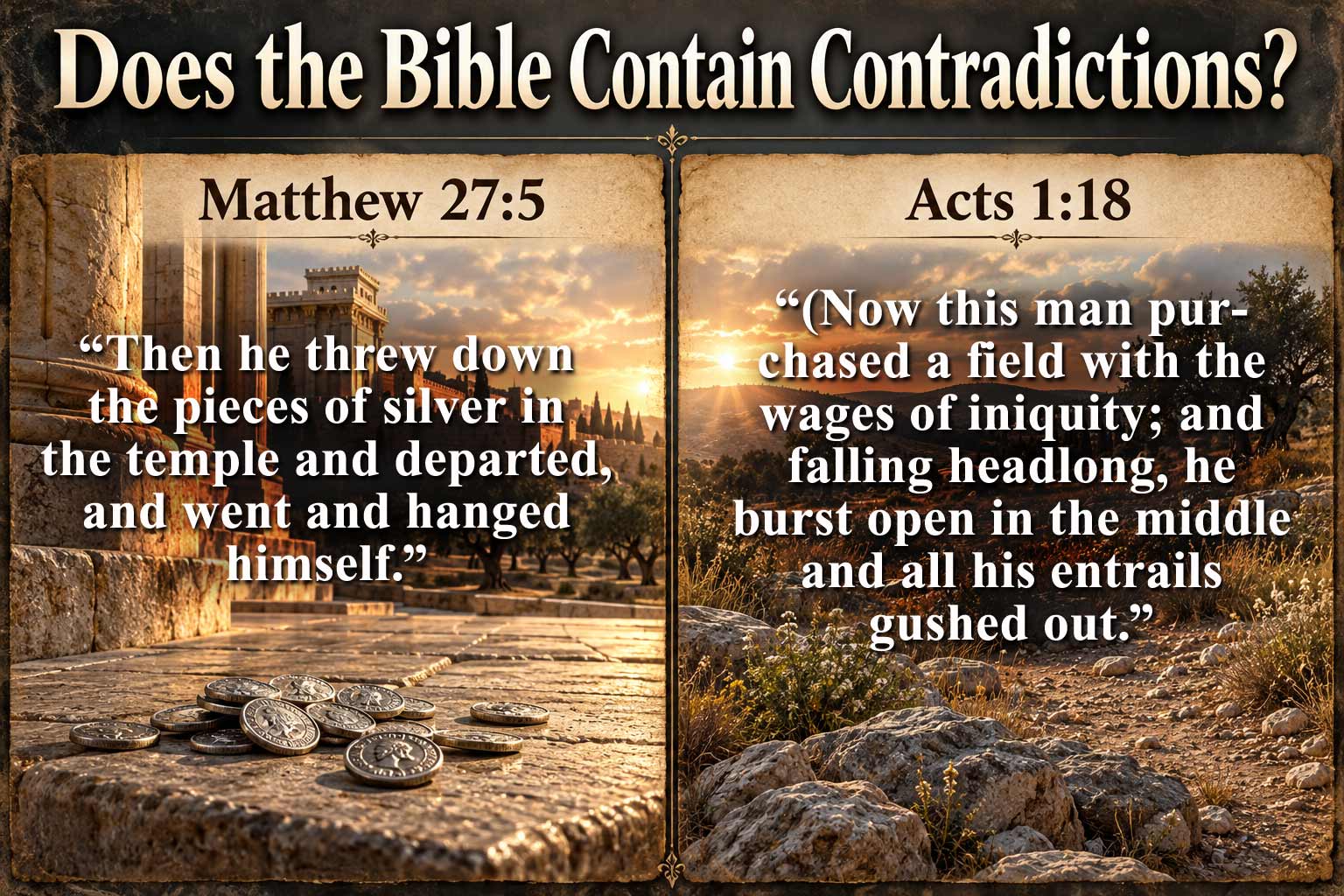
Matthew 27 describes Judas returning the betrayal money, leaving, and hanging himself. The priests then use the money to purchase the potter’s field. Acts 1 associates Judas with acquiring a field through the proceeds of his wrongdoing and describes a headlong fall in which his body bursts open. These accounts raise questions about both the circumstances of his death and the acquisition of the field.
One proposed explanation is that Judas hanged himself and his body later fell. Another is that Acts attributes the field to Judas because it was purchased with his money, although the priests carried out the transaction. Those suggestions could explain how elements of the accounts might fit together. Neither passage, however, explicitly supplies that combined sequence.
I don’t think we should ridicule a proposed explanation merely because it includes an inference. Historical reconstruction often involves inference. But the explanation should be presented according to the strength of its evidence, rather than announced as a settled fact. I’m comfortable saying that I don’t know exactly how these accounts relate. That uncertainty doesn’t require me to stop believing in Jesus, and it doesn’t require me to pretend the difficulty isn’t there.
Does a Discrepancy Make the Whole Bible Unreliable?
A factual discrepancy gives us a reason to examine the reliability of the relevant detail. It doesn’t automatically prove that every other statement in the document is false. We ordinarily recognize this when reading historical accounts, biographies, or personal recollections. A source can be informative and substantially reliable while still containing mistakes, although the number, seriousness, and pattern of those mistakes affect our assessment.
That doesn’t mean every biblical difficulty is trivial. Some questions concern details that have little bearing on the central Christian message, while others concern events or teachings that matter greatly. We need to assess the particular claim and the evidence for it. A disagreement over census totals doesn’t settle whether Jesus rose from the dead, but calling a difficulty “minor” also doesn’t explain it.
Christianity makes historical claims, and those claims deserve historical examination. The resurrection matters because Christians believe it happened, rather than merely because the story is encouraging. My willingness to acknowledge possible factual errors doesn’t remove the need to investigate the foundations of Christian belief. It means that I don’t require every biblical detail to be beyond dispute before that investigation can begin.
How Should We Approach a Difficult Passage?
The first step is to read the passages in full. We should identify who is speaking, what the author is asserting, and whether the passages actually refer to the same event or circumstances. We also need to distinguish historical narration from poetry, proverbial advice, figurative language, and reported speech. The Bible records statements by people whose judgments the surrounding account does not endorse.
Then we should compare interpretations and examine the reasons behind them. A translation difference may clarify a problem, but it may also leave it unchanged. A commentary may provide useful historical information or offer a reconstruction that deserves further scrutiny. We shouldn’t accept an explanation merely because it comes from someone who shares our theology, any more than we should accept an accusation merely because it sounds confident.
Sometimes careful reading resolves the difficulty. Sometimes it reveals several plausible explanations without establishing which one is correct. Sometimes we conclude that the accounts contain an actual factual disagreement. Those are different outcomes, and honest study should leave room for all of them.
Faith and Honesty Belong Together
I believe Scripture is inspired and authoritative, and I want to receive its teaching with the seriousness that deserves. I also recognize that it came through human authors whose perspectives and limitations are visible in their writings. I don’t believe I’m honoring God by claiming certainty where I don’t have it. Nor do I think acknowledging a discrepancy gives me permission to dismiss a teaching simply because I find it uncomfortable.
When someone asks whether the Bible contains contradictions, I’d rather examine the passages with them than answer with a slogan. Some alleged contradictions reflect a misunderstanding, and others identify genuine difficulties. We can explain the former and acknowledge the latter without treating honest questions as threats. The same Bible that calls us to faithfulness also calls us to speak truthfully, and that includes speaking truthfully about the Bible itself.