
If you grew up reading a Protestant Bible, opening a Catholic Bible can produce a surprise. Alongside familiar books such as Genesis, Psalms, and Isaiah, you’ll find titles such as Tobit, Wisdom, and Sirach. You might also discover passages in Esther and Daniel that aren’t in your usual edition. These aren’t differences in translation; they reflect a disagreement about which writings belong in Scripture.
Catholic Bibles contain seventy-three books, while the standard Protestant collection contains sixty-six. Both have the same twenty-seven New Testament books. The difference concerns the Old Testament, where Catholics recognize forty-six books and Protestants recognize thirty-nine. Explaining why requires more than saying that Catholics added books or Protestants removed them. Those descriptions assume the very thing the two traditions disagree about: which collection should be regarded as the proper standard.
Which Books Are Different?
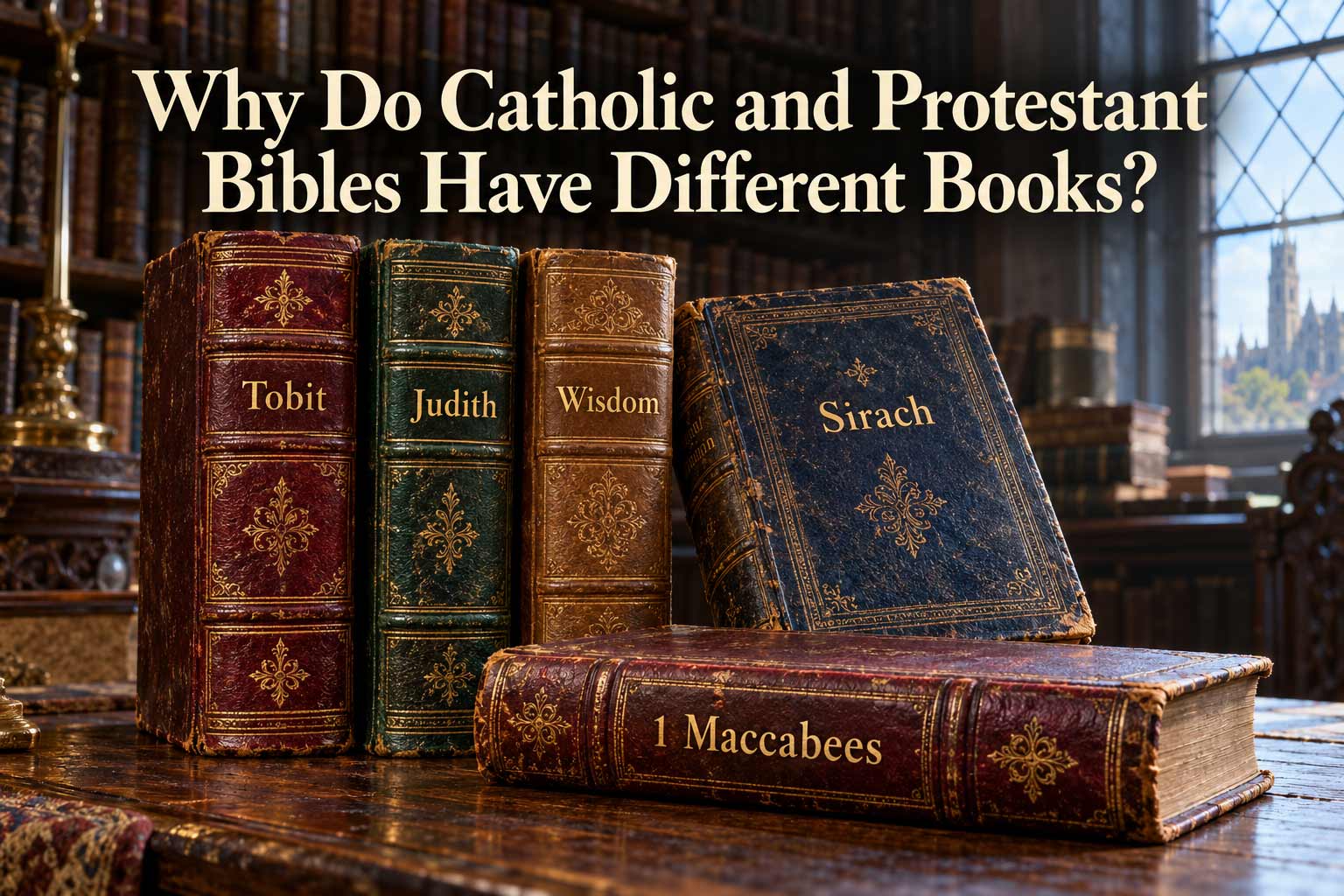
The seven books found in the Catholic Old Testament but outside the Protestant Old Testament canon are Tobit, Judith, Wisdom of Solomon, Sirach, Baruch, and 1 and 2 Maccabees. Sirach is also called Ecclesiasticus, which shouldn’t be confused with Ecclesiastes. Catholic versions of Esther and Daniel also contain additional material. In Daniel, this includes the Prayer of Azariah and the Song of the Three Young Men, Susanna, and Bel and the Dragon.
Catholics commonly call these writings “deuterocanonical,” a term associated with their disputed history of recognition. That doesn’t mean Catholic doctrine treats them as less inspired than Genesis or Isaiah. They are received as Scripture. Protestants commonly place them within a collection called the Apocrypha, although Protestant Apocrypha collections can include other writings as well.
The terminology can be confusing because “apocryphal” is also used more broadly for writings outside biblical canons. A reference to the Old Testament Apocrypha doesn’t ordinarily mean the Gospel of Thomas or a medieval story about Jesus. We need to identify the particular collection being discussed. Otherwise, a conversation about seven ancient Jewish books can wander into a debate about entirely different literature.
The Disagreement Began Before the Reformation
The earliest Christians inherited Israel’s Scriptures, but the history of those Scriptures wasn’t identical in every community. Greek-speaking Jews and Christians used Greek translations and other Jewish religious writings. The collection we commonly call the Septuagint became especially important in Christian reading and worship. Additional books were transmitted alongside writings that appear in every Christian Old Testament.
However, we shouldn’t picture one universally agreed, neatly bound Septuagint with an identical table of contents everywhere. Surviving ancient Christian Greek biblical manuscripts differ in their contents. The presence of a work in a manuscript also needs to be considered alongside other evidence about how readers regarded it. Being preserved with biblical writings is important evidence of reception, but it doesn’t settle every question about canonical status.
The Jewish canon eventually took the twenty-four-book form familiar in Judaism today. Its contents correspond to the thirty-nine books of the Protestant Old Testament, with different arrangements and divisions. Protestants generally follow those boundaries for their Old Testament. Catholics give greater weight to the broader collection received in the church’s tradition.
These differences cannot be explained simply by saying that the disputed books were written in Greek. Some originated in Hebrew or Aramaic, while others were composed in Greek. The issue concerns their reception and authority, rather than a rule that God could inspire one ancient language but not another. Language is part of the history, but it doesn’t provide a complete explanation.
Early Christians Didn’t All Agree
Jerome and Augustine illustrate the disagreement within ancient Christianity. Jerome, whose translation work helped shape the Latin Vulgate, gave particular weight to the Hebrew collection. In his preface to the books of Solomon, he distinguished writings the church read for instruction from writings used to establish doctrine. He placed Wisdom and Sirach in that category, alongside books such as Judith, Tobit, and Maccabees.
Augustine received a broader Old Testament collection. His list in On Christian Doctrine includes Tobit, Judith, Maccabees, Wisdom, and Sirach. He also emphasized the reception of books across the churches when discussing how readers should judge the canon. These two influential Christian teachers therefore provide evidence of different approaches long before Luther.
Over time, the broader collection became deeply established in Western Christian biblical use. Yet questions about the status of particular books didn’t disappear altogether. The ancient and medieval history contains both acceptance and reservations. That makes it difficult to defend either the claim that nobody regarded these books as Scripture before the Reformation or the claim that every Christian had always agreed about them.
What Changed During the Reformation?
The Protestant Reformers reconsidered the authority of inherited church practices and teachings, including the boundaries of the Old Testament. Many gave priority to the books of the Hebrew canon. They also drew on earlier Christian distinctions, particularly those associated with Jerome. Their position had historical precedents, even though the Reformation gave it a new and more sharply defined place in Christian division.
Luther’s complete German Bible of 1534 still printed the Apocrypha. He placed these writings in a separate section and described them as useful to read without regarding them as equal to Holy Scripture. That distinction matters. He rejected their canonical standing, but he didn’t simply make the writings unavailable to his readers.
Other Protestant traditions also distinguished usefulness from scriptural authority. Article VI of the Church of England’s Thirty-Nine Articles permits reading certain books for moral instruction while denying their use to establish doctrine. Protestant treatment wasn’t uniform, and some traditions took a more restrictive approach. But rejecting a book as canonical didn’t always mean rejecting every kind of religious use.
This is why we need to distinguish two questions: Was a book printed inside a Bible, and was it received as inspired Scripture? Those questions overlap, but they aren’t identical. A separate Apocrypha section communicated a different judgment from placing the same books among the canonical Old Testament writings. The physical contents of an edition don’t tell the whole story without its arrangement and stated purpose.
What Did the Council of Trent Decide?
In April 1546, the Council of Trent formally affirmed the Catholic collection, including the disputed books and the relevant portions of Esther and Daniel. This was part of the Catholic response to the challenges of the Reformation. The council required their reception as sacred and canonical. It settled the issue authoritatively for Roman Catholic teaching.
Trent didn’t invent Tobit or discover Maccabees in a forgotten cupboard. These writings had been read, copied, and received as Scripture by Christians for centuries. Their place in Catholic tradition was considerably older than the council. What Trent did was give a definitive ruling in a setting where their authority had become a major point of controversy.
At the same time, saying that Trent merely repeated something every Christian had always believed would conceal the earlier disagreements. The decision affirmed an established tradition while closing off competing judgments within Catholic doctrine. Both parts of that history matter. We can acknowledge the antiquity of Catholic reception without pretending the canon had never been questioned.
Was the Disagreement Really About Doctrine?
Doctrine played a role because the status of a book affects whether its teaching can establish Christian belief. Second Maccabees, for example, describes prayer and an offering on behalf of the dead. Catholics see that passage as relevant to their understanding of prayer for the departed. Protestants who reject the book’s canonical authority don’t receive it as a scriptural basis for that practice.
However, it would be too simple to say that the entire Protestant position resulted from disliking that passage. Arguments about the Hebrew canon and distinctions among church books existed long before the Reformation. Likewise, Catholic acceptance cannot reasonably be reduced to a plan to obtain support for one disputed doctrine. The broader reception of these writings also preceded the sixteenth-century controversy.
The deeper disagreement concerns authority. Catholics understand the church’s authoritative discernment within apostolic tradition as essential to identifying Scripture. Protestants generally argue that the church receives and recognizes Scripture but can be mistaken in its judgments about particular writings. Both appeal to history, but they understand the authority of that history differently.
What About Orthodox Bibles?
The Catholic–Protestant comparison doesn’t describe every Christian Bible. Orthodox traditions receive broader Old Testament collections, and those collections aren’t identical everywhere. Some include writings such as 3 Maccabees or Psalm 151. Other Christian traditions have additional distinctive histories of scriptural reception.
That wider picture should discourage us from assuming that the only possible collections are the two we know best. It doesn’t make the question of the canon unimportant or imply that every collection is equally justified. It does show that Christianity’s biblical history is more complicated than a single division between Rome and the Reformers. Any explanation that ignores the Eastern churches leaves out a substantial part of the story.
Can Protestants Read These Books?
A Protestant can read these writings without first accepting the Catholic canon. Their history, wisdom, and religious themes can help us understand the Jewish world preceding and surrounding early Christianity. First Maccabees, for example, introduces readers to the struggle associated with the Maccabean revolt. Reading it can be worthwhile even while questions about its inspiration remain separate.
Our Jew & Greek resources include these writings so readers can examine them rather than rely entirely on descriptions from opposing sides. Providing access doesn’t automatically confer canonical authority. We make the same basic distinction when offering early Christian writings, commentaries, or other historical resources. A book can deserve attention without being placed on the same level as Scripture.
Catholic and Protestant Bibles differ because their traditions reached different judgments about the Old Testament’s boundaries. Those judgments developed through centuries of reading, debate, and formal decisions. We can explain that history without accusing ordinary Catholics or Protestants of tampering with the Bible. Understanding the disagreement gives us a better foundation for evaluating it than starting with a charge and searching afterward for evidence.