
Most of us have had the experience of reading the Bible, arriving at a difficult passage, and wondering what we just read. Sometimes the language is unfamiliar. Sometimes the passage seems to disagree with something we read elsewhere. Other times we understand the words well enough, but we struggle with what they appear to say about God.
That doesn’t mean we’ve failed as Christians. Peter acknowledged that some things in Paul’s letters were hard to understand, and he knew Paul personally. The Bible is a collection of writings from different authors, cultures, and historical settings. We shouldn’t expect every part of it to be immediately clear to someone reading it thousands of years later.
The question is how we respond to that difficulty. We can ignore it, accept the first explanation we find, or decide that an unfamiliar passage must be wrong. We can also slow down, investigate, and admit what we haven’t figured out. That last approach gives us room to learn without pretending that we already have all the answers.
Identify What You Don’t Understand
Before looking for an explanation, try to identify the actual problem. Is there a word you don’t recognize? Are you unsure who is speaking or what situation the writer is addressing? Does the passage seem to contradict another passage, or does it raise a moral question? Those are different problems, and they require different kinds of investigation.
It can help to write your question in a sentence. “I don’t understand this chapter” is harder to work with than “Why does Paul give this instruction to this church?” A specific question gives your study some direction. It also helps you recognize whether a commentary or teacher has actually answered your question instead of discussing something nearby.
We should also distinguish between not understanding a passage and not liking what it says. Sometimes we need more information. Sometimes we understand the teaching but find it uncomfortable. We shouldn’t assume that every troubling passage is clear, but we shouldn’t call something confusing merely because it challenges us either.
Read Around the Passage
Our first move should usually be to keep reading. Read the paragraph before the difficult verse and the paragraph after it. If necessary, read the whole chapter or look back through the book. A statement that seems strange by itself may make sense once we see the question being answered or the argument being developed.
Pay attention to who is speaking and who is being addressed. The Bible records accusations, mistaken beliefs, foolish advice, and outright lies as part of its accounts. Recording a statement doesn’t mean endorsing it. We also need to ask whether we’re reading a command, a description, a poem, a parable, or a vision.
Historical background can help, too. An unfamiliar custom or conflict may explain why a writer emphasizes something that seems unusual to us. That doesn’t mean we need an advanced degree before we can benefit from Scripture. It means that when we encounter a difficulty, we should investigate the setting before making a sweeping conclusion.
Compare Translations and Consult Reliable Resources
Comparing a few translations can reveal whether your difficulty comes from the English wording. An older expression may be clear in a contemporary translation. A complicated sentence may become easier to follow when another translation arranges it differently. Sometimes the comparison will show that the underlying language itself allows more than one interpretation.
We shouldn’t simply choose whichever translation gives us the answer we prefer. Nor does counting translations settle every question. Several versions may follow the same interpretive tradition, while another makes a different decision for a reason worth considering. Translation notes can be especially useful because they sometimes identify an uncertainty that the main text cannot fully explain.
A good study Bible or commentary can provide information about language, background, and competing interpretations. Look for resources that explain their reasoning and distinguish evidence from speculation. An explanation should help you see why a particular reading makes sense in the passage. The author’s confidence, popularity, or agreement with your existing beliefs isn’t enough by itself.
Ask for Help
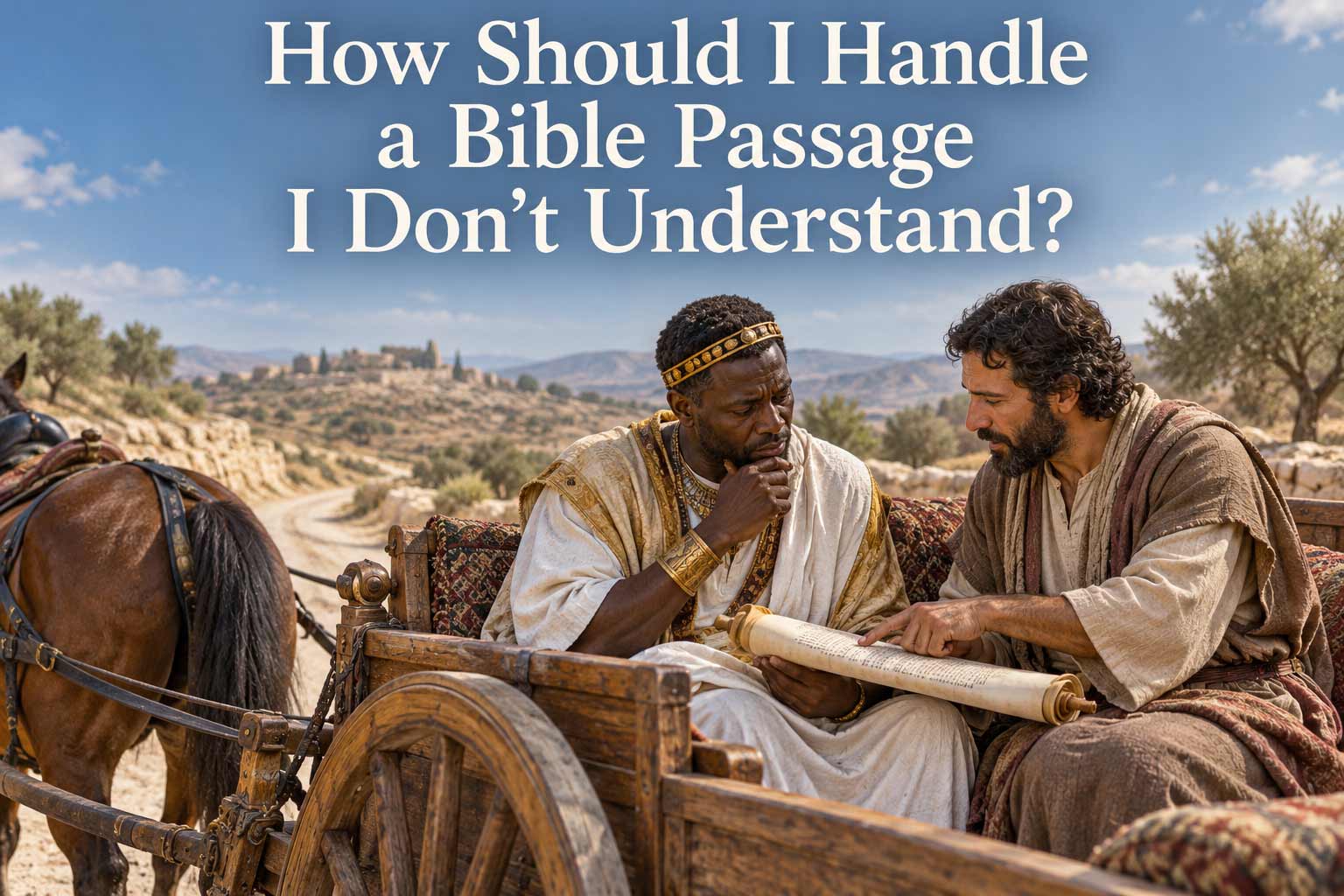
In Acts 8, Philip encountered an Ethiopian official reading Isaiah. When Philip asked whether he understood what he was reading, the man replied, “How can I, except some man should guide me?” He then asked whom the prophet was describing, and Philip began with that passage to explain Jesus. His willingness to ask a question opened the door to understanding.
There’s no shame in needing help. God has given the church teachers, and we can benefit from people who have spent time studying questions we’re encountering for the first time. A pastor, a knowledgeable friend, or a careful Bible teacher may help us notice something we missed. Asking for assistance is part of learning.
Still, a teacher’s explanation should be examined. Ask how it fits the surrounding passage and what supports it. If sincere Christians disagree, find out where the disagreement comes from rather than assuming that one side must be dishonest. You can respect someone’s knowledge while recognizing that teachers, like the rest of us, can make mistakes.
Pray for Wisdom Without Expecting an Instant Answer
James encourages those who lack wisdom to ask God for it. That invitation applies when we’re struggling to understand Scripture, too. We can ask God to help us read honestly, recognize our assumptions, and receive correction. Prayer reminds us that Bible study involves our attitudes as well as our information.
But prayer doesn’t guarantee that the first interpretation that comes to mind is correct. Feeling strongly about an explanation doesn’t make it the Holy Spirit’s explanation. God may help us through further reading, a conversation, a teacher, or something we learn much later. We should remain open to His guidance without treating our impressions as beyond examination.
Sometimes the answer will come slowly. We may need to become familiar with a book’s argument or learn something about its background before a passage becomes clearer. That process can develop patience and humility. There’s no reason to turn Bible study into a contest to see who can produce the quickest answer.
Be Honest About Difficulties
Some passages raise questions that don’t disappear after a quick search. There may be an apparent discrepancy between accounts, an uncertain historical detail, or a moral problem that deserves serious attention. We shouldn’t force an explanation merely because we’re uncomfortable leaving the question unresolved. A strained defense can create more problems than the difficulty it was supposed to solve.
I believe the Bible is inspired and authoritative, but I don’t believe that requires us to insist that its human authors never got a factual detail wrong. That doesn’t mean every apparent discrepancy is an error. It means we can examine each question honestly without deciding in advance that only one kind of conclusion is acceptable. Respect for Scripture should encourage careful reading.
An unresolved question also doesn’t invalidate everything else we understand. We regularly recognize someone’s insight without knowing how to explain every statement they’ve made. With Scripture, we can take a difficulty seriously while continuing to learn from its witness to God, Jesus, and the life of faith. We don’t have to pretend that a problem is insignificant or let it become the only thing we can see.
Leave Room to Keep Learning
It’s reasonable to reach a provisional conclusion. You might decide that one interpretation fits best while recognizing that another deserves consideration. You might also decide that you don’t yet have enough information to choose. Write down the question, the explanations you’ve encountered, and the reasons you find them persuasive or unpersuasive.
Be especially cautious about building a major doctrine on a passage whose meaning remains uncertain. An obscure verse shouldn’t carry more weight than it can bear. Consider how an interpretation fits the broader teaching of Scripture, while still allowing the difficult passage to contribute something of its own. The goal is understanding, not making every verse repeat what we already believe.
Meanwhile, keep reading and put into practice what you do understand. An unanswered question about one passage doesn’t prevent you from loving your neighbor, forgiving someone, praying, or helping a person in need. You may return to the question later with greater knowledge and a different perspective. Faithful reading includes both the willingness to learn and the honesty to say, “I haven’t worked this out yet.”