
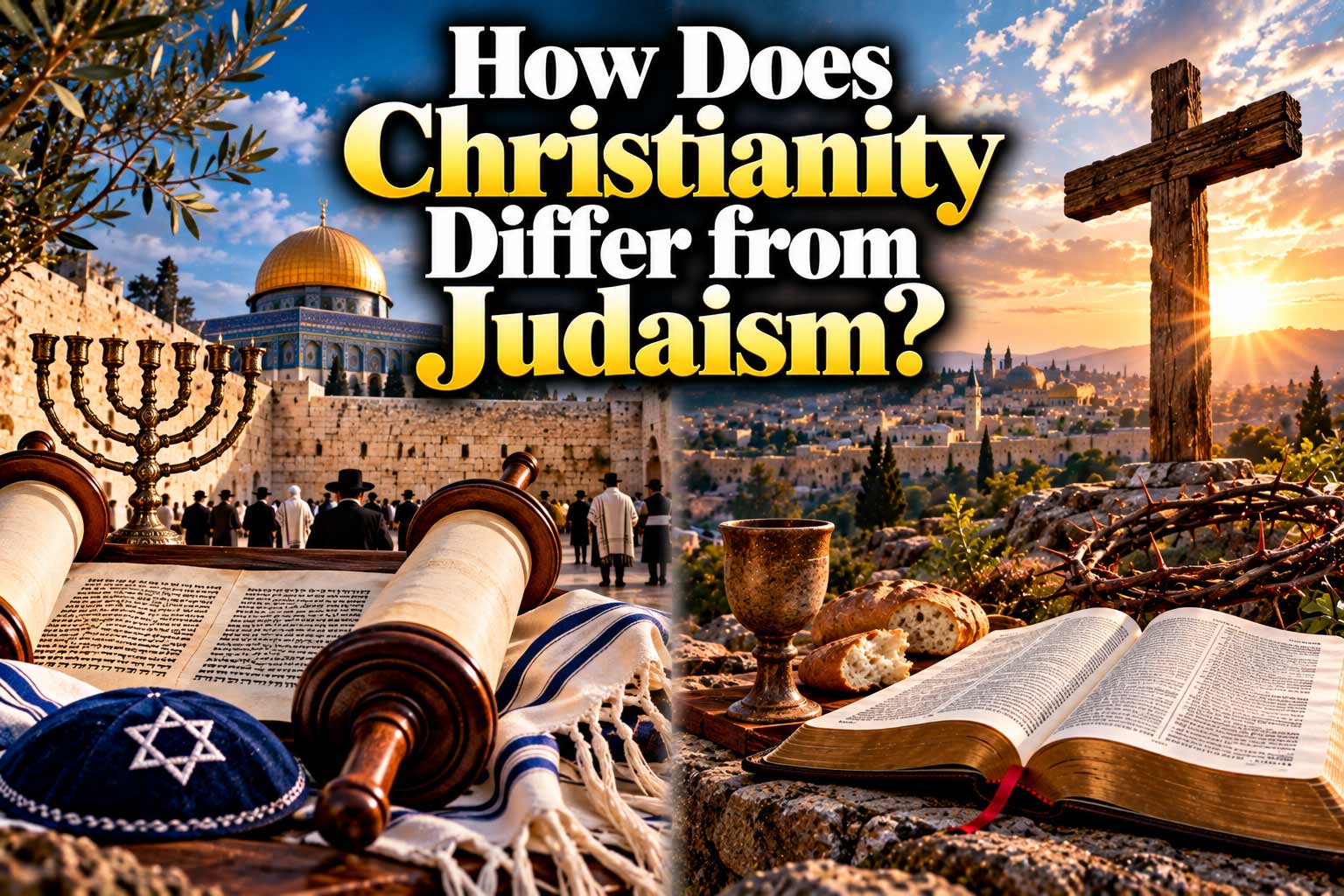
Christianity and Judaism have more in common than many people realize. Both believe in the God of Abraham, Isaac, and Jacob. Both regard the Hebrew Scriptures as sacred, affirm that God created the universe, and teach that human beings are morally accountable to Him. Christianity also emerged from Judaism, and its earliest followers were Jews who believed that Jesus of Nazareth was the promised Messiah.
That last point is where the two religions began to separate. Christians believe Jesus is the Messiah foretold in the Hebrew Scriptures, the Son of God who died for humanity’s sins and rose from the dead. Judaism rejects those claims and continues to await the fulfillment of the messianic promises. What began as a disagreement among Jews about the identity of Jesus eventually developed into two distinct religious traditions.
Understanding the differences requires more than comparing a church service with a synagogue service. The disagreement concerns the identity of God, the meaning of the Messiah, the authority of Scripture, the nature of salvation, and the relationship between Israel and the nations. But to understand those differences properly, we need to begin with what Christianity inherited from Judaism.
Christianity Began as a Jewish Movement
Jesus was born into a Jewish family, circumcised according to the Law of Moses, and raised within the religious traditions of first-century Judaism. He attended synagogues, observed Jewish festivals, and taught from the Scriptures of Israel. His twelve apostles were Jewish, as were the earliest members of the Church.
The New Testament makes little sense without this background. Jesus’ teaching about the kingdom of God, His references to Abraham and Moses, and His arguments with the Pharisees all took place within the world of Second Temple Judaism. Even His disagreements with Jewish religious leaders often resembled disputes already occurring among different Jewish groups.
The earliest Christians didn’t believe they were abandoning the God of Israel for a different deity. They believed that Israel’s God had fulfilled His promises through Jesus. Peter’s sermon in Acts 2, for example, presented Jesus’ resurrection and exaltation as the fulfillment of God’s covenant promises.
The relationship became more complicated as Gentiles began joining the movement. Acts 15 records a major disagreement over whether Gentile believers needed to be circumcised and observe the Mosaic Law. The apostles concluded that Gentiles didn’t need to become Jews in order to follow Jesus, a decision that helped Christianity develop into a worldwide religious movement.
The separation between Judaism and Christianity occurred gradually over the first several centuries. The destruction of Jerusalem’s temple in AD 70, the development of rabbinic Judaism, and increasing numbers of Gentile Christians all contributed to the emergence of distinct communities. It wasn’t a matter of Jesus founding one religion on Friday and His followers starting another on Sunday.
The Greatest Difference Is Jesus
The central disagreement between Christianity and Judaism concerns the identity of Jesus Christ.
Christians believe Jesus is the promised Messiah, the Son of God, and the eternal Word who became flesh. According to John 1:1–14, the Word was with God, was God, and entered human history through the incarnation. Christianity teaches that Jesus is fully divine and fully human, that His death accomplished redemption, and that His bodily resurrection confirmed His identity and victory over death.
Judaism doesn’t accept Jesus as the Messiah or as divine. Traditional Jewish teaching understands the Messiah as a future human descendant of David who will bring about the restoration of Israel, establish peace, gather the Jewish exiles, and inaugurate an era of widespread knowledge of God.
From a Jewish perspective, those expectations haven’t been fulfilled. Wars continue, suffering remains widespread, and the world hasn’t entered the promised age of peace. Consequently, Judaism doesn’t recognize Jesus as having accomplished the messianic mission.
Christians respond by distinguishing between Christ’s first coming and His future return. They believe Jesus fulfilled the promises concerning the suffering Messiah through His death and resurrection and will complete the remaining messianic expectations when He returns.
That distinction is fundamental to Christianity, but it isn’t accepted within Judaism. Jewish interpreters generally understand the messianic prophecies differently and don’t see biblical grounds for dividing the Messiah’s work into two comings separated by thousands of years.
This disagreement can’t be resolved by saying that Jews and Christians simply use different names for the same religious figure. Christianity’s entire understanding of salvation depends on claims about Jesus that Judaism rejects.
Do Jews and Christians Believe in the Same God?
Both religions identify the God of Abraham, Isaac, and Jacob as the Creator of heaven and earth. Christians believe the God revealed in the Hebrew Scriptures is the same God revealed through Jesus Christ. They don’t believe Jesus introduced a new deity who replaced Israel’s God.
However, Christianity teaches that the one God eternally exists as Father, Son, and Holy Spirit. The doctrine of the Trinity maintains that these are three distinct persons sharing one divine nature, not three separate gods.
Judaism firmly rejects the Trinity. The Shema, found in Deuteronomy 6:4, declares that the Lord is one, and this confession remains central to Jewish faith and worship. Jewish theologians generally regard the Christian identification of Jesus as divine as incompatible with their understanding of God’s absolute unity.
Christians also affirm Deuteronomy 6:4, but they believe the New Testament reveals a fuller understanding of God’s identity without contradicting His oneness. Passages such as Matthew 28:19 and John 1:1 are foundational to that interpretation.
The disagreement isn’t whether God is one. Both religions affirm that. The disagreement concerns whether the one God has revealed Himself through the incarnation of the Son and the person of the Holy Spirit in the way Christianity teaches.
Do Christianity and Judaism Have the Same Bible?
Christianity inherited the Hebrew Scriptures, which Christians generally call the Old Testament. Judaism refers to its collection of sacred Scriptures as the Tanakh, an acronym formed from the Hebrew names of its three major divisions: Torah, Prophets, and Writings.
The Jewish Tanakh contains the same basic books found in the Protestant Old Testament, although the books are arranged and counted differently. Catholic and Orthodox Christian Old Testaments also contain additional writings that aren’t part of the Jewish biblical canon.
The major difference is that Christians accept the New Testament as inspired Scripture, while Judaism doesn’t. The New Testament includes the Gospels, Acts, apostolic letters, and Revelation, all of which present Jesus as the fulfillment of God’s promises.
Christians also interpret many passages of the Hebrew Scriptures through the life, death, and resurrection of Jesus. Isaiah 53, for example, is commonly understood by Christians as describing the suffering and redemptive work of Christ. Jewish interpreters have offered other explanations, including interpretations identifying the servant with Israel.
Psalm 22, Daniel 7, and various passages concerning the Davidic kingdom are similarly understood in different ways.
Judaism also places considerable importance on the interpretive traditions preserved in rabbinic literature, especially the Mishnah and Talmud. These writings aren’t simply additional books of the Bible. They contain legal discussions, interpretations, debates, and traditions that have shaped Jewish religious life for centuries.
Christianity has its own interpretive traditions, creeds, councils, and theological writings. Both religions therefore interpret Scripture within historical communities, although they differ substantially in what they recognize as authoritative.
How Do Jews and Christians Understand Salvation?
Christianity teaches that humanity is separated from God through sin and that reconciliation comes through Jesus Christ. His death and resurrection are understood as central to God’s redemptive work, and salvation is received through God’s grace rather than earned through moral achievement.
Judaism generally approaches the relationship between God and humanity differently. It emphasizes covenant faithfulness, repentance, prayer, obedience to God’s commandments, and acts of righteousness. The Hebrew concept of teshuvah, commonly translated repentance or return, involves turning away from wrongdoing and restoring one’s relationship with God and others.
Judaism doesn’t teach that people must accept Jesus’ sacrifice to receive divine forgiveness. Nor does it generally accept the Christian doctrine of original sin in its traditional Augustinian form. Jewish thought recognizes the reality of human wrongdoing and the inclination toward evil, but it doesn’t ordinarily describe humanity as inheriting Adam’s guilt.
We should be careful, however, about portraying Judaism as a religion in which people earn salvation by keeping enough rules. That’s a common Christian caricature, and it doesn’t accurately represent the richness of Jewish teaching about God’s mercy, forgiveness, and covenant relationship with Israel.
Judaism also contains different understandings of the afterlife and the world to come. Although resurrection and future judgment are important in traditional Jewish thought, Jewish religious life often places greater emphasis on faithfulness to God in the present world than on developing a detailed explanation of individual salvation.
The central Christian difference remains the conviction that Jesus’ death and resurrection accomplished something essential for humanity’s reconciliation with God.
What Happened to the Law of Moses?
The Mosaic Law is another major point of disagreement. Traditional Judaism understands the Torah as God’s covenant instruction to Israel, governing religious worship, ethical behavior, family life, and many aspects of daily living.
Jewish observance includes practices such as keeping the Sabbath, following dietary laws, celebrating biblical festivals, and maintaining other commandments according to the interpretations of Jewish law. The degree and manner of observance vary considerably among Orthodox, Conservative, Reform, and other Jewish communities.
Christians believe Jesus fulfilled the Law, but they disagree about precisely what that means for believers today. Most Christian traditions maintain that Gentile Christians aren’t obligated to observe the Mosaic covenant’s dietary restrictions, circumcision requirements, or ceremonial regulations.
The New Testament addresses these issues extensively. In Galatians, Paul argues that Gentile believers don’t need circumcision to belong to God’s people. Acts 15 reaches a similar conclusion, while Hebrews presents Jesus as the fulfillment of the sacrificial and priestly institutions associated with the old covenant.
That doesn’t mean Christianity rejects the moral teachings of the Hebrew Scriptures. Jesus reaffirmed commandments concerning love for God and neighbor, and the apostles continued to teach against murder, adultery, dishonesty, and other forms of wrongdoing.
The disagreement concerns the continuing covenantal authority of the Mosaic Law and the significance of Jesus’ fulfillment of it.
How Do Worship and Religious Practice Differ?
Jewish worship traditionally centers on prayer, Scripture reading, study, and observance of the commandments. Synagogues serve as places of worship and community life, while the home also plays an important role through Sabbath meals, festivals, and family religious practices.
Christian worship generally centers on Jesus Christ, including prayer in His name, preaching from Scripture, baptism, and Communion. Christians ordinarily gather for corporate worship on Sunday, commemorating the resurrection of Jesus, although some Christian groups continue to observe Saturday as the Sabbath.
Judaism observes festivals such as Passover, Shavuot, Rosh Hashanah, Yom Kippur, and Sukkot. Christianity developed its own liturgical calendar, with Easter and Christmas becoming especially prominent.
There are historical connections between some of these observances. The Last Supper took place in the context of the Jewish Passover season, and the events of Pentecost occurred during the Jewish festival of Shavuot.
But Christians shouldn’t assume that modern Jewish worship is simply Christianity without Jesus. Judaism has undergone its own historical development, particularly since the destruction of the Second Temple. Rabbinic Judaism developed religious practices suitable for Jewish life without a functioning temple or sacrificial system.
Both religions emerged from the world of ancient Israel, but they developed along different historical paths.
What About the Jewish People and God’s Covenant?
One of the most difficult questions in Christian theology concerns the continuing relationship between God and the Jewish people.
Some Christians have taught that the Church completely replaced Israel in God’s purposes, leaving the Jewish people with no distinctive covenantal significance. This position is often called supersessionism or replacement theology, although those terms can describe several different interpretations.
Other Christians believe God continues to have specific promises for ethnic Israel that will be fulfilled in the future. Dispensationalists commonly emphasize a distinction between Israel and the Church, while other theologians understand Jewish and Gentile believers as belonging to one people of God without denying the continuing significance of Israel.
Romans 9–11 is central to the discussion. Paul expresses deep concern for his fellow Jews, describes Israel’s historical privileges, and warns Gentile believers against arrogance. In Romans 11:1, he explicitly rejects the idea that God has simply cast away His people.
Paul also describes a future turning of Israel toward God, although Christians disagree about the precise meaning of his statement that all Israel will be saved.
Whatever interpretation we adopt, the New Testament gives Christians no justification for contempt toward Jewish people. Paul reminds Gentile believers that they have been grafted into an existing olive tree and warns them not to boast against its natural branches.
Christianity’s Jewish roots aren’t an embarrassing detail from its past. They’re essential to understanding the gospel itself.
What About Messianic Judaism?
Messianic Judaism consists of movements and congregations that affirm Jesus, often using the Hebrew name Yeshua, as the Messiah while retaining various elements of Jewish religious identity and practice.
Many Messianic Jews observe Jewish festivals, use Hebrew in worship, and emphasize the Jewish context of the New Testament. Some also maintain traditional Jewish customs while affirming central Christian doctrines concerning Jesus’ death, resurrection, and divine identity.
Most mainstream Jewish organizations don’t recognize Messianic Judaism as a branch of Judaism because accepting Jesus as the divine Messiah conflicts with fundamental Jewish religious beliefs. They generally regard it as a form of Christianity, regardless of the Jewish practices its adherents maintain.
Messianic Jews, on the other hand, often understand themselves as continuing the faith of the earliest Jewish followers of Jesus. They argue that accepting Jesus doesn’t require a Jewish person to abandon Jewish identity.
The disagreement illustrates the central issue separating the two religions. Jewish cultural identity and religious practice can overlap with Christianity in various ways, but the question of Jesus’ identity remains decisive.
How Should Christians Relate to Judaism Today?
Christian history includes some shameful treatment of Jewish people. Jews have experienced discrimination, forced conversions, expulsions, violence, and persecution in societies that identified themselves as Christian. Some religious leaders used distorted interpretations of Scripture to justify hostility toward Jewish communities.
Christians should acknowledge that history rather than excuse it. The New Testament’s disagreements with Jewish religious leaders occurred within a first-century Jewish context and don’t justify collective blame against Jewish people in later generations.
It’s also important to remember that Jesus, His apostles, and the earliest Christians were themselves Jews. The Christian faith cannot be separated from its Jewish foundations without seriously distorting its message.
Christians can affirm that Jesus is the Messiah while respecting Jewish people who reject that claim. We can discuss the meaning of Isaiah 53, the messianic promises, and the New Testament without treating Jewish religious identity as something deserving ridicule or hostility.
Honest disagreement doesn’t require contempt. In fact, meaningful dialogue becomes more difficult when either side refuses to acknowledge what the other actually believes.
Two Religions With a Shared Beginning
Christianity and Judaism share the Hebrew Scriptures, belief in the God of Israel, and a religious heritage extending back to Abraham. Christianity emerged from Judaism, and many of its central teachings cannot be understood without that background.
But the religions differ fundamentally concerning Jesus Christ. Christians believe He is the promised Messiah, God incarnate, and the Savior whose death and resurrection accomplished redemption. Judaism rejects those claims and continues to understand God’s covenant, the Messiah, and the path of religious faithfulness through its own traditions.
I believe the New Testament presents Jesus as the fulfillment of God’s promises to Israel. His coming wasn’t a rejection of Israel’s history but the continuation and fulfillment of the redemptive purposes revealed through Abraham, Moses, and the prophets. That’s why understanding Judaism is so important to understanding Christianity.
At the same time, we shouldn’t confuse recognizing Christianity’s Jewish roots with pretending the two religions are essentially identical. Their differences are substantial, and both deserve to be represented accurately.
Christianity didn’t begin as a religion that had nothing to do with Judaism. It began with Jewish men and women who became convinced that the Messiah had come, that God had raised Him from the dead, and that the promises made to Israel were being extended to the nations through Him.
Everything that followed grew out of that conviction.