

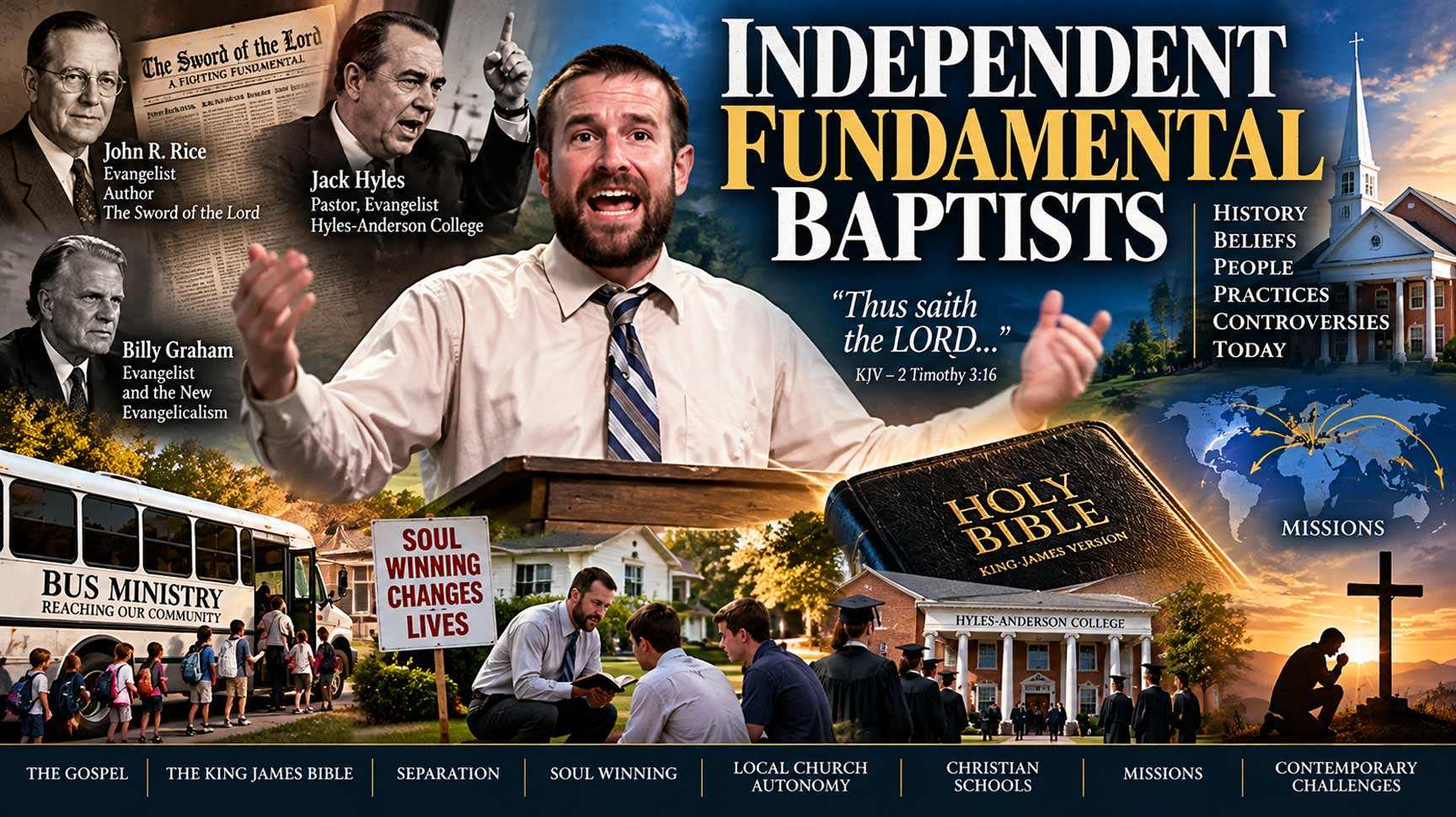
If you’ve spent much time around conservative Baptist churches, you’ve probably heard of Independent Fundamental Baptists, usually shortened to IFB. You may have seen churches with names such as Independent Baptist Church, Bible Baptist Church, Fundamental Baptist Church, or some combination of those words. You may also associate them with the King James Version, door-to-door soul winning, conservative dress, revival meetings, bus ministries, altar calls, and pastors who can preach for forty-five minutes without appearing to inhale.
That certainly describes parts of the IFB world. But there’s an important fact we need to establish before going any further: Independent Fundamental Baptists aren’t actually a denomination. There is no Independent Fundamental Baptist Convention. There is no IFB president. There is no headquarters that determines what every IFB church must believe, and there’s no official membership list that tells us exactly how many IFB churches exist. Individual churches may participate in fellowships, support common missionaries, attend the same conferences, send students to the same Bible colleges, and read the same publications, but they insist that the local congregation remains independent.
That immediately raises an interesting question. If they aren’t a denomination, why do so many Independent Fundamental Baptist churches look so much alike? The answer takes us into one of the most important battles in twentieth-century American Christianity.
What Does Fundamentalist Mean?
Today the word fundamentalist is sometimes used as a synonym for extremist. That isn’t how the term originated.
Christian fundamentalism developed during the late nineteenth and early twentieth centuries as conservative Protestants responded to theological liberalism, higher biblical criticism, evolutionary theories, and challenges to traditional Christian doctrines. Between 1910 and 1915, a series of essays called The Fundamentals defended doctrines such as biblical authority, the deity and virgin birth of Christ, His substitutionary death, His bodily resurrection, and the reality of miracles.
The original controversy therefore wasn’t about whether women should wear pants or whether churches should use drums. It was about whether Christianity could surrender doctrines its defenders regarded as fundamental and still remain Christianity. Baptists became deeply involved in that struggle.
The Fundamentalist-Modernist Controversy
We encountered this conflict when discussing American Baptist Churches USA. During the early twentieth century, the Northern Baptist Convention contained conservatives, moderates, and theological liberals. Fundamentalist Baptists increasingly worried that seminaries, mission boards, and denominational institutions were tolerating teachers who denied or questioned doctrines they regarded as essential.
Some conservatives remained within the convention and fought for change. Others concluded that the problem was deeper. If a denomination knowingly supported institutions or ministers teaching serious theological error, should a Bible-believing church continue supporting that denomination? For many fundamentalists, the answer eventually became no. That decision introduced a word that would become enormously important in the IFB world: separation.
Separation
Independent Baptist fundamentalism can’t be understood without understanding separation. Fundamentalists believed Christians were commanded to separate from serious theological error. If a church denied the bodily resurrection of Jesus, for example, another church shouldn’t treat that disagreement as though Christians were merely debating the color of the carpet.
That basic principle is understandable. But it immediately created another question: How far should separation go? Should you separate only from the minister denying the resurrection? Should you also separate from a denomination that permits him to remain? What about an evangelical preacher who personally believes the resurrection but cooperates with ministers who don’t?
Those questions eventually divided fundamentalists from other conservative evangelicals. And sometimes from one another.
Leaving the Denominations
During the twentieth century, conservative Baptist churches increasingly separated from established Baptist organizations and created new associations, fellowships, mission agencies, schools, and publications.
One example was the General Association of Regular Baptist Churches, organized in 1932 by churches that had separated from the Northern Baptist Convention. GARBC belongs to the broader history of Baptist separatism, although it shouldn’t simply be treated as another name for the entire IFB movement.
The point is that an ecosystem of independent and separatist Baptist churches was developing. These churches still needed missionaries. They still needed pastors. They still needed colleges. They still wanted fellowship.
So independent Baptists began creating organizations through which independent churches could cooperate. There’s the first great paradox of Independent Fundamental Baptists: Independent churches discovered that they needed one another.
The Baptist Bible Fellowship
One of the most important examples is the Baptist Bible Fellowship International, founded in 1950.
The BBFI operates missions, educational ministries, conferences, communications, and cooperative ministries among Baptist churches. Yet its constitution explicitly protects the sovereignty of the local congregation and says its structures must never infringe upon the autonomy of a local church.
So what is it? It’s a fellowship. That’s more than Baptist wordplay. The distinction is theological.
A participating church may cooperate with the BBFI, support BBFI missionaries, attend BBFI meetings, and share its doctrinal convictions. But the fellowship doesn’t own the church, appoint its pastor, or possess ecclesiastical authority over it. That arrangement became characteristic of much of independent Baptist life.
A Denomination That Isn’t a Denomination
This explains why IFB can look remarkably denominational from the outside. Churches may share virtually identical beliefs. Their pastors may have attended the same Bible college. They may support missionaries from the same agency, attend the same conferences, read the same publications, and invite the same evangelists to preach.
But there’s no organization governing all of them. In fact, one independent Baptist church may have almost no relationship with another independent Baptist church ten miles away. That’s why we should think of IFB as a movement or religious subculture composed of overlapping networks of autonomous churches rather than as a single denomination. And those networks were often built around influential personalities.
John R. Rice
One of the most important was John R. Rice. Rice was a Baptist pastor and evangelist who founded The Sword of the Lord in 1934. What began as a small religious newspaper became one of the most influential publications in fundamentalist Baptist Christianity.
Rice emphasized biblical authority, revival, evangelism, prayer, separation from theological liberalism, and what fundamentalists commonly called soul winning. The Sword of the Lord circulated sermons, articles, evangelistic methods, books, tracts, and news throughout a network of churches that didn’t belong to a common denomination. The ministry continues today with the same strong emphasis upon revival and soul winning.
That helps answer our earlier question. How can independent churches develop a common culture without a denomination? Give them common colleges, conferences, preachers, missionaries, and publications. They’ll influence one another just fine.
Billy Graham and the New Evangelicals
Another important figure in the development of modern fundamentalism was Billy Graham, although for a very different reason. Graham emerged from the conservative evangelical world and initially enjoyed substantial support among fundamentalists. But as his evangelistic crusades became larger, Graham increasingly cooperated with Christians across denominational boundaries.
That approach became unacceptable to stricter separatists. A broader movement known as new evangelicalism was emerging. Its leaders remained committed to traditional evangelical doctrines but rejected some of fundamentalism’s separatist tendencies and sought greater engagement with scholarship, culture, and Christians outside fundamentalist circles.
Fundamentalists increasingly separated not only from theological liberals but also from evangelicals they believed cooperated too freely with them. This became known in some circles as secondary separation. And now separation became considerably more complicated.
When Separation Separates the Separatists
Suppose Pastor A denies an essential Christian doctrine. Pastor B believes orthodox doctrine but cooperates with Pastor A. Pastor C refuses to cooperate with Pastor A but continues associating with Pastor B. Should Pastor D separate from Pastor C because Pastor C hasn’t separated sufficiently from Pastor B, who hasn’t separated sufficiently from Pastor A? Welcome to fundamentalism.
That’s a simplified example, but it illustrates a genuine problem that developed within some separatist movements. Once separation became an important test of faithfulness, Christians could disagree not only about doctrine but about how many degrees of separation faithfulness required. The result was fragmentation. Independent fundamentalism consequently became a collection of overlapping networks rather than a unified movement.
Jack Hyles
No discussion of twentieth-century Independent Fundamental Baptists would be complete without Jack Hyles. Hyles became pastor of First Baptist Church of Hammond, Indiana, in 1959 and developed it into one of America’s best-known independent Baptist churches. The church became famous for aggressive evangelism, enormous Sunday-school attendance, and an extensive bus ministry that transported thousands of children and adults to services.
Hyles also founded Hyles-Anderson College, which trained generations of pastors, missionaries, evangelists, and Christian workers. His influence extended far beyond Hammond. His preaching, books, conferences, church-growth methods, and emphasis upon soul winning shaped a major branch of IFB culture.
For many Independent Baptists, Hyles demonstrated what an aggressive evangelistic church could accomplish. For critics, however, the Hyles model also demonstrated the dangers of concentrating extraordinary authority in a charismatic pastor. Both parts of that legacy belong in the story.
Soul Winning
Perhaps nothing characterizes traditional IFB culture more than soul winning. The phrase generally refers to personally presenting the gospel to an unbeliever and urging that person to receive Christ as Savior.
Independent Baptist churches often organized regular soul-winning nights in which members went door to door. Churches distributed gospel tracts, conducted revival meetings, held evangelistic campaigns, supported missionaries, and trained members to explain salvation personally.
The Sword of the Lord still identifies soul winning and revival as central purposes of its ministry. Whatever criticisms we eventually make of IFB culture, its evangelistic zeal deserves to be understood fairly. These people really did believe their neighbors needed Jesus. And many of them were willing to knock on their doors and tell them.
The Bus Ministry
The bus ministry became one of the most distinctive expressions of that evangelistic culture. Churches purchased buses and sent workers into neighborhoods to invite children and families to Sunday school and worship. Workers might spend Saturdays visiting families and then begin early Sunday morning driving established routes to pick up riders. Large independent Baptist churches sometimes operated fleets of buses. The ministry reached thousands of children who might otherwise never have entered a church.
It also reflected the movement’s enormous emphasis upon measurable evangelistic activity: attendance, baptisms, professions of faith, Sunday-school enrollment, and bus ridership could all be counted. That emphasis sometimes produced remarkable energy. It could also produce pressure to make the numbers bigger.
“How Many Did You Get Saved?”
This is where a legitimate criticism enters the story. Some independent Baptist evangelistic methods became strongly oriented toward obtaining an immediate decision. A soul winner might explain several Bible verses, ask whether the person wanted to be saved, lead him through a sinner’s prayer, and then report another salvation. That approach was sometimes called easy believism by its critics.
To be fair, IFB doctrinal statements frequently say considerably more about salvation than merely repeating a prayer. BBFI’s current statement, for example, explicitly connects the new birth with repentance, faith, transformed life, and the work of the Holy Spirit. So the theological problem isn’t necessarily the formal doctrine.
The question is whether the method sometimes became thinner than the theology. Getting someone to repeat words isn’t the same thing as making a disciple. Jesus told us to do the latter.
What Independent Fundamental Baptists Believe
Because IFB isn’t a denomination, there’s no universal IFB confession. Nevertheless, a recognizable theological core appears throughout much of the movement.
Independent Fundamental Baptists generally affirm the inspiration and authority of Scripture, the Trinity, the deity and virgin birth of Jesus Christ, His substitutionary death, bodily resurrection and return, the reality of heaven and hell, salvation by grace through faith, believer’s baptism by immersion, the Lord’s Supper, local-church autonomy, evangelism, and missions.
Dispensationalism has also exercised enormous influence. Many IFB churches teach a premillennial return of Christ and pretribulational rapture. The BBFI Articles of Faith provide a useful example of this conservative Baptist theology while also insisting that each local church possesses the right of self-government without interference from an outside hierarchy.
So far, most conservative evangelicals would recognize much of this. Then we get to the King James Bible.
Are Independent Fundamental Baptists KJV Only?
This is probably the characteristic outsiders most readily associate with IFB churches. And there’s good reason for it.
King James Onlyism has become extremely influential within Independent Fundamental Baptist culture. Many IFB churches use the King James Version exclusively, and some explicitly identify themselves as KJV-only churches. The modern Sword of the Lord, for example, states that it believes God’s Word is inspired and preserved in the King James Bible.
But here’s the surprise: KJV-onlyism isn’t universal among Independent Fundamental Baptists. It can’t really be universal because no central authority exists to impose it. Even the BBFI’s doctrinal statement defines inspiration in reference to the biblical books “as originally written” rather than declaring the King James Version itself uniquely inspired.
So IFB and KJV-only aren’t synonyms. But there’s certainly a large overlap.
Not All KJV-Onlyism Is the Same
There’s another complication. When someone says, “I believe in the King James Bible,” we need to ask what he means.
Some Christians simply prefer the KJV. They grew up with it, appreciate its literary style, and use it in preaching while accepting other translations. Others believe the KJV is the best or most reliable English translation because of the Greek and Hebrew textual tradition underlying it.
A stronger KJV-only position holds that God providentially preserved His Word specifically in the King James Version for English-speaking Christians. Still stronger versions have sometimes treated the English KJV as possessing an authority that effectively prevents it from being corrected by reference to Hebrew or Greek manuscripts.
Those are substantially different claims. Putting everybody who uses a King James Bible into the same category doesn’t help us understand the controversy.
Why Did the KJV Become Such a Big Deal?
Part of the answer is historical. For generations, the King James Bible was simply the English Bible for enormous numbers of American Protestants. When newer translations became common during the twentieth century, conservative Christians encountered debates about textual criticism, omitted or bracketed passages, translation philosophy, gender language, theological liberalism, and the reliability of modern scholarship.
Fundamentalists were already suspicious of religious institutions they believed had compromised biblical authority. So debates about Bible translations weren’t occurring in a vacuum. For some Christians, the KJV became a symbol of resistance against theological compromise. The logic was understandable even when some of the resulting arguments weren’t.
(For the record, I’m a New King James guy, but I feel that bible translations are a very personal thing, and this is an area where believers need to grant others considerable latitude.)
The Local Church
Independent Baptists place enormous emphasis upon the local church. The congregation isn’t supposed to be a branch office of a denomination. It doesn’t answer to a bishop, presbytery, convention, or denominational headquarters.
The church calls its own pastor. It owns its property. It determines its ministries. It chooses which missionaries to support. It decides which organizations, if any, it will cooperate with.
The BBFI describes this principle very strongly: each local church possesses self-government, and no fellowship structure is supposed to interfere with that sovereignty. There’s a strong Baptist case for local-church autonomy. But autonomy creates another question.
So what happens when something goes seriously wrong?
The Authority of the Pastor
Many IFB churches have taught a particularly strong view of pastoral leadership. The pastor is sometimes described as the “man of God,” and biblical stories about respecting God’s anointed servants may be applied to the pastor’s authority.
In a healthy church, strong pastoral leadership isn’t necessarily a problem. Somebody has to lead, and Scripture clearly gives elders or pastors genuine responsibility for the church. The danger arises when pastoral authority becomes practically unaccountable. If the pastor dominates the deacons, controls the staff, influences church discipline, shapes the congregation’s understanding of Scripture, and answers to no denominational authority, challenging him can become extremely difficult.
Independence protects a healthy church from outside interference. It can also protect an unhealthy church from outside correction. That’s the other side of autonomy.
When the System Fails
This issue became particularly serious as reports of sexual abuse and misconduct emerged from independent fundamental Baptist churches and institutions. Because IFB isn’t a denomination, there is no single denominational disciplinary body capable of investigating allegations throughout the movement, removing ministers from a central credentialing system, or maintaining one authoritative list of disqualified pastors.
That doesn’t mean independent churches are incapable of accountability. A healthy congregation can establish strong safeguards, plural leadership, transparent finances, appropriate reporting procedures, and meaningful accountability. But independence doesn’t automatically produce those things.The same structure that allows a good congregation to govern itself also allows a dysfunctional congregation to govern itself.
Church polity isn’t glamorous until something goes wrong. Then it matters enormously.
Standards and Separation From the World
IFB culture also became famous for personal standards. Depending upon the church and era, these might involve alcohol, tobacco, dancing, movie theaters, television, rock music, contemporary Christian music, dating, clothing, hair length, mixed swimming, or other aspects of popular culture. Women in some churches were strongly encouraged or required to wear dresses or skirts rather than pants. Men might be expected to keep their hair short. Christian schools and homeschooling became important in many IFB communities.
Again, there’s no universal IFB rulebook. Some independent Baptist churches today retain very strict standards. Others have relaxed many of them. The theological idea underneath the standards was usually separation from the world. The harder question was deciding precisely what worldly meant.
Conviction or Legalism?
Christians should certainly live differently from a culture that rejects God. The New Testament doesn’t teach that conversion leaves our behavior unchanged. The problem comes when human applications gradually acquire the authority of biblical commands.
“I don’t believe Christians should drink alcohol” is a conviction that can be argued from biblical principles. “The Bible says a Christian man can’t have hair touching his ears” requires a considerably more creative concordance. Fundamentalist culture sometimes blurred that distinction. Standards intended to protect holiness could become measurements by which Christians evaluated one another’s spirituality. That’s where separation can drift toward legalism.
Music
Few subjects demonstrate this better than music. Traditional IFB churches commonly used hymns, gospel songs, piano, and organ while rejecting rock music and, in many cases, contemporary Christian music. Some argued that certain musical rhythms or styles were inherently worldly. Others objected primarily to the culture associated with contemporary music. The result was another boundary marker.
You could sometimes learn quite a lot about an independent Baptist church before the pastor ever preached simply by listening to the first song. That situation has changed considerably in some churches, while others maintain traditional musical standards. Again, IFB isn’t one organization. There isn’t anyone capable of settling the argument.
Women and Ministry
Most traditional Independent Fundamental Baptist churches hold a complementarian position regarding pastoral leadership. Men and women are regarded as equal before God while being assigned different roles in the home and church. The BBFI, for example, limits the offices of pastor and deacon to men in its current Articles of Faith.
Women nevertheless have played enormous roles in IFB churches as missionaries, teachers, musicians, ministry workers, pastors’ wives, children’s workers, and administrators. As with other conservative Baptist traditions, the real debate isn’t whether women can serve. It’s which forms of leadership Scripture permits them to exercise.
Christian Schools and Bible Colleges
Education became another major part of IFB culture. Independent Baptist churches established Christian schools partly because parents wanted an educational environment consistent with their religious convictions. Churches also founded Bible colleges to train pastors, missionaries, evangelists, teachers, and church workers.
Institutions such as Hyles-Anderson College, Baptist Bible College, Tennessee Temple, and numerous smaller schools helped transmit independent Baptist culture from one generation to another. This is another reason IFB developed such recognizable characteristics without a denomination.
A student could grow up in an independent Baptist church, attend an independent Baptist Christian school, graduate from an independent Baptist Bible college, become pastor of another independent Baptist church, attend independent Baptist conferences, support independent Baptist missionaries, and read independent Baptist publications. No denomination required any of it. The culture reproduced itself anyway.
Missions
Missions have always been one of the movement’s strongest emphases. Independent churches may support missionaries directly or work through mission agencies and fellowships while retaining local-church authority over their missionary involvement.
The BBFI, for example, describes missions and church planting as central purposes of its cooperative work and supports missionaries serving internationally. This produces another interesting paradox. A movement built upon separation has also built extensive international networks. Independent Baptists may be suspicious of denominational structures, but they have never been suspicious of the Great Commission.
The IFB Paradox
That’s ultimately what makes Independent Fundamental Baptists interesting. They left denominational structures because they feared institutions could compromise biblical doctrine. Then they built fellowships because churches needed cooperation. They rejected ecclesiastical hierarchy because they believed in local-church autonomy.
Then some churches developed extremely powerful pastors. They emphasized biblical authority because they didn’t want human traditions replacing Scripture. Then some communities developed cultural standards that could begin functioning very much like traditions. They emphasized separation to protect Christian faithfulness.
Then separation sometimes fragmented Christians who agreed on nearly every major doctrine. They rejected centralized denominations. Then colleges, conferences, publications, missionaries, and famous pastors created a remarkably recognizable culture anyway.
None of those contradictions mean the movement is meaningless, but they do make it worth studying.
More Diverse Than the Stereotype
It’s tempting to picture every Independent Fundamental Baptist church as a congregation full of men in white shirts and ties, women in ankle-length skirts, a pastor carrying a King James Bible, and a bus waiting outside to pick up neighborhood children. You can certainly find churches that resemble that picture.
But IFB is broader and messier than the stereotype. Some churches are strongly KJV-only. Others aren’t. Some maintain extremely strict dress and music standards. Others have changed substantially. Some pastors identify proudly with the IFB label. Others share most of its theology while avoiding the label because of its cultural baggage. Some churches remain connected with long-established fundamentalist networks. Others are independent even of the independent Baptist fellowships.
Which brings us back to the problem we started with. Nobody really owns the name.
Why Independent Fundamental Baptists Matter
IFB Christianity represents one of the clearest attempts in modern American Protestantism to answer a serious question: What should Christians do when the institutions intended to preserve Christianity begin tolerating doctrines they believe contradict Christianity?
The early fundamentalists answered that Christians must defend the fundamentals of the faith. Many Baptist fundamentalists eventually concluded that defending those doctrines required separation.
That decision preserved communities fiercely committed to Scripture, evangelism, missions, local churches, and personal holiness. It also produced some communities in which separation became excessive, cultural preferences became biblical rules, pastors accumulated too much authority, and independence weakened external accountability.
Both stories are true. Reducing IFB to legalistic KJV-only Baptists misses the movement’s theological origins and missionary accomplishments. Pretending that legalism, authoritarianism, fragmentation, and accountability failures never became serious problems misses just as much.
Independent Means Independent
Perhaps the most surprising thing about Independent Fundamental Baptists is that the first word in the name really does explain much of everything else – Independent. There is no IFB denomination capable of deciding what every IFB church must believe.
That’s why not every IFB church is KJV-only. It’s why worship and standards can differ. It’s why nobody can provide an exact IFB membership number. It’s why influential pastors and institutions have mattered so much. It’s why accountability can become complicated.
And it’s why Independent Fundamental Baptists can sometimes spend almost as much energy separating from other Independent Fundamental Baptists as they spend explaining why they separated from denominations in the first place. They share a recognizable history and culture. They just don’t have a headquarters.
For Independent Baptists, that’s not a flaw in the system. That IS the system.