
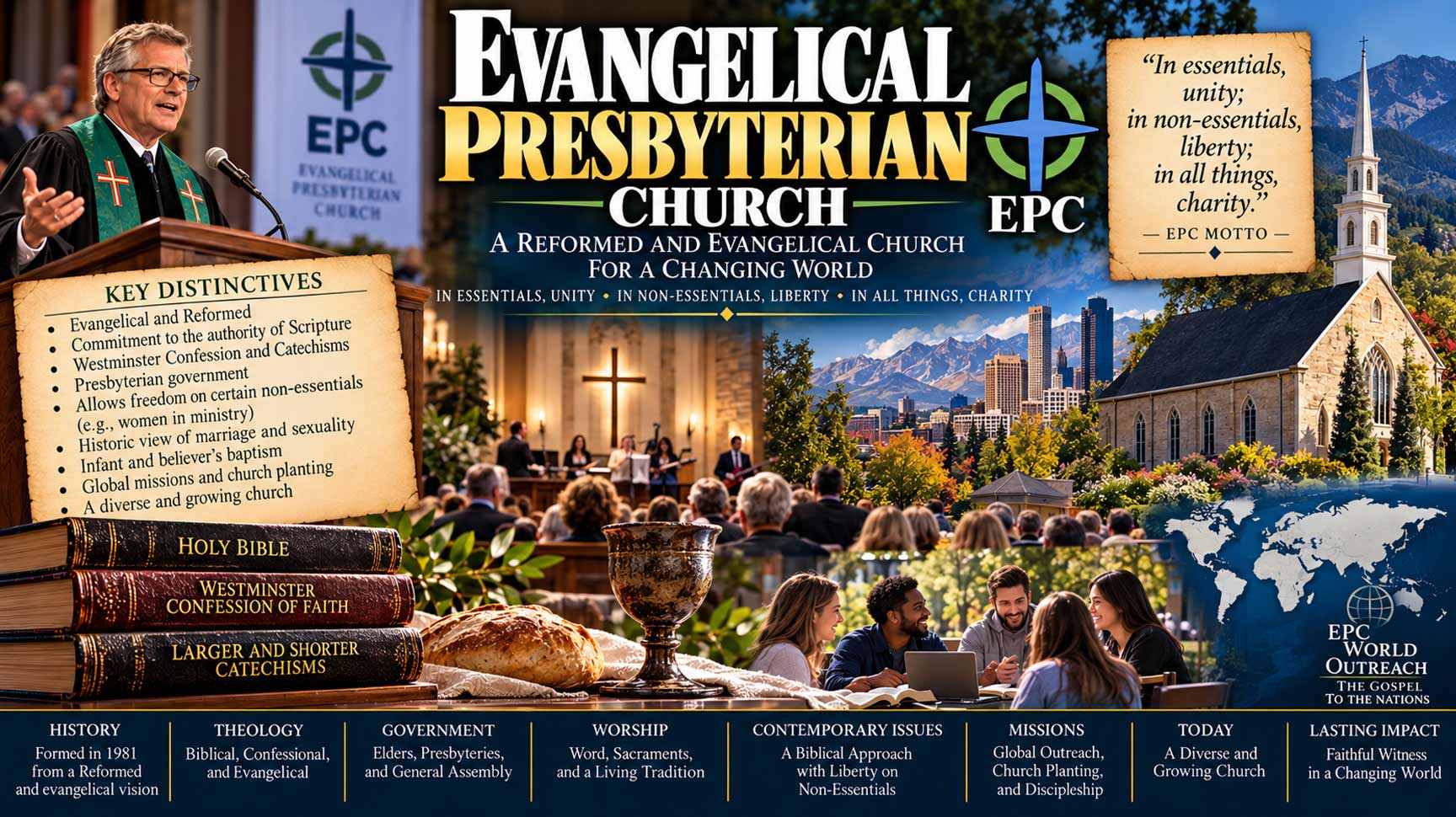
The Evangelical Presbyterian Church occupies an interesting place in American Presbyterianism. It is firmly evangelical, explicitly Reformed, committed to the authority of Scripture, and governed according to historic Presbyterian principles. At the same time, the EPC deliberately allows greater freedom on certain disputed questions than denominations such as the Presbyterian Church in America. That combination has given the EPC an identity of its own rather than making it simply a smaller version of either the PCA or Presbyterian Church (USA).
The denomination’s frequently repeated motto captures the idea: “In essentials, unity; in non-essentials, liberty; in all things, charity.” The EPC therefore tries to distinguish doctrines that define historic evangelical Christianity from issues on which Christians who take Scripture seriously can legitimately disagree. That sounds wonderfully simple until Christians have to decide which doctrines belong in which category. Much of the EPC’s story is about precisely that question.
A Presbyterian Church for Evangelicals
The EPC was organized in 1981, during a period of substantial upheaval within American Presbyterianism. Conservative and evangelical Presbyterians within the older mainline denominations had become increasingly concerned about biblical authority, theological pluralism, missions, and the direction of denominational institutions. Some eventually joined the PCA, while others wanted an evangelical Presbyterian denomination that permitted somewhat greater theological and ecclesiastical flexibility.
The EPC emerged from that environment. Its founders wanted a church that was recognizably Presbyterian and Reformed without allowing denominational structures to overshadow the authority of Scripture or the mission of the local church. They also wanted to avoid making every theological disagreement a reason for another Presbyterian denomination.
Considering Presbyterian history, that last goal was ambitious.
Evangelical and Reformed
Both words in the denomination’s name matter. The EPC is evangelical in its emphasis upon the gospel, personal faith in Jesus Christ, biblical authority, evangelism, missions, and the Great Commission. It is Presbyterian in theology and government, standing within the Reformed tradition associated historically with Calvin, Knox, and the Westminster Assembly.
The EPC’s Essentials of Our Faith affirms the Trinity, the full deity and humanity of Christ, his virgin birth, sacrificial death and bodily resurrection, salvation by God’s grace through faith in Christ, the work of the Holy Spirit, the reality of the Church, the bodily return of Christ, and the Great Commission. It describes the sixty-six books of Scripture as the infallible Word of God and the supreme and final authority concerning everything on which Scripture speaks.
That places the EPC squarely within historic evangelical Christianity. Whatever freedom the denomination permits on secondary matters, its concept of theological liberty isn’t intended to mean that every Christian doctrine is negotiable.
The Westminster Confession
The EPC also retains a distinctly Reformed confessional identity. The Westminster Confession of Faith and its catechisms provide the denomination’s doctrinal standards. Ministers and other officers therefore aren’t merely required to affirm a short list of generic evangelical beliefs; they’re serving within a theological tradition with a detailed understanding of God, Scripture, salvation, covenant, the Church, sacraments, and Christian life.
The EPC makes an interesting distinction between the Westminster Standards and its Essentials of Our Faith. The Essentials summarize central beliefs shared within historic evangelical Christianity, while the Westminster Confession expresses the more comprehensive system of Reformed doctrine to which EPC officers subscribe. The denomination explicitly says the Essentials aren’t a replacement for Westminster.
That distinction tells us a great deal about the EPC. It wants to be both broadly evangelical and specifically Reformed.
The Authority of Scripture
The EPC’s understanding of Scripture is one of the clearest differences between it and more theologically progressive expressions of Presbyterianism. Its Essentials of Our Faith begins with Scripture rather than burying biblical authority somewhere near the end of a denominational statement.
The denomination describes Scripture as inspired by the Holy Spirit, infallible, unified in its witness to God’s redemptive work, and the supreme and final authority on the matters about which it speaks.
That commitment doesn’t mean EPC Presbyterians always agree about biblical interpretation. If they did, the denomination wouldn’t need its principle of liberty in non-essentials. The more important claim is that disagreement takes place under a shared conviction that Scripture possesses authority over the Church. Christians may disagree about what a passage means, but the Church isn’t free simply to disregard Scripture when it becomes inconvenient.
Salvation by Grace
The EPC stands within the Reformed understanding of salvation. Human beings are estranged from God by sin and can’t save themselves. Salvation depends entirely upon God’s grace, and justification comes through faith in Christ rather than human merit. The denomination’s Essentials state that God credits righteousness to those who place their faith in Christ alone and that people become God’s children through the regenerating work of the Holy Spirit and reception of Christ.
Behind those evangelical affirmations stands the fuller Calvinistic theology of the Westminster Confession. Election, God’s sovereignty in salvation, effectual calling, justification, adoption, sanctification, and perseverance all belong to the theological system inherited from the Reformed tradition.
So despite the EPC’s reputation for allowing theological latitude, nobody should confuse it with a denomination that regards doctrine as unimportant. Its flexibility operates inside a decidedly Reformed theological framework.
Covenant Theology and Baptism
Like other historic Presbyterian churches, the EPC practices infant baptism as well as the baptism of previously unbaptized converts. That practice grows from covenant theology rather than from a belief that baptism automatically saves an infant.
Presbyterians see substantial continuity between God’s covenant people in the Old Testament and the Church in the New Testament. Just as children were included within the covenant community under Abraham, Presbyterians understand the children of believers as belonging visibly to the covenant community of the Church. Baptism functions as the New Covenant sign corresponding to that covenantal inclusion.
Baptists, of course, read the New Testament differently and connect baptism more directly with an individual’s profession of repentance and faith. The disagreement therefore goes considerably deeper than the amount of water involved or the age of the person getting wet. It reflects different understandings of how the biblical covenants fit together.
The Lord’s Supper
The EPC follows the Reformed tradition in its understanding of the Lord’s Supper. It rejects the Roman Catholic doctrine of transubstantiation but also treats Communion as more than an exercise in remembering Jesus. Within classic Reformed theology, Christ is genuinely present to believers spiritually, and the sacrament becomes a means through which God nourishes faith.
This sacramental understanding is one of those places where Presbyterians can sound surprisingly different from many Baptists and nondenominational evangelicals even when they agree on most of the doctrines printed on a church’s statement-of-faith page. Reformed Christianity historically gives baptism and the Lord’s Supper a more substantial role in the life of the Church.
The EPC therefore looks thoroughly evangelical in some settings and unmistakably Presbyterian in others. Both impressions are correct.
Presbyterian Government
The EPC follows the traditional Presbyterian system of representative government through elders. A local congregation elects elders who serve together in the Session. Congregations are connected regionally through presbyteries, while the denomination as a whole meets through its General Assembly.
That creates accountability beyond the local congregation without establishing bishops over the churches. Ministers aren’t simply employees of independent congregations, and local churches aren’t isolated organizations that can operate without meaningful connection to other churches. At the same time, the EPC deliberately reserves significant authority to congregations and presbyteries. This becomes especially important when we reach one of the denomination’s most unusual characteristics.
Women in Ministry
The EPC permits something that distinguishes it sharply from the PCA: women may serve in ordained ministry. But the EPC doesn’t simply mandate women’s ordination throughout the denomination.
Instead, it regards the question as a non-essential on which Christians committed to the authority of Scripture may disagree. Local congregations determine whether women may serve as ruling elders and deacons in their churches, while presbyteries determine whether women may be ordained as ministers within their jurisdiction. The denomination adopted this approach very early in its history and has explicitly defended it as an application of liberty in non-essential matters.
That creates an unusual arrangement. One EPC congregation may have women serving as elders and a woman preaching as senior pastor, while another EPC congregation may maintain an entirely male eldership because it interprets the relevant New Testament passages differently.
The EPC’s official position isn’t that one interpretation is correct and the other should eventually disappear. Its position is that faithful Christians who affirm the infallibility of Scripture have reached different conclusions and that this disagreement doesn’t concern an essential doctrine necessary to the existence of the Church.
For someone trying to understand the EPC, this may be the single most useful example of what the denomination means by “liberty in non-essentials.”
Not PC(USA) Lite
Because the EPC permits women in ordained ministry, it would be easy to assume that it represents a halfway point on a path toward the positions now associated with PC(USA). That would be misleading.
The EPC remains much closer to conservative evangelical Christianity on major questions of biblical authority and sexual ethics. Its willingness to tolerate disagreement concerning women’s ordination grows from its conviction that sincere Christians committed to biblical authority can reach different interpretations of the relevant passages. It doesn’t follow from a general principle that inherited Christian teaching should change whenever cultural attitudes change.
That distinction is important. Two denominations can arrive at the same practice—in this case, women serving as pastors—while arriving there through substantially different theological reasoning.
Marriage and Sexuality
The EPC maintains the historic Christian understanding of marriage as the covenantal union of a man and a woman and doesn’t follow PC(USA) in recognizing same-sex marriage. Questions concerning sexuality and qualifications for ordained ministry remain active subjects of denominational reflection, but the EPC approaches them from within its stated commitments to biblical authority and historic Christian sexual ethics.
The denomination has continued discussing difficult pastoral questions surrounding same-sex attraction and ordination rather than pretending those questions don’t exist. Its General Assembly has devoted formal study and discussion to the subject in recent years.
That makes the EPC’s concept of theological liberty especially interesting. Liberty doesn’t mean that every disputed issue automatically becomes a non-essential. The denomination still has to determine where legitimate diversity ends and where biblical and confessional boundaries begin.
Therein lies the hard part of the motto.
“In Essentials, Unity”
The first part of the EPC motto prevents theological liberty from becoming theological relativism. Christianity actually teaches things, and some of those things are essential.
The EPC’s Essentials include one God eternally existing as Father, Son, and Holy Spirit; the deity and humanity of Jesus Christ; the virgin birth; Christ’s sacrificial death; bodily resurrection; salvation by grace through faith; regeneration by the Holy Spirit; the reality of the Church; Christ’s personal and bodily return; and the obligation to carry the gospel throughout the world.
A minister therefore can’t appeal to “liberty in non-essentials” to deny the resurrection or Trinity. Those doctrines belong to the faith the denomination exists to proclaim.
“In Non-Essentials, Liberty”
The second part is more difficult because somebody has to decide what counts as non-essential. Women’s ordination provides the clearest example, but the principle reaches beyond that one controversy.
Presbyterian history contains disagreements over worship practices, eschatology, charismatic gifts, creation, education, political involvement, and numerous other questions. The EPC attempts to maintain meaningful confessional boundaries without turning every disagreement among Bible-believing Christians into grounds for denominational separation.
There’s something attractive about that goal even when we disagree about where the line should be drawn. Christians have demonstrated a remarkable ability to turn secondary questions into tests of fellowship. On the other hand, churches can also call something “non-essential” precisely when clarity is needed.
The challenge isn’t coming up with the motto. The challenge is applying it.
“In All Things, Charity”
The final phrase may be the most difficult one of all. The EPC’s vision assumes that Christians can disagree seriously without treating one another as enemies. Charity doesn’t require pretending theological differences don’t matter. It requires remembering that the person on the other side of the argument may still be a brother or sister in Christ.
That principle helps explain why the EPC has intentionally made room for congregations with different practices concerning women’s ordination. Rather than demanding uniformity before fellowship is possible, the denomination attempts to maintain cooperation around doctrines it considers essential while allowing conscience to operate elsewhere.
Whether that balance can always be maintained is another question. But it gives the EPC a distinctive personality within Presbyterianism.
Missions and the Great Commission
Missions aren’t an afterthought in the EPC. The Great Commission appears directly in its Essentials, which state that Christ commands believers to proclaim the gospel throughout the world and make disciples of all nations.
EPC World Outreach coordinates international mission efforts, while the denomination also emphasizes church planting, evangelism, discipleship, leadership development, and ministry among emerging generations. Recent General Assemblies have continued giving substantial attention to global missions and the effectiveness of local churches in evangelism and discipleship.
This missionary emphasis is one reason the word Evangelical belongs in the denomination’s name. The EPC isn’t merely attempting to preserve Reformed theology as a historical inheritance. It understands the Church as having been sent into the world with a message that people need to hear.
Worship in the EPC
EPC worship can vary significantly from congregation to congregation. Some churches retain a traditional Presbyterian service built around hymns, creeds, Scripture readings, preaching, prayer, baptism, and Communion. Others employ contemporary music and a worship style that would feel familiar to someone coming from a modern evangelical church.
That diversity reflects both Presbyterian history and the EPC’s philosophy of allowing freedom where it doesn’t believe uniformity is required. Reformed principles remain important, but local congregations have considerable room concerning how those principles are expressed.
An EPC congregation may therefore look traditional enough to satisfy someone who thinks every respectable Presbyterian church ought to possess an organ, while another may look contemporary enough that a visitor doesn’t immediately realize he’s attending a Presbyterian church.
Somehow they still manage to find one another at Presbytery meetings.
The EPC, PCA, and PC(USA)
The easiest way to understand the EPC may be to place it beside the two Presbyterian denominations we’ve already examined. All three share the Presbyterian name, Reformed ancestry, government by elders, and important connections to the Westminster tradition. Their differences concern what theological boundaries should accompany that heritage.
The PCA maintains relatively tight confessional boundaries and reserves ordained church office for qualified men. PC(USA) permits much broader theological and ethical diversity and officially affirms women in ministry, same-sex marriage, and transgender and nonbinary inclusion. The EPC remains confessionally Reformed and evangelical while intentionally allowing greater freedom than the PCA on selected questions, most notably women’s ordination.
That doesn’t make the EPC simply the theological midpoint between the other two. It has developed its own principle for determining unity: strong agreement on evangelical and Reformed essentials combined with intentional liberty where it believes faithful Christians may disagree.
A Home for Churches in Transition
That position has made the EPC attractive to some congregations seeking a new denominational home. Churches uncomfortable with developments in mainline Presbyterianism have sometimes found the EPC appealing because it retains Reformed theology and evangelical convictions without requiring complete uniformity on every issue.
That has also broadened the denomination beyond the relatively small group that created it in 1981. The EPC now includes congregations with somewhat different histories, worship cultures, and approaches to ministry while attempting to preserve a common theological center.
Growth through churches changing denominations can create its own challenges. A denomination has to integrate congregations that may know what they’re leaving more clearly than they know what they’re joining. The EPC therefore has to do more than provide a safe harbor from theological controversy. It has to cultivate a positive identity of its own.
The EPC Today
The Evangelical Presbyterian Church continues to emphasize Reformed theology, biblical authority, evangelism, church health, leadership development, church planting, and world missions. Its recent General Assemblies have included substantial attention to strengthening local churches, developing younger generations, missions, theological education, biblical worldview, and maintaining Presbyterian identity in contemporary culture.
That combination makes the EPC particularly interesting at a time when American Protestant denominations are frequently pressured toward one of two extremes. One approach responds to theological diversity by continually expanding the boundaries of acceptable belief. Another responds by defining an increasingly detailed list of positions on which everyone must agree.
The EPC is attempting something different: a strong theological center surrounded by a deliberately defined area of liberty.
Why the EPC Matters
The EPC helps complete our picture of modern American Presbyterianism because it demonstrates that the choice isn’t simply between PCA and PC(USA). Presbyterian churches can share the same Reformed ancestry and still draw their denominational boundaries in different places.
PC(USA) has increasingly emphasized theological breadth and inclusion. PCA emphasizes tighter adherence to conservative Reformed and confessional convictions. EPC attempts to preserve evangelical and Reformed orthodoxy while allowing conscientious disagreement on selected secondary questions.
Whether it always draws those lines in exactly the right places is something Christians within and outside the EPC can debate. The more important point for understanding the denomination is that those lines are intentional.
“In essentials, unity; in non-essentials, liberty; in all things, charity.”
That’s more than a catchy Presbyterian slogan. It’s an experiment in how much Christians need to agree about before they can build a church together.