
Protestant Christianity includes a remarkably diverse collection of churches and theological traditions. Lutherans, Reformed Christians, Anglicans, Baptists, Methodists, Pentecostals, and other Protestants may disagree considerably about baptism, communion, predestination, spiritual gifts, church government, and other doctrines. Yet beneath this diversity is a recognizable theological heritage that emerged from the Protestant Reformation and continues to distinguish Protestant Christianity from Roman Catholicism and Eastern Orthodoxy.
At the center of Protestant theology is the conviction that the Christian faith must ultimately be grounded in the revelation of God contained in Scripture and that salvation is received through faith in Jesus Christ rather than earned through human merit.
Scripture and Authority
One of the defining principles of Protestantism is sola Scriptura, Latin for “Scripture alone.”
The Reformers did not generally mean that Christians should ignore church history, creeds, councils, pastors, or theologians. Rather, they argued that Scripture is the highest and ultimately binding authority for Christian doctrine.
Martin Luther, John Calvin, and other Reformers believed that church traditions should be respected when they agreed with Scripture but could be corrected when they contradicted it.
This represented a major disagreement with Roman Catholic Christianity, which recognizes both Sacred Scripture and Sacred Tradition within the teaching authority of the Church.
Protestants themselves disagree about exactly how sola Scriptura should function. Some traditions place considerable importance on historic creeds and confessions, while others emphasize the ability of individual Christians and local congregations to interpret Scripture.
Nevertheless, the supreme authority of Scripture remains one of the most widely shared characteristics of Protestant Christianity.
Salvation by Grace
Protestants generally teach that salvation originates entirely in the grace of God.
Human beings cannot earn reconciliation with God through moral achievement, religious ceremonies, or good works. Salvation is possible because of what God has accomplished through the life, death, and resurrection of Jesus Christ.
This principle is traditionally summarized by the Reformation phrase sola gratia—“grace alone.”
Protestant traditions differ significantly in how they understand the operation of grace. Reformed theology emphasizes God’s sovereign initiative in salvation, while Wesleyan and Arminian traditions place greater emphasis on God’s grace enabling a genuine human response.
Despite these differences, Protestants broadly agree that salvation is a gift of divine grace rather than something humanity can earn.
Justification by Faith
Closely connected with salvation by grace is sola fide—“faith alone.”
The doctrine of justification became one of the central theological controversies of the Protestant Reformation.
The Reformers argued that sinners are justified—declared righteous before God—through faith in Jesus Christ rather than through works performed in cooperation with grace.
Martin Luther regarded justification by faith as central to understanding the gospel.
Protestants have traditionally emphasized passages such as Romans 3:28:
“For we hold that one is justified by faith apart from works of the law.”
This does not mean that good works are considered unimportant. Classical Protestant theology teaches that good works are the result of salvation rather than the basis of salvation.
Saving faith is expected to produce a transformed life.
Different Protestant traditions have developed somewhat different explanations of justification, sanctification, and the relationship between faith and works, but justification by faith remains one of Protestantism’s defining doctrines.
Jesus Christ and Salvation
Protestants share the historic Christian confession that Jesus Christ is fully God and fully human.
Most Protestant churches affirm the theological conclusions expressed in the early ecumenical creeds concerning the Trinity and the person of Christ.
Jesus’ death and resurrection stand at the center of Protestant teaching about salvation.
Through Christ, humanity can be reconciled to God, forgiven of sin, and given eternal life.
Protestants have developed several explanations of how Christ’s death accomplishes salvation. Many Evangelical and Reformed Christians emphasize penal substitutionary atonement, according to which Christ bears the judgment associated with human sin.
Other Protestants emphasize themes such as Christ’s victory over sin and death, reconciliation with God, sacrificial substitution, or the transforming power of Christ’s self-giving love.
These explanations are not always considered mutually exclusive.
The Priesthood of All Believers
Another important Reformation principle is the priesthood of all believers.
Protestants teach that Christians have direct access to God through Jesus Christ and do not require a separate priestly class to mediate their relationship with God.
This does not mean Protestant churches reject pastors or other church leaders. Most Protestant traditions maintain recognized offices of ministry.
Rather, ordained ministers are generally understood as leaders, teachers, and servants of the church rather than priests who uniquely mediate saving grace between God and ordinary Christians.
The doctrine also contributed to the Protestant emphasis on personal Bible reading, prayer, Christian vocation, and participation in the ministry of the church.
Baptism
Nearly all Protestant traditions practice baptism, but they disagree considerably about its meaning and proper recipients.
Lutherans, Anglicans, Presbyterians, Methodists, and many Reformed churches practice infant baptism as well as the baptism of converts.
Baptists, Pentecostals, many Evangelicals, and several other traditions practice believer’s baptism, maintaining that baptism should follow a personal profession of faith.
There are also differences concerning what baptism accomplishes.
Some Protestants understand baptism as a means through which God communicates grace. Others regard it primarily as an outward testimony of faith and identification with Christ.
These differences have produced some of the most enduring theological divisions within Protestant Christianity.
The Lord’s Supper
Protestants also disagree about the nature of the Lord’s Supper, commonly called Communion or the Eucharist.
Martin Luther rejected the Roman Catholic doctrine of transubstantiation but strongly affirmed Christ’s real presence in Communion.
Reformed traditions associated with John Calvin developed a different understanding, emphasizing a genuine spiritual participation in Christ.
Ulrich Zwingli and traditions influenced by him emphasized the meal primarily as a memorial of Christ’s death.
Many later Evangelical churches adopted forms of the memorial understanding.
Consequently, Protestant views of Communion range from strong doctrines of Christ’s presence to predominantly symbolic interpretations.
The Church
Protestants generally understand the Church as the community of those who belong to Christ, but they have developed many different forms of church organization.
Some Protestant churches retain bishops and historic liturgical structures. Anglicanism and some Lutheran traditions are prominent examples.
Presbyterian churches are governed through elders and representative assemblies.
Baptist and many independent churches emphasize the authority of the local congregation.
Methodist churches developed connectional structures, while Pentecostal denominations use several different forms of government.
This diversity reflects a broader Protestant disagreement about how closely the New Testament prescribes a particular structure of church leadership.
Sacraments and Ordinances
Roman Catholicism recognizes seven sacraments. Most Protestants recognize only Baptism and the Lord’s Supper as rites specifically instituted by Christ.
Some Protestant traditions call them sacraments, emphasizing that God works through them as means of grace.
Others prefer the term ordinances, emphasizing that Christ commanded believers to observe them.
The difference in terminology often reflects deeper theological differences concerning what happens through baptism and Communion.
Mary and the Saints
Protestants generally honor Mary as the mother of Jesus and an important example of faithfulness but reject devotional practices that involve invoking Mary or the saints.
Most Protestants do not accept later Catholic doctrines such as the Immaculate Conception or the bodily Assumption of Mary as doctrines required of Christians.
Protestants also generally reject prayer directed to departed saints, arguing that believers may approach God directly through Jesus Christ.
At the same time, many Protestants recognize Christians throughout history as valuable examples of faith and discipleship.
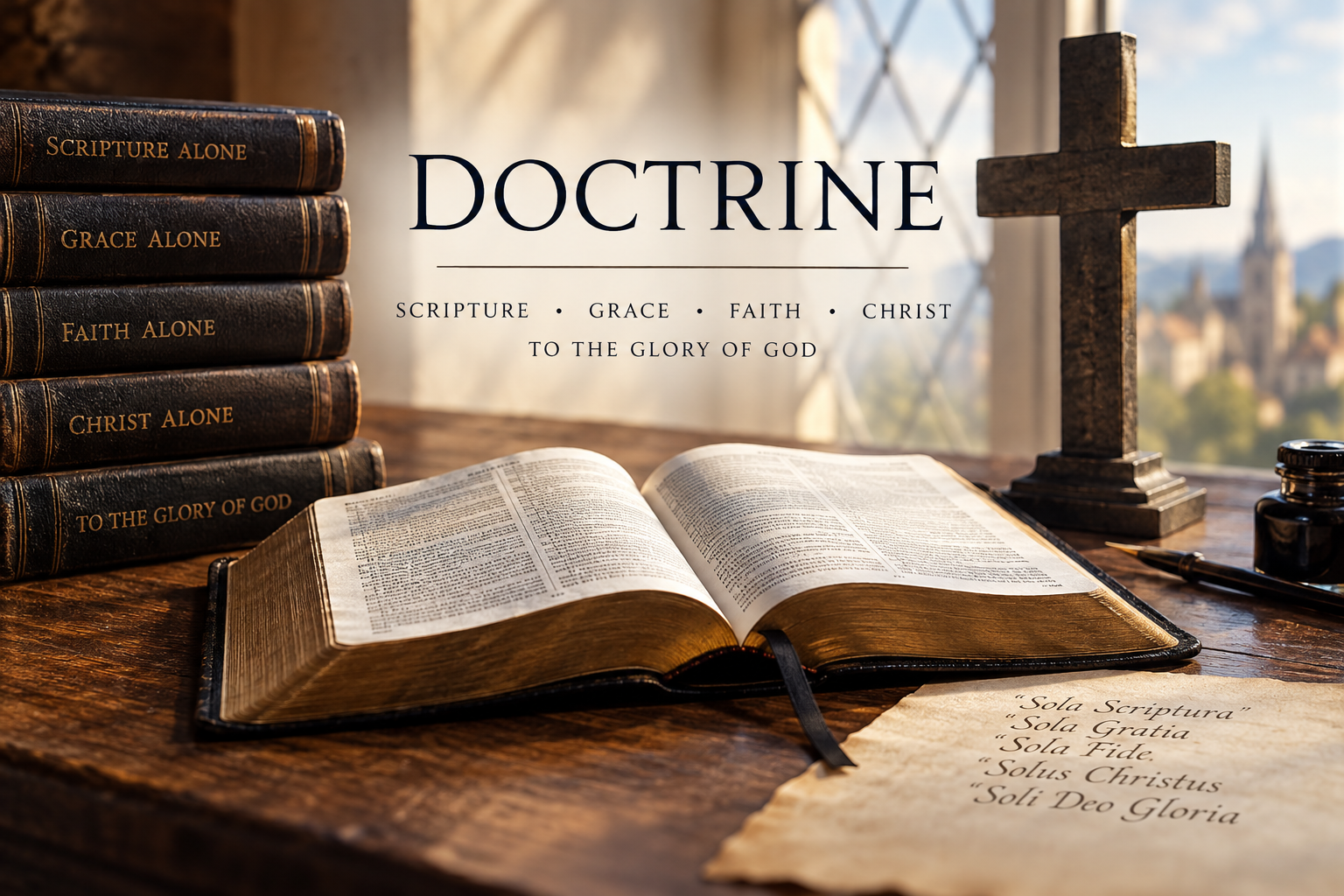
The Five Solas
The theology of the Reformation is often summarized through five Latin expressions known as the Five Solas:
Sola Scriptura — Scripture alone is the final authority for Christian doctrine.
Sola Fide — Justification is received through faith rather than earned through works.
Sola Gratia — Salvation is a gift of God’s grace.
Solus Christus — Jesus Christ is the unique mediator of salvation.
Soli Deo Gloria — Salvation and the Christian life ultimately exist for the glory of God.
These expressions were not originally presented by the Reformers as a single five-part formula. They developed over time as a convenient summary of major themes within Reformation theology.
Areas of Protestant Disagreement
Although Protestants share an important theological inheritance, significant doctrinal disagreements remain.
Among the most important are:
- Predestination and free will
- Infant baptism and believer’s baptism
- The meaning of Communion
- The nature and government of the church
- Eternal security and the possibility of apostasy
- The role of women in church leadership
- The continuation of miraculous spiritual gifts
- The relationship between divine sovereignty and human freedom
- End-times theology
- Worship and liturgy
These differences have contributed to the formation of numerous Protestant denominations and theological movements.
Yet disagreement does not necessarily mean that every Protestant tradition considers every other tradition outside Christianity. Most recognize a substantial body of shared Christian belief despite their doctrinal differences.
Protestant Doctrine in Perspective
Protestantism is best understood not as a single theological system but as a family of Christian traditions shaped by the Reformation.
Its major branches developed different answers to important theological questions, but several convictions continue to provide a recognizable center: the authority of Scripture, salvation by God’s grace, justification through faith, the centrality of Jesus Christ, and the conviction that every believer may approach God through Christ.
Understanding both this common foundation and the disagreements that developed within it is essential for understanding Protestant Christianity today.