
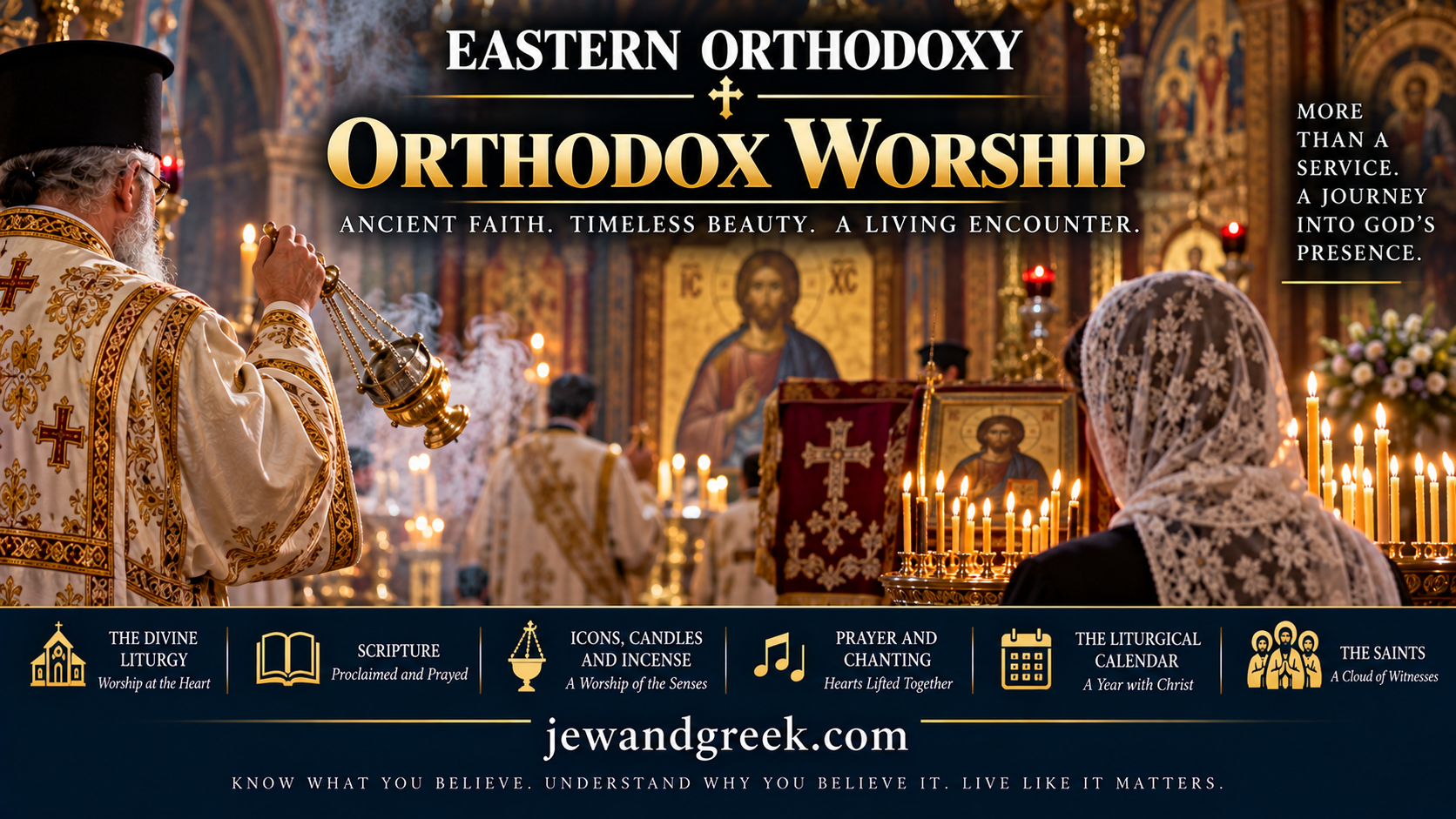
Worship stands at the center of Eastern Orthodox Christianity. Orthodox Christians do not generally think of a worship service primarily as a gathering for preaching, fellowship, or religious instruction, although all of those things may occur. Worship is understood as participation in the life of God and in the worship of the church both on earth and in heaven.
That helps explain why an Orthodox service can feel so different to someone accustomed to a Protestant church. There may be icons, candles, incense, chanting, processions, elaborate vestments, repeated prayers, and considerable standing. Very little is designed to give the impression that Christianity was invented last Tuesday.
The Divine Liturgy
The principal Orthodox worship service is the Divine Liturgy, centered on the celebration of the Eucharist. The two liturgies used most commonly are associated with John Chrysostom and Basil the Great.
The service contains Scripture readings, prayers, hymns, litanies, a homily, the Nicene Creed, and the celebration of Communion. Although details vary among Orthodox traditions, the basic structure has deep historical roots.
The Divine Liturgy is not viewed simply as a religious meeting organized by the congregation. Orthodox Christians understand themselves as entering into a worship already taking place—the eternal worship of God.
The Eucharist
The Eucharist is the high point of the Divine Liturgy. Bread and wine are offered, consecrated, and received as the body and blood of Christ.
Orthodoxy affirms Christ’s real presence in the Eucharist without making a detailed philosophical explanation of how the transformation occurs the center of its teaching. The Eucharist remains a mystery to be received rather than a process that must be completely explained.
Communion also expresses the unity of the church. For that reason, Orthodox churches ordinarily restrict reception of the Eucharist to Orthodox Christians who are in communion with the church and properly prepared to receive it.
Scripture in Orthodox Worship
The Bible is woven throughout Orthodox worship. Psalms are sung and prayed, passages from the Epistles and Gospels are read, and biblical language fills the prayers and hymns of the liturgy.
The Gospel book itself receives particular honor and may be carried ceremonially during the service. This does not mean the physical book is worshiped. Rather, it reflects the importance of the Gospel and of Christ whose words and life it proclaims.
For someone accustomed to measuring the biblical content of a service primarily by the length of the sermon, this can be easy to miss. Much of the Scripture in Orthodox worship is encountered through prayer, song, and liturgical language rather than exposition alone.
Icons, Candles, and Incense
Orthodox worship engages the senses. Icons surround the congregation. Candles burn before them. Incense fills the church. Worshipers may cross themselves, bow, make prostrations, kiss icons, and move about the church to light candles.
These practices are intended to involve the whole person in worship rather than treating worship as a purely mental activity.
Incense, for example, carries biblical associations with prayer and worship. Candles symbolize Christ as the light of the world and may accompany prayers. Icons visually place the worshiping congregation within the larger communion of Christ, the apostles, Mary, and the saints.
The result is worship meant to be seen, heard, smelled, touched, and experienced.
Prayer and Chanting
Much Orthodox worship is sung or chanted. In many churches, musical instruments are absent and the human voice provides the music.
The congregation may participate in responses and hymns, although the degree of congregational singing varies by local tradition. Priests, deacons, chanters, and choirs carry substantial portions of the service.
Orthodox prayer is also highly repetitive by modern Protestant standards. The Jesus Prayer—“Lord Jesus Christ, Son of God, have mercy on me, a sinner”—is among the best-known examples of Orthodox devotional prayer.
Repetition is not understood as an attempt to persuade God through sheer quantity of words. Ideally, repeated prayer disciplines the mind and directs the heart continually toward God.
Standing, Bowing, and the Sign of the Cross
Orthodox Christians traditionally stand through much of the Divine Liturgy, although seating practices vary considerably from one country and congregation to another.
Worshipers frequently make the sign of the cross, usually touching the forehead, chest, right shoulder, and then left shoulder. They may also bow or make full prostrations at particular times.
These bodily actions express an important Orthodox conviction: human beings worship God not merely with their minds but with their bodies as well. Christianity involves the whole person.
Anyone attending an Orthodox service for the first time may spend part of it wondering when to stand, bow, cross himself, or move out of someone’s way. Visitors are generally not expected to have mastered several centuries of liturgical practice before walking through the door.
Fasting
Fasting occupies a much larger place in Orthodox spirituality than many Protestants are accustomed to seeing. The Orthodox calendar includes regular weekly fasts as well as extended fasting seasons, especially Great Lent before Easter.
Traditional fasting often involves abstaining from meat, dairy products, and sometimes other foods. The precise practice can vary according to circumstances and pastoral guidance.
Fasting is not intended merely as religious dieting. It is a spiritual discipline connected with prayer, repentance, self-control, and generosity toward others.
Orthodoxy sees the body as participating in spiritual formation. What and when a Christian eats can therefore become part of the life of prayer.
The Liturgical Calendar
Orthodox worship follows a yearly cycle centered on the life of Christ and the major events of the Christian faith.
Pascha, the Orthodox name for Easter, stands at the center of the calendar. The celebration of Christ’s resurrection is preceded by Great Lent and Holy Week and is marked by some of the most distinctive services in Orthodox Christianity.
Other major feasts commemorate events such as the Nativity of Christ, Theophany, the Transfiguration, and Pentecost, along with events associated with Mary and the saints.
The calendar gives the Christian year a rhythm. Rather than merely remembering biblical events as historical facts, worshipers repeatedly move through the story of Christ through fasting, feasting, prayer, and worship.
Holy Week and Pascha
The importance of the resurrection in Eastern Orthodoxy is particularly visible during Holy Week and Pascha.
Services throughout Holy Week remember the final days, crucifixion, and burial of Christ. The Paschal celebration then announces His resurrection with repeated proclamations that Christ is risen.
Light, bells, hymns, processions, and the Eucharist combine in a celebration of Christ’s victory over death. The resurrection is not treated merely as the happy ending after the tragedy of Good Friday. It is central to the Orthodox understanding of salvation itself.
Christ has entered death and defeated it. That conviction runs throughout Orthodox worship and explains why Pascha occupies such a prominent place in Orthodox spiritual life.
Worship as Theology
Eastern Orthodox worship cannot easily be separated from Eastern Orthodox doctrine. Much of what the church believes is communicated through what the church prays.
The Trinity, Incarnation, resurrection, communion of saints, the work of the Holy Spirit, and the hope of eternal life appear continually in Orthodox hymns and prayers. Someone could therefore learn a considerable amount of Orthodox theology simply by paying attention during the liturgy—although preferably while standing comfortably.
That relationship between worship and belief is one of the defining characteristics of Eastern Orthodoxy. Theology is not confined to books or classrooms. It is sung, prayed, enacted, and repeated through the life of the church.