
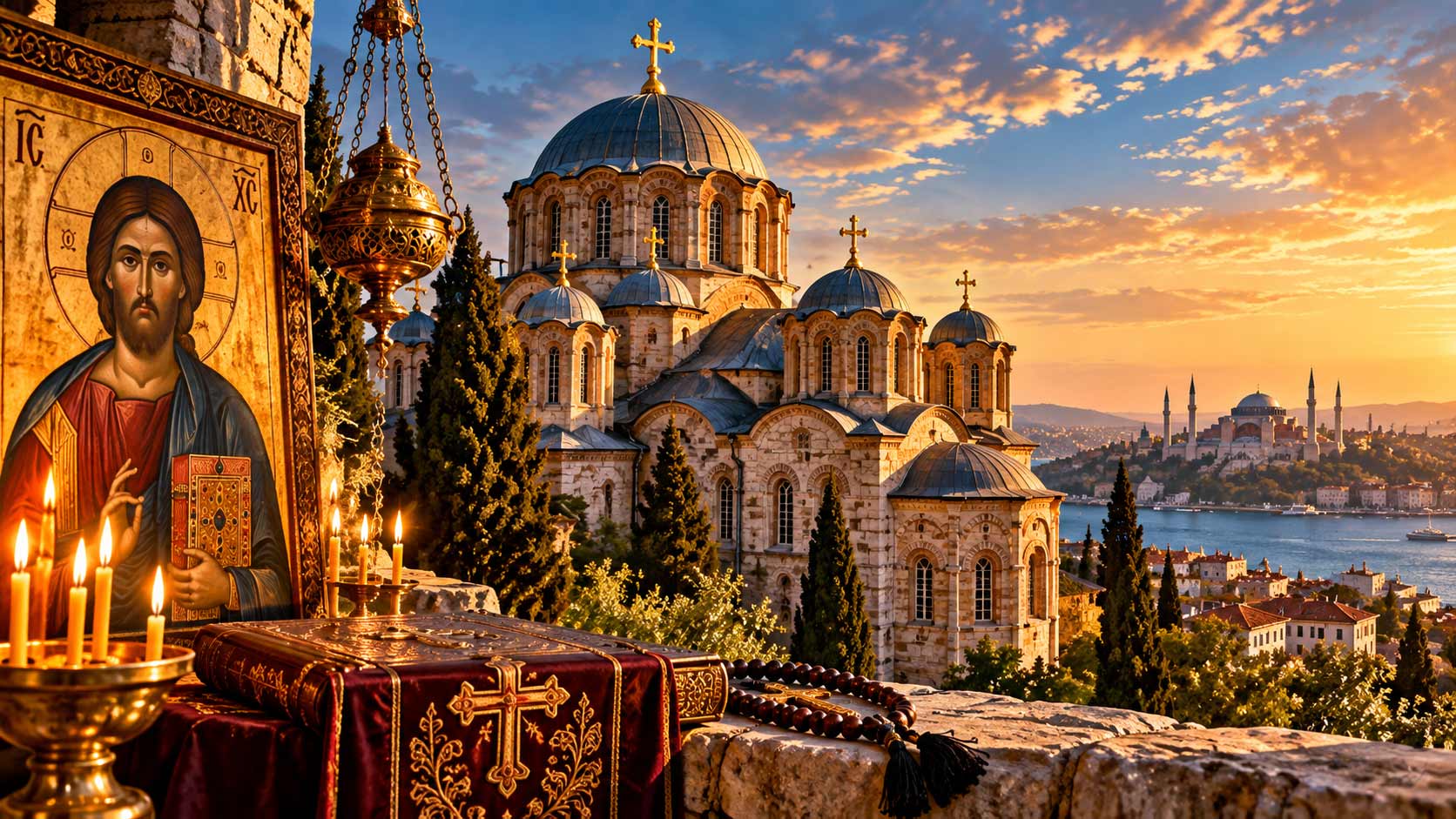
Walk into an Eastern Orthodox church for the first time and you may wonder whether you’ve walked into Christianity or another world entirely. Icons cover the walls. Incense fills the sanctuary. Candles burn before images of Christ and the saints. The priest may disappear behind an icon screen and emerge carrying the Gospel or the chalice. Much of the service is sung or chanted, and worshipers may cross themselves, bow, kiss icons, and stand through most of a service that can last well over an hour. If your entire experience of Christianity has been evangelical Protestantism, very little of this will feel familiar.
Yet Orthodox Christians would insist that what you’re seeing isn’t an exotic variation of Christianity invented somewhere in Eastern Europe. They understand themselves as preserving the faith, worship, and sacramental life of the ancient Church. That claim is essential to understanding Eastern Orthodoxy. Orthodoxy doesn’t primarily think of itself as one denomination among many. It sees itself as the historical continuation of the apostolic Church.
Today Eastern Orthodoxy exists as a family of self-governing churches that share essentially the same faith, sacraments, and liturgical tradition. Greek, Russian, Serbian, Romanian, Bulgarian, Georgian, Antiochian, and other Orthodox churches aren’t denominations in quite the way Baptists, Methodists, and Presbyterians are. Many are autocephalous, literally “self-headed,” meaning that they govern themselves and choose their own bishops while remaining in communion with other Orthodox churches. There is no Orthodox equivalent of the pope exercising universal jurisdiction over all of them.
Before There Was an Eastern Orthodox Church
For the first thousand years of Christianity, Christians didn’t speak about “Roman Catholicism” and “Eastern Orthodoxy” as two separate worldwide communions. Christianity developed around several great centers, including Rome, Constantinople, Alexandria, Antioch, and Jerusalem. Christians in the Greek-speaking East and Latin-speaking West gradually developed different theological vocabularies, worship traditions, political relationships, and ways of exercising church authority.
Those differences eventually became divisions. One famous date is 1054, when representatives of Rome and Constantinople excommunicated one another, but the Great Schism wasn’t really a single-day divorce. Estrangement had been developing for centuries and continued afterward. The Crusades, and especially the brutal sack of Constantinople by Western crusaders in 1204, made reconciliation considerably more difficult.
Among the disputes was the filioque, Latin for “and the Son.” The original form of the Nicene-Constantinopolitan Creed confessed that the Holy Spirit proceeds from the Father. The Western church eventually added “and the Son.” Eastern Christians objected both to the theology of the addition and to the fact that the creed of an ecumenical council had been altered without another ecumenical council. What can look like three insignificant words on paper became symbolic of much larger questions about the Trinity and the authority of Rome.
Scripture and Holy Tradition
Protestants commonly begin theological discussions by asking, “What does the Bible say?” Orthodox Christians certainly regard Scripture as inspired and authoritative, but they don’t ordinarily separate the Bible from the Church that received, preserved, interpreted, and worshiped with it. Scripture exists within what Orthodoxy calls Holy Tradition.
Tradition in this sense doesn’t simply mean old customs. It encompasses the apostolic faith handed down in the Church through Scripture, worship, creeds, councils, Fathers, liturgy, and the continuing life of the Christian community. Orthodoxy therefore doesn’t generally frame the issue as Bible versus tradition. From its perspective, Scripture is itself at the heart of the Church’s Tradition.
The seven ecumenical councils hold a particularly important place in Orthodox theology. These councils, beginning with Nicaea in 325 and ending with the Second Council of Nicaea in 787, addressed controversies involving the Trinity, the person of Christ, and eventually the use of icons. Eastern Orthodoxy recognizes these seven councils as authoritative expressions of the faith of the undivided Church.
That helps explain why Orthodox theology can sometimes feel different from Western theology. Orthodoxy certainly has theologians and doctrinal definitions, but it tends to be less interested in constructing Christianity as a complete theological system. Mystery isn’t something theology eventually eliminates. Some things can be known truly without being known exhaustively.
Salvation as Healing and Transformation
Ask many Protestants about salvation and the conversation quickly turns to justification: How can a guilty sinner be declared righteous before God? That question matters in Orthodoxy, but Orthodox theology often approaches salvation using different biblical images. Sin isn’t only guilt; it is also sickness, corruption, bondage, and death. Christ doesn’t merely change our legal standing before God. He conquers death, heals corrupted humanity, restores the image of God, and brings human beings into communion with God.
This doesn’t mean Orthodox Christians believe people save themselves by becoming sufficiently holy. Salvation is possible because of the incarnation, death, and resurrection of Jesus Christ and the grace of God. But Orthodoxy strongly emphasizes cooperation with grace. Human beings aren’t passive objects upon whom salvation is performed. Grace calls for a response involving faith, repentance, obedience, prayer, participation in the mysteries, and a life increasingly transformed by the Holy Spirit.
That brings us to one of the most important ideas in all of Eastern Christianity.
Theosis: Becoming Like God
Theosis is sometimes translated as “deification” or “divinization,” which can sound alarming to Christians encountering the idea for the first time. Orthodox Christians aren’t teaching that human beings become additional members of the Trinity or cease being creatures and become God by nature.
The idea is that salvation ultimately involves participation in the life of God.
Second Peter 1:4 speaks of believers becoming “partakers of the divine nature.” First John says that when Christ appears, “we shall be like him.” Paul describes believers being transformed into Christ’s image “from glory to glory.” Orthodox theology takes this language with remarkable seriousness. God didn’t merely forgive humanity so that forgiven sinners could remain essentially unchanged. He intends to restore human beings to what they were created to become.
A famous expression associated with the early Church Fathers summarizes the idea: God became man so that man might become god. The lowercase “g” is important. Human beings don’t become divine by nature. They participate by grace in God’s life.
Think of a piece of iron placed in a fire. The iron doesn’t become fire, but it takes on properties of the fire. It becomes hot and begins to glow. In a similar way, the Christian remains a creature while becoming increasingly filled and transformed by God’s grace.
Theosis isn’t merely something that happens after death. It begins now. Prayer, repentance, communion, fasting, love, humility, and the work of the Holy Spirit gradually transform the believer into the likeness of Christ. Salvation, in this sense, isn’t simply about where you go when you die. It’s about what you’re becoming.
God’s Essence and Energies
Theosis creates an obvious theological problem. If God is utterly transcendent and human beings are creatures, how can human beings genuinely participate in God without becoming God?
One important Orthodox answer is associated especially with the fourteenth-century theologian Gregory Palamas. Palamas distinguished between God’s unknowable essence and His uncreated energies. God’s essence—what God is in Himself—remains inaccessible to creatures. Yet God’s energies aren’t created substitutes standing between God and us. They are God’s genuine action and presence through which human beings can truly know Him and participate in His life.
This distinction became particularly important during controversies surrounding hesychasm, a tradition of contemplative prayer associated especially with Orthodox monasticism. Orthodox teaching consequently maintains both sides of the mystery: God’s essence remains incomprehensible, yet genuine communion with God is possible.
Ancestral Sin
Orthodox Christians believe humanity is fallen and desperately needs salvation, but they don’t always describe the Fall exactly as Western Christianity does. The term ancestral sin is commonly used instead of original sin.
Orthodoxy strongly emphasizes the consequences humanity inherited from Adam—mortality, corruption, and a world enslaved to sin and death. Orthodox explanations have traditionally been less inclined to say that every human being personally inherits Adam’s guilt. We enter a damaged human condition and then add our own sins to it.
That difference affects the way salvation is described. Western Christianity has often emphasized the courtroom: guilt, judgment, justification, and acquittal. Eastern Christianity has often emphasized the hospital: sickness, healing, corruption, restoration, and life. Scripture contains both kinds of imagery, but the different emphases help explain why conversations between Orthodox and Protestant Christians sometimes sound as though they’re answering different questions.
The Holy Mysteries
What Western Christians usually call sacraments, Orthodox Christians commonly call the Holy Mysteries. Baptism, Chrismation, Eucharist, Confession, Marriage, Holy Orders, and Holy Unction are conventionally identified as seven major mysteries.
But even saying “the seven sacraments” can be slightly misleading. Orthodox sources themselves note that rigidly numbering the sacraments as seven was a later development influenced by Western Christianity. The older Orthodox instinct is broader: the entire life of the Church is sacramental because material things can become means through which God’s grace is encountered.
This sacramental worldview explains much of what a visitor sees inside an Orthodox church. Water, oil, bread, wine, incense, human touch, painted images, spoken words, and physical gestures aren’t viewed as distractions from spiritual reality. Christianity itself begins with the astonishing claim that the eternal Son of God became flesh. Matter isn’t the enemy of spiritual life.
Baptism and Chrismation
Orthodox Christians baptize both converts and infants, ordinarily by threefold immersion in the name of the Father, Son, and Holy Spirit. Baptism is understood as genuine participation in Christ’s death and resurrection, not merely as a public symbol that someone has already been saved.
Chrismation normally follows baptism immediately. The newly baptized person is anointed with holy chrism and receives what the liturgy calls the seal of the gift of the Holy Spirit. Rather than separating baptism and confirmation by years, as often happens in Western churches, Orthodoxy keeps baptism, chrismation, and admission to the Eucharist closely connected. Even baptized and chrismated infants may receive Communion.
Orthodox teaching sometimes describes baptism as the believer’s personal participation in Pascha—Christ’s death and resurrection—and chrismation as a personal Pentecost.
The Eucharist
The Eucharist stands at the center of Orthodox worship. Orthodox Christians believe that the bread and wine truly become the Body and Blood of Christ. They don’t ordinarily feel compelled to explain that mystery using the precise philosophical mechanism developed in the Roman Catholic doctrine of transubstantiation. The emphasis is on the reality of Christ’s presence rather than on explaining exactly how the change occurs.
Communion is also an expression of the unity of the Church. For that reason, Orthodox Eucharistic practice is normally closed: receiving Communion isn’t simply an individual declaration that “I believe in Jesus.” It signifies communion with the faith and sacramental life of the Orthodox Church itself. Orthodox sources accordingly connect reception of the Eucharist with baptism, chrismation, and communion with the Church.
Confession and Repentance
Orthodox Christians confess serious sins in the presence of a priest, but the priest isn’t understood as replacing Christ. The confession is made to God within the Church, with the priest serving as witness, spiritual father, and minister of reconciliation.
Repentance isn’t merely feeling guilty about something you’ve done. The Greek word metanoia carries the idea of a change of mind and direction. Confession therefore belongs to the larger Orthodox understanding of salvation as healing. Sin damages communion with God; repentance involves turning again toward Him and being restored to the life of the Church.
Marriage, Ordination, and Holy Unction
Marriage is understood sacramentally as the union of a man and woman within Christ and His Church. One of the most visually distinctive elements of an Orthodox wedding is the crowning of the bride and groom, symbolizing both the glory and the self-sacrifice of Christian marriage.
Orthodoxy also differs from Roman Catholicism in allowing married men to be ordained to the priesthood, although a man generally must marry before ordination if he intends to be a married priest. Bishops are chosen from celibate clergy, commonly from the monastic tradition.
Holy Unction involves anointing the sick with oil accompanied by prayer for healing. Physical healing may occur, but the mystery isn’t a guarantee that every illness will disappear. Suffering and sickness themselves are brought into the life, death, and resurrection of Christ.
The Divine Liturgy
Sunday worship in an Orthodox church centers on the Divine Liturgy, most commonly the Liturgy of St. John Chrysostom. Calling it simply an Orthodox “church service” doesn’t quite capture how Orthodox Christians understand it. The liturgy is participation in heavenly worship and culminates in the Eucharist.
Much of it is sung. Scripture is woven throughout the prayers. Incense is used. The Gospel is carried in procession. The priest and congregation repeatedly pray, “Lord, have mercy.” Worship engages the whole person: people see icons, smell incense, hear chanting, taste the Eucharist, make the sign of the cross, bow, and sometimes prostrate themselves.
This is one reason Orthodox worship can initially seem extraordinarily formal to evangelical visitors. Spontaneity isn’t the primary goal. Orthodox Christians generally don’t come to church expecting the service to be reinvented each Sunday. They enter a liturgical tradition they believe connects their worship with generations of Christians who came before them.
Icons: Idolatry or Windows to Heaven?
Few Orthodox practices trouble Protestants more quickly than icons. Orthodox Christians kiss icons, bow before them, carry them in processions, and burn candles and incense before them. To someone raised with a strong suspicion of religious images, the whole thing can look suspiciously like idolatry.
Orthodoxy draws a sharp distinction between worship and veneration. Worship belongs to God alone. Icons are venerated because of the persons they depict, much as respect shown toward a photograph is directed toward the person represented rather than toward paper and ink.
The theological argument goes deeper than that. Christianity teaches that the invisible God truly became visible in Jesus Christ. The incarnation therefore changes the discussion about religious images. The Seventh Ecumenical Council, held at Nicaea in 787, defended the veneration of icons after a long and sometimes violent iconoclastic controversy. For Orthodoxy, rejecting every image of Christ can raise an uncomfortable question: if the Son truly became human and could actually be seen, why couldn’t His human appearance be depicted? The defense of icons thus became connected with the defense of the incarnation itself.
Mary, the Theotokos
Orthodox Christians have an extremely high view of Mary. Her most important title is Theotokos, usually translated “God-bearer” or “Mother of God.” That title isn’t primarily intended to magnify Mary; historically, it protects a claim about Jesus. The child Mary bore was not merely a human person later associated with God. Jesus Christ is one person, truly God and truly man.
Orthodox Christians ask Mary and the saints to pray for them, much as Christians might ask other believers to pray for them. The difference, of course, is that the saints have died. Orthodoxy understands them as alive in Christ and still members of the Church. Protestant Christians generally reject or question this practice, while Orthodox Christians see the communion of saints as extending beyond physical death.
Mary is highly venerated, but she isn’t worshiped as a goddess. Orthodox theology reserves worship for God alone.
Prayer, Fasting, and the Jesus Prayer
Orthodox spirituality can be surprisingly demanding. The church calendar includes substantial periods of fasting, particularly Great Lent before Pascha, as Orthodox Christians usually call Easter. Traditionally, fasting involves abstaining from certain foods, but merely changing the menu isn’t the point. Fasting is intended to discipline desire, deepen prayer, encourage generosity, and train the Christian toward mastery over the passions.
One of the best-known Orthodox prayers is the Jesus Prayer: “Lord Jesus Christ, Son of God, have mercy on me, a sinner.” It may be repeated slowly and attentively, sometimes with the aid of a prayer rope. Within the hesychast tradition, the prayer became associated with interior stillness and continual remembrance of God.
The goal isn’t to produce a hypnotic state. The goal is communion with God and purification of the heart.
Monasticism
Monasticism occupies a place in Orthodoxy that can be difficult for modern Protestants to appreciate. Monks and nuns aren’t considered a separate class of super-Christians who earn salvation by being unusually religious. Ideally, monastic life is an intensified pursuit of the same repentance, prayer, humility, and union with God toward which every Christian is called.
Mount Athos in Greece is perhaps the most famous center of Orthodox monasticism. For more than a thousand years, monasteries there have maintained traditions of prayer, fasting, worship, manuscript preservation, and spiritual direction. Monasticism has also produced many of Orthodoxy’s most influential theologians, bishops, and spiritual writers.
This helps explain why theosis isn’t merely an abstract doctrine discussed in Orthodox theology books. Orthodoxy has developed an entire spirituality around the conviction that human beings can actually be transformed by communion with God.
No Orthodox Pope
Eastern Orthodoxy has bishops, archbishops, metropolitans, and patriarchs, but it doesn’t have a single bishop exercising the kind of universal jurisdiction claimed by the Roman Catholic pope.
The Ecumenical Patriarch of Constantinople occupies a special place of honor and is traditionally described as “first among equals,” but that doesn’t mean he governs every Orthodox church. Autocephalous churches govern themselves through their own bishops and synods while remaining united by common faith and sacramental communion. The precise boundaries of authority among Orthodox churches can become complicated—and occasionally contentious—but the basic structure is conciliar rather than papal.
That’s why names such as Greek Orthodox, Russian Orthodox, and Serbian Orthodox can be confusing. They usually identify historical and administrative churches within Eastern Orthodoxy rather than different theological denominations.
Eastern Orthodox and Oriental Orthodox
There is another distinction that can easily trip us up. The Ethiopian Orthodox Tewahedo Church, Coptic Orthodox Church, Armenian Apostolic Church, Syriac Orthodox Church, and several related bodies aren’t Eastern Orthodox churches. They belong to a different family generally called Oriental Orthodoxy.
The separation reaches back to disputes surrounding the Council of Chalcedon in 451 and the proper language for describing the relationship between Christ’s divinity and humanity. Centuries of separation have sometimes made the disagreement sound larger—or simpler—than it really is, and modern dialogue has revealed substantial areas of agreement. Nevertheless, Eastern Orthodox and Oriental Orthodox churches remain distinct communions.
So when we eventually look at Ethiopian Christianity, we’re entering a related but different branch of ancient Christianity.
Eastern Orthodoxy, Catholicism, and Protestantism
Eastern Orthodoxy shares much with Roman Catholicism that distinguishes both from most Protestant churches: apostolic succession, bishops and priests, sacramental worship, infant baptism, a strong doctrine of the Eucharist, veneration of saints, devotion to Mary, and an authoritative role for historic Christian tradition.
But significant differences remain between Orthodoxy and Catholicism. Orthodoxy rejects universal papal jurisdiction and the later Roman Catholic definitions of papal infallibility. It rejects the Western addition of the filioque to the Creed. Orthodox churches permit married priests under particular circumstances, don’t define purgatory in the Roman Catholic manner, and frequently express salvation using the language of healing and theosis rather than the categories that became dominant in Western theology.
The differences with Protestantism are often even more immediately apparent. Orthodoxy rejects sola scriptura as Protestantism ordinarily understands it, treats baptism and Eucharist as genuine mysteries through which God acts, venerates icons and saints, maintains apostolic episcopal succession, baptizes infants, and places Christian faith within the continuing life and Tradition of the Church.
Yet simply labeling Orthodoxy “Catholicism without the pope” doesn’t work. Eastern Christianity developed its own theological vocabulary, spirituality, liturgy, and emphases over many centuries. To understand Orthodoxy on its own terms, we have to allow the East to speak with its own voice.
An Ancient Christianity That Is Still Alive
Eastern Orthodoxy can seem simultaneously familiar and foreign. It confesses the Trinity, the deity and humanity of Christ, His death and bodily resurrection, the inspiration of Scripture, and the hope of eternal life. It recites a creed that reaches back to the great doctrinal struggles of the ancient Church. Yet its worship and theological vocabulary may feel worlds away from contemporary evangelical Christianity.
Perhaps the most important thing to understand is that Orthodoxy doesn’t view Christianity primarily as agreement with a list of doctrines followed by a ticket to heaven. Christianity is participation in the life of Christ. Doctrine, worship, prayer, fasting, sacraments, repentance, community, and moral transformation belong together because they serve the same end: communion with God.
That brings us back to theosis.
The Orthodox vision of salvation isn’t merely that sinners are forgiven, important as forgiveness is. It is that human beings corrupted by sin and death can be healed, restored, transformed, and brought into genuine communion with the God who created them. They never cease being creatures, and God never ceases being God. Yet by grace they can become what humanity was created to be—people increasingly conformed to the image of Christ and participating in the life of God.
You don’t have to agree with Eastern Orthodoxy to understand why that vision has sustained Christians for centuries. But once you understand theosis, the mysteries, icons, liturgy, fasting, monasticism, and the Orthodox understanding of Tradition begin to fit together. What initially looks like a collection of unusual ancient practices turns out to be parts of a much larger theological vision.