

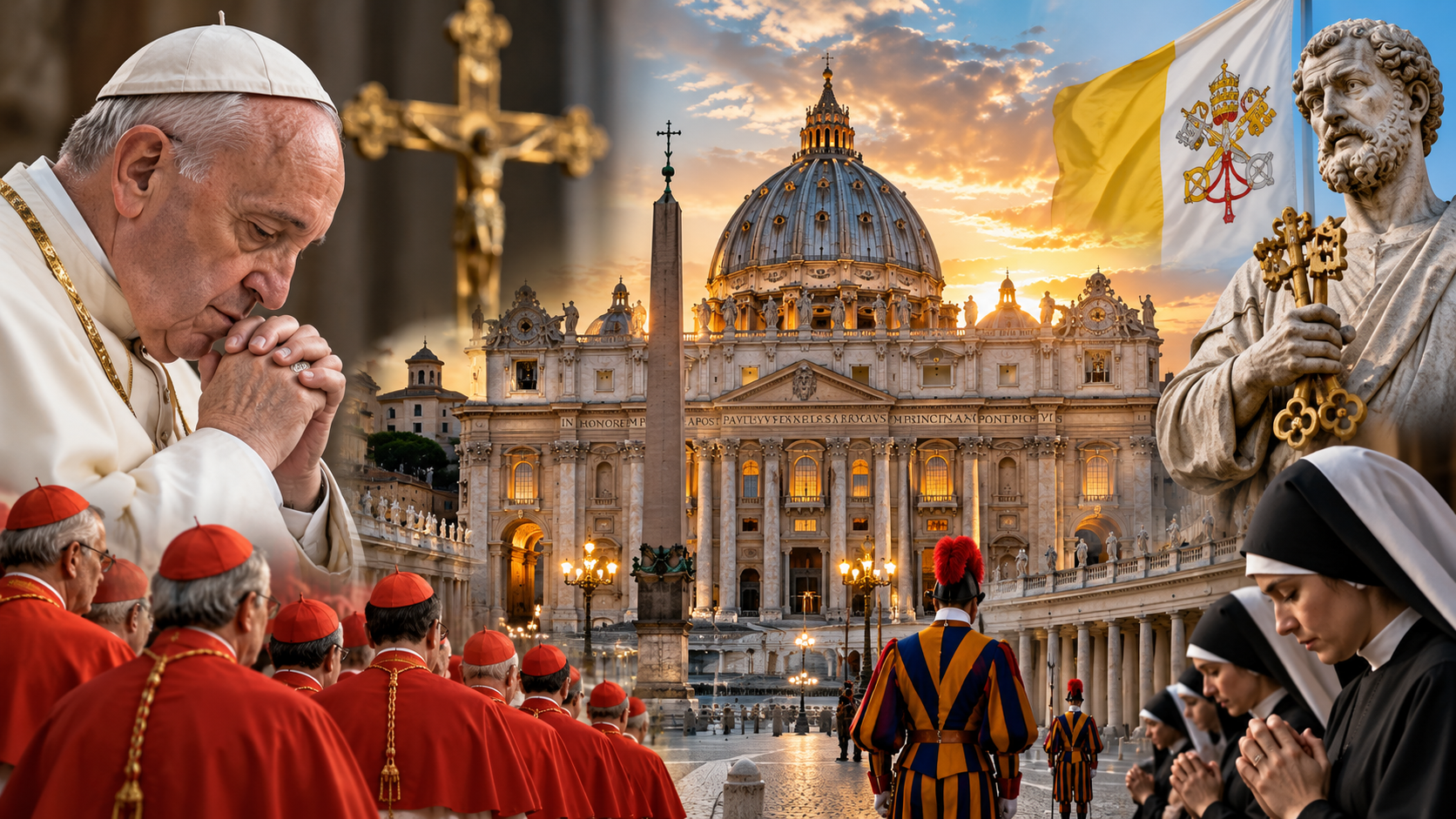
Roman Catholicism is the largest Christian tradition in the world and traces its history through the ancient church to the apostles. Catholics understand the Roman Catholic Church not simply as one denomination among many, but as the church established by Jesus Christ and entrusted to the apostles, with a continuing teaching and sacramental authority.
At the center of Catholic life is Jesus Christ. Catholics affirm the historic Christian doctrines expressed in the ancient creeds, including belief in one God as Father, Son, and Holy Spirit; the full divinity and humanity of Christ; His death and bodily resurrection; the forgiveness of sins; the resurrection of the dead; and eternal life.
Where Catholicism differs most noticeably from Protestant Christianity is not usually over these ancient doctrines but over questions of authority, the church, salvation, the sacraments, and the role of Mary and the saints.
Scripture, Tradition, and the Church
Catholicism teaches that God’s revelation has been handed down through both Sacred Scripture and Sacred Tradition. These are not understood as two unrelated sources of revelation, but as closely connected ways in which the apostolic faith has been transmitted within the church.
The task of authoritatively interpreting that revelation belongs to the church’s teaching office, known as the Magisterium, exercised by the bishops in communion with the bishop of Rome.
This is one of the fundamental differences between Catholicism and most forms of Protestantism. Protestants historically emphasize sola Scriptura—Scripture as the final authority for Christian doctrine—while Catholicism understands Scripture within the apostolic tradition and teaching authority of the church.
The Pope and the Bishops
Roman Catholicism recognizes the pope, the bishop of Rome, as the successor of the apostle Peter and the visible head of the church on earth.
Catholics believe Christ gave Peter a distinctive role among the apostles and that this Petrine ministry continues in the bishops of Rome. The pope therefore possesses an authority that Eastern Orthodox and Protestant Christians do not recognize in the same way.
Catholic teaching on papal infallibility is also frequently misunderstood. It does not mean that Catholics believe everything a pope says is without error. It applies under specific conditions when the pope definitively teaches a doctrine concerning faith or morals for the whole church.
The Sacraments
Catholicism recognizes seven sacraments:
Baptism • Confirmation • Eucharist • Penance • Anointing of the Sick • Holy Orders • Matrimony
Catholics understand the sacraments as means through which God communicates grace rather than merely symbolic ceremonies.
The Eucharist, or Communion, occupies a particularly important place in Catholic worship. Catholic teaching holds that during the Mass the bread and wine truly become the body and blood of Christ while retaining their outward appearances. This doctrine is commonly called transubstantiation.
Salvation
Catholics teach that salvation is entirely dependent upon the grace of God and made possible through Jesus Christ.
Catholic theology does not, however, describe justification in exactly the same way that the Protestant Reformers did. Catholicism understands justification as involving not only the forgiveness of sins but also an actual transformation of the person through God’s grace.
This disagreement became one of the central controversies of the Protestant Reformation and remains an important theological difference between Catholics and many Protestants.
Mary and the Saints
Catholics give Mary a unique place of honor as the mother of Jesus and affirm several doctrines concerning her, including her perpetual virginity, the Immaculate Conception, and her bodily Assumption.
Catholics also honor the saints and may ask them to pray on their behalf.
Catholic theology distinguishes this veneration from the worship that belongs to God alone. Many Protestants nevertheless object to these practices and question whether they have sufficient biblical support.
That disagreement is considerably easier to understand once we allow Catholics to explain what they believe before criticizing them for something they say they don’t believe.
Catholic Worship
The central act of Catholic worship is the Mass, particularly the celebration of the Eucharist.
Catholic worship is liturgical and follows an established structure that includes Scripture readings, prayers, preaching, confession, and Communion. Catholic churches also observe a liturgical calendar organized around events in the life of Christ and the history of the church.
Catholicism is far from culturally uniform. A Mass celebrated in Poland, Mexico, Nigeria, the Philippines, and the United States belongs to the same church while reflecting very different cultures.
Catholicism Today
Roman Catholicism is a worldwide church consisting of local dioceses led by bishops who are in communion with the bishop of Rome.
Although people often use “Roman Catholic” and “Catholic” interchangeably, the Catholic Church actually contains a number of Eastern Catholic churches as well as the much larger Latin Church. These Eastern churches maintain distinctive liturgies and traditions while remaining in communion with Rome.
That is another reminder that Christian history rarely fits as neatly into our categories as our charts would like it to.
The Papacy
Peter • Bishops of Rome
Papal Authority • Infallibility
Catholic Doctrine
Scripture & Tradition
Justification • Purgatory
The Sacraments
Baptism • Eucharist
Confession • Holy Orders
Mary and the Saints
Marian Doctrines • Saints
Veneration • Intercession
Catholic Worship
The Mass • Liturgy
Eucharist • Liturgical Calendar
Catholic History
Early Church • Medieval Church
Trent • Vatican I & II