
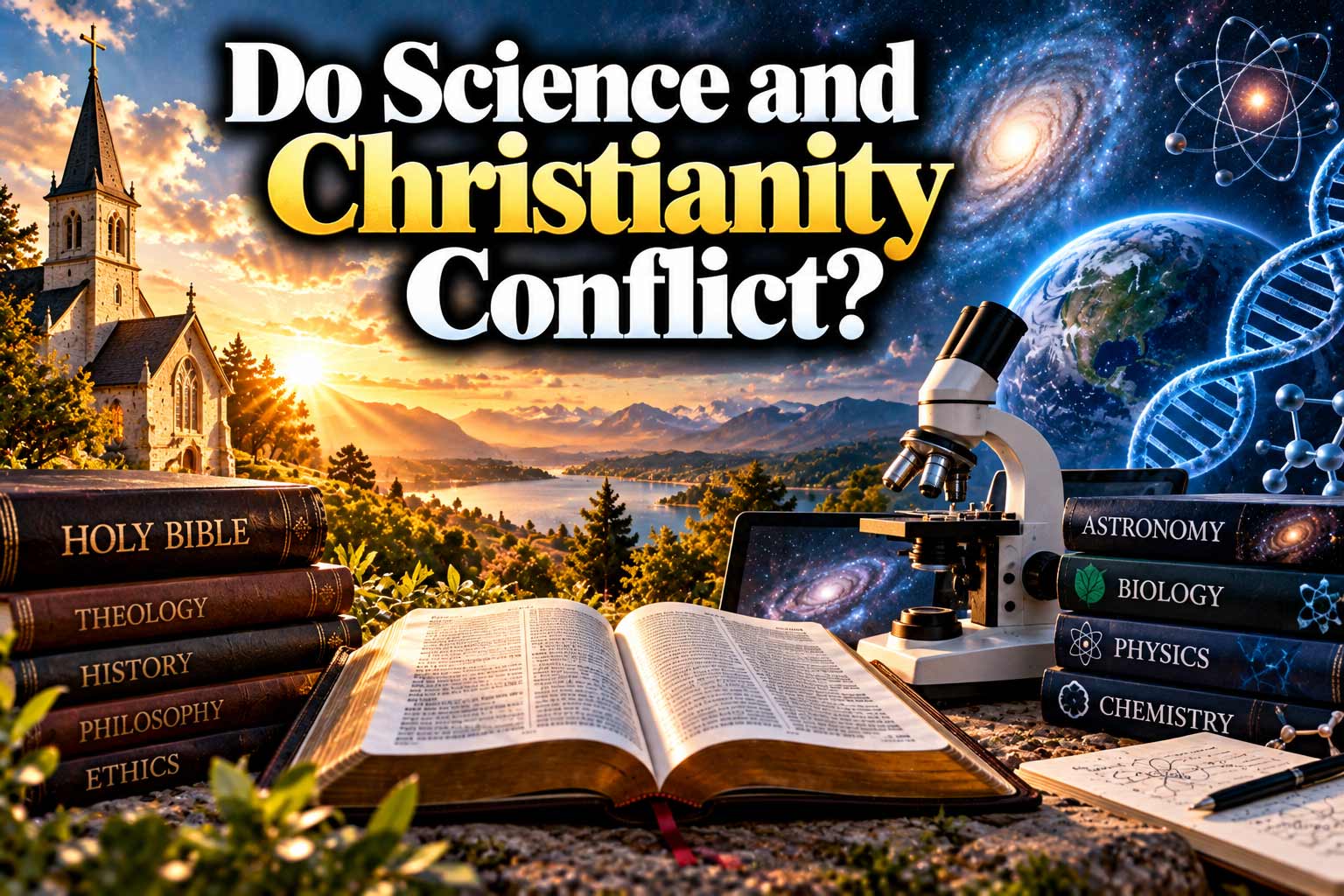
If you listen to some scientists, Christianity is an outdated belief system that has been steadily retreating as scientific knowledge advances. If you listen to some Christians, modern science is a collection of theories invented by atheists to undermine the Bible. Both sides can make it sound as though you have to choose between believing in God and understanding how the universe works.
But the relationship between Christianity and science is considerably more complicated than that. Many of the people who helped establish modern science were committed Christians, and many scientists today continue to practice their faith without seeing a contradiction between their scientific work and their religious convictions. At the same time, there are genuine disagreements involving evolution, the age of the earth, miracles, and the interpretation of Genesis.
The important question isn’t whether science and Christianity have ever conflicted. They certainly have, or at least particular scientific theories and biblical interpretations have. The question is whether those disagreements demonstrate an unavoidable conflict between scientific knowledge and Christian faith.
What Is Science Supposed to Explain?
Science investigates the natural world through observation, experimentation, measurement, and the development of explanations that can be tested against evidence. Scientists study everything from the behavior of subatomic particles to the formation of galaxies, the development of living organisms, and the workings of the human brain.
Scientific explanations are expected to be supported by evidence and open to revision when better evidence becomes available. That’s one of the strengths of the scientific method. Scientists don’t have to defend a theory simply because someone proposed it centuries ago, although scientists can certainly become attached to their own ideas.
Christianity addresses some different questions. It teaches that God created the universe, that human beings possess moral responsibility, that sin has damaged humanity’s relationship with God, and that Jesus Christ accomplished redemption through His death and resurrection. These claims concern history, morality, metaphysics, and theology, although some also intersect with matters investigated by science.
The distinction is important because science and theology don’t always attempt to answer the same questions. Science can investigate the physical processes involved in the development of the universe, while theology asks why anything exists and whether creation has a purpose.
However, we shouldn’t exaggerate the separation. Christianity makes claims about events in the physical world, including the resurrection of Jesus. Science also investigates questions that affect traditional religious interpretations. There are areas of overlap, and sometimes those areas produce genuine disagreements.
Didn’t Christianity Oppose the Development of Science?
The popular story of science and Christianity is often presented as a centuries-long struggle between enlightened scientists and religious authorities determined to suppress knowledge. The trial of Galileo usually serves as the centerpiece of that story.
Galileo supported the heliocentric model, which placed the sun rather than the earth at the center of the planetary system. His position brought him into conflict with Catholic authorities, and in 1633 he was tried by the Roman Inquisition and placed under house arrest.
The Galileo affair was a genuine example of religious authority interfering with scientific inquiry. However, the controversy also involved questions about scientific evidence, biblical interpretation, institutional authority, and Galileo’s relationship with influential church officials. It wasn’t simply a case of every scientist accepting heliocentrism while every Christian rejected it.
The broader history of science includes numerous Christians who made major contributions to scientific knowledge. Nicolaus Copernicus, whose work helped establish heliocentrism, was a Catholic canon. Johannes Kepler, who developed the laws of planetary motion, was a committed Lutheran. Isaac Newton wrote extensively about theology, although his personal beliefs departed from orthodox Trinitarian Christianity.
Robert Boyle, an important figure in the development of modern chemistry, regarded the study of nature as compatible with Christian faith. Gregor Mendel, whose experiments helped establish the foundations of genetics, was an Augustinian friar.
These examples don’t prove Christianity is true, and scientific discoveries don’t become Christian simply because a Christian made them. They do demonstrate that belief in God hasn’t historically prevented people from making important scientific discoveries.
The relationship between Christianity and science has involved cooperation, conflict, and everything in between. Reducing that history to a continuous war between faith and reason makes for a dramatic story, but it isn’t particularly good history.
Does Genesis Conflict With Modern Science?
Much of the contemporary disagreement centers on the opening chapters of Genesis. The Bible describes God creating the heavens and the earth, forming living creatures, and creating humanity in His image. Modern science describes a universe approximately 13.8 billion years old and an earth approximately 4.54 billion years old, with life developing over immense periods of time.
Christians interpret Genesis in several ways. Young-earth creationists generally understand the creation days as six ordinary days and maintain that the earth is only thousands of years old. Old-earth creationists accept the scientific evidence for an ancient universe while believing God created life through acts of divine intervention. Evolutionary creationists believe God created through evolutionary processes, although they differ about how to understand Adam, Eve, and the Fall.
These aren’t merely disagreements about whether the Bible is authoritative. Christians who affirm the inspiration of Scripture can still disagree about the literary structure, historical setting, and intended meaning of Genesis.
For example, the Hebrew word yom, translated “day,” can refer to an ordinary day or a broader period depending on context. Some Christians believe the sequence of creation days should be understood chronologically, while others see a literary arrangement emphasizing God’s sovereignty and the goodness of creation.
The scientific evidence for an ancient earth and universe is substantial, supported by several independent methods of investigation. Christians who reject those conclusions must address the evidence rather than simply dismissing it as atheistic propaganda.
At the same time, science cannot determine whether God created the universe for a purpose. Even a complete physical explanation of the universe’s development wouldn’t automatically answer the theological question of why the universe exists.
What About Evolution?
Evolution is probably the most controversial scientific subject among conservative Christians. Biological evolution describes changes in populations over generations, while the broader theory of common descent proposes that living organisms share evolutionary ancestors.
The evidence supporting evolution includes genetics, fossils, comparative anatomy, and observed changes in living populations. Evolutionary biology is a foundational part of modern biological science, not a fringe theory maintained simply because scientists dislike religion.
Nevertheless, Christians disagree about whether evolutionary explanations are compatible with biblical teaching. Some reject common descent because they believe Genesis describes the separate creation of major kinds of living organisms. Others accept limited evolutionary change but question whether natural processes can account for the full diversity of life.
Evolutionary creationists generally accept common descent while maintaining that God is the Creator who sustains the natural processes through which life developed. For them, evolution describes a mechanism of creation rather than an alternative to God.
The more difficult theological questions concern human origins, the historical identity of Adam and Eve, the entrance of sin into the world, and the relationship between death and the Fall. Romans 5 connects Adam’s sin with the human condition and Christ’s redemptive work, so Christians cannot simply dismiss Adam as an irrelevant detail.
I think Christians should distinguish between the scientific evidence for biological change and the philosophical claims sometimes attached to evolutionary theory. Evolution doesn’t establish that God doesn’t exist, but neither should Christians pretend that the scientific questions disappear simply because they believe God created life.
Can Science Explain Away God?
Some atheists argue that science has made belief in God unnecessary. In earlier centuries, people attributed events such as lightning, disease, and planetary motion to divine activity because they didn’t understand the natural processes involved. As scientific knowledge increased, those supernatural explanations became less necessary.
This criticism has considerable force against what philosophers call the God of the gaps approach. If someone argues that God must have caused a particular phenomenon simply because science hasn’t explained it, that argument becomes vulnerable whenever scientists discover a natural explanation.
Christians shouldn’t build their faith around gaps in scientific knowledge. History provides plenty of examples of mysteries that eventually received convincing natural explanations.
But explaining a natural process doesn’t necessarily eliminate the possibility of divine action. A Christian can believe that God sustains the universe while also recognizing that gravity governs the motion of planets. Understanding how rain forms doesn’t require abandoning the belief that God created a world in which atmospheric processes make rainfall possible.
The philosophical question concerns whether the existence of natural laws and processes makes God unnecessary or whether those laws themselves belong to a created order.
Science investigates the physical universe, but it doesn’t possess a method for determining whether reality has an ultimate purpose or whether a transcendent Creator exists. Those questions require philosophical reasoning that extends beyond scientific experimentation.
That doesn’t mean arguments for God’s existence are automatically successful. It means scientific explanations and metaphysical explanations shouldn’t be confused.
What About Miracles?
Miracles present a more direct challenge because Christianity teaches that God sometimes acts in ways that ordinary natural processes cannot explain. The resurrection of Jesus is the clearest example. Christianity doesn’t merely claim that Jesus’ followers experienced a powerful spiritual awakening after His death. It teaches that God raised Him bodily from the dead.
Science can establish that people who have been dead for several days don’t ordinarily return to life. Christians agree. That’s precisely why the resurrection is regarded as a miracle rather than an unusual medical recovery.
The question is whether the regularity of natural processes proves that exceptions are impossible. Science investigates what occurs under observable conditions, but it cannot demonstrate that a supernatural agent could never intervene in the natural world.
On the other hand, Christians shouldn’t label every unexplained event a miracle. Unusual recoveries, apparent coincidences, and experiences we don’t understand may have natural explanations that haven’t yet been discovered.
Claims of miracles deserve careful examination, especially when they involve medical conditions or events that can be independently investigated. Faith doesn’t require abandoning critical thinking.
The resurrection is ultimately a historical claim involving testimony, evidence, and competing explanations. Science can inform our understanding of death and biological processes, but evaluating whether God raised Jesus also requires historical and philosophical considerations.
Is Science Based on Atheism?
Some Christians confuse the methods of science with the philosophy of naturalism. The distinction is important.
Methodological naturalism means that scientific investigations seek explanations in terms of observable natural processes. Scientists studying a disease investigate biological mechanisms rather than treating supernatural activity as a testable scientific explanation.
That approach doesn’t require scientists to believe that God doesn’t exist. A Christian physician and an atheist physician can investigate the same disease using the same scientific methods while holding different beliefs about the ultimate nature of reality.
Philosophical naturalism, by contrast, is the belief that reality consists entirely of the natural world and that no supernatural being or realm exists. That’s a philosophical position, not a conclusion automatically established by the scientific method.
Some scientists embrace philosophical naturalism, while others are Christians, Jews, Muslims, or members of other religious traditions. Their scientific work may be equally rigorous regardless of their personal convictions.
Christians should resist the assumption that every scientific explanation is an attack on God. Likewise, scientists shouldn’t assume that scientific expertise automatically qualifies them to settle every philosophical or theological question.
A physicist may understand quantum mechanics brilliantly without possessing any particular expertise in biblical interpretation. The reverse is also true: a theologian’s knowledge of Scripture doesn’t automatically make him an authority on cosmology.
How Should Christians Respond When Science Challenges Their Interpretation?
This may be the most important practical question. Christians who believe Scripture is inspired by God naturally want to defend its truthfulness. But defending Scripture isn’t always the same thing as defending a particular interpretation of Scripture.
Church history provides examples of Christians revising interpretations when new knowledge demonstrated that earlier assumptions were mistaken. The acceptance of heliocentrism is an obvious case. Biblical passages describing the sun rising or standing still weren’t abandoned, but Christians reconsidered whether those expressions were intended as scientific descriptions of the solar system.
That doesn’t mean every traditional interpretation should be discarded whenever a new scientific theory appears. Scientific theories can be revised, and biblical interpretation requires careful attention to language, context, and the intentions of the biblical authors.
But Christians shouldn’t be afraid to examine evidence. If God is the Creator of the natural world and the source of biblical revelation, genuine truth discovered through either shouldn’t ultimately contradict the other.
The difficulty is that human beings can misunderstand both Scripture and nature. Scientists can draw mistaken conclusions from evidence, and theologians can mistake inherited interpretations for the actual teaching of the Bible.
Humility is therefore essential on both sides. Christians shouldn’t demand that scientific discoveries conform to interpretations that may be mistaken, and scientists shouldn’t treat philosophical assumptions as though they were experimental results.
Do Christians Have to Choose Between Faith and Science?
I don’t believe they do. Christianity teaches that God created an orderly universe, and scientific investigation helps us understand how that universe operates. There is no necessary contradiction between believing that God created the world and studying the physical processes through which it developed.
That doesn’t eliminate every disagreement. Christians still need to wrestle with questions about Genesis, evolution, Adam and Eve, miracles, and the relationship between divine action and natural laws. Some of those questions are difficult, and we shouldn’t pretend otherwise.
But the existence of difficult questions doesn’t establish that Christianity and science are fundamentally incompatible. The conflict often arises when scientific findings are turned into sweeping philosophical claims or when particular biblical interpretations are treated as though they were beyond reconsideration.
I believe Christians should take both Scripture and scientific evidence seriously. We shouldn’t be intimidated by legitimate discoveries, nor should we accept every philosophical conclusion someone attaches to them. The goal is to understand truth, not to protect ourselves from uncomfortable questions.
The Bible tells us that God created the heavens and the earth. Science helps us investigate the extraordinary complexity of what He created. Those aren’t necessarily competing explanations, and Christians shouldn’t assume that learning more about the universe means believing less in its Creator.
If God is the author of both creation and Scripture, we have nothing to fear from discovering how His creation works.