
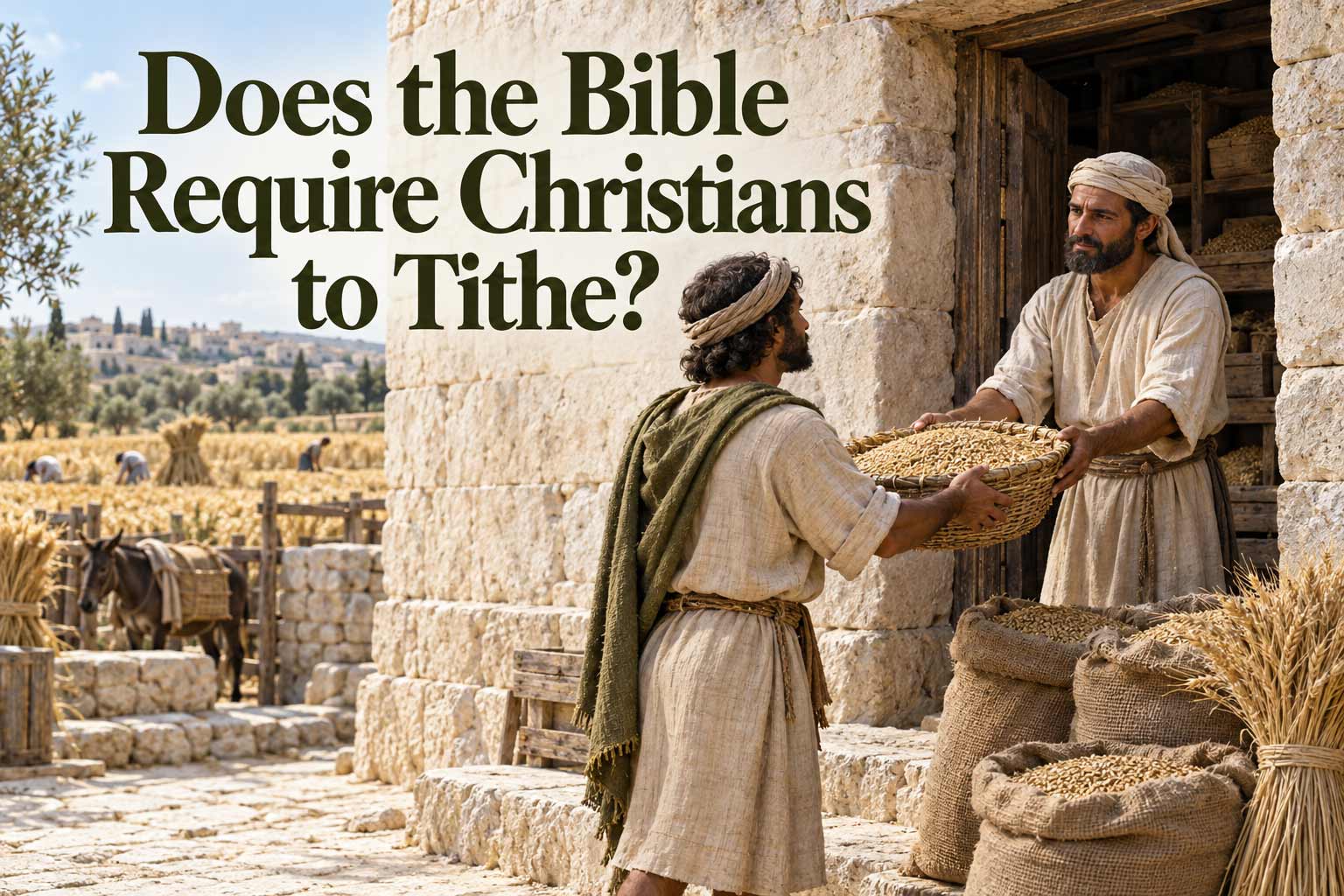
If you’ve attended church for any length of time, you’ve probably heard that Christians should give ten percent of their income to God. Some churches present that as a helpful starting point for generosity. Others teach it as a binding requirement and warn that failing to tithe amounts to robbing God. Those are different claims, and we should examine the passages before treating them as interchangeable.
The Bible clearly teaches generosity, support for ministry, and care for people in need. It also contains commands concerning tithing under Israel’s covenant law. The question is whether those commands establish a universal requirement for Christians to give exactly ten percent of their income to their local church. The New Testament doesn’t state that requirement directly, and its instructions about giving emphasize willingness, resources, and love.
What Was the Old Testament Tithe?
A tithe is a tenth. Under the law given to Israel, tithing involved agricultural produce and livestock within a larger system of worship and community responsibility. Numbers 18 describes tithes supporting the Levites, who served at the sanctuary and didn’t receive a tribal land inheritance like the other tribes. The arrangement provided for people whose responsibilities differed from those of Israel’s farming households.
Deuteronomy 14 describes tithing in connection with a shared meal before the Lord and provision for Levites, foreigners, orphans, and widows. It even allows produce to be converted into money when the journey is too long, with that money then used for the prescribed celebration. These details remind us that biblical tithing was more complex than a modern instruction to transfer ten percent of a paycheck to a church account. Its purposes included worship, celebration, ministry support, and care for vulnerable people.
Christians can learn important principles from that system. Resources should serve more than our personal comfort, and worship should involve gratitude expressed through practical action. But applying those principles isn’t the same as transferring every feature of Israel’s covenant arrangements into church life. We need to examine what the New Testament actually instructs believers to do.
Didn’t Abraham Tithe Before the Law?
Supporters of mandatory Christian tithing often point out that Abraham gave a tenth to Melchizedek before the law of Moses. Genesis 14 records that gift, and Hebrews 7 discusses it while explaining the significance of Melchizedek in relation to Christ’s priesthood. Jacob also promised a tenth to God in Genesis 28. These accounts show that giving a tenth wasn’t confined to the later Mosaic legislation.
However, an action occurring before the law doesn’t automatically establish a command for every Christian. Abraham’s recorded gift arose from a particular encounter following a military victory, and Jacob’s promise was part of a personal vow. Neither passage directly instructs all future believers to give ten percent of every source of income. The examples can support the practice of tithing without settling whether it’s universally required.
Hebrews 7 likewise needs to be read according to its argument. The chapter uses Abraham’s encounter with Melchizedek to discuss priesthood and superiority. It doesn’t conclude by directing Christians to calculate and pay a tithe. We should avoid turning a supporting detail in one argument into a command the author doesn’t give.
What About Jesus’ Teaching on Tithing?
In Matthew 23:23, Jesus criticized religious leaders who carefully tithed small herbs while neglecting justice, mercy, and faithfulness. He said they should have practiced the latter without neglecting the former. That passage genuinely affirms tithing for the people He was addressing. It shouldn’t be dismissed as though Jesus said nothing positive about it.
At the same time, He was speaking to religious leaders living under Israel’s existing covenant obligations. Determining how that instruction applies to the church requires considering the wider New Testament teaching. The passage doesn’t directly explain how Gentile Christians should calculate offerings or establish that every Christian owes a fixed percentage to a local congregation. Its unmistakable warning is that meticulous religious giving can coexist with serious moral failure.
That warning remains relevant whether someone gives ten percent, twenty percent, or another amount. Financial contributions don’t excuse injustice or replace compassion. A person can be exact about the offering while being careless about people. Jesus refused to let careful accounting conceal that contradiction.
Are Christians “Robbing God” if They Don’t Tithe?
Malachi 3 contains the well-known accusation that God’s people were robbing Him in tithes and offerings. The instruction to bring the tithe into the storehouse belongs to Israel’s covenant setting, with provision for God’s house and promises concerning crops and agricultural threats. God was confronting a people who were withholding what their covenant required. Understanding that setting is necessary before applying the accusation to a Christian’s paycheck.
The passage can challenge our selfishness and unwillingness to support God’s work. But it doesn’t establish that a struggling Christian who gives less than ten percent is automatically under a divine curse. Nor does it authorize a minister to promise that a particular donation will produce a particular financial return. Those claims require more than repeating the phrase “windows of heaven.”
We should be especially cautious when a fundraising appeal uses fear to override someone’s circumstances. A church ought to encourage generosity honestly, explain its needs, and handle contributions responsibly. Threatening people with disaster unless they meet a payment threshold distorts that responsibility. Giving should express faith and love rather than panic about what God might do if an envelope is too small.
What Does the New Testament Require?
Second Corinthians 8–9 gives substantial instruction concerning an offering for believers in need. Paul encourages willing generosity and relates giving to what a person actually has. He doesn’t want one group relieved while another is unfairly burdened. The needs of both recipients and contributors receive consideration.
Second Corinthians 9:7 emphasizes giving according to a person’s considered intention, without grudging reluctance or compulsion. That doesn’t mean generosity is irrelevant or that selfishness becomes acceptable under the label of personal choice. Paul is actively encouraging a meaningful contribution. But his appeal seeks a willing response rather than compliance with a stated ten-percent rule.
First Corinthians 16:1–2 also encourages planned giving according to prosperity. Together, these passages support giving that is intentional, regular, proportionate, and generous. They provide guidance for responsible decisions without specifying the same percentage for every household. Christian freedom involves considering how to give faithfully, not finding a theological excuse never to give.
Is Ten Percent a Good Starting Point?
Ten percent can be a useful personal practice. Setting aside a proportion of income can make generosity deliberate rather than dependent on whatever happens to remain. For some households, that amount provides a manageable discipline and a starting point for growth. Nothing about questioning a universal tithing requirement makes voluntarily giving a tenth wrong.
However, a useful practice shouldn’t become a measure of every Christian’s faithfulness. Ten percent may involve substantial sacrifice for one household and little sacrifice for another. Someone facing serious hardship may need help from the congregation rather than pressure to give money needed for food or essential care. Someone with abundant resources may be capable of giving considerably more.
The right question extends beyond whether a percentage has been reached. Are we using our resources responsibly, supporting worthwhile ministry, and responding to genuine needs? Are we protecting unnecessary comforts while dismissing opportunities to help? Those questions can be more demanding than simply proving that we met a minimum.
Support Ministry With Wisdom and Accountability
The New Testament supports providing for those who labor in ministry, and churches have real expenses. Teaching, pastoral care, missions, and practical assistance require resources. Believers shouldn’t assume that somebody else will always provide them. Regular support for a healthy local congregation is a reasonable expression of shared responsibility.
Giving also calls for discernment. Churches and ministries should explain how funds are used and maintain meaningful financial oversight. A request for accountability shouldn’t be treated as an attack on God’s work. Christian generosity is meant to serve people and advance faithful ministry, so we should care whether contributions accomplish those purposes.
The Bible requires us to take generosity seriously, but it doesn’t clearly impose a universal ten-percent rule on Christians. You can choose to tithe without condemning everyone who follows another thoughtful approach. You can also give less or more while examining whether your decision reflects genuine willingness and responsible stewardship. The goal is a life in which gratitude to God produces practical generosity toward His work and the people He calls us to love.