
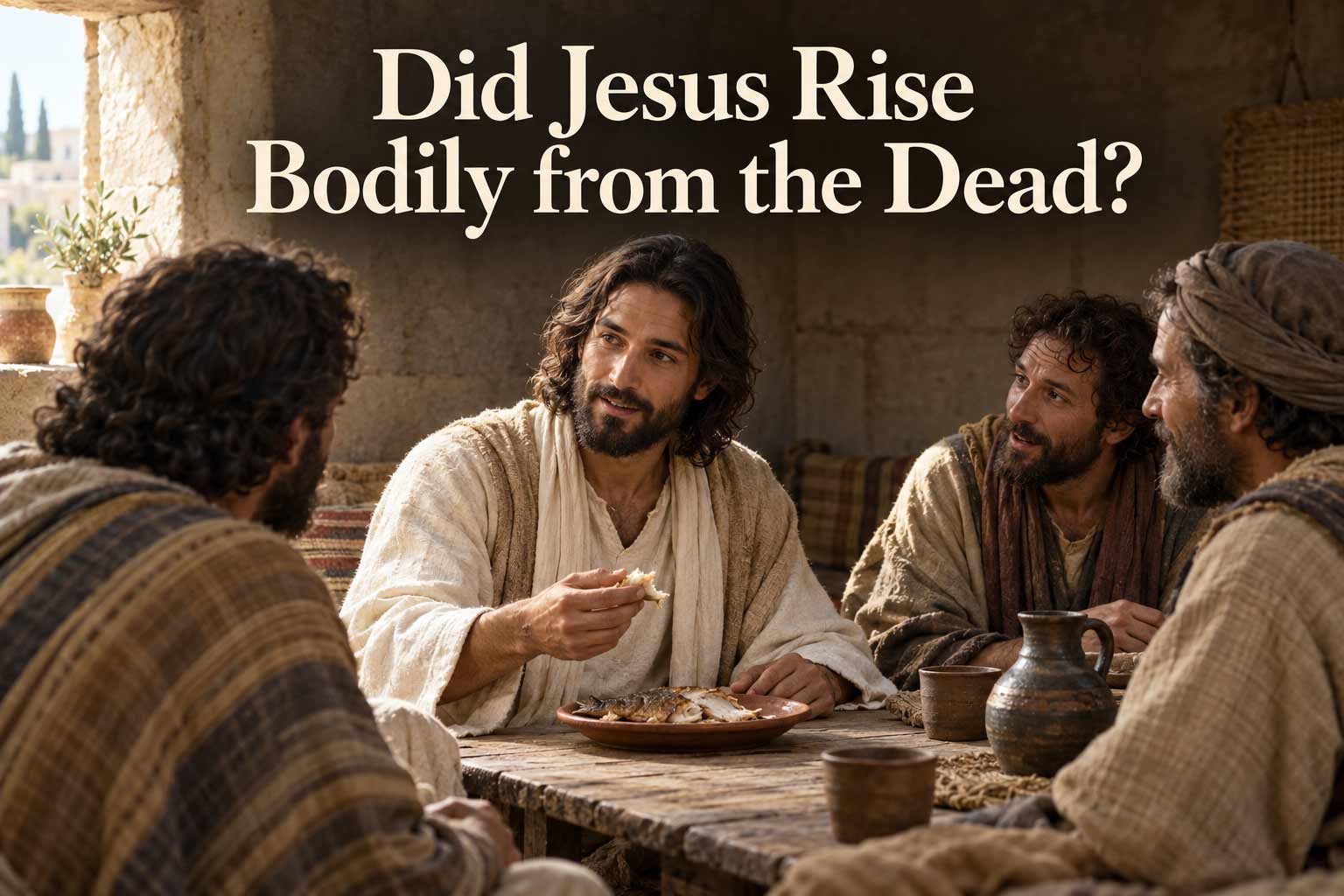
Yes. The New Testament presents Jesus’ resurrection as a bodily event, not simply the survival of His soul or the continuation of His influence. The person who had been crucified and buried appeared alive to His followers. They encountered someone who could speak with them, show them His wounds, and eat in their presence.
But bodily resurrection doesn’t mean that Jesus merely returned to the life He had been living before the cross. His risen life was transformed and no longer subject to death. We need to keep both parts of that claim in view. The resurrection involved the same Jesus who had died, now living in a condition that went beyond ordinary mortal existence.
The Accounts Emphasize His Physical Presence
Luke records the disciples becoming frightened when Jesus appeared among them because they thought they were seeing a spirit. Jesus responded by directing their attention to His hands and feet. He invited them to touch Him and pointed out that a spirit doesn’t have flesh and bones as they could see He had (Luke 24:36–39). The account explicitly distinguishes His appearance from an encounter with a disembodied spirit.
Jesus then asked whether they had anything to eat. They gave Him broiled fish, which He ate in front of them. Luke includes these details to establish the character of the encounter. The disciples were being asked to recognize an embodied person, not merely accept that Jesus somehow remained spiritually present.
That doesn’t answer every question about the properties of His risen body. It does establish what Luke wants readers to understand. Jesus’ body wasn’t irrelevant to His resurrection, and the disciples’ experience wasn’t presented as an inward feeling. The one standing before them was the person who had suffered and died.
The Wounds Connect Him with the Crucified Jesus
John’s account gives similar attention to Jesus’ wounds. Thomas said he wouldn’t believe the other disciples’ report without seeing the marks of the nails and the wound in His side. When Jesus appeared again, He invited Thomas to examine those very places (John 20:24–27). His response addressed Thomas’s concern about whether the crucified Jesus was actually alive.
John doesn’t explicitly say that Thomas then touched Him. We often supply that detail from paintings or retellings of the account. What John records is the invitation, followed by Thomas’s confession: “My Lord and my God.” The encounter brought him from resistance to recognition.
The wounds establish continuity between Jesus before and after His death. He wasn’t replaced by someone who resembled Him, and His resurrection didn’t make His suffering someone else’s experience. The risen Lord was the same person His followers had known. His transformed life still bore the identifying marks of what He had endured.
The Empty Tomb Belongs to the Claim
The resurrection accounts also describe the tomb as empty. In John 20, Mary Magdalene initially interprets the missing body as evidence that someone has taken Jesus away. She doesn’t immediately conclude that He has risen. The account distinguishes finding an empty tomb from understanding what had happened.
An empty tomb by itself wouldn’t establish resurrection. A missing body could prompt several possible explanations, as Mary’s response demonstrates. The Christian claim brings the empty tomb together with the appearances of Jesus. The body was absent from the place of burial, and the person who had been buried was encountered alive.
That combination matters when we ask whether the resurrection was bodily. If the claim were only that Jesus’ spirit survived death, the whereabouts of His body would be a different question. The Gospels instead connect His burial, the empty tomb, and His appearances. They present a resurrection involving the person who had died in His embodied life.
Resurrection Was More Than Resuscitation
A person can be restored to ordinary life and still remain subject to illness, aging, and eventual death. Christian belief about Jesus goes further. Paul says that, having been raised, Christ will not die again and death no longer has dominion over Him (Romans 6:9). His resurrection begins a life beyond death’s reach.
The appearances also include features that the writers don’t fully explain. John describes Jesus standing among the disciples when the doors were shut. We shouldn’t turn that detail into an elaborate theory about how resurrected bodies move through matter. The text tells us that He appeared; it doesn’t describe the mechanism.
The important distinction is between continuity and transformation. Jesus remained Himself, and His risen life differed from the mortal life He had previously lived. We shouldn’t use the unusual features to deny His embodiment. Nor should we reduce the resurrection to an ordinary recovery because the accounts describe physical contact and eating.
What Does Paul Mean by a “Spiritual Body”?
Paul describes the resurrection body as a “spiritual body” in 1 Corinthians 15:44. That expression can sound like a contradiction if we assume that “spiritual” always means immaterial. In context, however, Paul contrasts our present mortal condition with the transformed life God gives. He continues to speak of a body.
The contrast includes weakness and power, dishonor and glory, and decay and incorruptibility. A spiritual body is therefore best understood as a body transformed for life through God’s Spirit. Paul isn’t describing the abandonment of embodiment. He’s describing embodiment freed from the limitations of our present mortal condition.
The same context helps us understand his statement that flesh and blood cannot inherit God’s kingdom. Paul immediately connects the problem with corruption and mortality, then says that we must be changed. The solution is transformation. Reading the phrase as a rejection of all bodily existence would pull it away from the argument surrounding it.
We should be cautious about claiming more detail than Paul supplies. His discussion gives us a basis for hope, not a medical description of resurrection physiology. We know that the raised life is imperishable and that God provides the body appropriate to it. We don’t know every feature of that existence.
Was It Only a Symbol of Hope?
Some people interpret the resurrection as a way of saying that Jesus’ message survived or that His followers found renewed courage after His death. Those ideas may describe effects of resurrection belief, but they don’t capture what the New Testament writers claim. The accounts describe encounters with Jesus, not simply a decision to preserve His teaching.
We should distinguish what a text claims from whether someone finds the claim convincing. A person may question the reliability of the accounts or reject the possibility of resurrection. Those are questions about evidence and belief. They don’t change the fact that the accounts present Jesus as having actually risen.
Christianity rests on more than admiration for someone who died bravely. It announces that the crucified Jesus lives and has overcome death. That claim is extraordinary, and it deserves serious examination. Reducing it to a symbol makes it easier to accept only by changing what is being asserted.
His Resurrection Shapes Our Hope
Paul connects our future with Jesus’ risen life. Philippians 3:20–21 says that Christ will transform our lowly bodies to be like His glorious body. Christian hope therefore includes the restoration of embodied life. It doesn’t treat our humanity as a temporary mistake from which salvation finally releases us.
That gives bodily life significance now. Illness, disability, aging, and death are real experiences that affect people deeply. Resurrection hope doesn’t require us to minimize their pain. It gives us reason to believe that the condition we presently endure isn’t the limit of what God intends for us.
Jesus rose bodily, but His resurrection carried Him into transformed life beyond death. The same Lord who had suffered appeared to His followers, and His victory became the foundation of their hope. We don’t need to understand every property of His risen body to recognize the promise involved. The Savior who entered our human condition didn’t discard it when He overcame death.