
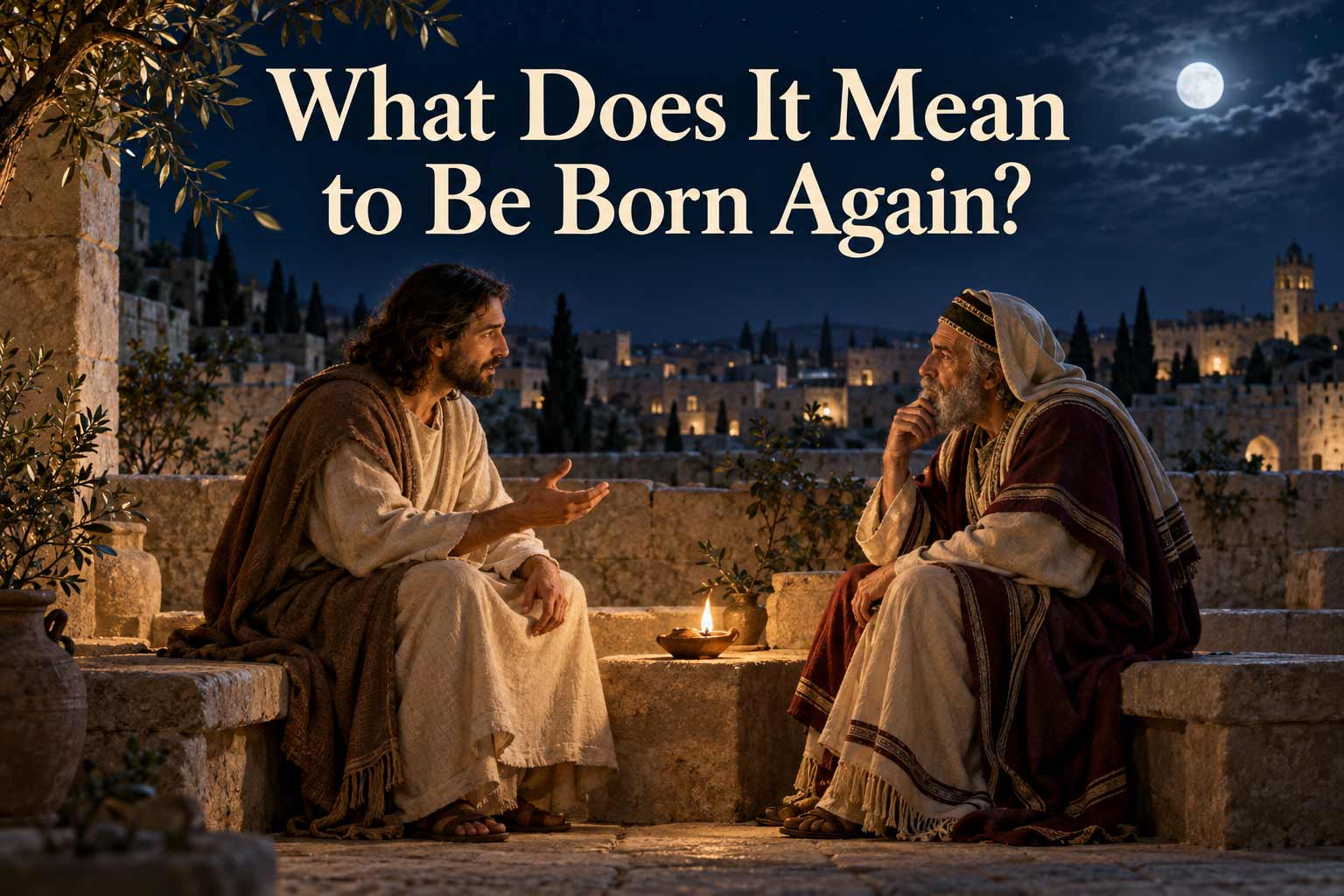
“Born again” is one of those Christian expressions that people can use for years without explaining. Some associate it with a dramatic conversion, others with a particular kind of church, and others with a person who has become unusually outspoken about religion. But Jesus used the expression to describe something deeper: receiving new spiritual life through God’s Spirit.
Being born again means that God brings us into a new life and relationship with Him through Jesus Christ. It involves forgiveness and inward renewal, beginning a life of trust and obedience. We don’t produce that life simply by becoming more religious. We receive it through God’s grace as we turn to Christ.
Why Did Jesus Say It to Nicodemus?
In John 3, Nicodemus comes to Jesus at night. He is a Pharisee and a Jewish leader who recognizes that Jesus’ works point to God’s presence. He isn’t approaching as someone with no religious knowledge or interest. He already has an established place within his religious community.
Jesus nevertheless tells him that he must be born again to see God’s kingdom. Nicodemus responds by asking how an older person could return to his mother’s womb. He understands the language in terms of another physical birth. Jesus explains that He is speaking about birth through the Spirit.
The encounter challenges the assumption that religious standing is enough. Knowledge, upbringing, and participation in a community can be valuable, but they don’t replace the life God gives. Nicodemus needed more than recognition that Jesus was an impressive teacher. He needed to understand and receive what God was doing through Him.
The same challenge applies to us. Growing up in church can help us learn the Christian message, but family background doesn’t automatically make that message our own. Nor does an absence of religious upbringing put someone beyond God’s reach. The invitation concerns receiving life from Him.
New Birth Is God’s Work
Jesus distinguishes what is born of the flesh from what is born of the Spirit (John 3:6). Human birth brings us into ordinary human life. The Spirit brings the spiritual life Jesus is describing. We can’t manufacture that life through determination or familiarity with religious practices.
Titus uses the related language of regeneration and renewal by the Holy Spirit. It places this within God’s mercy, rather than righteous deeds through which we have earned salvation (Titus 3:5). “Regeneration” simply refers to receiving new life. The emphasis is on what God does for people who need His help.
That doesn’t mean our response is irrelevant. The conversation in John 3 moves toward believing in the Son and receiving eternal life through Him. God’s gift and our response of faith belong together. We turn to Christ, and the life we receive comes from God.
New birth therefore involves more than a decision to improve our behavior. Improvement may follow, and sometimes it requires considerable effort. But the foundation is a changed relationship with God and the Spirit’s renewing work. Christian life begins with receiving what we couldn’t provide for ourselves.
What Does “Water and the Spirit” Mean?
Jesus says that a person must be born of water and the Spirit to enter God’s kingdom (John 3:5). Christians have interpreted the reference to water differently. Some connect it directly with baptism, while others understand it through biblical imagery of cleansing. The phrase deserves consideration within the whole conversation.
An important background is Ezekiel 36:25–27. God promises cleansing, a new heart, and the presence of His Spirit, enabling His people to live differently. That combination makes good sense of Jesus’ language. It also helps explain why He expected a teacher of Israel to recognize something of what He meant.
I understand the passage primarily in terms of God’s cleansing and renewing work through the Spirit. I don’t believe water baptism automatically creates spiritual life in someone regardless of faith. But baptism remains a meaningful, commanded response to Christ. We shouldn’t dismiss it merely because we distinguish the outward act from the inward work.
Whichever interpretation someone adopts, the central point of Jesus’ conversation remains clear. Entrance into God’s kingdom requires the life God gives. Religious credentials and physical ancestry can’t supply it. We need cleansing and renewal that reach beyond appearances.
Does New Birth Feel Dramatic?
Sometimes it does. A person may experience relief, joy, sorrow over sin, or a strong sense of God’s presence when turning to Christ. Those experiences can be significant and memorable. But they shouldn’t become the standard by which we judge everyone else.
Other people respond quietly. Someone raised around Christianity may struggle to identify the exact moment when inherited beliefs became personal faith. Another person may come to trust Christ through a process of asking questions and learning. Uncertainty about the date doesn’t settle whether the relationship is real.
We should also distinguish emotion from enduring faith. A powerful service can move someone deeply without producing a lasting response to Jesus. Conversely, a quiet response can begin a life of genuine discipleship. We need to consider what someone is trusting and how they respond over time, rather than measuring the intensity of one experience.
If you’re unsure, the useful question is what your relationship with Jesus is now. Are you turning to Him, relying on His mercy, and becoming willing to receive His direction? You don’t need to reproduce someone else’s testimony. You can come honestly with the understanding and need you have.
New Birth and Spiritual Growth Are Different
A newborn child has life but still has much to learn. The same distinction helps us think about new birth and maturity. Receiving spiritual life doesn’t instantly give us wisdom, self-control, or a complete understanding of Scripture. Growth follows through learning, practice, correction, and dependence on God.
We should expect change, but we shouldn’t expect every struggle to disappear immediately. A person may become newly aware of wrongdoing they previously ignored. They may also need help changing established habits or repairing damaged relationships. That process can be difficult without making the new beginning meaningless.
At the same time, we shouldn’t use gradual growth to excuse a permanent refusal to listen. New life calls for a response. When we discover something that needs to change, we’re invited to repent and seek help. Maturity develops as we continue responding to God rather than defending everything about ourselves.
The evidence isn’t that we have become flawless. It includes a growing willingness to trust Christ, receive correction, love others, and take sin seriously. Those developments may be uneven, and they should be considered with patience. God’s renewing work calls us into an ongoing relationship.
Is It the Same as Baptism in the Holy Spirit?
In my understanding, new birth and baptism in the Holy Spirit are distinct aspects of Christian experience. The Spirit gives us new life when we come to Christ. I also believe believers can experience a subsequent empowering by the Spirit for witness and ministry. Christians differ over how to describe that relationship.
Acts 8 contributes to this discussion. The Samaritans believed Philip’s message and were baptized, then Peter and John came and prayed for them to receive the Holy Spirit. I understand that sequence as supporting a distinction between conversion and a later experience of spiritual empowerment. Other Christians interpret its significance differently.
The distinction shouldn’t leave a new believer thinking that God has given them only part of a relationship with Him. The Spirit is already at work in new birth. Seeking further empowerment grows from that relationship. Speaking in tongues isn’t a requirement for receiving salvation or proof that someone has been born again.
How Do I Receive This New Life?
Turn to God in repentance and place your faith in Jesus Christ. Acknowledge your need for forgiveness and trust the Son who died for your sins and rose from the dead. Ask God for His mercy and renewing work. You can respond in prayer without needing a particular ceremony or wording.
Then begin learning to follow Jesus. Be baptized, read Scripture, pray, and seek a healthy Christian community where you can receive teaching and encouragement. These steps help you grow in the life you’ve received. They don’t purchase the new birth.
Peter connects new birth with a living hope through Jesus’ resurrection (1 Peter 1:3). That gives this new beginning a future as well as a present. God’s purpose reaches beyond a moment of religious excitement into a life lived with Him. Being born again means receiving that life and beginning to grow within it.