
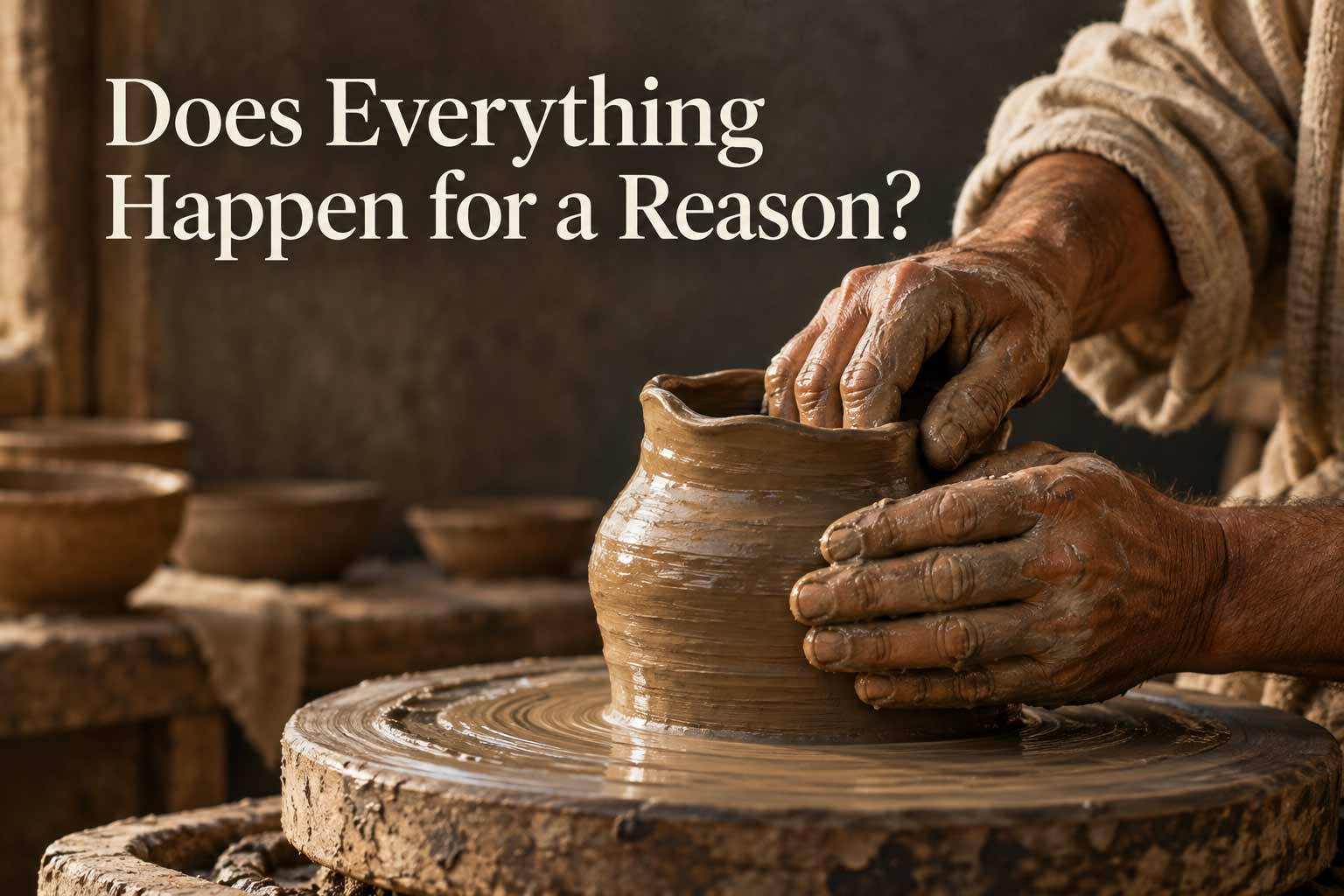
“Everything happens for a reason” is one of those statements people offer when they don’t know what else to say. Sometimes it expresses confidence that God hasn’t abandoned us. At other times, it suggests that every illness, betrayal, and tragedy was carefully arranged to accomplish something good. Those are different claims, and a person who’s grieving may hear the second one even when the speaker intended the first.
I believe God has purposes for our lives and can work through circumstances we don’t understand. I don’t believe that requires us to call every event His preferred plan. Some things happen because people make destructive choices, because bodies are vulnerable, or because we live in a world that hasn’t yet been restored. God’s ability to redeem what happens gives us hope without requiring us to describe everything that happens as something He wanted.
What Do We Mean by “a Reason”?
The word “reason” can refer to a cause or a purpose. If a pipe bursts because it froze, we have an explanation for what happened. That doesn’t establish that the resulting damage was arranged to teach the homeowner patience. Likewise, knowing that an employer’s dishonesty caused someone to lose their savings doesn’t mean the loss served a divine purpose that made the dishonesty necessary.
We often move from one meaning to the other without noticing. Someone asks why an event happened, and we answer as though identifying a cause would also reveal God’s intention. But physical causes, human motives, and divine purposes aren’t interchangeable. Understanding one doesn’t automatically give us knowledge of the others.
That distinction allows us to investigate problems without claiming more than we know. We can identify negligence, treat an illness, or repair damage even when we don’t understand why God allowed the circumstances. There may be something to learn from the experience, but learning afterward isn’t proof that the event was arranged for that lesson.
What Does Romans 8:28 Promise?
Romans 8:28 assures those who love God that all things work together for good according to His purpose. It’s a substantial promise, but we need to read it alongside the surrounding verses. Paul has been discussing suffering, creation’s groaning, and our weakness in prayer. The promise belongs in a chapter that acknowledges pain rather than denying it.
Paul doesn’t say that every individual event is good. He also doesn’t say that every hardship will soon produce an advantage we can identify. The next verse connects God’s purpose with believers being conformed to the image of His Son. That gives the promised good a deeper meaning than financial recovery, improved circumstances, or an opportunity that neatly compensates for what we lost.
I understand the passage as an assurance that suffering doesn’t place believers beyond God’s redeeming work. He remains able to sustain us, form us, and bring us toward the fulfillment of His purposes. That’s different from claiming that He caused every injury along the way. We can trust the promise without supplying a detailed explanation Paul himself doesn’t provide.
The Bible Doesn’t Present Life as a Simple Formula
Ecclesiastes 9:11 observes that the fastest runner doesn’t always win and the strongest army doesn’t always prevail. Wisdom and ability don’t guarantee prosperity, because time and chance affect human lives. The passage recognizes something we see regularly: outcomes don’t always match effort, skill, or deservingness. Life contains circumstances we can’t predict or control.
That observation doesn’t require us to believe God is absent. It does challenge the assumption that every result reveals a straightforward divine message. A person can prepare wisely and still experience a setback, while someone careless may escape consequences for a time. We shouldn’t turn those outcomes into reliable indicators of God’s approval.
Christians differ over how chance, human freedom, and providence fit together. Some understand every event as part of a comprehensive divine decree, while others emphasize God’s purposes being worked out amid genuine choices and changing circumstances. We should describe those differences fairly. My own approach leaves room for God to act purposefully without treating every human decision as something He determined people must do.
God’s Work Includes Our Response
Jeremiah 18:7–10 describes God announcing judgment against a nation and relenting when it turns from evil. It also describes Him reconsidering promised good when people refuse to obey. Whatever questions we bring to those verses, they present human response as significant. Repentance and disobedience aren’t treated as irrelevant details.
That should caution us against fatalism, the idea that everything will unfold the same way regardless of what we do. Scripture calls us to pray, repent, seek wisdom, and care for others. Those instructions invite participation in what God is doing. We shouldn’t use “everything happens for a reason” to make our actions seem pointless.
If someone is being mistreated, they don’t have to assume the circumstances must continue because they’re part of a divine plan. If a problem can be prevented or addressed, doing so can be an act of faithfulness. Trusting God doesn’t require surrendering our responsibility to make wise choices. Sometimes our response helps determine what happens next.
Redemption Doesn’t Make the Wrongdoing Right
Joseph’s story shows God accomplishing good amid terrible human conduct. His brothers sold him into slavery, yet his eventual position in Egypt enabled him to preserve lives during famine. In Genesis 50:20, Joseph distinguishes their evil intention from God’s good purpose. Recognizing God’s work didn’t require him to pretend their betrayal was righteous.
We should preserve that distinction when discussing our own experiences. Someone may develop compassion after being mistreated or discover a new direction after a painful loss. They can be thankful for what followed without becoming thankful that someone wronged them. The good doesn’t retroactively turn the harm into acceptable behavior.
We also shouldn’t require every survivor to identify a beneficial outcome. Some losses remain painful throughout a person’s life, and some consequences can’t be repaired within the present world. Christian hope includes resurrection and restoration beyond what we can presently see. It isn’t limited to finding an encouraging explanation for every event before we die.
Be Careful What You Say to Someone Who’s Hurting
People usually say “everything happens for a reason” because they want to offer comfort. But the statement can leave a grieving person feeling that they’re expected to approve of what happened. It may also suggest that the speaker knows something about God’s intentions that the sufferer ought to accept. Neither implication is helpful when the explanation is unsupported.
We can offer care without trying to resolve the mystery. We can acknowledge that something was terrible, admit that we don’t know why it happened, and affirm that we’ll remain beside the person. Practical help and patient listening may communicate God’s love more clearly than a confident theory. Comfort doesn’t depend on explaining the cause of someone’s pain.
There’s also room for people to interpret their own experiences over time. They may come to see a particular event as a turning point through which God redirected them. We can listen respectfully without making their interpretation a rule for everyone else. A testimony about one person’s life shouldn’t become an obligation imposed on another.
You Can Trust God Without Explaining Everything
We naturally want our experiences to make sense. Sometimes they do, and we can recognize how God guided, protected, corrected, or provided for us. At other times, we’re left with questions that remain unanswered despite prayer and reflection. That uncertainty doesn’t prevent us from seeking Him or receiving His help.
I’d rather say that God can give purpose to our lives amid what happens than insist that every event occurred for a good purpose we’re supposed to discover. That leaves room to resist evil, mourn losses, and take responsibility for our choices. It also leaves room for genuine gratitude when we recognize His work. We don’t have to defend every circumstance in order to trust the God who meets us within it.