
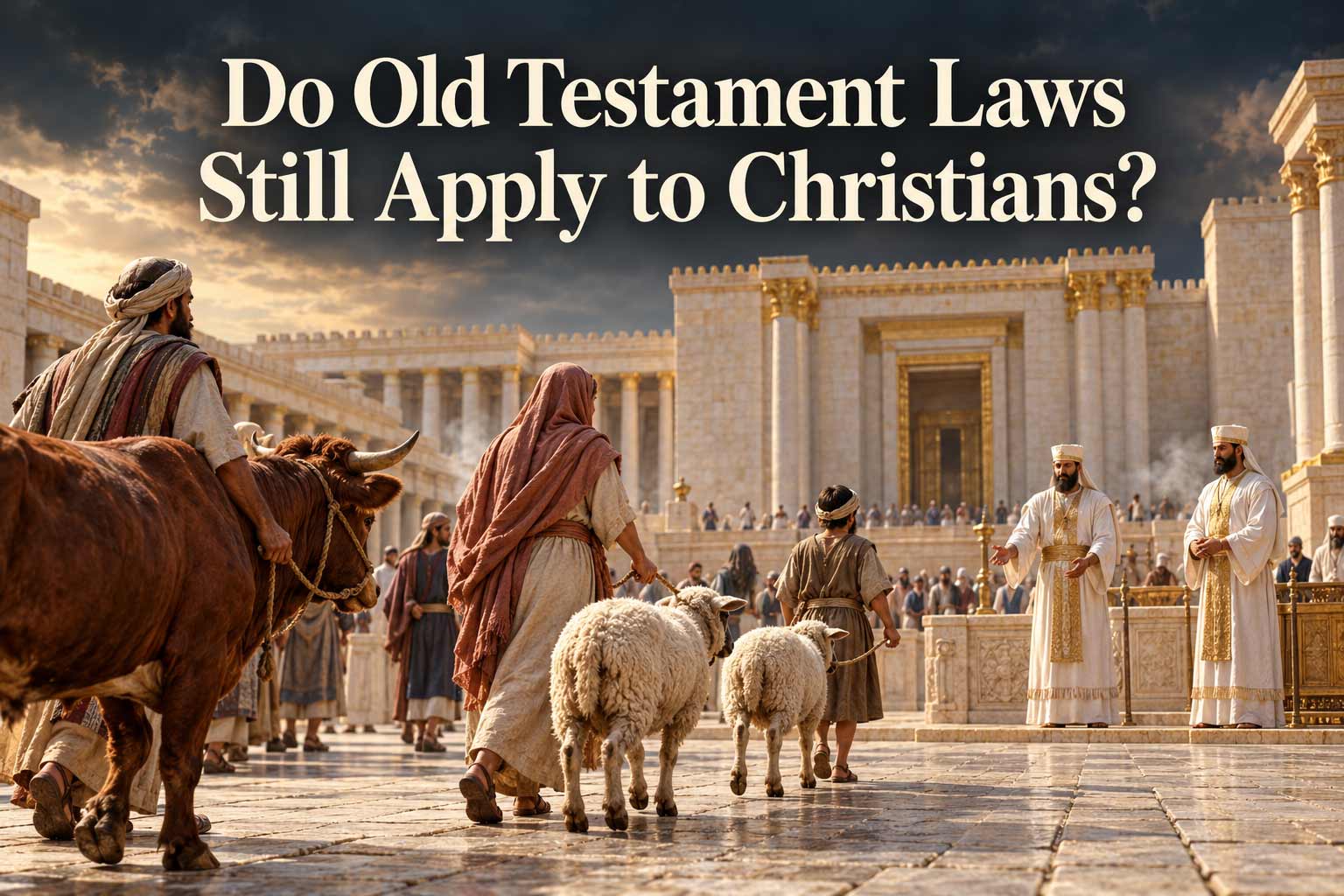
Christians regularly appeal to the Old Testament when discussing right and wrong, but most don’t follow its instructions about sacrifices, circumcision, food, or ritual purity. That can raise a fair question: Are we making a principled distinction, or simply keeping the commands we like? If someone cites an Old Testament law in one discussion and dismisses another as irrelevant, he ought to explain why.
My answer is that Christians aren’t under the Mosaic covenant as the governing covenant of their lives. We follow Jesus under the new covenant. However, that doesn’t make the Old Testament disposable or mean that its moral teaching has become meaningless. We need to understand how a command functioned in Israel’s covenant and how its teaching relates to Christ and the instructions given to His followers.
The Law Was Given Within a Covenant
The law of Moses wasn’t a collection of unrelated rules addressed equally to every society. It belonged to God’s covenant with Israel. Its instructions addressed worship, community life, justice, agriculture, family relationships, purity, and Israel’s identity among the nations. Reading those commands without their covenant setting can leave us treating ancient Israel’s national responsibilities as though they were automatically the church’s responsibilities.
A covenant establishes a relationship with particular promises and obligations. The New Testament presents Jesus as the mediator of a new covenant, and Hebrews 8 explicitly contrasts that covenant with the earlier one. It also describes God’s laws being written in people’s hearts. The change in covenant therefore doesn’t mean that God has stopped caring about how His people live.
This distinction helps explain how an earlier command can remain part of authoritative Scripture without governing Christians in its original form. We can learn from instructions addressed to Israel without assuming that we occupy Israel’s place in every provision. The question is how those instructions should be understood and applied in light of Christ.
Didn’t Jesus Say He Came to Fulfill the Law?
In Matthew 5:17, Jesus says that He came to fulfill the Law and the Prophets rather than destroy them. The following verses emphasize their seriousness and warn against casually setting commandments aside. We shouldn’t use “fulfillment” as a convenient word for declaring the Old Testament unimportant. Jesus’ statement calls for respect for those Scriptures.
At the same time, fulfillment has to be understood alongside what the New Testament says about Jesus’ work and the new covenant. Hebrews 10 presents His sacrifice in relation to the repeated sacrifices of the law. Christians don’t offer animal sacrifices because they believe Christ’s offering accomplishes what those sacrifices could not finally accomplish. Continuing the earlier practice isn’t what faithfulness to its fulfillment requires.
Christians disagree over how every part of Matthew 5 relates to later apostolic teaching. That deserves careful study rather than a slogan. But an interpretation that makes every Mosaic requirement binding on every Christian must account for the New Testament’s treatment of circumcision, sacrifice, food, and covenant membership. We need to read those passages together.
The Early Church Addressed This Question
Acts 15 records a dispute over whether Gentile converts should be circumcised and required to keep the law of Moses. This wasn’t a minor disagreement about personal preference. It concerned what people needed to do when entering the Christian community. The apostles and elders met to consider it.
Peter appealed to God’s reception of Gentiles and emphasized salvation through the grace of Jesus. The resulting letter did not impose the whole Mosaic law on Gentile believers. It gave instructions concerning idol-related food, blood, strangled animals, and sexual immorality. That decision provides substantial evidence against requiring Gentile Christians to adopt the entire Mosaic covenant.
Christians debate aspects of those instructions, including their relationship to Jewish–Gentile fellowship and their continuing application. We shouldn’t pretend that the chapter answers every later question. Its central decision, however, is clear: Gentile conversion did not require circumcision and comprehensive Mosaic observance.
Paul addresses the same basic danger in Galatians. His warning concerns receiving circumcision as part of an obligation to the law, rather than the medical procedure considered by itself. He insists that Christian freedom must express itself through loving service. Freedom from that covenant obligation and responsibility for Christian conduct belong together in his argument.
What About Moral, Ceremonial, and Civil Laws?
Many Christians distinguish moral laws from ceremonial and civil laws. Moral laws concern right and wrong, ceremonial laws concern worship and ritual, and civil laws govern Israel’s national life. This framework has an important place in Christian theology, including the Reformed tradition. It can help explain why Christians reject theft while not offering sacrifices or enforcing Israel’s ancient judicial penalties.
However, Scripture doesn’t attach those three labels to every command. The categories are an interpretive framework, and some laws involve more than one concern. A rule about worship may also teach a moral responsibility. A national law may express a principle of justice that deserves attention beyond its original legal setting.
We should therefore do more than classify a command and consider the question settled. We need to examine its purpose, its covenant setting, and how the New Testament treats the relevant subject. The categories can assist that work, but they shouldn’t replace it. Otherwise, “moral” can quietly become the label for whichever laws we’ve already decided to retain.
Why Are Murder and Adultery Still Wrong?
Christians don’t need to place themselves under the whole Mosaic covenant to recognize enduring moral obligations. Jesus and the apostles teach against murder, adultery, theft, idolatry, and other forms of wrongdoing. They also teach positively about love, honesty, mercy, generosity, and faithfulness. The New Testament draws extensively on the Old Testament while addressing the life of people who follow Christ.
Romans 13:8–10 connects several commandments with loving our neighbor. Love doesn’t replace moral responsibility with a pleasant feeling. It expresses itself through conduct that refuses to harm another person. A claim to love someone doesn’t excuse stealing from him or betraying her.
Paul also describes himself as being under Christ’s law in 1 Corinthians 9:21. His freedom in relating to different communities doesn’t mean he is free from accountability to God. Christians are called to obey Christ, and that obedience includes moral demands. “We’re not under the law” is a poor defense for conduct the New Testament plainly condemns.
What About Food, Festivals, and the Sabbath?
Food and sacred days are among the most visible areas of disagreement. Colossians 2:16–17 warns believers against being judged over food, drink, festivals, new moons, and Sabbaths, connecting these things with a shadow whose substance belongs to Christ. Romans 14 also addresses differing practices concerning food and days. Its instructions emphasize honoring God without despising or condemning fellow believers.
My understanding is that Christians aren’t required to adopt Israel’s dietary rules or religious calendar as conditions of belonging to Christ. That doesn’t mean someone is forbidden to avoid certain foods or observe a day with religious significance. A voluntary practice and a requirement imposed on the whole church are different matters. We should also distinguish questions of covenant obligation from ordinary considerations of health or personal discipline.
Christians differ over the Sabbath and how it relates to Christian worship. Some affirm a continuing seventh-day obligation, while others understand a weekly Christian Sabbath or take a different view of sacred days. I don’t believe Sunday worship is commanded as a simple transfer of every Sabbath requirement to a new day. Gathering with believers matters, but we should be careful about claiming a universal command where the evidence doesn’t establish one.
Can We Still Learn from Laws We Don’t Directly Observe?
Yes. Israel’s laws can teach us about justice, responsibility, worship, human vulnerability, and the seriousness of sin. We can examine instructions protecting people from harm or addressing the treatment of the poor without reproducing every feature of Israel’s legal system. The principle and its application need to be explained carefully.
That process doesn’t allow us to ignore difficult laws. Some raise serious questions about ancient society, punishment, warfare, or the treatment of vulnerable people. We should acknowledge those questions and examine them honestly. Saying that a law isn’t directly binding on the church answers one question about application; it doesn’t automatically resolve every question about the law itself.
Nor does learning from Israel’s laws authorize the church to enforce Israel’s national penalties. A congregation isn’t ancient Israel’s government. Moral judgment, church discipline, and civil punishment involve different responsibilities. Moving from an Old Testament penalty to a proposed modern policy requires an argument that takes those differences seriously.
Follow Christ While Reading the Whole Bible
When examining an Old Testament command, begin with whom it addresses and what it required in that setting. Then consider its purpose and what the New Testament says about the subject. Ask whether its original practice continues, whether it points toward Christ’s work, or whether it provides a principle that needs a different application. Don’t start with the conclusion that every command applies unchanged or that none can teach us anything.
This takes more effort than selecting a verse that supports our position. It also protects us from treating Scripture inconsistently. If we appeal to an Old Testament command, we should be willing to explain why it bears on Christians today. If we say that another command isn’t binding, we should explain that judgment with the same care.
Christians live under the new covenant and are called to follow Jesus. We can do that while continuing to learn from the Scriptures that shaped Israel’s life and anticipated His coming. Grace doesn’t make obedience unnecessary, and a new covenant doesn’t make the earlier writings worthless. It changes how we understand our relationship to their commands.