
The Short Answer
I believe speaking in tongues is a genuine gift of the Holy Spirit and that it is available to believers today.
I don’t believe the New Testament gives us any reason to think tongues disappeared with the apostles or with the completion of the Bible. Paul certainly expected tongues to operate in the church, although he placed clear restrictions on their public use. His conclusion wasn’t, “Tongues are causing too many problems, so stop doing it.” It was:
“Don’t forbid speaking with other languages. Let all things be done decently and in order.” (1 Corinthians 14:39–40)
That seems like a pretty good place for us to land too.
But there’s an important distinction that is often missed. The New Testament describes tongues in several different contexts. Tongues appear in connection with baptism in the Holy Spirit, as a public ministry gift accompanied by interpretation, and as prayer or praise directed toward God.
Confusing those uses creates a lot of unnecessary theological problems.
Key Scriptures
- Acts 2:1–18 — The disciples speak in other tongues when the Holy Spirit is poured out at Pentecost.
- Acts 10:44–47 — Peter recognizes that Gentiles have received the Holy Spirit because he hears them speaking in tongues and magnifying God.
- Acts 19:1–7 — The Ephesian disciples speak in tongues and prophesy when the Holy Spirit comes upon them.
- 1 Corinthians 12:4–11 — Tongues and interpretation are included among the gifts of the Spirit.
- 1 Corinthians 12:27–30 — Paul asks, “Do all speak with other languages?” in his discussion of ministry within the body.
- 1 Corinthians 13:8–12 — Paul says tongues will cease when what is complete comes.
- 1 Corinthians 14:1–19 — Paul discusses speaking, praying, singing, and giving thanks in tongues.
- 1 Corinthians 14:26–33 — Paul regulates the public use of tongues in the church.
- 1 Corinthians 14:39–40 — Paul says not to forbid tongues, while insisting that worship remain orderly.
What Is Speaking in Tongues?
Speaking in tongues is Spirit-enabled speech in a language the speaker has not learned.
The Greek word glōssa literally means “tongue” and can also mean “language.” That much isn’t particularly controversial.
The controversy begins when we ask whether every biblical instance of tongues must be an ordinary human language spoken somewhere in the world.
Acts 2 certainly includes recognizable human languages. People from numerous regions hear the disciples declaring “the mighty works of God” in their own languages (Acts 2:6–11).
But I don’t think Acts 2 establishes that every occurrence of tongues must therefore be a recognizable human language.
Paul describes a person speaking in a tongue this way:
“For he who speaks in another language speaks not to men, but to God; for no one understands.” (1 Corinthians 14:2)
That doesn’t sound much like someone speaking French in a room containing a Frenchman.
Paul also mentions “the languages of men and of angels” (1 Corinthians 13:1). Because Paul is using deliberately extravagant language in that passage, I wouldn’t build a doctrine of “angelic prayer languages” on that verse. But neither would I use Acts 2 to insist that every tongue must correspond to a presently identifiable human language.
The biblical evidence seems broader than either claim.
What Happened at Pentecost?
Pentecost is the most famous example.
Jesus had told his disciples:
“You will receive power when the Holy Spirit has come upon you. You will be witnesses to me in Jerusalem, in all Judea and Samaria, and to the uttermost parts of the earth.” (Acts 1:8)
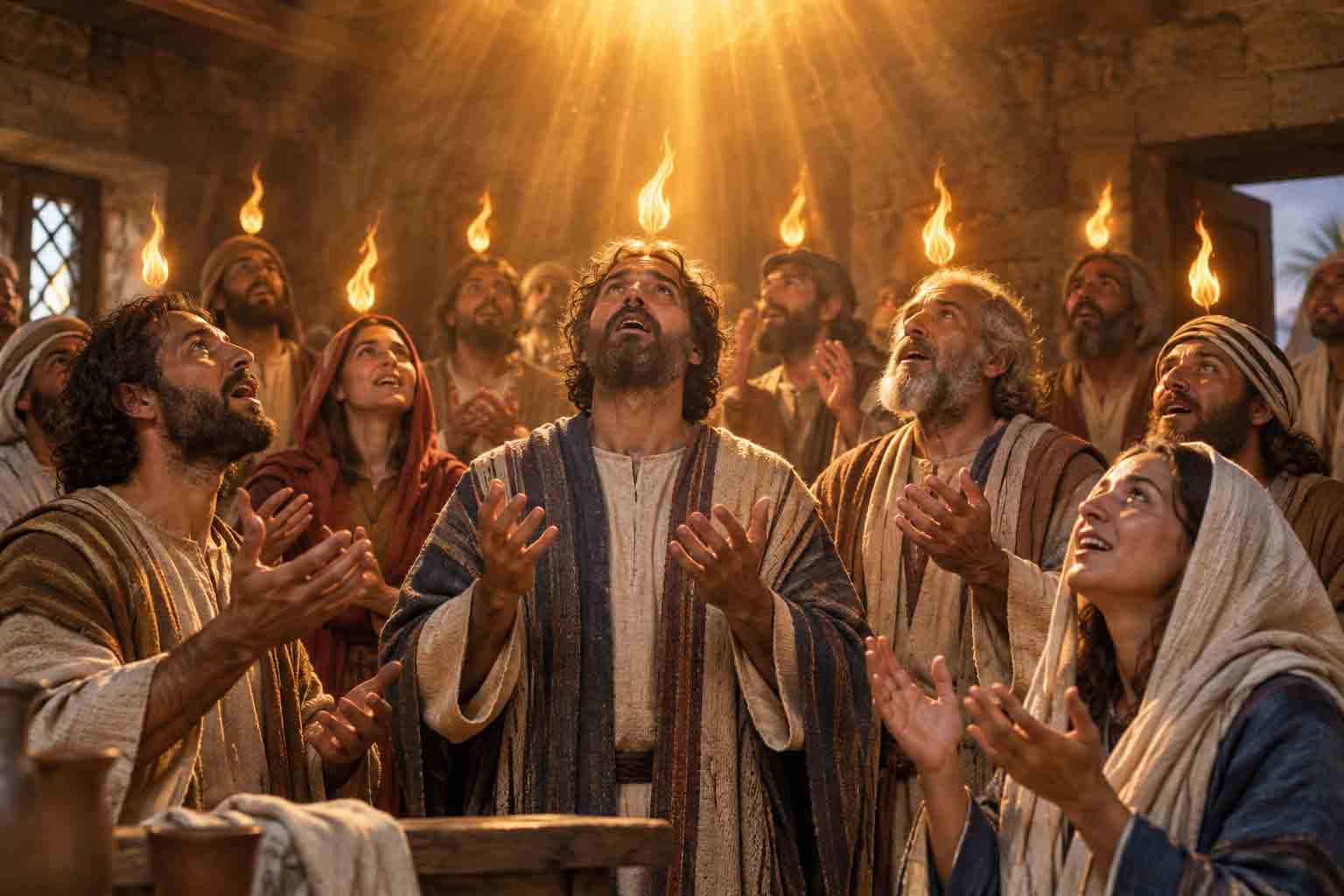
In Acts 2, the Spirit comes. The disciples speak in other tongues. A crowd gathers, and people from different parts of the world hear them declaring God’s mighty works in their native languages.
Some are amazed.
Others think they’re drunk.
Peter then stands up and preaches Christ.
That sequence matters.
Were Tongues Used to Preach the Gospel to Foreigners?
I’ve heard it said many times that God gave the early Christians tongues so they could preach the gospel to people whose languages they didn’t know.
There’s only one problem.
The Bible never says they did that.
Acts 2 doesn’t say the disciples were preaching evangelistic sermons in multiple languages. It says they were declaring the mighty works of God (Acts 2:11).
Then the crowd asks what this means.
Peter stands up and preaches the gospel to them (Acts 2:14–40).
Luke doesn’t say Peter preached his sermon simultaneously in fifteen supernatural languages. He depicts Peter addressing the crowd as a whole.
We don’t know whether Peter spoke Aramaic or Koine Greek. Either way, Greek was widely used as a common language throughout the eastern Roman world, and pilgrims in Jerusalem didn’t necessarily require a supernatural language gift merely to understand a public address.
So I wouldn’t say tongues were God’s solution to the missionary language barrier.
The tongues got their attention. Peter’s sermon gave them the gospel. Those aren’t the same thing.
And throughout the rest of Acts, we never find a missionary arriving in a foreign country, discovering that he doesn’t speak the language, and solving the problem by preaching in tongues.
Could God miraculously enable someone to speak a language he never learned? Certainly.
Acts 2 shows that he can.
But that’s different from saying Scripture presents evangelism as the purpose of the gift.
Are Tongues the Initial Evidence of Baptism in the Holy Spirit?
This is where I find myself largely in agreement with classical Pentecostal theology, although I’m less dogmatic about it than some Pentecostals are.
The Assemblies of God teaches that speaking in tongues is the initial physical evidence of baptism in the Holy Spirit. It also distinguishes that initial evidence from the public ministry gift of tongues in 1 Corinthians 12. That remains its official doctrinal position.
I think there’s a strong biblical case for that position.
I just don’t think the Bible states it quite as explicitly as we Pentecostals sometimes make it sound.
Consider the major accounts in Acts.
Pentecost — Acts 2
This one is easy.
They are filled with the Holy Spirit and:
“began to speak with other languages, as the Spirit gave them the ability to speak.” (Acts 2:4)
Tongues are explicit.
Samaria — Acts 8
Philip preaches in Samaria. People believe and are baptized, but the Holy Spirit has not yet “fallen on” them. Peter and John arrive, lay hands on them, and they receive the Holy Spirit (Acts 8:12–17).
Tongues aren’t mentioned.
But something happened that Simon could observe.
Luke says:
“Now when Simon saw that the Holy Spirit was given through the laying on of the apostles’ hands, he offered them money.” (Acts 8:18)
What did Simon see?
Luke doesn’t tell us.
Pentecostals commonly infer that he saw and heard manifestations such as speaking in tongues. That’s possible, and I think it’s reasonable in light of the other accounts.
But we need to be fair with the text.
Acts 8 doesn’t say they spoke in tongues.
Something observable happened. We aren’t told exactly what it was.
Paul — Acts 9
Ananias tells Saul that Jesus sent him:
“that you may receive your sight and be filled with the Holy Spirit.” (Acts 9:17)
Acts doesn’t say Paul spoke in tongues at that moment.
But we know Paul eventually did because he later wrote:
“I thank my God, I speak with other languages more than you all.” (1 Corinthians 14:18)
Did he begin when Ananias prayed for him?
Maybe. I think that’s a reasonable possibility.
But again, Scripture doesn’t say.
Cornelius — Acts 10
This case is especially important.
The Holy Spirit falls upon the Gentiles, and the Jewish believers recognize what has happened:
“For they heard them speaking in other languages and magnifying God.” (Acts 10:45–46)
Here tongues aren’t merely present. They function as evidence that the Gentiles have received the same gift.
Peter later compares the experience directly with Pentecost (Acts 11:15–17).
That’s significant.
Ephesus — Acts 19
Paul lays hands on the Ephesian disciples:
“The Holy Spirit came on them, and they spoke with other languages and prophesied.” (Acts 19:6)
Again, tongues are explicit.
So in three of these five major accounts, tongues are explicitly mentioned. Paul isn’t described speaking in tongues in Acts 9, but we know he did speak in tongues. And in Samaria something visible occurred, although Luke doesn’t identify it.
I think that’s a substantial pattern.
But here’s where I put on the brakes.
Nowhere does the Bible simply say, “Everyone who is baptized in the Holy Spirit will initially speak in tongues.”
That’s a theological conclusion drawn from the pattern in Acts.
I think it’s probably the right conclusion. I side with the Assemblies of God on this more than I disagree with them.
But I distinguish between saying “I think this is the pattern Scripture gives us” and “Scripture explicitly says this must happen in every case.”
Those aren’t quite the same statement.
Doesn’t Paul Say, “Do All Speak With Tongues?”
Yes.
And this is often presented as a decisive argument against the Pentecostal position.
Paul asks:
“Are all apostles? Are all prophets? Are all teachers? Are all miracle workers? Do all have gifts of healings? Do all speak with various languages? Do all interpret?” (1 Corinthians 12:29–30)
The expected answer is no.
But look at the context.
Paul is talking about the different ministries and gifts within the body of Christ.
Not everyone is an apostle.
Not everyone is a prophet.
Not everyone teaches.
Not everyone has a ministry of miracles or healings.
Not everyone exercises the public gift of tongues and interpretation.
I don’t think Paul is discussing private devotional prayer here.
That’s why I don’t see a contradiction between 1 Corinthians 12:30 and the Pentecostal belief that believers may speak in tongues in connection with Spirit baptism or private prayer.
Paul is talking about ministry function within the assembled body.
What Is the Public Gift of Tongues?
In a church gathering, a person may give an utterance in tongues intended for the congregation.
Paul says that such an utterance should be interpreted.
Without interpretation, the congregation doesn’t understand it and therefore isn’t edified.
That’s Paul’s central concern throughout 1 Corinthians 14: edification.
He writes:
“He who speaks in another language edifies himself, but he who prophesies edifies the assembly.” (1 Corinthians 14:4)
That’s why prophecy is preferable in a public meeting unless the tongue is interpreted.
Once interpreted, the congregation can receive the message.
Paul even puts numerical limits on public tongues:
“If any man speaks in another language, let it be two, or at the most three, and in turn; and let one interpret. But if there is no interpreter, let him keep silent in the assembly.” (1 Corinthians 14:27–28)
That’s remarkably practical.
Two or three.
One at a time.
Interpretation.
No interpreter? Don’t give the public utterance.
Whatever else we believe about tongues, a room full of people simultaneously shouting in tongues isn’t the public ministry Paul describes here.
Can People Control Speaking in Tongues?
They had better be able to, because Paul’s instructions make no sense otherwise.
He tells someone to remain silent if there is no interpreter.
He tells speakers to take turns.
He limits the number.
You can’t obey any of those instructions if the Holy Spirit takes possession of your vocal cords and makes self-control impossible.
Paul makes the same principle explicit concerning prophecy:
“The spirits of the prophets are subject to the prophets, for God is not a God of confusion, but of peace.” (1 Corinthians 14:32–33)
Being moved by the Spirit isn’t the same thing as losing control of yourself.
That matters because some Pentecostal and charismatic practices have unfortunately encouraged the idea that the more uncontrollable something appears, the more spiritual it must be.
Paul seems to think otherwise.
What Is Praying in Tongues?
This is where another distinction becomes important.
Paul writes:
“For if I pray in another language, my spirit prays, but my understanding is unfruitful.” (1 Corinthians 14:14)
Then he asks what he should do:
“I will pray with the spirit, and I will pray with the understanding also. I will sing with the spirit, and I will sing with the understanding also.” (1 Corinthians 14:15)
Notice that Paul doesn’t say, “Since I don’t understand what I’m saying, I should stop.”
He says he’ll do both.
Pray with the spirit.
Pray with the understanding.
Sing with the spirit.
Sing with the understanding.
That sounds very much like a devotional use of tongues.
What Does It Mean That Tongues Edify the Speaker?
Paul says:
“He who speaks in another language edifies himself.” (1 Corinthians 14:4)
Sometimes I’ve heard this treated almost as a criticism—as though self-edification must be selfish.
But Christians do things to edify themselves all the time.
We read Scripture.
We pray.
We worship.
We listen to teaching.
There’s nothing inherently wrong with spiritual edification.
Paul’s objection is about the purpose of the church gathering. When I’m addressing the congregation, I should seek to edify everyone rather than merely myself.
Private prayer is different.
In my experience, praying in tongues can help focus prayer and allow a believer to continue praying when ordinary words seem inadequate.
I wouldn’t tell someone that praying in tongues makes him more spiritual than another Christian.
It doesn’t.
But neither would I tell Paul he shouldn’t have done something he says he did frequently.
Is Romans 8:26 Talking About Tongues?
Paul says:
“The Spirit also helps our weaknesses, for we don’t know how to pray as we ought. But the Spirit himself makes intercession for us with groanings which can’t be uttered.” (Romans 8:26)
Pentecostals sometimes identify this directly with praying in tongues.
It may be related.
But the verse doesn’t say “tongues,” and I wouldn’t use it as a primary proof-text.
We already have 1 Corinthians 14, where Paul explicitly says he prays in a tongue. We don’t need to make Romans 8 say more than it says.
What Are “Tongues of Angels”?
Paul writes:
“If I speak with the languages of men and of angels, but don’t have love, I have become sounding brass or a clanging cymbal.” (1 Corinthians 13:1)
Some charismatics take this as proof that tongues can be heavenly or angelic languages.
Maybe they can.
But I’m hesitant to make this verse prove it.
Paul’s rhetoric becomes intentionally expansive: if he possessed extraordinary speech, understood all mysteries and knowledge, possessed all faith, gave away everything, and even surrendered his body—without love it would amount to nothing (1 Corinthians 13:1–3).
So “tongues of angels” may be rhetorical.
The verse leaves the possibility open. It doesn’t settle the question.
Are Tongues a Sign to Unbelievers?
Paul says:
“Therefore other languages are for a sign, not to those who believe, but to the unbelieving.” (1 Corinthians 14:22)
This isn’t as simple as it first appears.
Paul has just quoted Isaiah 28:11–12, where foreign speech functions as a sign of judgment upon people who refused to listen to God’s clear word.
Then Paul immediately says that if the entire church speaks in tongues and outsiders enter, they’ll think everyone is crazy (1 Corinthians 14:23).
So “sign” doesn’t necessarily mean an evangelistic technique designed to produce conversion.
Sometimes a sign exposes unbelief or brings judgment.
Pentecost itself demonstrates another possibility: supernatural speech gets people’s attention and makes them ask what is happening.
But again, the gospel still has to be explained intelligibly.
Did Speaking in Tongues Cease?
Paul unquestionably says tongues will cease.
The question is when.
He writes:
“But where there are prophecies, they will be done away with. Where there are various languages, they will cease…. For we know in part and we prophesy in part; but when that which is complete has come, then that which is partial will be done away with.” (1 Corinthians 13:8–10)
Some Christians believe the miraculous gifts ceased with the apostolic age. This position is normally called cessationism.
Others believe the gifts continue until Christ’s return. That’s continuationism.
I’m a continuationist.
What Is “That Which Is Complete”?
One traditional cessationist interpretation identifies “that which is complete” or “the perfect” with the completion of the New Testament canon.
I don’t find that convincing.
Look at Paul’s description of what happens when the perfect comes:
“For now we see in a mirror, dimly, but then face to face. Now I know in part, but then I will know fully, even as I was also fully known.” (1 Corinthians 13:12)
I own a complete Bible.
I still don’t know as I am known.
And I certainly wouldn’t claim that Christians today, because we possess all twenty-seven New Testament books, have moved beyond Paul’s partial knowledge into something resembling face-to-face knowledge.
Interestingly, this objection isn’t limited to continuationists. Cessationist New Testament scholar Thomas Schreiner has also argued that 1 Corinthians 13:8–10 shouldn’t be used this way and that “the perfect” is not convincingly explained as the completed canon.
The natural direction of Paul’s language seems eschatological.
We’re moving toward the time when partial knowledge gives way to fullness and we see face to face.
Tongues will cease.
Prophecy will cease.
A lot of things we need now won’t be necessary then.
I just don’t see evidence that “then” happened when the last New Testament book was written.
What About the Argument That Miracles Were Only for the Apostles?
This is a stronger cessationist argument than the completed-canon interpretation.
Miracles certainly authenticated the apostles and their message. Paul refers to “the signs of an apostle” in 2 Corinthians 12:12.
But it doesn’t follow that only apostles exercised miraculous gifts.
Stephen performed great wonders and signs (Acts 6:8).
Philip performed signs in Samaria (Acts 8:6–7).
The Corinthian congregation exercised spiritual gifts.
Paul gives ordinary Christians instructions for using those gifts rather than telling them they belong exclusively to apostles.
And when Paul discusses tongues, he never says, “Enjoy this while it lasts, because it will disappear when the apostles die.”
That’s a pretty important omission if that’s what he intended us to believe.
What About Modern Speaking in Tongues?
This is where continuationists need to be willing to criticize our own side.
Not everything called a manifestation of the Holy Spirit necessarily comes from the Holy Spirit.
People can imitate things.
People can get caught up emotionally.
People can respond to group pressure.
And unfortunately, people can be coached into producing sounds because someone desperately wants them to “receive.”
I don’t think we protect genuine spiritual gifts by refusing to acknowledge counterfeit or questionable manifestations.
Paul didn’t.
His solution to abuse in Corinth wasn’t gullibility.
It was discernment and order.
At the same time, bad examples don’t prove the genuine gift doesn’t exist.
Counterfeit money doesn’t prove there’s no real money.
If anything, 1 Corinthians demonstrates that genuine gifts can operate among remarkably imperfect Christians.
The Corinthians weren’t exactly the church you’d put on the brochure.
Does Speaking in Tongues Make Someone More Spiritual?
No.
Paul’s entire argument in 1 Corinthians works against that idea.
The Corinthians were gifted and immature at the same time.
You can speak in tongues and still be selfish.
You can prophesy and still lack love.
You can believe God works miracles and still behave foolishly.
That’s precisely why 1 Corinthians 13 sits between chapters 12 and 14.
The gifts aren’t substitutes for Christian character.
I’d rather have the fruit of the Spirit in my life than impress somebody with a spiritual manifestation.
Ideally, of course, we shouldn’t have to choose.
Should Christians Seek the Gift of Tongues?
Paul says:
“Pursue love, and earnestly desire spiritual gifts.” (1 Corinthians 14:1)
So I’m not uncomfortable encouraging Christians to desire spiritual gifts.
But I wouldn’t pressure anyone to manufacture an experience.
You don’t have to help the Holy Spirit fake the Holy Spirit.
Ask God.
Seek him.
Be open to whatever he wants to do.
But don’t start producing sounds merely because someone standing beside you tells you that you need to.
And don’t judge your relationship with God by comparing your experience with somebody else’s.
Is Speaking in Tongues for Today?
I believe it is.
I don’t see a biblical passage establishing that tongues ceased with the apostles or with the completion of Scripture.
I see the opposite.
Paul tells Christians to desire spiritual gifts.
He regulates tongues rather than eliminating them.
He speaks in tongues himself.
He describes praying and singing with his spirit.
And after spending an entire chapter correcting abuses of spiritual gifts, he finishes with an extraordinarily balanced instruction:
“Therefore, brothers, desire earnestly to prophesy, and don’t forbid speaking with other languages. Let all things be done decently and in order.” (1 Corinthians 14:39–40)
Some churches have emphasized the first sentence and forgotten the second.
Others have emphasized the second and effectively ignored the first.
I think we need both.
Don’t forbid tongues.
Don’t create chaos.
That’s not complicated.
And after two thousand years of argument about spiritual gifts, Paul may still have given us the best policy.