
Who Was Dorcas (Tabitha)?
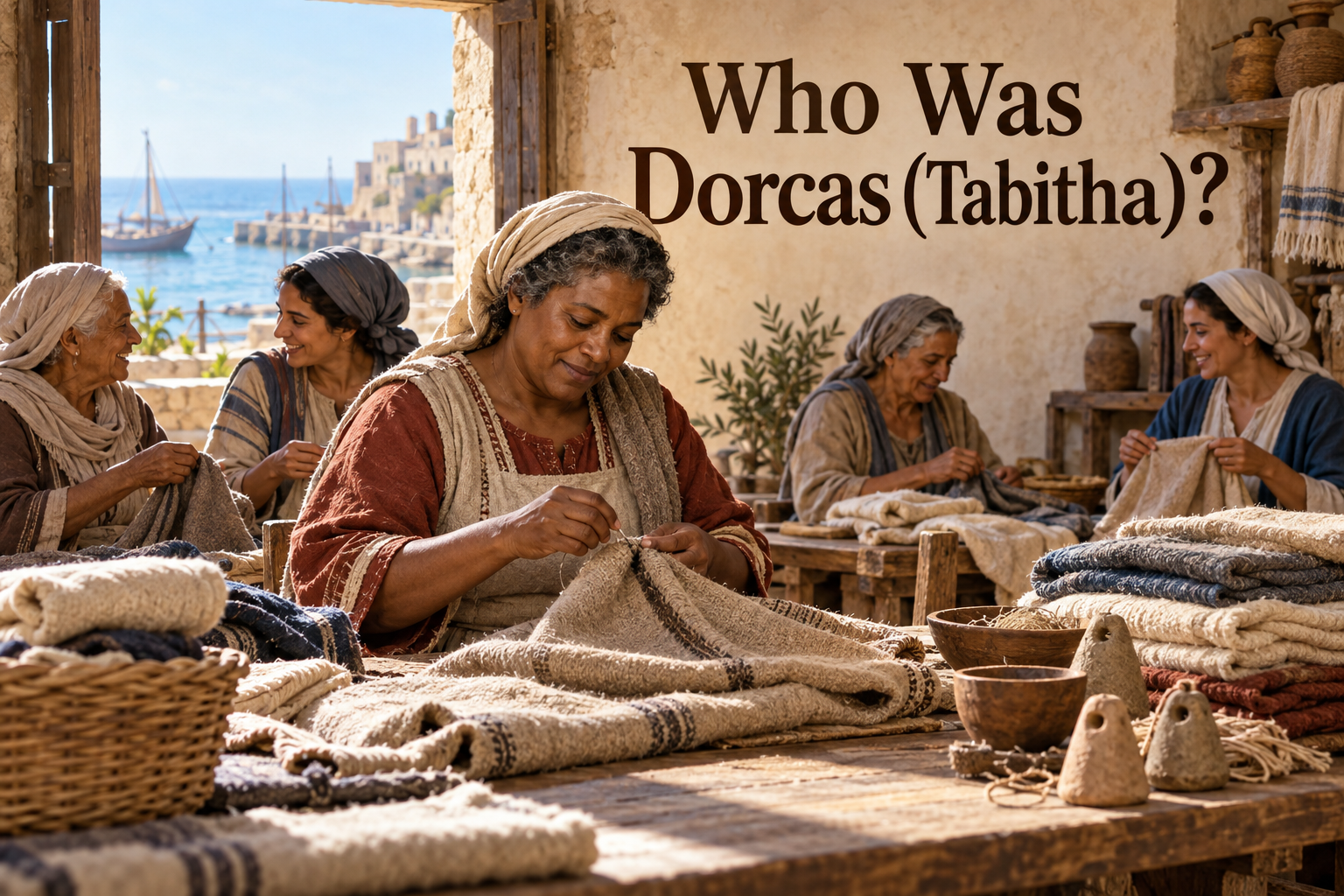
Dorcas appears in a single chapter of Acts, yet the few paragraphs devoted to her have inspired Christian ministries for centuries. She was a disciple in the port city of Joppa whose life was known through clothing she made and the people she helped. When she died, the widows who gathered around her didn’t offer a list of titles or public achievements. They held up the garments she had made, tangible evidence that her faith had taken useful form.
Tabitha and Dorcas
Acts introduces her by two names: Tabitha in Aramaic and Dorcas in Greek, both meaning “gazelle” (Acts 9:36). This isn’t evidence that she was two different women or that one name was a later nickname. Bilingual names were common in the eastern Roman world, and Luke translates the name for his Greek-speaking readers. Calling her Dorcas is therefore no less biblical than calling her Tabitha.
Luke calls Tabitha a disciple, using the feminine form of the Greek word. This is the only occurrence of that particular feminine noun in the New Testament, though women are clearly included among disciples elsewhere. The wording gives her identity before it describes her work: she belonged to the community of people who followed Jesus. Her good works and gifts to the poor were the practiced expression of that discipleship.
Joppa was an old Mediterranean port on the coast of Judea, remembered in the Old Testament as the place where Jonah boarded a ship in flight from God’s call. In Acts it became an important staging point for the gospel’s movement toward Gentiles, since Peter received his vision there shortly after Tabitha’s restoration. The text doesn’t tell us whether Tabitha was Jewish, Gentile, or from a mixed cultural background. Her two names fit the multilingual environment but don’t settle her ancestry.
The Community That Mourned Her
Tabitha became ill and died while Peter was in nearby Lydda. The believers washed her body and placed it in an upstairs room, then sent two men to urge Peter to come without delay (Acts 9:37-38). Washing the body was a normal preparation for burial, not an indication that the disciples expected a miracle as a matter of routine. Their urgent appeal may express hope because they had heard of Peter’s ministry, but Acts doesn’t record what they asked him to do.
When Peter arrived, widows stood around him weeping and showing him tunics and other garments Dorcas had made while she was with them (Acts 9:39). Widows in the ancient world could be economically vulnerable, although not every widow was destitute. These women had clearly received more than impersonal charity. Their grief and the work they displayed reveal a network of relationship built by repeated acts of skill and generosity.
The passage doesn’t specify whether Tabitha was wealthy, operated a workshop, or was herself a widow. Later readers have sometimes pictured her as a professional seamstress, but Acts only says that she made the garments. She may have purchased materials, sewn them herself, organized others, or combined several kinds of service. The safest conclusion is the one Luke gives us: she was consistently devoted to good works and aid for those in need.
Peter Raises Tabitha
Peter sent everyone from the room, knelt, and prayed. He then turned toward the body and said, “Tabitha, get up.” She opened her eyes, saw Peter, and sat up; he gave her his hand, raised her, and presented her alive to the believers and widows (Acts 9:40-41). The action is attributed to God’s power in answer to prayer, not to a technique Peter controlled.
The scene resembles Jesus’ raising of Jairus’s daughter, including the command for the woman to arise (Mark 5:35-43). Luke doesn’t explicitly pause to explain the parallel, but it fits Acts’ larger portrait of Jesus continuing his work through the apostles by the Holy Spirit. Peter prays before speaking, which keeps the source of life clear. The apostle is the servant in the room, not the owner of resurrection power.
Tabitha’s return to life was extraordinary, but it wasn’t yet the final resurrection promised to God’s people. Like Lazarus and Jairus’s daughter, she returned to ordinary mortal life and would face death again. Jesus’ resurrection is different in the New Testament: he is raised beyond death and becomes the beginning of the general resurrection still to come. Keeping that distinction clear lets us celebrate what happened in Joppa without making the episode carry more than Luke claims for it.
News of the event spread throughout Joppa, and many believed in the Lord (Acts 9:42-43). The result isn’t admiration for Peter or a cult of personality around Tabitha. The sign points people to the Lord and prepares the narrative for Peter’s stay in Joppa, where messengers from the Gentile centurion Cornelius will soon find him. A local act of mercy and restoration thus sits beside a major turning point in the church’s mission.
What Happened to Dorcas Later?
Acts says nothing about Tabitha’s life after she was restored. She presumably died again at a later time, as did others raised before the final resurrection, but Scripture doesn’t record when or how. Traditions locating her tomb near Joppa and assigning details to her later ministry can’t be verified from the earliest evidence. They may reflect centuries of local devotion, but they shouldn’t be presented as though Luke supplied them.
Christian sewing circles, charitable societies, and relief ministries have often taken the name Dorcas. That legacy makes sense because her work was practical, personal, and easy to imitate. Still, she shouldn’t be reduced to a mascot for sewing. Acts presents her as a disciple whose generosity bound a vulnerable community together so strongly that her death left a visible hole.
Tabitha’s biography is short because Luke doesn’t give us a childhood, family tree, speech, or missionary itinerary. What he gives is enough to show what a faithful life looked like in one congregation: needs noticed, skills offered, and people treated as neighbors rather than projects. The widows held up her work because it had kept them warm and told them they weren’t forgotten. That is a modest legacy by the standards of royal biographies, and Acts treats it as worthy of a miracle.