
Who Was Hagar?
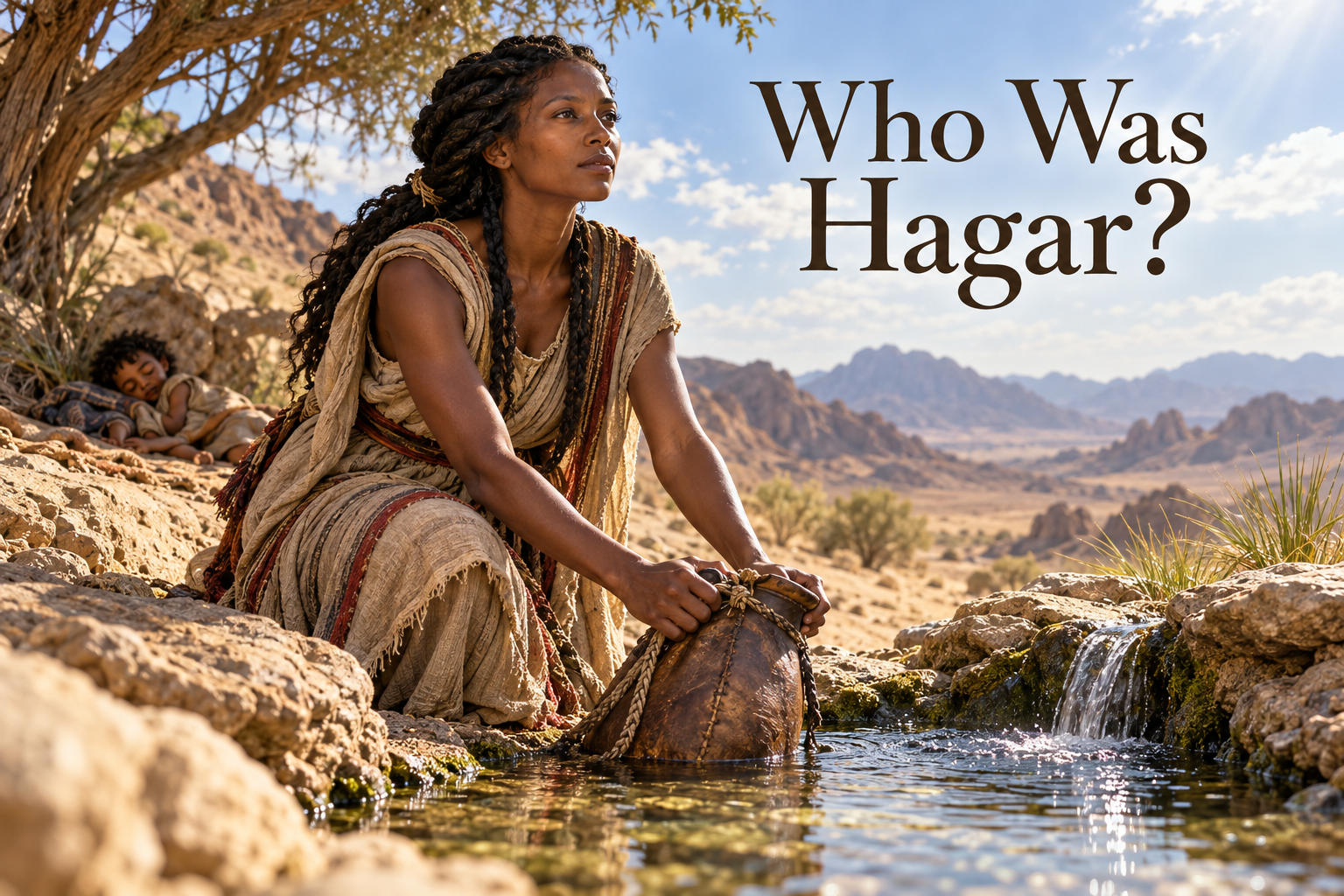
Hagar enters the biblical story as an enslaved Egyptian woman whose future is decided by other people. Sarah gives her to Abraham, Abraham yields responsibility back to Sarah when conflict erupts, and Hagar is eventually expelled with her son into the wilderness. Yet God addresses her personally, hears her distress, and gives her promises about Ishmael’s future. She is vulnerable in nearly every human relationship in the story, but she is never invisible to God.
An Egyptian servant in Abraham’s household
Genesis calls Hagar an Egyptian female slave belonging to Sarai, later named Sarah. Scripture doesn’t tell us how she entered the household. Some readers connect her presence with Abraham and Sarah’s earlier stay in Egypt, but Genesis doesn’t explicitly make that connection. What is clear is that Hagar lacked the freedom and social power enjoyed by those who owned her.
God had promised Abraham descendants, but years passed and Sarah remained childless. Sarah proposed that Abraham have a child through Hagar, following an ancient practice in which an enslaved woman’s fertility could be used to produce an heir for the household. Abraham agreed, and Hagar conceived (Genesis 16:1-4). The cultural setting helps us understand the arrangement, but it doesn’t make Hagar’s consent irrelevant. The text never says she was free to refuse, and modern readers shouldn’t romanticize a system in which an enslaved woman’s body served the plans of her owners.
After Hagar conceived, the relationship between the women deteriorated. Genesis says Hagar viewed Sarah with contempt, while Sarah blamed Abraham and then dealt harshly with Hagar after Abraham placed her back under Sarah’s authority (Genesis 16:4-6). The narrative doesn’t simplify the conflict into one perfectly innocent person and one perfectly malicious person. Hagar’s contempt is named, but so is Sarah’s harsh treatment, and the large imbalance of power remains impossible to ignore. Hagar responded as an oppressed person often has: she ran away.
The God who saw her
The angel of the Lord found Hagar near a spring in the wilderness on the road toward Shur. He called her by name, identified her relationship to Sarah, and asked where she had come from and where she was going. Hagar answered that she was fleeing, and the angel told her to return and submit to Sarah while promising to multiply her descendants (Genesis 16:7-10). That command is difficult, and the text shouldn’t be used as a standing order that abused or enslaved people must return to danger. It belongs to Hagar’s particular story and comes with a divine promise; it is not a general policy for responding to abuse.
The angel said her son would be named Ishmael, meaning “God hears,” because the Lord had heard her affliction. He also described Ishmael as a wild donkey of a man who would live in tension with his relatives (Genesis 16:11-12). The image is not necessarily an insult; the wild donkey was free and untamed, a striking promise for the son of an enslaved woman. Ishmael’s life would involve conflict, but he wouldn’t remain under another household’s control.
Hagar responded by naming the Lord who spoke to her “El Roi,” commonly understood as “the God who sees me” or “God of seeing.” She marveled that she had seen the one who saw her, and the well became known as Beer Lahai Roi (Genesis 16:13-14). Genesis gives unusual prominence to an enslaved foreign woman naming the God who addressed her. The story doesn’t elevate her because she held social rank or covenant authority. It shows God meeting an Egyptian slave woman alone in the wilderness and taking her suffering seriously.
Hagar returned and gave birth to Ishmael when Abraham was eighty-six years old (Genesis 16:15-16). Genesis moves quickly over the next thirteen years, but Hagar presumably raised her son within Abraham’s household. When God later established circumcision as the sign of the covenant, Ishmael was circumcised with Abraham and every male in the household (Genesis 17:23-27). He was not the promised covenant heir through whom Isaac’s line would continue, but neither was he outside God’s concern or Abraham’s family.
Sent away with Ishmael
After Isaac was born and weaned, Sarah saw Ishmael doing something described by a Hebrew word that can mean laughing, playing, or mocking. Paul later interprets the conflict as persecution, but Genesis itself gives only the brief description before Sarah demands that Abraham drive out the slave woman and her son (Genesis 21:8-10). Sarah’s demand was about inheritance as well as household tension. Calling Hagar “that slave woman” also strips away the personal name by which God had already addressed her.
Abraham was deeply distressed because Ishmael was his son. God told him to listen to Sarah concerning the covenant line through Isaac while promising to make a nation from Ishmael too. Abraham gave Hagar bread and water and sent her away (Genesis 21:11-14). Some translations and artistic traditions picture Hagar carrying Ishmael as a small child, but the chronology indicates that he was an adolescent. The provisions were soon exhausted, however, and mother and son faced death in the wilderness.
Hagar placed Ishmael under a shrub and sat at a distance because she couldn’t bear to watch him die. God heard the boy, and the angel of God called to Hagar from heaven, told her not to fear, repeated the promise of a great nation, and opened her eyes to a well (Genesis 21:15-19). The passage says God heard Ishmael’s voice while also noticing Hagar’s grief. Divine provision doesn’t erase the injustice and terror of the expulsion; it meets them in the place where human protection had failed.
God was with Ishmael as he grew. He lived in the wilderness, became an archer, and Hagar obtained an Egyptian wife for him (Genesis 21:20-21). That final action shows Hagar acting as a mother with responsibility for her son’s future rather than merely as a victim in Abraham’s household. She connects Ishmael with her own people and helps establish the family whose growth God had promised.
Hagar in later interpretation
Paul uses Sarah and Hagar allegorically in an argument about slavery and freedom, associating Hagar with Mount Sinai and the present Jerusalem while connecting Sarah with the Jerusalem above (Galatians 4:21-31). His purpose is to oppose reliance on the Law as the basis of inheritance in Christ, not to declare that ethnic descendants of Hagar are rejected by God or that enslaved women are spiritually inferior. Allegory draws a theological comparison from the story; it doesn’t cancel the story’s plain portrayal of Hagar as a person whom God saw and helped.
Jewish, Christian, and Islamic traditions later developed Hagar’s story in different directions. Islamic tradition closely connects Hagar and Ishmael with Abraham, Mecca, and the origin of the well of Zamzam, although Genesis doesn’t contain the Meccan setting or the Zamzam story, and the Quran doesn’t name Hagar. The Quran does associate Abraham and Ishmael with raising the foundations of the sacred House; later Islamic accounts give Hagar a fuller role in that setting. Christians should distinguish later traditions from the biblical account even when explaining their importance to religious communities. Hagar’s Egyptian identity also doesn’t justify attempts to force modern racial categories onto the ancient text.
Why Hagar matters
Hagar’s story exposes the damage people can do while trying to secure what God has promised. Abraham and Sarah’s impatience operated through an accepted social institution, but acceptance within a culture didn’t make the arrangement harmless. Hagar bore the cost in her body, status, security, and relationship with her son’s father. Scripture tells that truth without pretending every action of its central patriarchal family was approved by God.
At the same time, Hagar isn’t reduced to what others did to her. She fled, spoke honestly, encountered God, named him, returned under a hard command, endured expulsion, and built a future for Ishmael. The God of Abraham was also the God who found an Egyptian woman beside a spring and heard her son in the wilderness. Hagar’s human masters repeatedly spoke about her; God spoke to her.