
Who Was Jacob?
Jacob’s life is the story of a man who spends years grasping for blessing and eventually discovers that blessing cannot be controlled. He emerges from the womb holding his brother’s heel, acquires a birthright from a hungry Esau, deceives his blind father, and then meets an uncle who can outmaneuver him. He leaves Canaan with a staff and returns with wives, children, flocks, fear, wealth, grief, and a limp. God gives him the name Israel, but Genesis keeps using both names. The transformed man and the old schemer remain recognizably the same person.
The younger twin
Jacob and Esau struggled before birth. When Rebekah inquired of the Lord, she was told that two nations were in her womb and that the older would serve the younger. Esau was born first, with Jacob gripping his heel. The name Jacob is associated in the narrative with the heel and with supplanting. Yet the oracle addresses the future of peoples as well as the rivalry of brothers, so it shouldn’t be reduced to a prediction that every later trick Jacob performed carried divine approval.
The twins grew into different men. Esau became a hunter, while Jacob stayed among the tents. One day Esau returned exhausted and asked for Jacob’s stew. Jacob demanded the birthright in exchange, and Esau agreed. Genesis concludes that Esau despised his birthright, but Jacob’s hard bargain is hardly brotherly compassion. The episode exposes both men: Esau treats a lasting inheritance as less important than an immediate appetite, and Jacob recognizes vulnerability as an opportunity.
The greater deception came when Isaac prepared to bless Esau. Rebekah designed the plan, but Jacob carried it out. Wearing Esau’s clothes and goatskins, he repeatedly lied to his father, claimed to be Esau, and invoked the Lord to explain how he had found the game so quickly. Isaac gave him the blessing, including abundance and authority over his relatives. Esau’s anguish turned into a plan for murder, and Jacob fled to Rebekah’s family in Harran.
Bethel and the God of the fugitive
On the journey, Jacob slept with a stone near his head and dreamed of a stairway or ramp reaching between earth and heaven, with angels ascending and descending. The Lord stood above or beside it and reaffirmed the promises of land, descendants, divine presence, and blessing to the families of the earth. Jacob awoke afraid, named the place Bethel, “house of God,” and set up the stone as a pillar. God met him before he had repaired the damage at home and before he had anything to offer.
Jacob responded with a vow that can sound either faithful or cautiously conditional: if God remained with him, provided for him, and returned him safely, then the Lord would be his God, the pillar would mark God’s house, and Jacob would give a tenth. The ambiguity fits him. He has received an unconditional promise, yet he speaks like a man still negotiating terms. His education in grace has begun, but the old instinct to bargain has not vanished.
Jacob meets his match
In Harran, Jacob met Rachel at a well and fell in love. He agreed to serve her father, Laban, for seven years to marry her, but after the wedding celebration Laban substituted Leah. The text says that in the morning, there was Leah, a line whose brevity captures the shock without turning Leah herself into the joke. Laban appealed to local custom and required another seven years of service for Rachel. The deceiver had been deceived through darkness, clothing, and mistaken identity, much as he had deceived his father.
Jacob married both sisters and also fathered children through their enslaved women, Bilhah and Zilpah. The arrangement produced a large family but not a peaceful one. Jacob loved Rachel more than Leah, and the sisters competed for children, affection, and status. Ancient custom helps explain plural marriage and surrogate childbearing, but Genesis does not portray the resulting household as an ideal. The women and enslaved servants bear much of the cost of decisions made in a system where marriage, fertility, labor, and inheritance were tightly connected.
Eleven sons and a daughter were born during the Harran years, and Benjamin came later in Canaan. These children became central to Israel’s tribal memory, but the birth narratives preserve the mothers’ pain as well as national origins. Leah names sons out of longing to be seen and loved. Rachel cries out over infertility, gives Bilhah to Jacob, and competes with her sister. Jacob is present, but he often responds rather than heals. Being the father of Israel’s tribes did not mean he ran a healthy home.
Jacob also built wealth through a complicated arrangement with Laban’s flocks. The account includes breeding practices and peeled branches that have prompted various explanations, but Genesis attributes Jacob’s prosperity ultimately to God’s protection rather than to sympathetic magic. Laban repeatedly changed his wages and benefited from his labor. Eventually God told Jacob to return home, and Jacob left secretly. Rachel stole her father’s household gods without Jacob’s knowledge, and the family barely avoided violence before making a covenant boundary with Laban.
Wrestling before reconciliation
Returning to Canaan meant facing Esau. Jacob heard that his brother was approaching with four hundred men and became deeply afraid. He divided his camp, prayed by appealing to God’s command and promise, and sent generous gifts ahead in waves. The strategy was shrewd, but the prayer was also honest: Jacob confessed that he was unworthy of God’s steadfast love and admitted his fear. For once, he could not disguise himself as the brother he wanted to overcome.
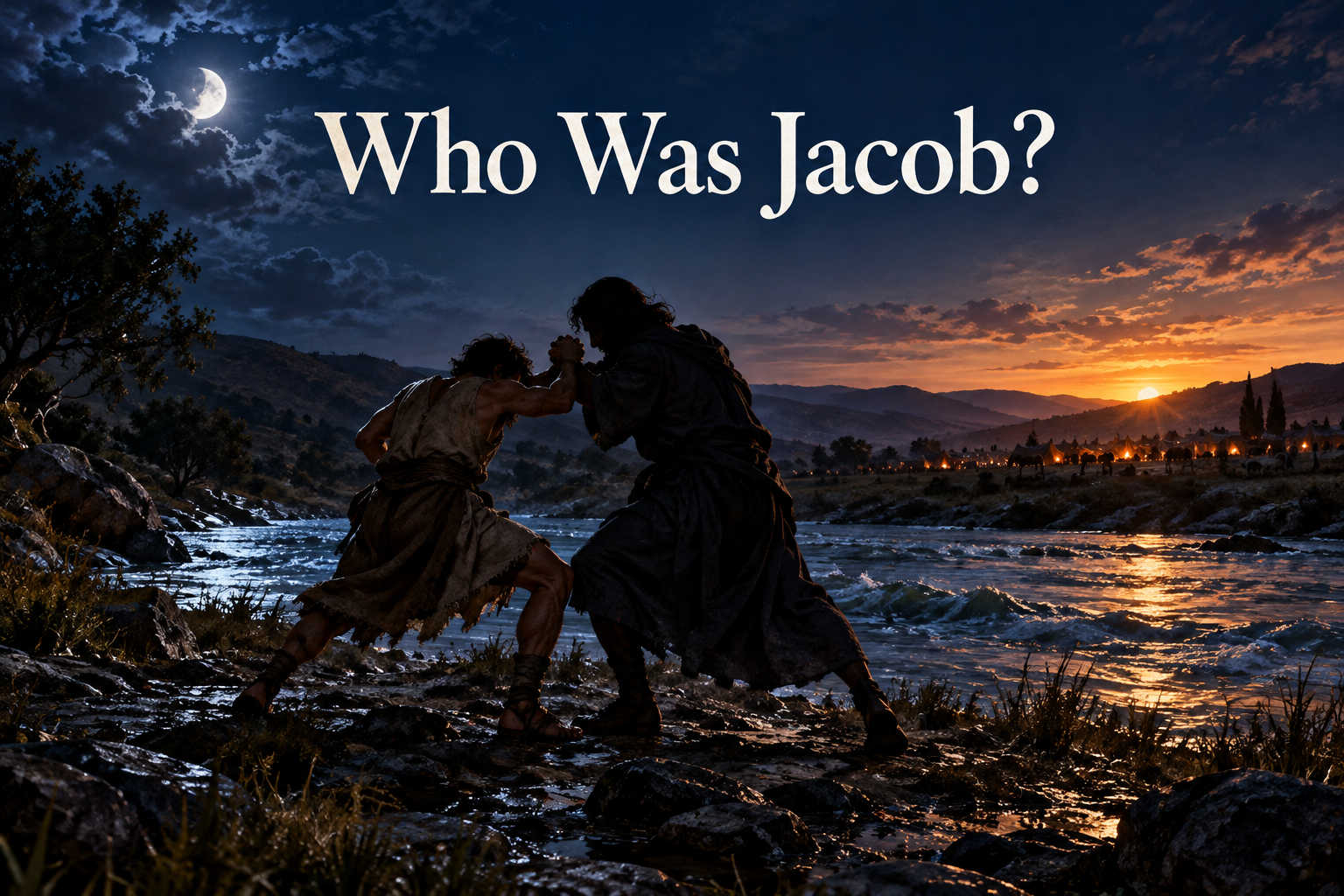
That night a mysterious man wrestled with Jacob until daybreak. The opponent touched Jacob’s hip and disabled it, yet Jacob refused to release him without a blessing. The man renamed him Israel, explaining that he had struggled with God and humans and had prevailed. Jacob named the place Peniel because he believed he had seen God face to face and survived. Hosea 12 later describes the encounter with both divine and angelic language, which confirms the mystery rather than removing it.
Jacob crossed the river limping. The injury became a bodily reminder that his greatest encounter was not a clean victory achieved by superior technique. When Esau arrived, Jacob bowed repeatedly, but Esau ran to embrace him. The feared brother wept, welcomed the family, and initially resisted the gifts. Their reconciliation was genuine, though they did not merge households or erase their complicated history. Forgiveness does not require pretending the past never happened, and peace can include wise distance.
Failure and grief in Canaan
Jacob’s later years include some of Genesis’s darkest family episodes. At Shechem, a local prince sexually violated Jacob’s daughter Dinah and then sought marriage. Her brothers Simeon and Levi used the family’s covenant sign deceptively, persuading the city’s males to be circumcised and then killing them while they were incapacitated. Jacob condemned the danger their violence created for his household, though his immediate words focused more on retaliation than on Dinah. On his deathbed he more directly denounced their fierce anger and cruelty.
Rachel died giving birth to Benjamin, and Jacob buried her near Bethlehem. Reuben later slept with Bilhah, Jacob’s concubine and Rachel’s enslaved woman; the brief report leaves Bilhah’s experience unspoken. Jacob heard about it, and his final words to Reuben show that he did not forget. The household is not presented as morally exemplary simply because it carries the covenant promise. Genesis repeatedly distinguishes God’s faithfulness from the failures of the chosen family.
Jacob’s favoritism toward Joseph, Rachel’s older son, deepened the brothers’ jealousy. They sold Joseph into slavery and deceived Jacob with a bloodied robe, allowing their father to believe Joseph had been killed. The man who once used a son’s clothing to deceive his own father was deceived with his son’s clothing. Jacob grieved for years and refused comfort. The narrative doesn’t reduce his loss to poetic justice, but it does show how patterns of favoritism and deceit can pass through a family and return with devastating force.
Israel goes down to Egypt
Famine eventually forced Jacob’s sons to seek grain in Egypt, where Joseph had risen to authority. When Jacob learned that Joseph was alive, he traveled south with the entire household. At Beersheba God told him not to fear going to Egypt and promised to make him a great nation there and bring him up again. Jacob met Pharaoh, described his 130 years as few and difficult, and blessed the king. It is a wonderfully unsentimental assessment from a man who had received extraordinary promises and also lived with the consequences of extraordinary conflict.
Before his death Jacob adopted Joseph’s sons Ephraim and Manasseh and deliberately gave the younger Ephraim precedence over Manasseh. He then spoke over his sons in Genesis 49, words that combine blessing, judgment, character assessment, and tribal horizons. Judah receives the prominent royal promise, while Joseph receives abundant blessing. These sayings reach beyond private parental affection toward Israel’s future, though interpreters debate the historical setting and development of the poem.
Jacob died in Egypt at 147, and Joseph arranged for his body to be embalmed and carried back to the cave of Machpelah in Canaan. No external inscription identifies Jacob as an individual, and archaeology cannot independently confirm his travels or family events. Israel is named in an Egyptian inscription from the late thirteenth century BC, but that evidence concerns a people in Canaan centuries after the period in which traditional chronologies place Jacob. It establishes the later presence of a group called Israel, not a direct archaeological biography of the man.
The New Testament remembers the patriarchs as heirs of promise and identifies God as the God of Abraham, Isaac, and Jacob. Jacob’s own story explains why grace cannot mean divine approval of every narrated act. He receives promises he cannot manufacture, discipline he cannot evade, and reconciliation he cannot force. By the end, Israel is still capable of partiality and grief, but he has learned to bless while leaning on his staff. The grasping hand has become the hand extended over the next generation.