
Who Was Silas?
Silas is easy to overlook because he never becomes the central figure in Acts. He arrives as a trusted leader in Jerusalem, travels with Paul through beatings and imprisonment, helps establish churches in Macedonia, and then largely disappears from Luke’s account. The letters of Paul probably mention him under the Roman form of his name, Silvanus, and 1 Peter may place him alongside Peter as well. That combination makes him an important connecting figure in the New Testament. Silas belonged to the Jerusalem church, but he spent much of his recorded ministry helping the gospel take root among Gentiles.
A leader and prophet from Jerusalem
Silas first appears after the Jerusalem council, where the apostles and elders addressed the claim that Gentile believers had to be circumcised to be saved. The church chose Judas Barsabbas and Silas, described as leading men among the brothers, to accompany Paul and Barnabas to Antioch (Acts 15:22). A written decision could be forged, misunderstood, or detached from the discussion that produced it. Sending respected representatives allowed the Jerusalem church to confirm the message personally and strengthen fellowship across a difficult cultural divide.
Acts also calls Judas and Silas prophets. They “said much to encourage and strengthen the believers” in Antioch (Acts 15:32), so their prophetic ministry included substantial exhortation rather than only predictions about the future. The passage doesn’t preserve their exact words, and it doesn’t tell us when Silas became a Christian. It does show that the Jerusalem congregation trusted his judgment, teaching, and spiritual character at a moment when a careless messenger could have deepened the conflict.
Why Paul chose Silas
After Paul and Barnabas separated over John Mark, Paul chose Silas for a journey through Syria and Cilicia (Acts 15:36–41). The choice made practical and theological sense. Silas knew the Jerusalem council’s decision firsthand and could attest that Gentile converts didn’t need circumcision in order to belong to Christ. He was also an experienced leader rather than an untested assistant. Timothy joined the team in Lystra, and together they carried the council’s letter while strengthening the churches.
Some readers treat Silas as Barnabas’s replacement, but that description can make him sound interchangeable. Barnabas had been Paul’s senior partner and advocate; Silas brought his own history and standing. Acts doesn’t explain how well Paul knew him before the journey or whether Silas expected the assignment to become a long missionary partnership. It simply shows him committing himself to the work and sharing its cost.
Singing in a Philippian prison
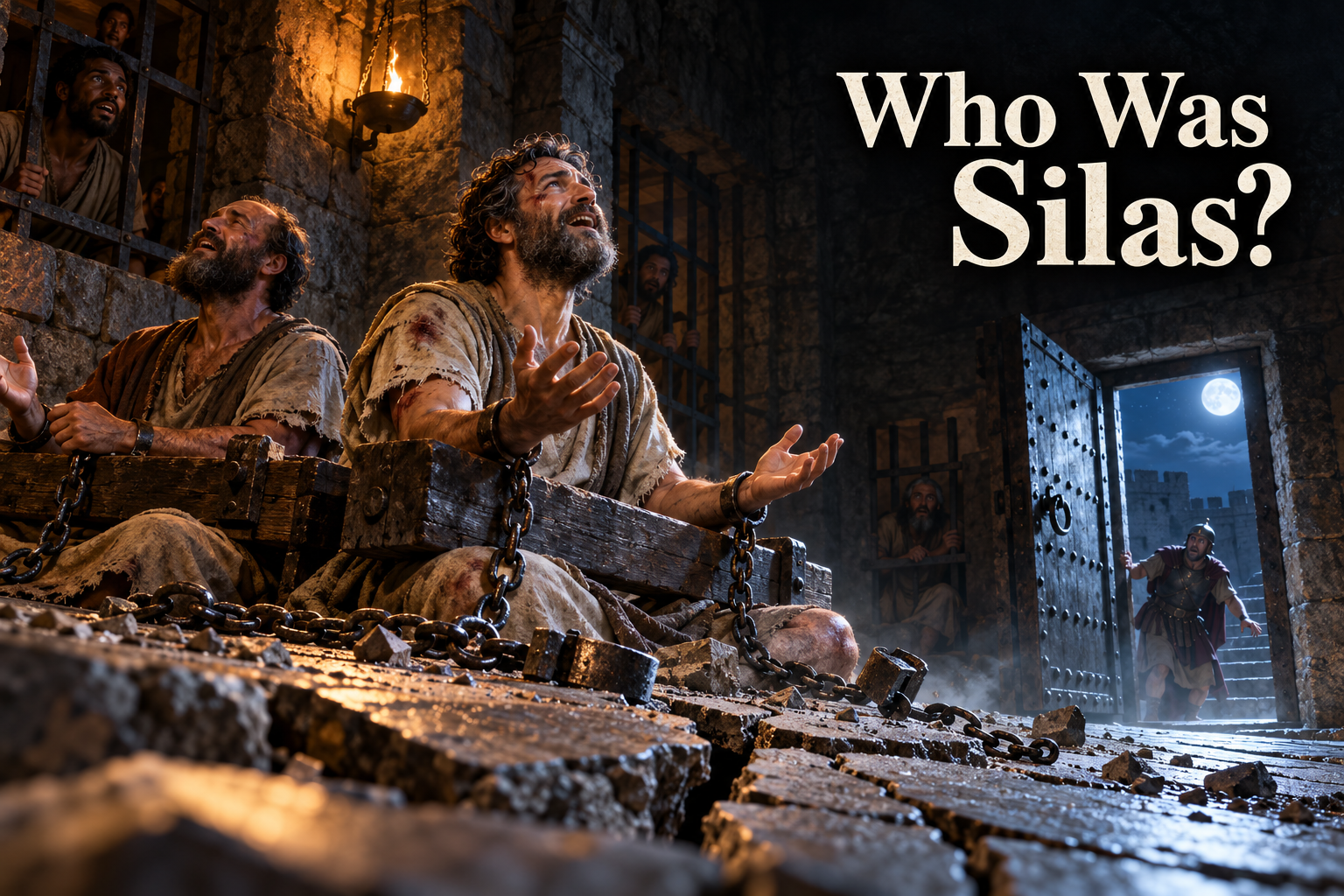
In Philippi, Paul cast a spirit of divination out of an enslaved girl whose owners had profited from her fortune-telling. When their income disappeared, they dragged Paul and Silas before the magistrates. The men were beaten with rods and confined in the inner prison with their feet in stocks (Acts 16:16–24). Their suffering wasn’t the result of private religious contemplation. The gospel had disrupted exploitation, and those who lost money turned civic prejudice against the missionaries.
At midnight Paul and Silas were praying and singing hymns when an earthquake opened the doors and loosened the prisoners’ chains. They didn’t use the opportunity to flee. Paul stopped the jailer from killing himself, and that night the jailer and his household heard the word of the Lord, cared for the missionaries’ wounds, and were baptized. The account doesn’t say that praise mechanically caused the earthquake. It presents two battered believers worshiping God before deliverance arrived, then protecting the life of the man who had guarded them.
The next morning Paul disclosed that he and Silas were Roman citizens who had been beaten publicly without trial. Because Acts uses the plural, it strongly indicates that Silas shared Paul’s citizenship. They required the magistrates to come and escort them out rather than quietly concealing the unlawful treatment. That wasn’t wounded pride. A public acknowledgment could help protect the young church from the charge that its founders were convicted criminals.
Thessalonica, Berea, and Corinth
Paul and Silas next preached in Thessalonica, reasoning from the Scriptures that the Messiah had to suffer and rise from the dead. Some Jews, many devout Greeks, and a number of prominent women believed, but opposition forced the missionaries to leave (Acts 17:1–10). In Berea, hearers examined the Scriptures daily to test their message. When agitators arrived from Thessalonica, Paul departed for Athens while Silas and Timothy remained behind for a time. They later rejoined him in Corinth, where Acts says Paul became occupied with testifying that Jesus is the Messiah (Acts 18:5).
Paul’s letters add to this picture. The opening of 1 Thessalonians names Paul, Silvanus, and Timothy, and the same three names appear in 2 Thessalonians. Paul also reminds the Corinthians that the Son of God was proclaimed among them by himself, Silvanus, and Timothy (2 Corinthians 1:19). These references fit the movements recorded in Acts and show that Silas wasn’t merely a travel companion. He participated in the preaching and pastoral work from which these congregations emerged.
Was Silvanus the same man as Silas?
Acts consistently calls him Silas, while the letters use Silvanus. Most interpreters identify the two names as belonging to the same person, much as Saul was also known as Paul. The shared association with Paul, Timothy, Thessalonica, and Corinth makes that conclusion very strong. Even so, no New Testament writer pauses to say explicitly that Silas and Silvanus are the same man. It is a well-supported identification rather than a sentence Scripture states directly.
How much Silvanus contributed to the Thessalonian letters is harder to determine. His name in the greetings means he stood with Paul and Timothy behind the message, but it doesn’t tell us whether he helped compose particular sentences. Modern categories such as author, coauthor, secretary, and editor don’t map neatly onto every ancient letter-writing practice. We can affirm his meaningful participation without pretending to know the division of labor.
Silvanus and Peter
First Peter closes by saying, “Through Silvanus, whom I regard as a faithful brother, I have written to you briefly” (1 Peter 5:12). This is probably the same Silvanus, though the identification isn’t certain. The phrase may mean that he carried the letter, assisted with its composition, or did both. Some interpreters have suggested that Silvanus’s help accounts for the letter’s polished Greek, but the verse doesn’t specify the extent of his role. Questions about the authorship and date of 1 Peter involve more evidence than this one phrase can settle.
If the identification is correct, Silas served alongside both Paul and Peter and helped connect believers across a remarkable range of places. That wouldn’t make him the secret author of their letters. It would show why a respected, mobile leader with roots in Jerusalem was valuable to the wider church. He could carry a message because the recipients knew, or were told, that he was a faithful brother.
What we know and what we don’t
Later Christian traditions assign Silas various bishoprics and describe his death, but the accounts aren’t early or consistent enough to establish what happened. Acts leaves him at Corinth, and the probable references in the letters show continued ministry without supplying a final chapter. We don’t know where he spent his last years or whether he died as a martyr. Those gaps shouldn’t be filled by turning later tradition into biblical biography.
Silas matters because the early church needed more than its most famous apostles. It needed trustworthy people who could represent one congregation to another, explain hard decisions, endure hostility, and strengthen believers after the public attention moved elsewhere. Silas did that work as a leader, prophet, missionary, and faithful brother. His ministry helped keep the mission to the Gentiles connected to the church in Jerusalem while making clear that unity in Christ didn’t require Gentiles to become Jews.