
Who Was the Prophet Nahum?
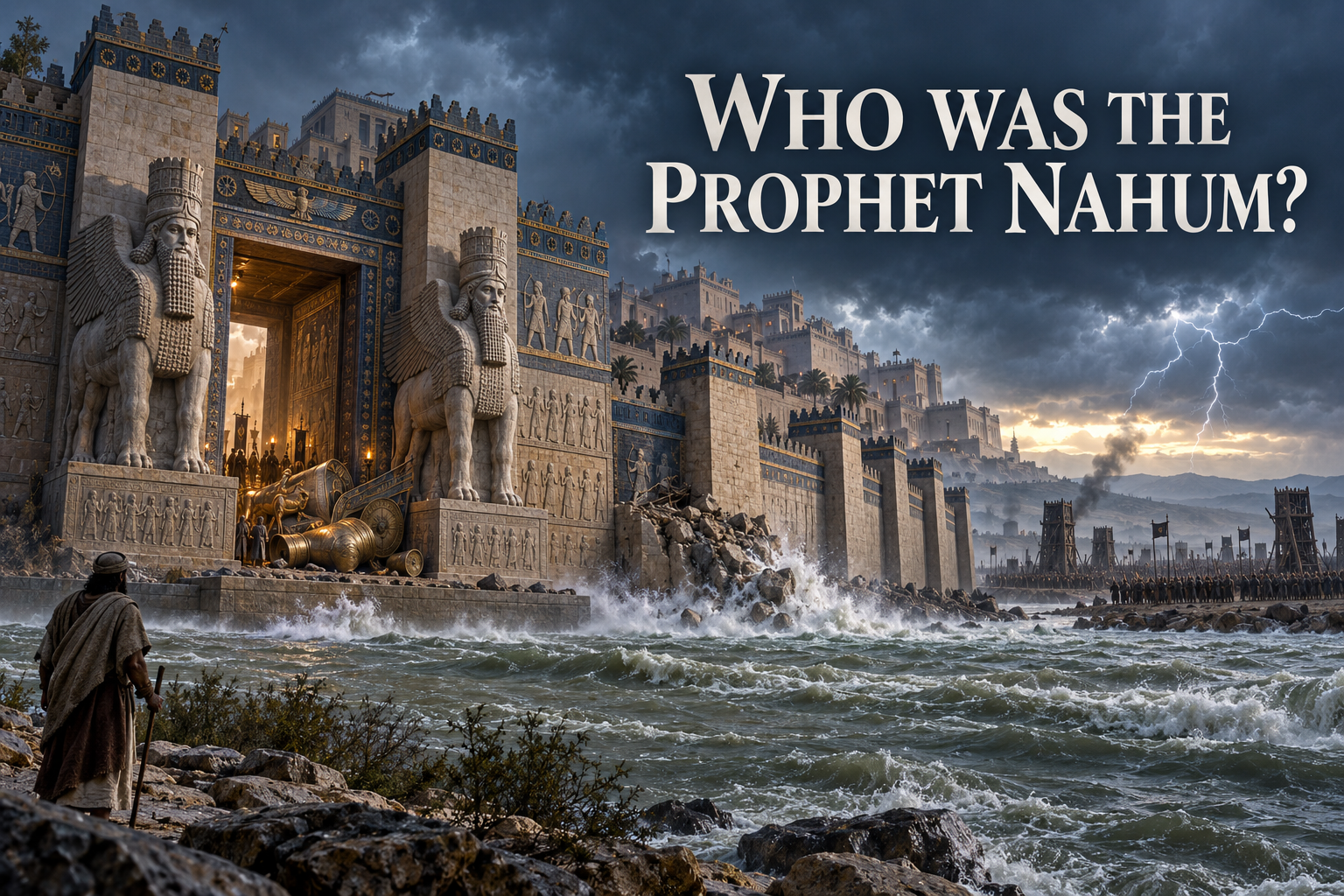
For generations, Judah lived in the shadow of an empire that seemed too large to fail. Assyria had destroyed cities, deported populations, demanded tribute, and made examples of nations that resisted. Its capital, Nineveh, advertised imperial wealth and power on a scale few people in Judah could imagine. Nahum announced that this “bloody city” would fall. To people accustomed to Assyria’s apparent permanence, the message must have sounded both astonishing and dangerous.
Nahum the Elkoshite
The book identifies its author as Nahum the Elkoshite and describes his work as an oracle concerning Nineveh and a book of vision. Nahum’s name is related to the Hebrew word for comfort, which suits a prophecy intended to console people under oppression. Beyond that, Scripture gives us no biography. Elkosh has not been located with confidence, despite proposals placing it in Judah, Galilee, or even the vicinity of Nineveh. We don’t know Nahum’s occupation, family, or the circumstances in which he first delivered his message.
We can date his prophecy more closely than we can locate his hometown. Nahum 3:8-10 looks back on the Assyrian conquest of Thebes in Egypt, which occurred around 663 BC, while the book presents Nineveh’s destruction as still ahead. Nineveh fell to a Babylonian and Median coalition in 612 BC. That places the prophecy somewhere within a span of roughly fifty years, though scholars disagree about where. Some date it soon after Thebes fell, while others place it near Nineveh’s collapse; the text gives us boundaries rather than an exact year.
Why Nineveh’s Fall Mattered
Nineveh became Assyria’s capital under Sennacherib, the king whose invasion devastated much of Judah in 701 BC. Assyria had already conquered the northern kingdom of Israel and its capital, Samaria, in 722 BC. The empire maintained control through military force, tribute, deportation, and calculated displays of what happened to rebels. Its royal inscriptions and palace reliefs celebrated victories in ways designed to impress subjects and frighten enemies. Nahum’s original audience didn’t need an introduction to Assyrian power; they lived with its consequences.
This history explains why Nahum’s prophecy is filled with relief as well as judgment. He isn’t describing the downfall of an ordinary foreign city simply because it is foreign. Nineveh represents an imperial system that enriched itself through conquest and left ruined communities behind. Nahum 3:1 calls it a city of blood, lies, and plunder, and the book closes by saying that nations applaud its fall because they have all suffered under its cruelty. The cheering sounds severe until we remember who has been doing the cheering and what they have survived.
The Lord Is Slow to Anger, but Not Indifferent
Nahum begins with a hymn describing the Lord as jealous, avenging, powerful, and wrathful. Those words can sound like a portrait of uncontrolled divine temper, but the passage also echoes God’s self-revelation in Exodus 34 by declaring that the Lord is slow to anger. Divine patience isn’t divine apathy. The God who is a refuge for those who trust him also confronts powers that assume patience means they will never be called to account. Nahum holds refuge and judgment together because the rescue of victims may require the defeat of those who refuse to stop victimizing them.
God’s jealousy here is not petty insecurity. In the Old Testament’s covenant setting, it describes his refusal to share his people with gods and empires that enslave them. His vengeance is likewise presented as judicial action rather than personal spite. That doesn’t make every difficult feature of Nahum easy, but it does identify the moral claim at the center of the book: history is not finally governed by whichever ruler can field the largest army. The Lord remains sovereign over the forces that present themselves as sovereign.
A City Under Siege
Chapters 2 and 3 portray Nineveh’s fall with rapid, vivid images. Shields flash, chariots race, soldiers stumble toward the wall, river gates open, and the palace collapses. The city that had accumulated wealth through conquest is plundered, and the lion’s den of Assyrian power is emptied. Nahum writes poetry, not a military report, so interpreters should be cautious about matching every image to a particular feature of the siege. The effect is unmistakable even when the details remain debated: panic has replaced imperial confidence.
Nahum then points to Thebes. That Egyptian city had defensive advantages, allies, and impressive resources, yet Assyria had conquered it and carried its people away. Nineveh should not assume that its fortifications make it immune to the fate it inflicted on others. The comparison has a sharp irony. Assyria’s own victory at Thebes becomes evidence against Assyria’s claim to permanence.
Nahum, Jonah, and the Mercy of God
Readers often notice that Nahum and Jonah speak very differently about Nineveh. Jonah ends with God expressing concern for the city after its people respond to a warning; Nahum announces Nineveh’s irreversible collapse. The two books need not be forced into a contest between mercy and justice. Together they show that God’s compassion is real and that repentance matters, but a previous experience of mercy doesn’t grant an empire permanent immunity while it returns to violence.
We should also avoid constructing a detailed chronology that the books themselves don’t provide. Jonah doesn’t name the Assyrian king or securely date the city’s repentance, and Nahum doesn’t discuss that earlier episode. The canonical contrast is still theologically valuable. God can pity a wicked city and call it to repentance, and he can judge a violent city that persists in oppression. Mercy is not moral indifference, and judgment does not prove that mercy was insincere.
The Violence That Troubles Modern Readers
Nahum is a difficult book because it doesn’t merely state that justice will occur; it celebrates Nineveh’s violent defeat in graphic language. Chapter 3 personifies the city as a woman accused of prostitution and witchcraft, then describes her exposure and public humiliation. This was part of the stock imagery by which ancient writers portrayed conquered cities, but identifying the convention doesn’t remove the ethical problem. The metaphor uses a woman’s sexual humiliation to represent imperial defeat, and modern readers are right to recognize how such language can demean women and echo real sexual violence.
Faithful interpretation doesn’t require us to pretend that this imagery is harmless. Scripture came through genuinely human authors who wrote in ancient cultures, using the rhetorical forms available to them. We can receive Nahum’s inspired testimony that God opposes brutal empire while also refusing to reproduce its gendered humiliation as acceptable speech or behavior. No one should appeal to this passage to excuse abuse, sexual degradation, or violence against women. The metaphor serves the prophet’s announcement about Nineveh; it is not a moral instruction for how God’s people may treat an enemy.
At the same time, readers who have never lived under terror should be slow to lecture the oppressed about the intensity of their relief. Nahum gives voice to people whose homes, families, and futures had been treated as expendable by an empire. His fierce poetry assures them that their suffering is visible to God and that the machinery crushing them will not run forever. We can take that hope seriously without treating every image in the poem as a pattern to imitate.
Justice Without Imperial Imitation
Nahum offers no mandate for Christians to identify a modern enemy as Nineveh and imagine themselves authorized to carry out divine vengeance. The book announces what God will do; Judah is not told to become a new Assyria. That distinction is essential because victims can reproduce the very cruelty they once condemned when they gain power. Biblical justice does not consist of attaching God’s name to our own appetite for domination.
The New Testament continues to place vengeance in God’s hands while calling believers to overcome evil with good (Romans 12:17-21). That teaching doesn’t erase Nahum. It prevents us from turning his oracle into propaganda for personal hatred, national conquest, or delight in suffering for its own sake. Christians can pray for oppressive systems to end, protect those being harmed, and work for justice while remembering that our enemies remain human beings accountable to the same God who judges us.
Why Nahum Matters
Nineveh fell in 612 BC, though a remnant of Assyrian power survived briefly afterward. The capital that had appeared invincible never recovered its imperial standing. Nahum’s prophecy therefore belongs to a specific historical crisis, but the temptation it confronts remains familiar. Powerful institutions still confuse longevity with righteousness, military or economic reach with moral authority, and delayed judgment with immunity.
Nahum tells the oppressed that God’s patience with evil has a limit. It also warns everyone who enjoys power that no empire is permanent and no victim is invisible. The book’s violent rhetoric requires careful, honest reading, especially where its metaphors can wound people in ways the prophet did not address. Yet its central hope should not be lost: the God who is slow to anger is also a refuge, and the bloody city will not rule forever.