
Who Was Timothy?
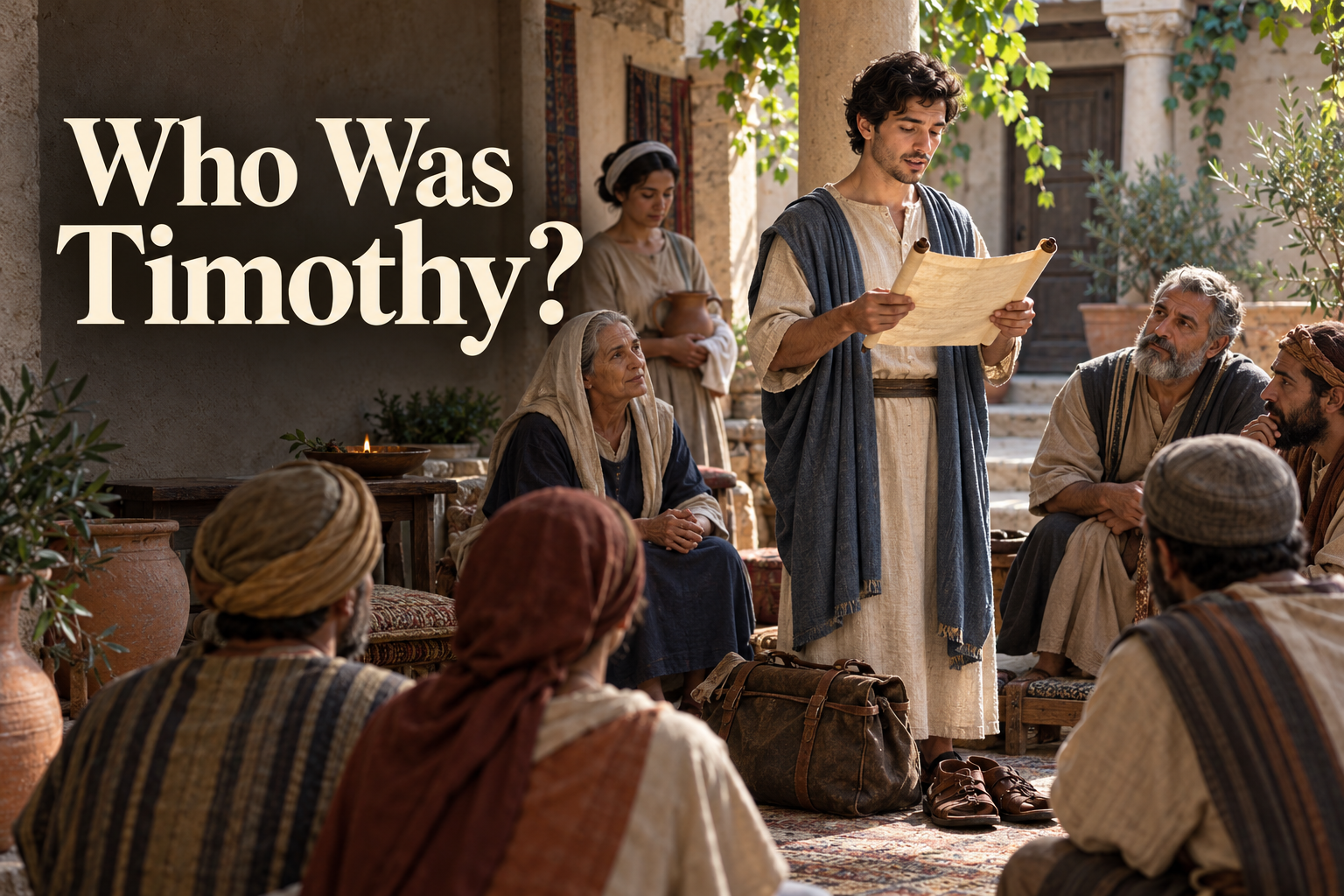
Timothy is sometimes pictured as a permanently nervous young pastor who needed Paul to keep telling him to be brave. The New Testament gives us a sturdier figure. He did receive encouragement, and he apparently had recurring health problems, but Paul repeatedly entrusted him with difficult churches, sensitive assignments, and the representation of Paul’s own ministry. Timothy wasn’t important because he was impressive on his own. He became indispensable because he proved faithful over years of service.
A disciple from Lystra
Acts introduces Timothy in Lystra as a disciple whose mother was Jewish and a believer and whose father was Greek (Acts 16:1–2). Believers in Lystra and Iconium spoke well of him. Acts doesn’t state exactly when Timothy became a Christian, though Paul had preached in the region on an earlier journey and later called Timothy his beloved and faithful child in the Lord. That language points to a close spiritual relationship, but it doesn’t prove every detail of Timothy’s conversion story.
Second Timothy names his mother, Eunice, and grandmother, Lois, and speaks of the sincere faith that lived in them (2 Timothy 1:5). It also says Timothy had known the sacred writings from childhood (3:15). Christians who accept Pauline authorship naturally read these as Paul’s personal recollections. Many scholars, however, believe the Pastoral Epistles were written after Paul’s lifetime by someone carrying forward his teaching, citing differences in vocabulary, church setting, and style. Defenders of Pauline authorship point to the letters’ personal details, early reception, and the possibility that a different setting or secretarial help affected their style. Whatever position one takes on that debate, Acts independently establishes Timothy’s Jewish and Greek family background, his good reputation, and his place on Paul’s missionary team.
Why Paul circumcised Timothy
Before taking Timothy along, Paul had him circumcised because the Jews in the area knew that his father was Greek (Acts 16:3). At first glance, that seems to contradict Paul’s refusal to have Titus circumcised in Galatians 2. The circumstances were different. Some people wanted Titus, a Gentile, circumcised as a requirement for full acceptance; Paul refused because that demand compromised the freedom of the gospel. Timothy had a Jewish mother, and his uncircumcised status would have created an immediate obstacle in the synagogues where the team regularly began its work.
Paul wasn’t teaching that circumcision contributed to Timothy’s salvation. The missionaries were at that very time delivering the Jerusalem council’s judgment that Gentile believers didn’t have to be circumcised. Timothy accepted a costly accommodation so that an avoidable controversy about his family status wouldn’t drown out the message. It was a missionary decision, not a second route into God’s covenant people.
Paul’s trusted representative
Timothy traveled with Paul and Silas through Macedonia and appears in the background of the missions to Philippi, Thessalonica, Berea, Athens, and Corinth. When persecution forced the team from Thessalonica, Timothy was later sent back to strengthen and encourage the believers in their faith. He returned with good news about their perseverance and affection (1 Thessalonians 3:1–6). Paul didn’t send him because the assignment was easy. He sent him into a pressured church because Timothy could be trusted to understand both the gospel and Paul’s pastoral concern.
The same pattern appears in Corinth. Paul sent Timothy to remind the church of his ways in Christ, yet asked the Corinthians to put him at ease and not despise him (1 Corinthians 4:17; 16:10–11). That request may reflect Timothy’s relative youth, the Corinthians’ combative habits, or both. It doesn’t mean Timothy lacked courage. Representing Paul to a divided congregation that questioned Paul’s authority required more than a forceful personality; it required loyalty, patience, and sound judgment.
Timothy is named with Paul in the openings of 2 Corinthians, Philippians, Colossians, 1 and 2 Thessalonians, and Philemon. A greeting doesn’t establish that he coauthored every part of each letter, but it does place him publicly within Paul’s ministry. Romans 16:21 calls him Paul’s fellow worker. In Philippians, Paul says he has no one else of comparable concern who will genuinely care for the believers’ welfare, because Timothy has served with him like a child with a father (Philippians 2:19–22). The family language expresses affection and shared service, not a relationship of domination.
Timothy and the church in Ephesus
First Timothy places Timothy in Ephesus with instructions to confront false teaching and help order the life of the congregation. The letter addresses prayer, qualified leadership, care for widows, money, discipline, and the faithful transmission of apostolic teaching. Timothy’s task wasn’t simply to deliver sermons. He had to resist speculative teaching, handle accusations responsibly, and model a life consistent with the message he defended.
Paul’s instruction not to let anyone despise Timothy’s youth has led to the familiar image of a teenage minister (1 Timothy 4:12). The text doesn’t give his age, and “youth” could be used comparatively for an adult younger than the elders around him. If the letter belongs late in Paul’s ministry and Timothy joined him years earlier, Timothy was probably no adolescent. The point is that he couldn’t control other people’s estimate of him, but he could answer contempt through speech, conduct, love, faith, and purity.
The counsel to take a little wine for his stomach and frequent ailments is equally revealing (1 Timothy 5:23). Timothy’s health troubles weren’t treated as proof of weak faith, and the advice wasn’t a rejection of prayer or divine healing. It was practical care for a coworker whose body needed attention. Scripture can affirm God’s power to heal without requiring believers to pretend that ordinary means of care are faithless.
Gift, character, and endurance
The Pastoral Epistles urge Timothy not to neglect the spiritual gift associated with prophecy and the laying on of hands (1 Timothy 4:14; 2 Timothy 1:6). The passages don’t provide enough detail to identify that gift with precision, nor do they present ministry as a matter of gifting alone. Timothy is repeatedly told to watch his life and teaching, pursue godly character, endure hardship, and entrust what he has learned to reliable people who can teach others. Calling and character belong together.
Second Timothy has the atmosphere of a final charge. Paul, facing death, urges Timothy not to be ashamed of testimony about the Lord or of Paul’s imprisonment. He tells him to guard the good deposit through the Holy Spirit and to preach the word with patience (2 Timothy 1:8, 13–14; 4:1–5). Those instructions have often been applied to every minister, and reasonably so, but they first address a particular coworker carrying responsibility in a dangerous time. Timothy’s courage wasn’t assumed to be automatic. It had to be renewed through grace, truth, and the Spirit’s presence.
What happened after Paul?
Hebrews 13:23 says that “our brother Timothy has been released,” or possibly sent away, depending on how the verb is understood. Most readers identify him with Paul’s coworker, but the brief reference doesn’t explain the circumstances. Later tradition remembers Timothy as a leader or bishop in Ephesus and eventually as a martyr. The fullest martyrdom account comes from centuries after the New Testament period, so its details can’t be treated as established history.
The biblical portrait is compelling without those additions. Timothy crossed cultural boundaries from birth, accepted personal inconvenience for the sake of mission, learned alongside experienced leaders, and became someone Paul could send where relationships were strained. He wasn’t a miniature Paul, and he didn’t need to be. His life shows how Christian ministry is passed on: not by manufacturing celebrity successors, but by forming trustworthy people who know the gospel, care about congregations, and remain faithful when the work becomes costly.