
Who Was Zacchaeus?
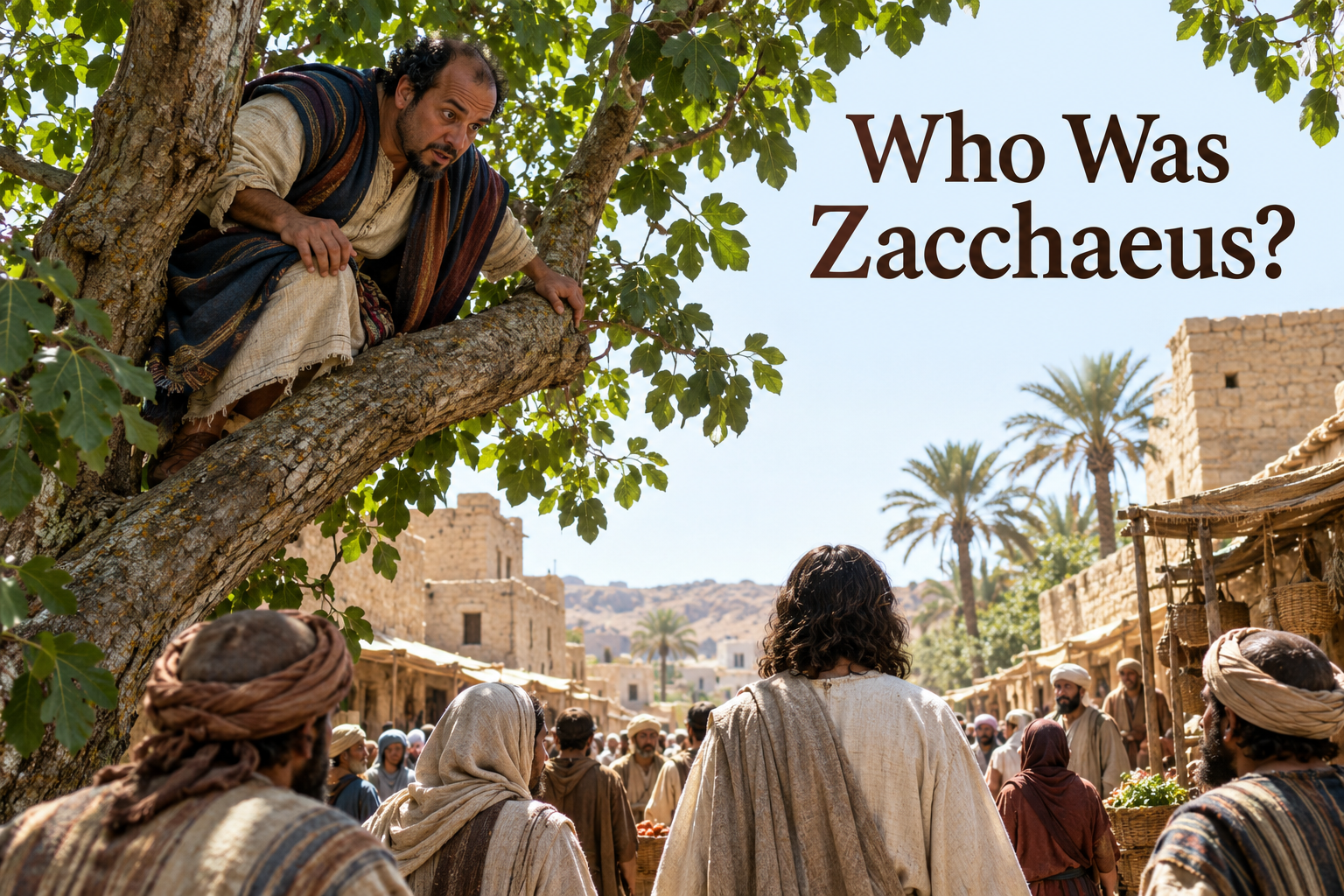
Zacchaeus was a wealthy chief tax collector in Jericho who climbed a tree to see Jesus and came down to receive him as a guest. His story occupies only ten verses, but it gathers several of Luke’s central themes into one encounter: money, social contempt, repentance, hospitality, and the mission of Jesus to seek and save the lost. Zacchaeus isn’t praised because he was rich or condemned merely because he handled taxes. The question is what his wealth represented, how he responded to Jesus, and whether salvation would change his relationship to other people.
Luke is our only New Testament source for Zacchaeus. The Gospel gives no patronymic, family history, age, or later career. It doesn’t say that he had met Jesus before, and it never mentions him again. Later Christian tradition supplied offices and travel stories, but the secure biography remains the encounter in Luke 19:1-10. That brief account is enough to make Zacchaeus one of the most recognizable people in the Gospels.
A Chief Tax Collector in Jericho
Jesus meets Zacchaeus while passing through Jericho on the way to Jerusalem. The city stood near important routes and a fertile oasis associated in antiquity with valuable agricultural products, including dates and balsam. It was an obvious place for collecting duties connected with goods and movement. Luke calls Zacchaeus a “chief tax collector,” an unusual title that probably indicates some supervisory authority within local revenue collection. The precise machinery isn’t explained, so we shouldn’t confidently assign him a modern job description.
Tax collection under Roman and local rulers could involve contracts, intermediaries, tolls, and opportunities for abuse. Collectors had to deliver required revenue, and the system could reward taking more than was due. That helps explain why tax collectors appear beside “sinners” in the Gospels and why John the Baptist told them not to collect beyond what was authorized (Luke 3:12-13). Still, the occupation didn’t prove that every collector committed every imaginable fraud. Luke signals a morally compromised system and a hated profession, then lets Zacchaeus’s own words raise the question of extortion.
Zacchaeus was rich, which sets him beside Luke’s sustained warnings about wealth. Just before entering Jericho, Jesus had challenged a wealthy ruler who couldn’t release his possessions (Luke 18:18-23). The proximity invites comparison, though the two men shouldn’t be collapsed into a simple morality chart. The ruler was respectable and went away sad; the despised collector welcomes Jesus joyfully and places his money on the table. Luke shows that status can conceal bondage and disgrace can hide someone ready to respond.
Running Ahead and Climbing
Zacchaeus wanted to see who Jesus was, but the crowd blocked him because he was short. The grammar could theoretically refer to Jesus’ stature, yet the ordinary reading and narrative logic point to Zacchaeus. He runs ahead and climbs a sycamore-fig tree along the route (Luke 19:3-4). For a wealthy official, scrambling up a tree in public would hardly protect his dignity. Curiosity has already made him willing to look ridiculous.
The tree wasn’t the same species as the North American sycamore. The sycamore fig common in the region has low, spreading branches that could support a climber and offer a view over a crowd. Modern visitors are sometimes shown a particular “Zacchaeus tree” in Jericho, but no method can verify that a living tree is the one in Luke’s story. The tradition may help people picture the setting; it isn’t archaeological identification.
When Jesus reaches the spot, he looks up and calls Zacchaeus by name. Luke doesn’t say whether this reflects supernatural knowledge, prior information, or someone in the crowd identifying him. The narrative leaves the mechanism unexplained and emphasizes the initiative: the man trying to see Jesus discovers that Jesus has stopped to see him. Jesus tells him to come down quickly because he “must” stay at his house, language Luke often uses for the necessity of God’s mission.
Hospitality and Public Complaint
Zacchaeus hurries down and welcomes Jesus gladly. In the ancient Mediterranean world, sharing a meal signaled acceptance and relationship, not merely a convenient place to eat. The crowd responds by grumbling that Jesus has gone to be the guest of a sinner (Luke 19:5-7). Their objection may reflect real injuries connected with taxation as well as social and religious contempt. Luke doesn’t require us to imagine that everyone who disliked Zacchaeus was motivated by envy or hypocrisy.
Jesus’ hospitality also doesn’t declare exploitation harmless. He enters the home before Luke records restitution, showing that mercy takes the initiative. Yet the welcome produces or reveals a concrete change in the use of wealth. Grace isn’t payment for Zacchaeus’s reform, but grace also refuses to leave economic wrongs untouched. The scene holds acceptance and accountability together.
It is important not to romanticize the crowd’s pain or Zacchaeus’s position. If he had used authority to overcharge people, the victims would have borne actual losses while he accumulated wealth. Forgiveness wouldn’t make repayment unnecessary. By placing restitution at the center of the response, Luke avoids a version of conversion that asks the harmed community to celebrate words while the beneficiary keeps every profit.
Did Zacchaeus Repent or Defend Himself?
Zacchaeus announces that he gives half his possessions to the poor and, if he has defrauded anyone, restores four times the amount (Luke 19:8). Most readers and many translations understand this as a new resolve: “I will give” and “I will pay back.” The Greek verbs are present tense, however, so some interpreters read them as a description of his customary practice. On that view, Zacchaeus is defending himself against the crowd’s assumption that his occupation tells the whole truth about him.
The traditional repentance reading fits the narrative movement and the impracticality of repeatedly giving away half of everything. It also fits Jesus’ declaration that salvation has come “today.” Yet the grammatical debate is real, and the Gospel doesn’t include an explicit statement such as “Zacchaeus repented.” We don’t have to force certainty. Whether he announces a new practice or defends a practice already begun, his response makes generosity and restitution the visible answer to accusations tied to wealth.
Fourfold repayment echoes the law’s severe restitution for certain thefts (Exodus 22:1). Other violations required restoring the loss plus an added fifth (Numbers 5:7). Zacchaeus chooses, or says he practices, a strikingly generous standard rather than calculating the smallest possible settlement. Giving half to the poor goes beyond repaying identifiable victims. His money will now serve both justice and mercy.
The phrase “if I have defrauded anyone” shouldn’t be used to excuse him automatically. In Greek it can acknowledge cases rather than imply that fraud is merely hypothetical. At the same time, Luke doesn’t provide a ledger of offenses, so it would also be wrong to invent particular victims or amounts. Zacchaeus commits himself to finding and repairing wrongs, which is more morally serious than either vague guilt or defensive denial.
A Son of Abraham
Jesus responds, “Today salvation has come to this house, because he too is a son of Abraham” (Luke 19:9). The phrase likely affirms Zacchaeus’s place among God’s covenant people, which public contempt had effectively denied. Jesus doesn’t say wealth or generosity purchases his ancestry. He restores a man treated as an outsider while showing what covenant faithfulness looks like when possessions have been entangled with injustice.
“This house” may include Zacchaeus’s household, but Luke doesn’t tell us that every family member made an individual confession at that moment. Ancient households were socially interconnected, and a household head’s decisions could transform everyone’s economic life. We should let the corporate language stand without using it to settle later debates about personal faith. Salvation reaches a home whose wealth and reputation had been shaped by the tax system.
Jesus then interprets the encounter with a mission statement: “The Son of Man came to seek and to save the lost” (Luke 19:10). Zacchaeus had been trying to see Jesus, but Jesus is the one who seeks. The lost person isn’t necessarily poor, powerless, or outwardly miserable. He can be wealthy, resourceful, and perched above the crowd while still needing rescue.
History and Later Tradition
No known contemporary inscription or outside record securely identifies this Zacchaeus. Jericho’s location and economic importance provide credible context, while Roman-era revenue practices help explain the hostility surrounding tax collectors. Those general facts don’t prove the conversation, the tree, or the restitution pledge. Christians receive Luke’s account as Scripture; historical honesty still distinguishes the Gospel testimony from independent confirmation.
Later traditions sometimes made Zacchaeus a bishop, associated him with Caesarea, or connected him with other named disciples. These claims aren’t found in Luke or the rest of the New Testament, and their historical support is uncertain. They may show how later communities imagined the continuing life of a memorable convert. They shouldn’t be attached to his biography with the same confidence as the Jericho encounter.
Salvation With Economic Consequences
Zacchaeus’s story is often reduced to a children’s song about a short man in a tree. Luke’s version is far more demanding. A socially hated official seeks a glimpse of Jesus, receives unexpected hospitality, and answers with a public commitment involving the wealth that defined his power. The crowd must reconsider whom God may welcome, and Zacchaeus must show that welcome in the way he treats the poor and anyone he has wronged.
The story doesn’t teach that rich people can save themselves by making a large donation. Jesus stops, calls, and comes to the house before Zacchaeus announces anything. But the story is equally unwilling to call an inward feeling sufficient when money has harmed neighbors. Salvation arrives as gift and becomes visible as repair. Zacchaeus comes down from the tree because Jesus calls him; once on the ground, he has accounts to settle.