
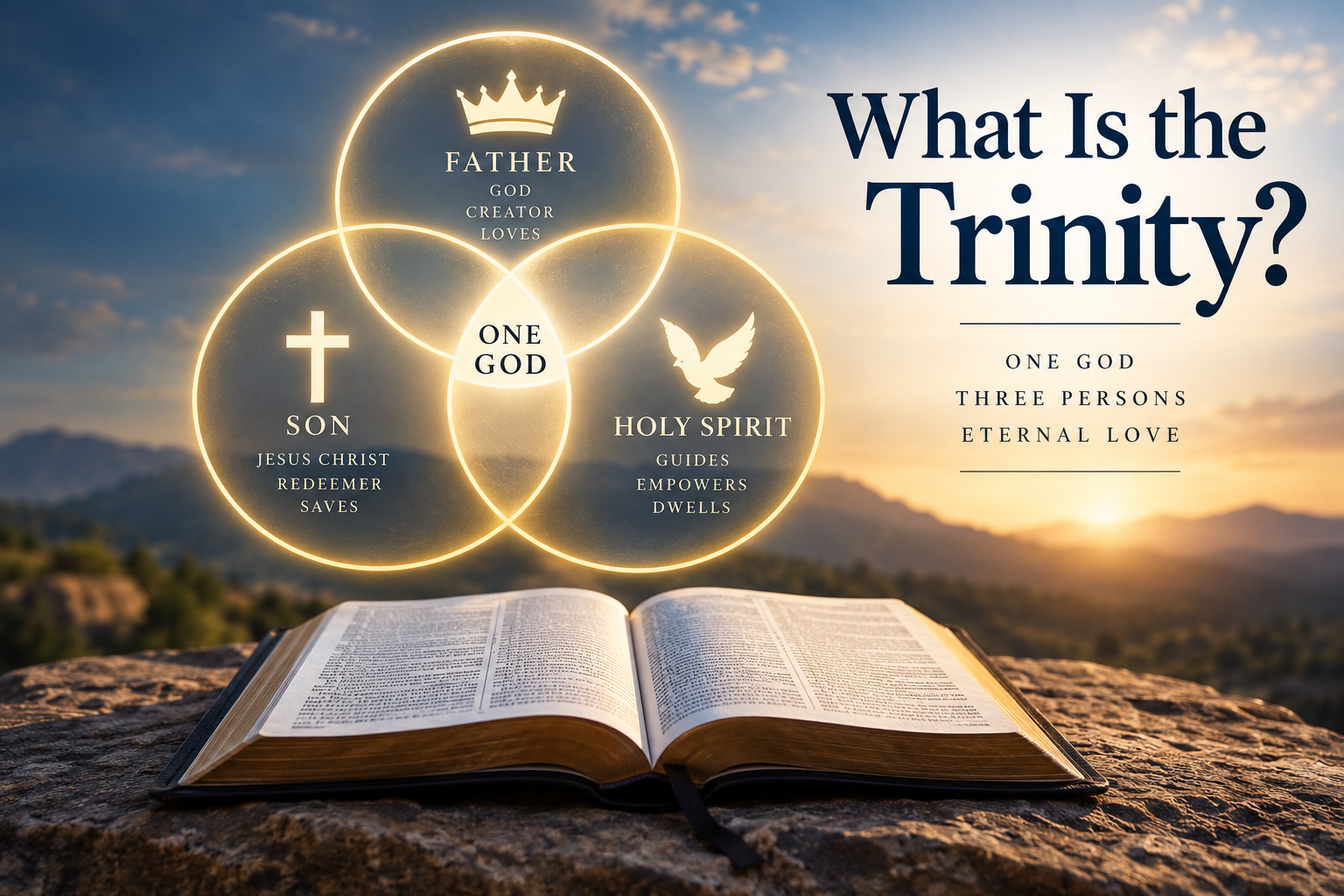
The Trinity is the Christian doctrine that there is one God who exists eternally as three distinct Persons: the Father, the Son, and the Holy Spirit. Christians who affirm the Trinity do not believe in three gods. Rather, the Father is God, the Son is God, and the Holy Spirit is God, while the Father, Son, and Spirit are personally distinct from one another.
The word Trinity does not appear in the Bible, and the New Testament does not present a formal doctrine using the later theological terminology of “one essence and three Persons.” The doctrine developed as Christians attempted to account for several biblical teachings simultaneously: there is only one God; the Father is God; Jesus is spoken of and treated in ways Christians understood as divine; the Holy Spirit is likewise associated with divine identity and activity; and yet the Father, Son, and Spirit are distinguished from one another.
Does the Bible Use the Word Trinity?
No. The English word Trinity is not found in Scripture.
That fact by itself does not establish whether the doctrine is true or false. Christians routinely use theological terms that summarize ideas drawn from multiple biblical passages. The important question is therefore not simply, “Is the word Trinity in the Bible?” but “Does the doctrine accurately account for what the Bible teaches about God, Jesus Christ, and the Holy Spirit?”
That question has generated debate throughout Christian history.
The Bible Teaches That There Is One God
Christian Trinitarianism begins with monotheism, not with three gods.
Christianity inherited from Judaism the conviction that there is one God. Consequently, orthodox Trinitarian theology has historically rejected the idea that the Father, Son, and Holy Spirit constitute three separate gods.
This distinction matters. The doctrine is not:
1 God + 1 God + 1 God = 3 Gods.
Rather, Trinitarian theology distinguishes between being and person. God is one with respect to divine being or essence and three with respect to person.
That formulation eventually became an important way Christians attempted to preserve both divine unity and the distinctions they encountered in Scripture.
The Father, Son, and Holy Spirit in the New Testament
Several New Testament passages place the Father, Son, and Holy Spirit together in striking ways.
Jesus commands his disciples to baptize “in the name of the Father and of the Son and of the Holy Spirit” in Matthew 28:19. Paul similarly closes 2 Corinthians by referring together to Jesus Christ, God, and the Holy Spirit.
These passages do not by themselves provide a complete philosophical definition of the Trinity. They do, however, help explain why early Christians had to think carefully about the relationship among the Father, Jesus Christ, and the Spirit.
Why Do Christians Believe Jesus Is Divine?
The identity of Jesus is central to the development of Trinitarian theology.
John’s Gospel begins by describing the Word as existing “in the beginning,” being with God, and being God; it later identifies this Word with the one who became flesh.
Other New Testament passages contributed to Christian reflection on Christ’s divine status. Yet the New Testament also distinguishes Jesus from the Father. Jesus prays to the Father, speaks of being sent by the Father, and relates to the Father as another.
This created an important theological challenge: How can Christians affirm the divinity of Christ while continuing to insist that there is only one God?
Trinitarian doctrine developed partly as an answer to that question.
What About the Holy Spirit?
The Holy Spirit is not merely interchangeable with the Father or Son in the New Testament. Scripture distinguishes the Spirit while associating the Spirit closely with God’s presence and work.
This means Christians eventually faced a threefold question rather than merely a debate about the Father and Jesus:
Who is the Father? Who is the Son? Who is the Holy Spirit—and how are all three related to the one God?
The doctrine of the Trinity represents the historic orthodox answer.
One God, Three Persons
The classic formula is:
One God in three Persons: Father, Son, and Holy Spirit.
The three Persons are not three parts that together make God. Nor, in classical Trinitarian theology, are they simply three temporary roles played by one divine Person.
The Father is not the Son.
The Son is not the Holy Spirit.
The Holy Spirit is not the Father.
Yet Trinitarian Christianity maintains that each is fully divine and that there remains only one God. The historic doctrine eventually expressed this by saying that the three Persons share one divine essence or substance. The Greek term homoousios, meaning “of the same substance” or “consubstantial,” became especially important in the fourth-century controversies.
Did the Early Christians Believe in the Trinity?
This requires a careful answer.
The earliest Christians certainly spoke about the Father, Jesus Christ, and the Holy Spirit. But the fully developed terminology of later Trinitarian theology did not appear immediately.
Early Christian writers debated how the Father and Son were related, how Christ could be divine without creating two gods, and eventually how the Holy Spirit fit into Christian teaching about God. The terminology translated as Trinity began appearing in Christian discussion in the late second century, while the precise doctrinal formulas familiar today emerged through later controversies and councils.
Therefore, saying simply that “the doctrine was invented at Nicaea” is misleading. But saying that first-century Christians already possessed the complete fourth-century theological formulation would also overlook genuine historical development.
What Happened at the Council of Nicaea?
The Council of Nicaea met in AD 325 amid controversy concerning the relationship between the Father and Son.
A major issue was whether the Son was eternal and fully divine or, in some sense, subordinate in being to the Father. The Nicene settlement used homoousios to affirm that the Son shared the same divine substance or essence as the Father.
The controversy did not end in 325. Debate continued for decades, and the theological language surrounding Father, Son, and Holy Spirit continued developing through the fourth century.
The resulting Nicene tradition became foundational for Roman Catholic, Eastern Orthodox, and most Protestant Christianity.
Does the Trinity Contradict Logic?
A common objection says that the Trinity claims God is simultaneously one and three and therefore violates the law of noncontradiction.
But the formal doctrine does not claim:
God is one Person and three Persons.
Nor does it claim:
God is one Being and three Beings.
It claims that God is one in one respect and three in another: one divine being or essence and three Persons.
That distinction removes the simplest logical contradiction, although significant philosophical questions remain about precisely what “person,” “essence,” and divine unity mean. Philosophers of religion continue to debate different models of Trinitarian coherence.
Common Misunderstandings of the Trinity
Several popular illustrations can actually create more confusion than clarity.
The Trinity is sometimes compared to water existing as ice, liquid, and vapor. Another analogy compares God to one person who can simultaneously be a father, husband, and son.
These analogies may sound helpful, but they can imply that God is one Person appearing in different forms or performing different roles. Historic Trinitarianism instead maintains genuine distinctions among Father, Son, and Holy Spirit.
The egg analogy—shell, white, and yolk—creates a different problem because each is only part of the egg. Classical Christianity does not teach that each divine Person is one-third of God.
No physical analogy perfectly represents the doctrine.
Are There Christian Alternatives to the Trinity?
Yes. Christian history contains competing understandings of God, Christ, and the Holy Spirit.
Some have understood Father, Son, and Spirit primarily as different manifestations or modes of the one God. Others have regarded the Father alone as the one God and understood the Son as subordinate to Him. Still others have proposed different philosophical models for understanding the three.
These alternatives demonstrate why terminology matters. Disagreement is not simply over the word Trinity. The deeper questions concern the identity of Jesus, the status of the Holy Spirit, the meaning of biblical monotheism, and how the relevant biblical passages should be interpreted. Scholarly treatments continue to recognize competing accounts of both the doctrine and its historical development.
Why Does the Trinity Matter?
For Trinitarian Christians, the doctrine is not merely an abstract puzzle.
It affects how Christians understand Jesus, salvation, worship, prayer, revelation, and God’s relationship with humanity. If Jesus is genuinely divine, worship directed toward Christ has a very different significance than it would if Jesus were merely a created messenger. Likewise, beliefs about the Holy Spirit affect how Christians understand God’s presence and activity.
The Trinity therefore became one of Christianity’s central doctrines because it attempts to answer one of Christianity’s central questions:
Who is God?
(NOTE: Jew & Greek affirms the historic evangelical doctrine of the Trinity: there is one God who eternally exists as three distinct Persons—Father, Son, and Holy Spirit. Each is fully divine, while God is one. However, Jew & Greek does not regard intellectual acceptance of the doctrine of the Trinity as, by itself, a necessary condition of salvation. A person is not necessarily condemned simply because he or she misunderstands or rejects Trinitarian theology. Salvation rests on one’s relationship to Christ rather than perfect theological understanding.)
Conclusion
The doctrine of the Trinity teaches that there is one God eternally existing as Father, Son, and Holy Spirit. The three are personally distinct, yet classical Trinitarian Christianity holds that each is fully divine and that there are not three gods.
The word Trinity is not found in Scripture, and the doctrine’s technical vocabulary developed over centuries. Nevertheless, Trinitarians argue that the doctrine arose as the church attempted to make coherent sense of the biblical testimony concerning the one God, the Father, Jesus Christ, and the Holy Spirit. Critics dispute whether the later doctrine is the best interpretation of that biblical evidence, which is why the Trinity remains an important subject for biblical, historical, theological, and philosophical study.