

The Short Answer
I don’t believe water baptism saves us or causes us to be born again. We are saved through faith in Jesus Christ, not by getting wet. But I also think Christians sometimes go too far in the other direction and reduce baptism to little more than a public illustration of something that has already happened. The New Testament speaks about baptism much more strongly than that.
Jesus commanded it. The apostles practiced it. People who believed the gospel were baptized, usually immediately. Baptism is connected with repentance, forgiveness, union with Christ, the washing away of sins, and even salvation itself.
So when Peter says, “baptism now saves you” (1 Peter 3:21), I don’t think our first response should be, “Well, he obviously doesn’t mean that.” He obvously means something. The question is “what”?
Key Scriptures
- Matthew 28:19–20 — Jesus commands his disciples to baptize those they make disciples.
- Acts 2:38–41 — Peter calls his hearers to repent and be baptized, and about three thousand respond.
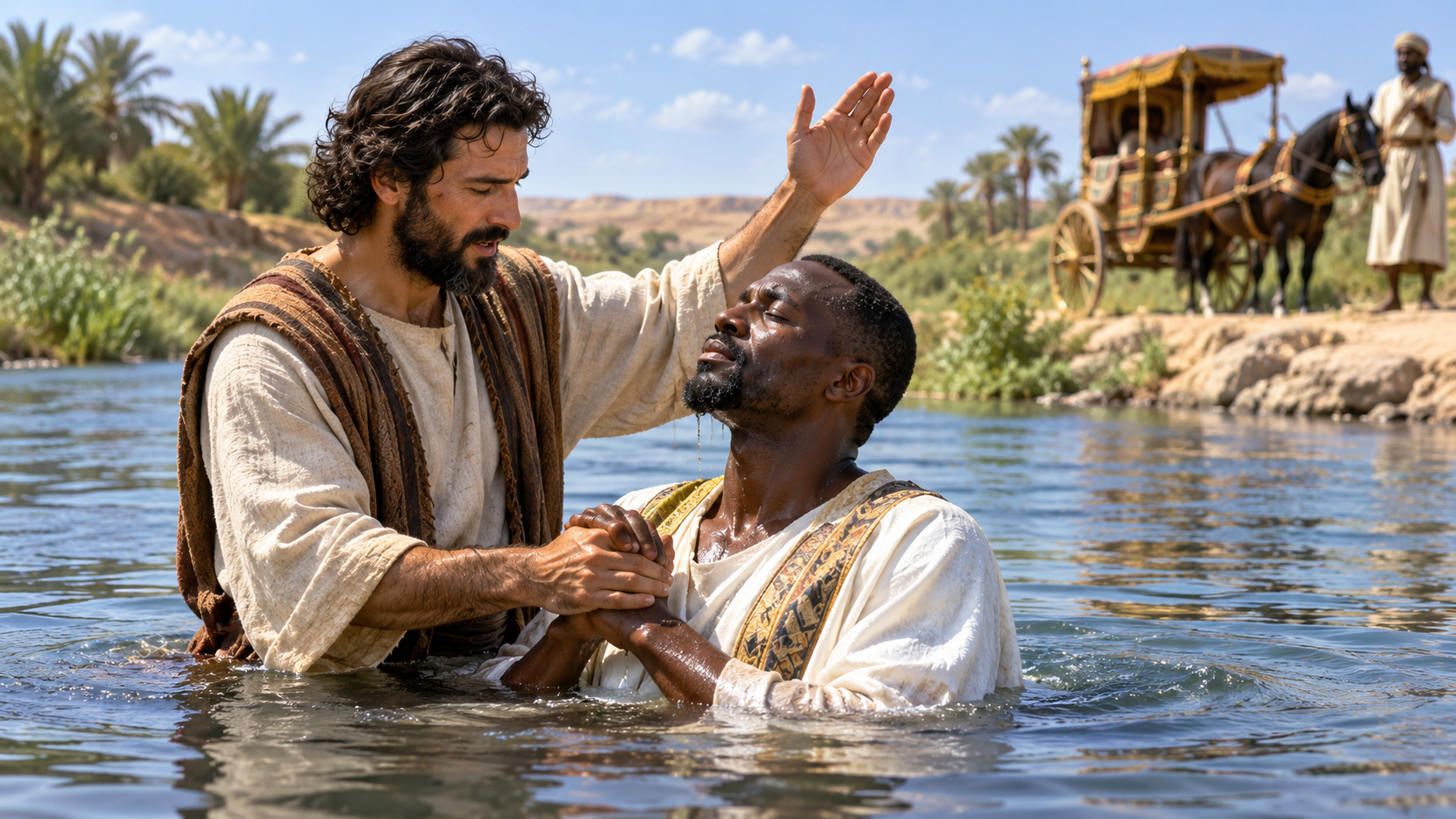
- Acts 8:35–38 — The Ethiopian believes Philip’s message about Jesus and is baptized.
- Acts 22:16 — Ananias tells Paul to arise, be baptized, and wash away his sins, calling on the Lord’s name.
- Romans 6:3–4 — Paul describes believers as baptized into Christ’s death and raised to walk in newness of life.
- 1 Corinthians 1:14–17 — Paul distinguishes his commission to preach the gospel from the act of baptizing.
- 1 Peter 3:20–21 — Peter makes the remarkable statement that “baptism now saves you,” while immediately qualifying what he means.
Why Is This Even a Question?
Because the New Testament contains some statements about baptism that are difficult to reconcile with the idea that baptism is merely an optional public symbol. On the day of Pentecost, people ask Peter what they should do. Peter answers:
“Repent, and be baptized, every one of you, in the name of Jesus Christ for the forgiveness of sins.”
That’s Acts 2:38. When Ananias speaks to Paul, he tells him:
“Arise, be baptized, and wash away your sins, calling on the name of the Lord.”
That’s Acts 22:16. And then Peter says:
“Baptism now saves you.”
That’s 1 Peter 3:21. If someone reads those verses and concludes that baptism has something to do with salvation, I can’t exactly accuse him of getting the idea from nowhere.
The language is there. The question is whether the water itself regenerates us or whether baptism is so closely associated with conversion in the New Testament that the biblical writers can speak about the two together. I believe it’s the latter.
What Is Baptism?
The Greek word baptizō ordinarily carries the idea of dipping, immersing, or washing. Christian baptism developed from a Jewish world already familiar with ritual washings, but Jesus gave baptism a particular place in Christian discipleship.
After his resurrection, Jesus told his followers:
“Go and make disciples of all nations, baptizing them in the name of the Father and of the Son and of the Holy Spirit.” (Matthew 28:19)
That makes one thing pretty clear to me. Baptism isn’t optional in the sense that Jesus doesn’t care whether Christians do it. He commanded it.
Someone who says, “I believe in Jesus, but I have no intention of being baptized,” isn’t treating baptism the way the New Testament does. That’s different, however, from saying that the water saves him.
Is Baptism Just a Symbol?
I wouldn’t put it that way. It certainly symbolizes something. Baptism pictures our identification with Christ in his death, burial, and resurrection. Paul develops that connection in Romans 6:3–4. But calling something symbolic doesn’t mean it is insignificant.
A wedding ceremony contains symbols. Wedding rings are symbols. Yet if the groom announces halfway through the ceremony that none of this really matters because they’re “just symbols,” the bride may have a different theological perspective.
Baptism is an act of obedience, confession, identification, and entrance into the visible community of Christian discipleship. In the New Testament, believing and being baptized normally belong together. That’s why I prefer saying baptism is more than a symbol rather than saying it is merely symbolic.
What About Acts 2:38?
This is probably one of the most debated baptism passages in the Bible. Peter’s audience has just heard that the Jesus they crucified is both Lord and Christ. They’re “cut to the heart” and ask what they should do.
Peter tells them:
“Repent, and be baptized, every one of you, in the name of Jesus Christ for the forgiveness of sins.” (Acts 2:37–38)
Some Christians argue that this means baptism is the point at which sins are forgiven. Others have tried to separate baptism from forgiveness grammatically or interpret “for” as meaning “because of” forgiveness already received. I’m not convinced we need to work that hard to get baptism away from forgiveness.
Peter is addressing people becoming Christians. Repentance, faith, baptism, forgiveness, receiving the Holy Spirit, and joining the community of believers are all clustered together. Three thousand people receive Peter’s message and are baptized that day (Acts 2:41).
There apparently wasn’t a six-week baptism class. Baptism was the expected response of someone who had accepted the gospel. That doesn’t require us to conclude that the water regenerated them. But it should make us uncomfortable with treating baptism as an optional ceremony that can be postponed indefinitely because it isn’t really that important.
What Does “Baptism Now Saves You” Mean?
If I believed baptism were merely an illustration, 1 Peter 3:21 would bother me. Peter actually says:
“This is a symbol of baptism, which now saves you.”
But fortunately, Peter keeps talking. He immediately explains that he isn’t referring simply to washing dirt from the body. He connects baptism with an appeal—or pledge, depending on how the Greek term is understood—of a good conscience toward God, through the resurrection of Jesus Christ. In other words, Peter doesn’t attribute saving power to bathwater. The power is in Christ and his resurrection.
Baptism is nevertheless so closely connected with the believer’s response to Christ that Peter can use remarkably strong language about it. Rather than weakening Peter’s statement, I’d rather let him make it and then let him explain it.
What About “Wash Away Your Sins”?
Ananias tells the newly converted Saul:
“Arise and be baptized, and wash away your sins, calling on the name of the Lord.” (Acts 22:16)
Again, that’s stronger language than many evangelicals would probably choose. But notice what accompanies baptism: calling upon the Lord. The water isn’t presented as some independent mechanism that removes sin. Baptism accompanies Paul’s appeal to Christ. That seems to be the New Testament pattern repeatedly.
Faith, repentance, confession, baptism, forgiveness, receiving the Spirit, and entrance into the Christian community occur so closely together that separating them into neat theological compartments can sometimes make the New Testament sound more complicated than it actually is.
The first Christians didn’t seem terribly interested in asking, “How long can I wait after believing before I get baptized?” They believed and got baptized.
Doesn’t Mark 16:16 Say Baptism Is Necessary?
Mark 16:16 says:
“He who believes and is baptized will be saved; but he who disbelieves will be condemned.”
There are two things worth noticing. First, the verse connects belief and baptism with salvation. Second, when it describes condemnation, it says “he who disbelieves”, not “he who isn’t baptized.”
What About the Thief on the Cross?
Then we have a man who had absolutely no opportunity to be baptized. The criminal crucified beside Jesus turns to him and says:
“Jesus, remember me when you come into your Kingdom.”
Jesus answers:
“Assuredly I tell you, today you will be with me in Paradise.” (Luke 23:42–43)
No baptism. No church membership. No communion. No opportunity to perform good works. Just a dying man placing his confidence in a dying Savior.
Some argue that this occurred before Christian baptism was instituted under the new covenant. There’s something to that chronological observation, but the larger point remains: Christ is capable of saving someone apart from water baptism. Salvation belongs to Christ.
Paul Makes an Interesting Distinction
Paul says something else that I find difficult to reconcile with the idea that baptism itself causes regeneration. Writing to the Corinthians, he thanks God that he personally baptized very few of them and then says:
“For Christ sent me not to baptize, but to preach the Good News.” (1 Corinthians 1:14–17)
Paul isn’t belittling baptism. His point concerns divisions in Corinth and people attaching themselves to the person who baptized them. Still, his distinction is significant.
If baptism were the actual mechanism by which an unbeliever becomes spiritually regenerated, it would be strange for the apostle to the Gentiles to distinguish baptizing people from the central gospel mission Christ gave him.
Paul preached Christ. People believed. And believers were baptized.
What About Baptismal Regeneration?
Baptismal regeneration is the belief that baptism is the means through which God grants regeneration or new birth. Different traditions explain that in different ways, so we shouldn’t lump everyone together.
The Roman Catholic Church, for example, officially teaches that baptism confers grace, forgives sins, incorporates a person into Christ and the Church, and is ordinarily necessary for salvation, while also recognizing circumstances in which someone may be saved without receiving water baptism.
Lutheran, Anglican, Orthodox, Restorationist, and other traditions have their own formulations. Even among people who use the phrase “baptismal regeneration,” there are important differences concerning faith, infants, sacraments, and what baptism accomplishes.
I don’t hold that position. I believe regeneration is God’s work in response to faith, not the result of applying water. But I also understand why Christians throughout church history have developed stronger sacramental understandings of baptism. They have biblical passages to which they’re trying to do justice. My disagreement is with their conclusion, not with their recognition that the New Testament speaks strongly about baptism.
Do You Have to Be Baptized to Be Saved?
If by “have to” we mean:
Can Christ save a person who has genuinely trusted him but has not yet been baptized?
I believe the answer is yes. If we mean:
Can a Christian knowingly refuse Christ’s command to be baptized and regard that refusal as completely unimportant?
That’s a different question. Why would someone genuinely confess Jesus as Lord and then respond to something Jesus commanded by saying, “No, I’m not doing that”?
Baptism doesn’t save us. But obedience matters. The normal New Testament pattern isn’t:
Believe → someday perhaps consider baptism.
It’s:
Believe → be baptized.
Should Infants Be Baptized?
I don’t believe so. The strongest argument for infant baptism doesn’t come from a verse saying, “Baptize infants,” because there isn’t one. The argument is usually theological. Baptism is understood in continuity with circumcision as a covenant sign, children were included in the covenant community under the Old Testament, and Acts records entire households being baptized.
That’s a serious argument, and Christians have held it for a very long time. Catholic teaching, for example, explicitly regards infant baptism as part of its sacramental understanding of baptism. But I think the New Testament pattern points toward believer’s baptism. People hear the gospel, repent, believe, and are baptized.
That’s why I would wait until a child is old enough to understand the gospel and make a meaningful profession of faith. I don’t think the Bible gives us a magic birthday. Ten might be perfectly appropriate for one child and not for another.
The issue isn’t whether the child can pass a theology examination. It’s whether we’re baptizing the child’s own faith rather than the faith of his parents.
Immersion, Pouring, or Sprinkling?
I prefer immersion. It fits the ordinary sense of baptizō, and it beautifully pictures burial and resurrection in Romans 6:3–4. But I wouldn’t make the amount of water the heart of the doctrine.
Christians have baptized by immersion, pouring, and sprinkling. The Didache, a very early Christian document, actually prefers baptism in running water but permits pouring water on the head when sufficient water isn’t available. That tells me early Christians cared about baptism without treating the mechanics as though God were standing there with a measuring cup.
My preference is immersion, but I wouldn’t turn this into a salvation issue.
Should We Baptize “In Jesus’ Name” or in the Name of the Trinity?
In Acts, people are repeatedly described as being baptized “in the name of Jesus Christ” or “in the name of the Lord Jesus.” Yet Jesus explicitly commands baptism:
“in the name of the Father and of the Son and of the Holy Spirit.” (Matthew 28:19)
I don’t see a contradiction. Acts is identifying whose baptism this is. These people are being baptized as followers of Jesus, not receiving John’s baptism or participating in some other ritual washing.
When actually performing a baptism, I prefer to follow the formula Jesus gave:
“I baptize you in the name of the Father, and of the Son, and of the Holy Spirit.”
That’s about as safe a precedent as we’re going to find.
Who Is Allowed to Baptize Someone?
I don’t see anything in the New Testament requiring an ordained minister to perform a baptism. Pastors normally do it because baptism takes place within the life of the church, and there’s nothing wrong with that. But Jesus gave the command to make disciples and baptize as part of the church’s mission. I don’t see a separate priestly class authorized to perform a baptism that ordinary believers are forbidden to perform.
Interestingly, even Catholic teaching recognizes that in cases of necessity a person who isn’t ordained can perform a baptism, provided the person intends to do what the Church does and uses water and the Trinitarian formula. So I certainly wouldn’t tell someone that his baptism “didn’t count” merely because the person who baptized him wasn’t ordained.
Should Someone Ever Be Baptized Again?
Sometimes I think so. If someone was baptized as an infant and later comes to personal faith in Christ, I would encourage believer’s baptism. Likewise, someone may have been baptized when young simply because friends were doing it, because parents expected it, or because everyone else at youth camp was heading toward the water.
Years later the person may conclude, “I wasn’t actually following Christ.” In that situation, I have no problem with baptism following the person’s genuine profession of faith. But I wouldn’t encourage people to get baptized repeatedly every time they go through a spiritual crisis.
Baptism isn’t a reset button. If you genuinely trusted Christ and were baptized as a believer, then went through a bad period, the answer isn’t necessarily another baptism. The answer may simply be repentance.
Is Baptism an Ordinance or a Sacrament?
I prefer the word ordinance because Christ ordained—or commanded—it. The word sacrament carries theological baggage because in sacramental traditions it commonly refers to a means by which divine grace is communicated. But I wouldn’t fight over the vocabulary. If someone uses sacrament simply to mean a sacred act commanded by Christ, we’re probably arguing over a dictionary.
The important question isn’t what we call baptism. It’s what we believe baptism does.
So What Does Baptism Actually Do?
I believe baptism is the God-ordained act by which a believer publicly identifies with Jesus Christ, his death, burial, and resurrection. It is an act of obedience. It is a confession of faith.
It marks entrance into the visible community of Christian discipleship. It pictures—and in a meaningful sense participates in—the believer’s identification with Christ. That’s considerably more than saying, “It’s just a symbol.”
But the water doesn’t regenerate us. Jesus does the saving.
So, Is Baptism Necessary for Salvation?
I would answer no—if by necessary we mean that nobody can be saved without undergoing water baptism. But I’d immediately add something. The New Testament never treats baptism casually.
Jesus commanded it. The apostles practiced it. Converts submitted to it. And the biblical writers sometimes speak of baptism in language so closely associated with salvation that Christians have debated those passages for nearly two thousand years.
I don’t think we honor Scripture by pretending those passages aren’t there. But neither do I think we should make water the Savior. We are saved by Jesus Christ through faith in him. Baptism is the commanded response of someone who has believed.
So I wouldn’t tell an unbaptized believer, “You aren’t saved until we get you into the water.” But if that same believer told me, “I know Jesus commanded baptism, but I simply refuse to do it,” I’d have another question: “Why?”
If Jesus is your Lord, baptism shouldn’t be something you’re trying to get out of. It should be something you’re ready to do.