

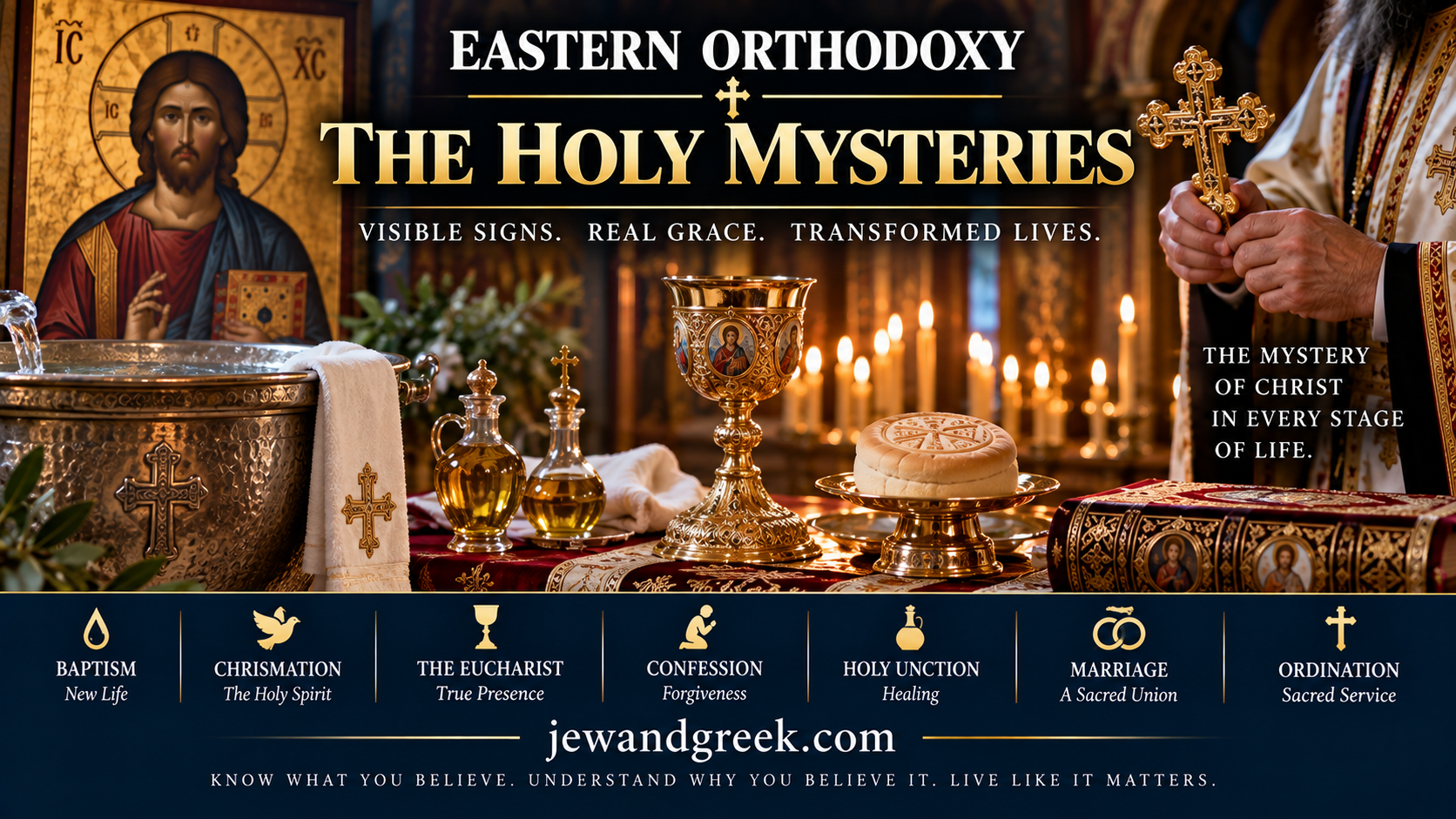
Eastern Orthodox Christians commonly refer to the sacraments as the Holy Mysteries. The choice of words reflects something important about the Orthodox approach to the Christian life. God’s grace can truly be encountered through physical things such as water, bread, wine, oil, and the laying on of hands, even when the manner in which God works through them cannot be completely explained.
Orthodoxy traditionally recognizes seven principal mysteries: Baptism, Chrismation, the Eucharist, Confession, Holy Unction, Marriage, and Ordination. But Orthodox theology is generally less concerned than Roman Catholic theology with defining an exact number. The entire life of the church can be understood as sacramental because God uses the material world to communicate His grace.
Baptism
Baptism is the beginning of the Christian’s sacramental life. Eastern Orthodox churches normally baptize by threefold immersion in water in the name of the Father, Son, and Holy Spirit.
Orthodoxy practices infant baptism as well as the baptism of adult converts. Baptism is understood as more than a public testimony or outward symbol. It is associated with participation in the death and resurrection of Christ, forgiveness of sins, new life, and entrance into the church.
Unlike many Western churches, Orthodox churches normally administer Baptism, Chrismation, and the Eucharist together. Consequently, an Orthodox infant may receive Communion shortly after being baptized.
Chrismation
Immediately following Baptism, the newly baptized person is normally chrismated. The priest anoints the person with specially consecrated oil called chrism while invoking the gift of the Holy Spirit.
Chrismation serves a role somewhat comparable to Confirmation in Western Christianity, but the timing is quite different. Roman Catholic Confirmation is commonly received later in life, while Orthodox Chrismation normally accompanies Baptism, including the baptism of infants.
Baptism and Chrismation therefore belong together as initiation into the life of the church: Baptism joins the believer to Christ, while Chrismation emphasizes the gift and work of the Holy Spirit.
The Eucharist
The Eucharist stands at the center of Orthodox worship. Bread and wine are consecrated during the Divine Liturgy and received as the true body and blood of Jesus Christ.
Orthodoxy affirms the real presence of Christ in the Eucharist but generally has not made one particular philosophical explanation of that presence central to its doctrine. The mystery is affirmed without insisting that everything about it can be neatly explained.
Communion is normally reserved for baptized and chrismated Orthodox Christians who are in communion with the church. Preparation may include prayer, fasting, and confession according to the practice of the particular church and the guidance of one’s priest.
The Eucharist is not simply an individual devotional experience. Sharing the same Eucharist is also an expression of unity in the faith and life of the church.
Confession
Eastern Orthodoxy practices sacramental confession of sins. A Christian confesses in the presence of a priest, who serves as a witness and spiritual pastor while pronouncing God’s forgiveness.
The setting may look somewhat different from the confessional booth familiar from popular images of Roman Catholicism. Orthodox confession commonly takes place before an icon of Christ, sometimes with the priest standing beside the person confessing.
The emphasis is not simply on satisfying a legal requirement. Sin is frequently described as a spiritual illness, and confession is part of the healing of the person through repentance, forgiveness, and reconciliation with God.
Holy Unction
Holy Unction is the anointing of the sick with oil accompanied by prayer for healing and forgiveness. The practice draws especially upon the instruction in James 5 for the elders of the church to pray over the sick and anoint them with oil.
The mystery is not restricted exclusively to someone who is near death. Prayer may be offered for physical healing as well as spiritual restoration.
In many Orthodox traditions, a service of Holy Unction is also celebrated during Holy Week, emphasizing humanity’s need for the healing grace of God.
Marriage
Orthodox Christianity regards marriage as a mystery in which a man and woman are united in a life of mutual faithfulness and growth in Christ.
One of the most distinctive elements of an Orthodox wedding is the crowning of the bride and groom. Crowns are placed upon their heads, symbolizing both the dignity of marriage and the self-sacrifice required within it. The couple also shares a common cup and processes around the altar or central table.
Interestingly, the central act is not the couple exchanging vows in the Western sense. The church invokes God’s blessing upon their union. Marriage is understood as a shared spiritual vocation rather than simply a contract between two people.
Ordination
Through Holy Orders, bishops, priests, and deacons are set apart for particular ministries within the church. Ordination takes place through prayer and the laying on of hands by a bishop.
Orthodox bishops are normally chosen from celibate clergy, frequently from the monastic life. Priests and deacons may be married if they marry before ordination, but they ordinarily may not marry after being ordained.
As in Roman Catholicism, Eastern Orthodoxy reserves priestly and episcopal ordination to men. Bishops preserve apostolic succession and ordain priests and deacons who serve under their authority.
More Than Seven?
The familiar list of seven mysteries developed partly through interaction with Western Christianity. Orthodox writers often point out that the church’s sacramental life cannot necessarily be reduced to seven isolated ceremonies.
Monastic profession, the blessing of water, funerals, the consecration of churches, and other acts of the church can also have a sacramental character.
This reflects the broader Orthodox understanding of creation. Material things are not inherently opposed to spiritual things. The God who created the physical world also entered it through the Incarnation. Water can therefore become the water of Baptism, oil can be used for anointing, and bread and wine can become the means through which believers encounter Christ.
Mystery and the Christian Life
The Holy Mysteries reveal something fundamental about Eastern Orthodox Christianity. Salvation is not understood merely as accepting certain doctrines or receiving a change in legal status before God. It involves participation in the life of Christ within the worshiping community of the church.
From Baptism at the beginning of Christian life to the Eucharist received throughout it, the mysteries unite physical actions with spiritual realities.
Orthodoxy does not claim that the mechanism behind every mystery can be completely explained. In fact, the word mystery rather suggests the opposite. God acts through ordinary elements of creation, and the church receives what He gives.