
Modern philosophy emerged during a period of profound intellectual, religious, political, and scientific change in Europe. Beginning roughly in the seventeenth century and extending into the nineteenth, philosophers increasingly reconsidered assumptions inherited from medieval scholasticism and asked whether knowledge could be established on new foundations.
The Scientific Revolution transformed understandings of nature. The Protestant Reformation fractured the religious unity of Western Europe. European exploration expanded awareness of different cultures and societies. New political theories challenged traditional accounts of authority. Against this background, philosophers asked fundamental questions about reason, experience, knowledge, God, human nature, morality, and political society.
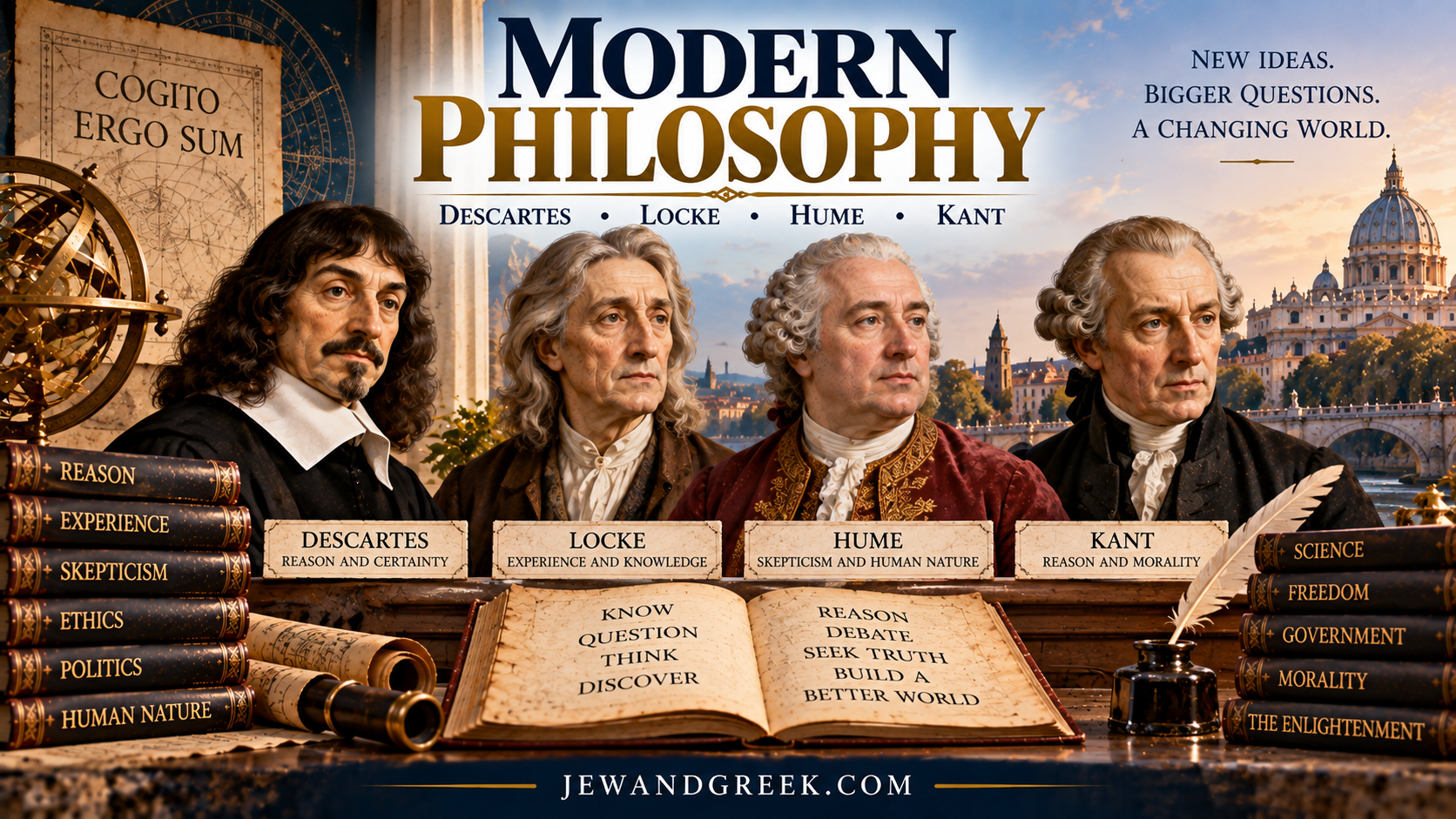
Four figures stand especially prominently in this story: René Descartes, John Locke, David Hume, and Immanuel Kant. Their disagreements helped define some of the central problems of modern philosophy and continue to influence contemporary debates.
From Medieval to Modern Philosophy
There was no single moment when medieval philosophy ended and modern philosophy began. Renaissance humanism, the recovery of ancient texts, religious reform, and developments in mathematics and natural science gradually altered Europe’s intellectual landscape.
Medieval philosophers such as Thomas Aquinas had constructed elaborate syntheses of Christian theology and Aristotelian philosophy. Early modern thinkers increasingly questioned whether inherited philosophical systems provided sufficiently secure foundations for knowledge.
The success of mathematical approaches to nature encouraged philosophers to reconsider how reliable knowledge is obtained. Nicolaus Copernicus challenged the traditional geocentric model of the cosmos. Johannes Kepler described planetary motion mathematically. Galileo Galilei combined mathematics with systematic observation and experimentation. Isaac Newton eventually provided a powerful mathematical account of motion and gravitation.
Philosophy increasingly confronted a new question: If traditional authorities can be mistaken, how can human beings know anything with certainty?
That question became central to modern epistemology.
René Descartes and the Search for Certainty
René Descartes, who lived from 1596 to 1650, is frequently called the father of modern philosophy. Although that description can exaggerate the break between medieval and modern thought, Descartes undeniably helped redirect philosophical attention toward the foundations of human knowledge.
Descartes sought a method capable of producing certainty comparable to mathematics. Rather than beginning with inherited authorities, he proposed systematically doubting any belief that could possibly be mistaken.
The senses sometimes deceive us. Dreams can seem indistinguishable from waking experience. Even apparently obvious reasoning might conceivably be manipulated by a powerful deceiver.
Descartes therefore pushed skepticism as far as he could in search of something that could not rationally be doubted.
“I Think, Therefore I Am”
Descartes concluded that the very act of doubting establishes the existence of the doubter. Even if everything he experiences is deceptive, there must be something experiencing the deception.
This insight became famous through the Latin expression Cogito, ergo sum—“I think, therefore I am.”
Descartes regarded the certainty of his own existence as a thinking being as the first secure foundation upon which knowledge could be reconstructed. From there he attempted to establish additional truths, including God’s existence and the reliability of clear and distinct ideas.
His method shifted philosophical attention dramatically toward the knowing subject. Questions about consciousness, certainty, and the relationship between the mind and external reality became increasingly prominent.
Descartes and Mind-Body Dualism
Descartes also became famous for his distinction between mind and matter. Physical things possess extension: they occupy space and operate according to physical laws. The mind, by contrast, thinks but does not appear to possess physical extension.
Descartes therefore argued that mind and body are distinct substances. This position became known as Cartesian dualism.
But the distinction created a difficult problem. If mind and body are fundamentally different kinds of things, how can they interact? How can an immaterial decision cause a physical arm to move, and how can physical events produce sensations in consciousness?
The mind-body problem remains a central issue in philosophy of mind, although contemporary positions differ considerably from Descartes’s original account.
Rationalism
Descartes is commonly associated with rationalism, the view that reason plays a fundamental role in obtaining knowledge and that at least some significant truths can be known independently of sensory experience.
Other major continental rationalists included Baruch Spinoza and Gottfried Wilhelm Leibniz.
Spinoza developed a radically different metaphysical system in which God and nature were understood within a single ultimate reality. His conclusions placed him outside traditional Jewish and Christian conceptions of a personal Creator distinct from creation.
Leibniz developed an elaborate metaphysical system involving simple substances he called monads. He also made major contributions to mathematics and logic and independently developed calculus alongside Newton.
Although Descartes, Spinoza, and Leibniz differed substantially, all placed considerable confidence in reason’s ability to discover fundamental truths about reality.
John Locke and Empiricism
John Locke, who lived from 1632 to 1704, became one of the most influential figures in British empiricism. Whereas rationalists emphasized reason and innate intellectual structures, empiricists emphasized experience as the source of human knowledge.
Locke famously rejected the doctrine of innate ideas. He argued that the human mind begins without the collection of ideas sometimes claimed to be naturally present within it.
His position is commonly associated with the image of the mind as a tabula rasa, or blank slate. Experience supplies the materials from which knowledge develops.
Locke distinguished between sensation, through which we encounter the external world, and reflection, through which the mind becomes aware of its own operations. Our ideas ultimately arise from these sources.
Locke on Primary and Secondary Qualities
Locke distinguished between primary and secondary qualities.
Primary qualities belong to objects themselves and include characteristics such as extension, shape, motion, and number. Secondary qualities, such as color, taste, smell, and sound, involve the powers objects possess to produce particular experiences in perceivers.
A red apple, for example, possesses physical characteristics that cause human observers under normal conditions to experience redness. But the subjective sensation of red does not exist in the apple in precisely the same way that its shape and spatial dimensions do.
This distinction raised important questions about how accurately human perception represents the external world.
Locke and Political Philosophy
Locke’s influence extended far beyond epistemology. His political philosophy became enormously important to later theories of constitutional government, religious toleration, natural rights, and political legitimacy.
Locke argued that human beings possess natural rights and that legitimate political authority depends upon the consent of the governed. Governments exist partly to protect life, liberty, and property. When political rulers systematically violate the purposes for which government exists, citizens may possess a right of resistance.
Locke’s ideas became influential within the broader development of liberal political thought and later discussions of constitutional government.
His political philosophy also illustrates a defining feature of modern thought: philosophical reasoning increasingly addressed not only abstract metaphysical questions but the foundations of political institutions and individual rights.
George Berkeley and the Problem of Matter
George Berkeley pushed empiricism in a surprising direction. If all human knowledge of physical objects comes through ideas experienced by the mind, Berkeley asked what justification exists for claiming that an unknowable material substance exists behind those experiences.
Berkeley argued that what we call physical objects consist fundamentally in ideas perceived by minds. His position is often summarized by the expression esse est percipi—“to be is to be perceived.”
Berkeley did not believe that objects simply disappear whenever no human observer is present. God continuously perceives reality and provides the stable order underlying human experience.
His idealism was intended partly as a defense against skepticism and materialism, although many philosophers regarded the solution as more radical than the problem it attempted to solve.
David Hume and Radical Empiricism
David Hume, who lived from 1711 to 1776, pushed empiricist principles toward conclusions that challenged many traditional philosophical assumptions.
Hume distinguished between impressions, the vivid contents of immediate experience, and ideas, which are less vivid copies or combinations of impressions. He argued that meaningful concepts must ultimately be traced back to experience.
This principle led him to examine critically concepts such as causation, personal identity, miracles, and religious belief.
Hume’s skepticism would profoundly influence Immanuel Kant and later philosophy.
Hume and Causation
One of Hume’s most influential arguments concerned causation.
Suppose one billiard ball strikes another and the second begins moving. We naturally say that the first ball caused the second to move. But what do we actually observe?
We observe one event followed by another. We do not directly perceive a mysterious necessary connection binding the two events together.
According to Hume, repeated experiences of similar sequences create an expectation that one event will follow another. Much of what we call causal reasoning therefore depends upon habits formed through experience.
This created a serious philosophical problem because scientific reasoning depends heavily upon causal inference.
Hume and the Problem of Induction
Hume also identified what became known as the problem of induction.
Human beings routinely infer future events from past experience. We expect the sun to rise tomorrow because it has always risen before. We expect fire to produce heat because repeated experience has established that pattern.
But what logically guarantees that the future will resemble the past?
Appealing to past experience cannot solve the problem without circularity, because doing so already assumes that patterns observed previously will continue.
Hume did not conclude that people should stop making inductive inferences. Human beings cannot practically live without them. His point was that philosophical justification for induction is more difficult than ordinary reasoning suggests.
The problem remains important in contemporary philosophy of science.
Hume on Miracles
Hume’s discussion of miracles became one of the most influential philosophical challenges to claims of supernatural events.
He argued that rational belief should proportion evidence to experience. Because a miracle involves an apparent violation of the regular course of nature, testimony for a miracle must overcome the strong evidence represented by ordinary experience.
Hume’s argument has generated extensive debate. Critics have questioned whether his reasoning improperly assumes that uniform experience against miracles has already been established, whether testimony can provide adequate evidence for extraordinary events, and how prior probabilities should be assessed.
These debates remain important in contemporary philosophy of religion and Christian apologetics.
The Rationalist-Empiricist Divide
Histories of modern philosophy often organize seventeenth- and eighteenth-century thinkers into two competing traditions.
Continental rationalists such as Descartes, Spinoza, and Leibniz emphasized reason and principles that do not depend entirely upon sensory experience. British empiricists such as Locke, Berkeley, and Hume emphasized observation and experience.
This classification is useful, but it can become too rigid. Rationalists did not reject experience, and empiricists did not reject reason. Their disagreements concerned the sources, limits, and structure of human knowledge.
Nevertheless, the tension between these approaches created the intellectual setting for Immanuel Kant.
Immanuel Kant
Immanuel Kant, who lived from 1724 to 1804, attempted one of the most ambitious philosophical projects of the modern era.
Kant later wrote that Hume had awakened him from his “dogmatic slumber.” Hume’s critique of causation forced Kant to reconsider how knowledge of the world is possible.
Rather than simply choosing between rationalism and empiricism, Kant argued that both captured part of the truth.
Knowledge begins with experience, but it does not necessarily follow that all knowledge arises entirely from experience. The human mind actively organizes experience according to structures that make coherent experience possible.
This became the foundation of Kant’s critical philosophy.
Kant’s Copernican Revolution
Kant compared his philosophical approach to the revolution associated with Copernicus.
Earlier philosophers often assumed that human knowledge must conform itself entirely to independently structured objects. Kant proposed examining whether objects as experienced must also conform to structures supplied by the human mind.
Space and time, in Kant’s account, are not simply properties discovered independently in things as they exist apart from us. They are forms through which human beings experience phenomena.
Likewise, concepts such as causality function as categories through which the mind organizes experience.
This allowed Kant to respond to Hume. We do not derive causality merely by repeatedly observing events; causal structure is part of the framework through which coherent experience becomes possible.
Phenomena and Noumena
Kant distinguished between phenomena and noumena.
Phenomena are things as they appear within human experience. Noumena, or things-in-themselves, refer to reality considered independently of the conditions through which human beings experience it.
Kant did not simply claim that the external world is unreal. Rather, he argued that human knowledge is necessarily shaped by the structures through which human cognition encounters reality.
This placed significant limits on traditional metaphysics. Human reason cannot simply extend concepts derived from possible experience and expect to obtain theoretical knowledge of realities lying entirely beyond experience.
Kant and the Limits of Arguments for God
Kant subjected traditional arguments for God’s existence to extensive criticism. He challenged versions of the ontological, cosmological, and teleological arguments and rejected the claim that speculative theoretical reason can demonstrate God’s existence in the ways earlier philosophers had attempted.
His critique of the ontological argument became especially famous because he argued that existence is not a real predicate—a property that can simply be included within the definition of a thing.
Yet Kant was not merely attempting to eliminate religious belief. God, freedom, and immortality remained important within his moral philosophy. His project significantly changed the terms under which later philosophers discussed natural theology and religious knowledge.
Kantian Ethics
Kant also developed one of the major ethical theories in Western philosophy.
Rather than grounding morality primarily in consequences or the pursuit of happiness, Kant emphasized duty and rational moral obligation. An action possesses genuine moral worth when it is performed from duty rather than merely because it produces a desired result.
His famous categorical imperative was formulated in several ways. One formulation asks whether the principle behind one’s action could consistently be willed as a universal law.
Another formulation requires human beings to treat humanity, whether in themselves or others, always as an end and never merely as a means.
Kant’s ethics became one of the principal alternatives to both virtue ethics and consequentialist moral theories.
The Enlightenment
Modern philosophy developed alongside the broader intellectual movement known as the Enlightenment. Enlightenment thinkers emphasized reason, criticism of inherited authority, scientific inquiry, religious toleration, education, and debates over political liberty.
The Enlightenment was not a single unified movement. Some thinkers remained committed Christians. Others embraced deism, skepticism, or more radical criticisms of traditional religion. Their political theories likewise varied considerably.
What united many of them was increased confidence that human beings could critically examine institutions and beliefs rather than accepting them solely because of tradition.
This intellectual movement profoundly influenced Western politics, science, education, religion, and culture.
Modern Philosophy and Christianity
The rise of modern philosophy presented Christianity with both opportunities and challenges.
Descartes attempted to establish philosophical certainty while maintaining belief in God. Locke defended Christianity while emphasizing reason and religious toleration. Berkeley regarded his philosophy as a defense against skepticism and materialism.
Hume subjected miracle claims, natural religion, and traditional metaphysical reasoning to powerful criticism. Kant restricted what theoretical reason could establish about God while attempting to preserve a significant place for religious ideas within moral reasoning.
Christian philosophers and theologians responded in many different ways. Some adopted elements of modern philosophical systems. Others argued that modern philosophy had begun with mistaken assumptions about reason, autonomy, or knowledge.
Those disagreements continue.
From Kant to the Nineteenth Century
Kant did not end modern philosophy. In many respects, he created an entirely new set of philosophical problems.
German Idealists such as Johann Gottlieb Fichte, Friedrich Schelling, and Georg Wilhelm Friedrich Hegel attempted to develop or overcome aspects of Kant’s philosophy. Hegel constructed an extraordinarily ambitious philosophical system addressing logic, history, politics, religion, consciousness, and reality itself.
Other nineteenth-century thinkers moved in dramatically different directions. Søren Kierkegaard emphasized individual existence, faith, choice, and commitment. Karl Marx developed a materialist analysis of history and society. Friedrich Nietzsche launched powerful attacks on traditional morality, Christianity, and many assumptions of Western philosophy.
These developments form an important bridge into contemporary philosophy, where analytic philosophy, phenomenology, existentialism, pragmatism, and other traditions would emerge.
The Legacy of Modern Philosophy
Modern philosophy fundamentally reshaped the questions philosophers ask about knowledge and reality.
Descartes made radical doubt and the certainty of consciousness central philosophical problems. Locke explored the experiential origins and limits of human knowledge. Hume demonstrated how difficult it is to justify assumptions concerning causation and induction. Kant attempted to explain how objective knowledge can be possible while recognizing the active role of the human mind.
Their questions remain remarkably current.
How do we know that the external world exists? How reliable are our senses? Can reason establish truths independently of experience? What justifies scientific inference? Is the mind reducible to physical processes? Can God’s existence be demonstrated philosophically? Are moral obligations objectively true?
Modern philosophy did not settle these questions. It helped establish the conceptual landscape in which many of them are still debated.